You’ve made sure every cable is tucked away, yet the living room still looks untidy. Your eye snags on something as you walk in, and you can’t say what. A tape measure and one evening are enough to find it. Cables rarely cause that on their own. The snag comes from the few centimetres that stay in view, and three faults explain nearly every case. Our example room measures 360 × 480 cm and has white walls. A television stands on a console 40 cm tall. These figures are rounded guesses, so use your own numbers once you’ve measured.
Why a Room Looks Untidy When Every Cable Is Tucked Away
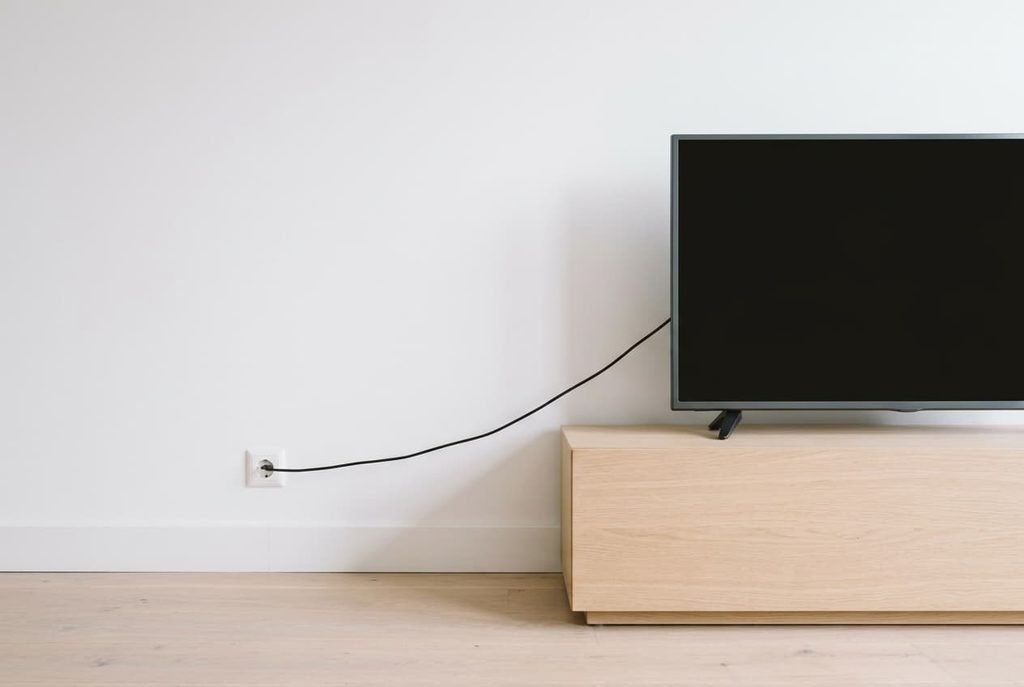
The eye reads a room by its straight edges: the skirting, the door frame, the corner where two walls meet. A cable that follows one of those lines disappears. A cable that crosses open wall or floor breaks the pattern, and the eye stops on it. Tucking a cable away removes its middle. The ends stay in view, and the ends are exactly where it leaves an edge.
Contrast then sets how loudly the break speaks. Say a white wall reflects 80% of incoming light, a black lead 5%. Allow 5% of glare on both. The ratio is (80 + 5) ÷ (5 + 5) = 8.5, a sharp dark stripe. A white lead returning 75% scores (80 + 5) ÷ (75 + 5) = 1.06, and nobody sees it.
The usual diagnosis is more hiding, yet the visible stubs break the room’s straight edges in a colour that stands out, and burying further cable leaves them where they were. Three faults produce that: slack in loops, a colour that clashes with its surface and a route that cuts across the wall the eye lands on.
Every Cable Tucked Away Is Still Seen: Five Checks From the Sofa
Take your regular seat with the lamps lit and a tape measure beside you. Each question below has a number attached, so the answer is never a matter of taste.
1. Half-close your eyes so that fine detail dissolves. Any dark line that survives the squint is a contrast fault.
2. Trace each visible cable with a finger. Count the ones that cross open wall or floor rather than following an edge. More than two is a route fault.
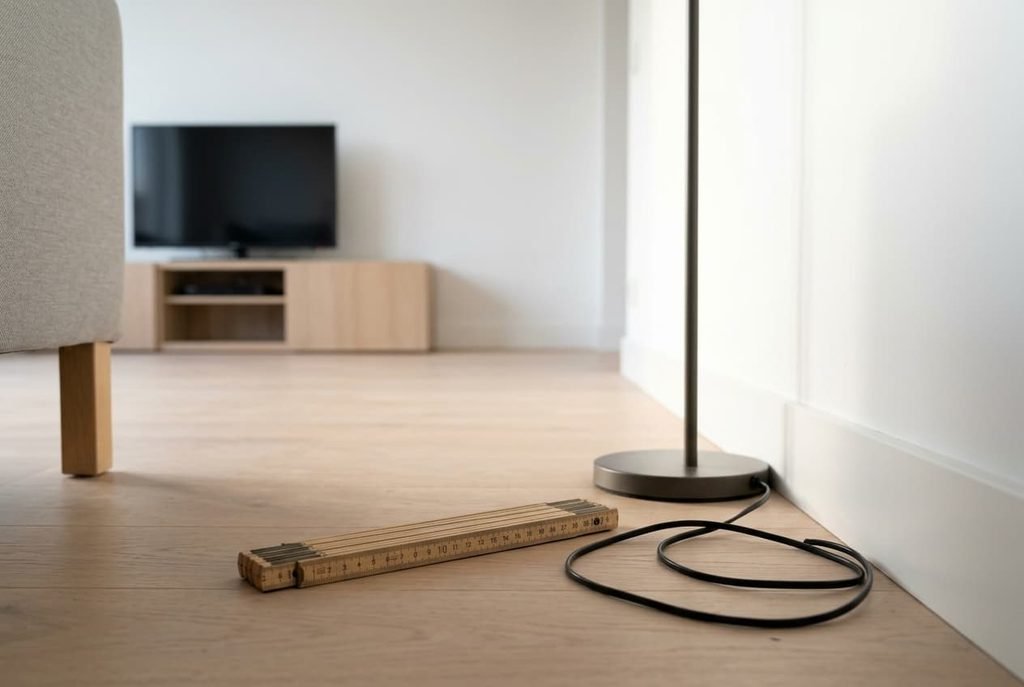
3. Measure each lead’s full length, then the distance it actually covers. A lamp lead of 3.0 m over a 1.2 m run has 1.8 m of excess, which is 60%. Anything above 50% is slack.
4. Count the plug heads and chargers visible from the seat. Four or more form a cluster that reads as clutter.
5. Photograph the television wall and shrink the picture to thumbnail size. A cable you can still see at that size is shouting.
Our room fails checks one to three.
Three Faults Behind Cables That Still Show
Each fault below explains why a room where every cable is tucked away can still look untidy. Take them in sequence.
“A loop of lead lies curling by the skirting.” Scale is the cause. The lamp came with a 3.0 m lead for a run of 1.2 m. The spare 1.8 m settles into loops, the only curves in a room made of straight lines. For nothing, gather the slack into one loop 20 cm across and tie it behind the sofa leg with a twist tie. If that still shows, swap in the shortest lead you own. A 1.5 m lead cuts the excess to 0.3 m, or 20%. A 1.2 m lead from a shop ends the slack altogether at modest cost. The restriction here is the lamp’s own position, since a lead can’t be shorter than the walk from socket to bulb.
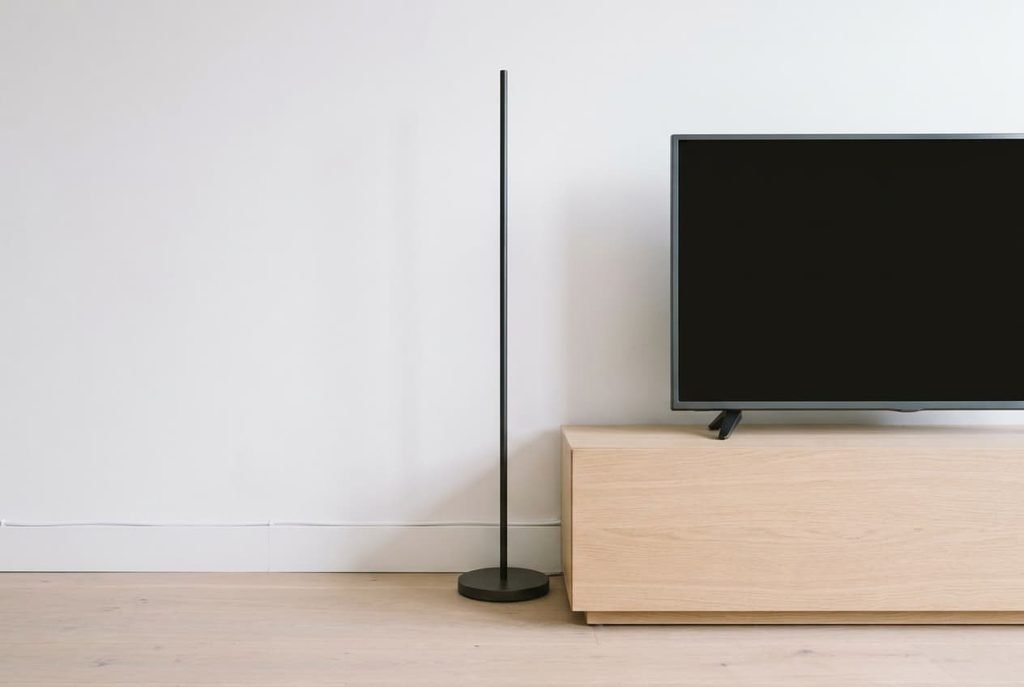
“A black stripe runs across the white wall.” Contrast is the cause. Two black television leads leave the back of the set at 55 cm. They cross the wall to a socket 70 cm along at 30 cm, a diagonal of √(70² + 25²) ≈ 74 cm. It scores 8.5 against the paint. For nothing, swap one black lead for a white one from a drawer, because chargers often come white. Rearrange next: stand a slim floor lamp beside the console, or a tall plant you already own, so that it screens the rest from the sofa. Buy last: white leads for the remaining pair, or a paintable cover in the wall’s colour, take the ratio down to about 1.1 for a small outlay.
“The leads cut across the wall I face from the sofa.” Placement is the cause. The same 74 cm diagonal forms the longest straight run on that wall, which the eye tracks. For nothing, drop both leads behind the console and run them along the skirting’s upper edge, so they follow a line. Rearrange next: slide the console 70 cm towards the socket, television included, so the socket sits behind it and no lead is visible. Buy last: a paintable channel in the skirting’s colour carries the leads along the edge for a modest cost. The wall decides the limit, as a console can only move until it meets the window.
Work down the faults in order, and photograph the wall again after each change.
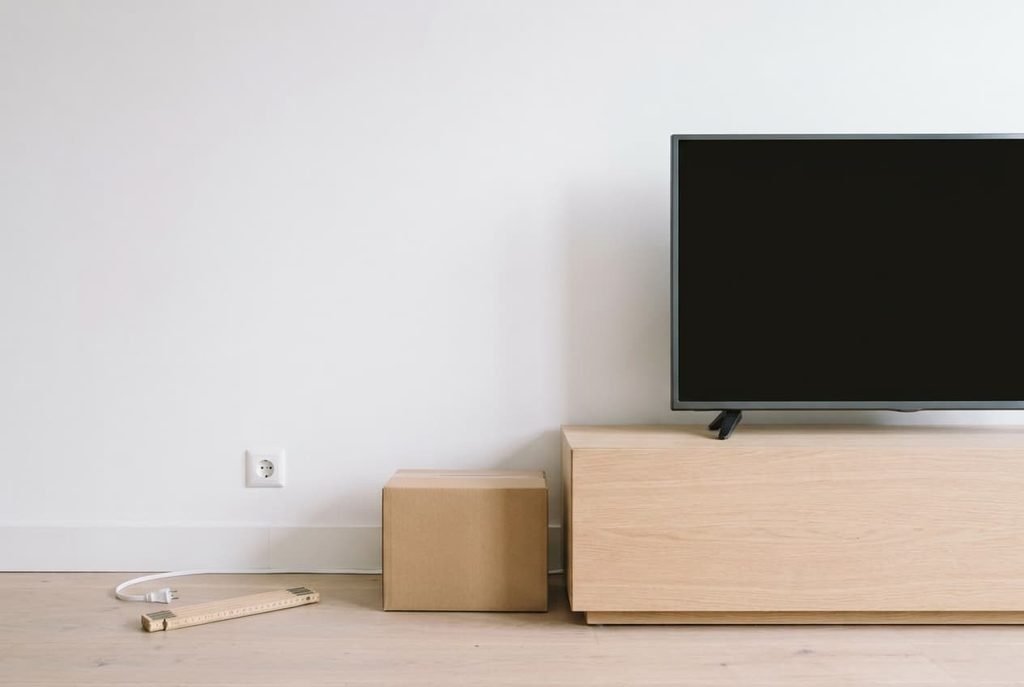
Plan the Route Before the Device Arrives
Prevention is cheaper than any fix. Before a new device comes home, measure from the socket to where it will stand. Choose a lead 20 cm longer than that run, so a 1.2 m run takes a 1.4 m lead and carries 14% excess. Pick the lead colour from the surface it will cross, and let the cable follow an edge such as the skirting.
Decide where the plug heads will sit as well. A new device undoes a room where every cable is tucked away within a day if nobody planned its route. A cluster of four adaptors under a side table reads as one dark object, while the same four spread along one wall read as four.
Keep one spare lead in white and one in black. A change of device then takes a minute, without a trip to the shop.
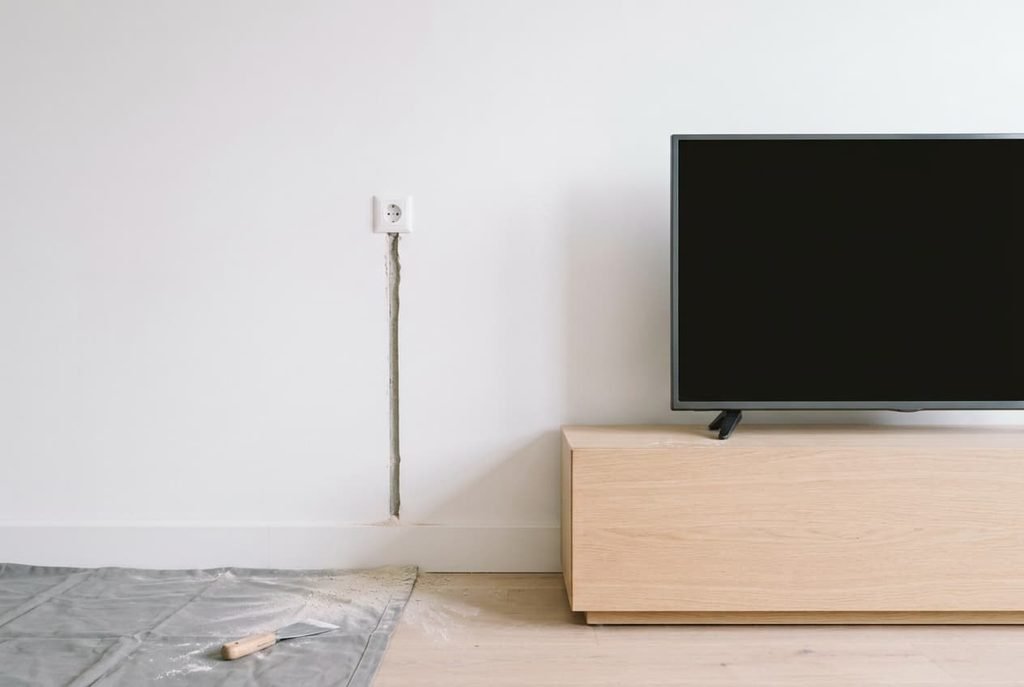
The Fix That Isn’t Worth Doing
Chasing the cables into the plaster looks like the most thorough answer, and it removes only the middle of each run. The 74 cm of lead disappears. Everything at the ends stays put, from the screen’s lower edge to the adaptors. Four stubs remain, which leaves the room untidy.
It also costs the most. A groove 75 cm long and 2 cm deep takes an afternoon, then a day for the filler to dry and another coat of paint. In a rented flat it also needs permission you may not get. The straight stripe is replaced by a fresh patch of paint that never matches the old.
Put the effort into the three checks instead. They take an evening and no tools beyond a tape measure.
When every cable is tucked away yet the room still looks untidy, the cause sits in what stays visible. Slack and colour come first, with route third. Measure the excess first. Score the contrast next, then trace the path. If you fix only one thing, take the stripe that scores 8.5 before the loop that adds 60%, since each of the three faults works independently. Photograph the television wall before and after, because a picture shows what a tired eye ignores. A tidy room is made of straight lines and quiet colours, and a cable that obeys both vanishes without being hidden.
Questions Readers Keep Asking
What is the most common cause?
Slack. Leads are sold long. A 3.0 m lead on a 1.2 m run leaves 1.8 m to lie in loops, and loops are the one shape a straight-edged room can’t absorb. Measure each lead against the distance it covers. Anything with over 50% excess is the first suspect.
Is there a quick fix I can try tonight?
Yes. Gather each loop of slack into one coil 20 cm across and tie it behind a leg of the furniture. Then ease the television leads into the corner by the door frame. Each step takes minutes and costs nothing. Photograph the wall afterwards to judge it properly.
Can this be fixed without renovation?
Almost always. Moving a console or shortening a lead needs no tools and no builder, and swapping a black cable for a white one is just as easy. A wall chase is the only renovation in sight, and the room doesn’t need one: the visible stubs remain after it.