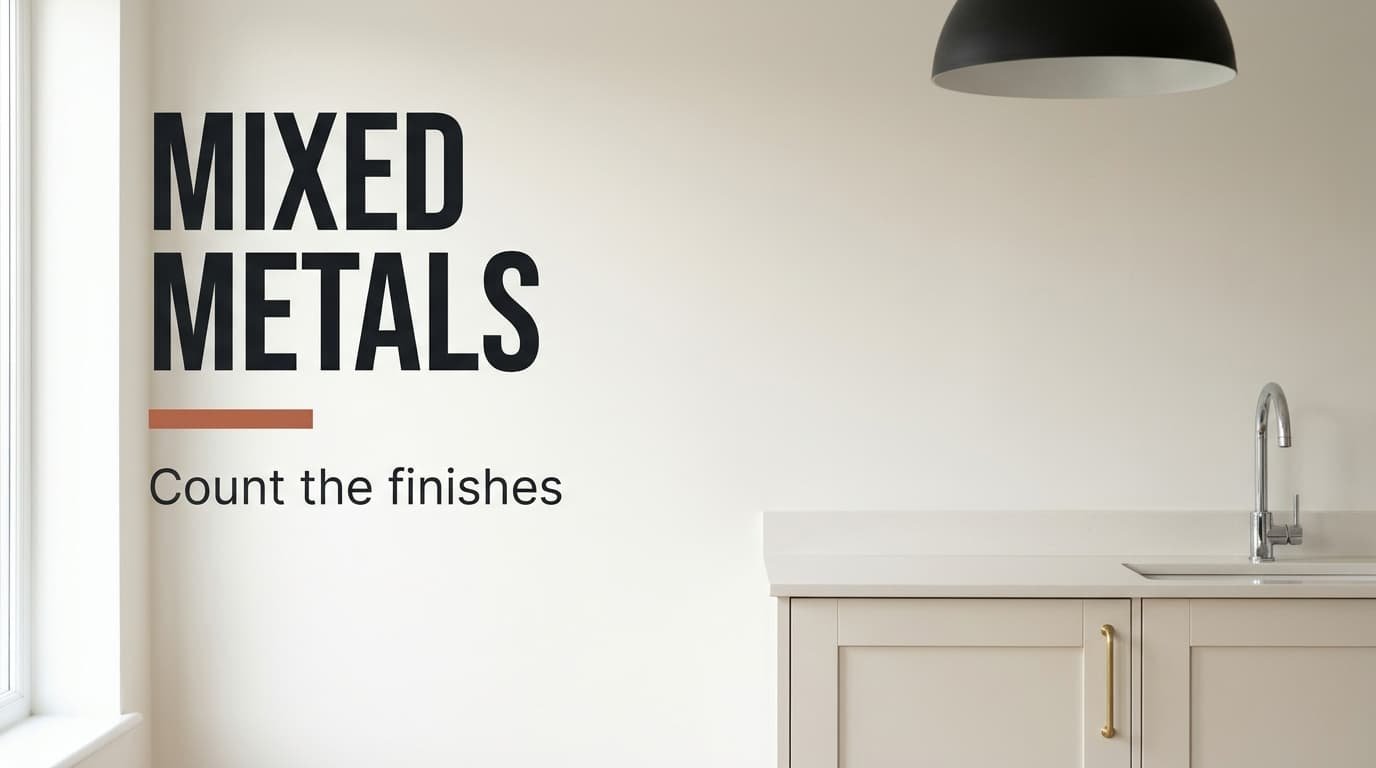
Nothing in the open-plan kitchen and dining area of this Haarlem flat is broken, and yet mixed metal finishes in our flat give the space a restless feel that nobody can pin down. Someone chose each fitting with care. Each looks right alone and wrong in company. Three faults can produce that effect. Photographs and a few measurements taken over one evening will reveal which one you have, with no special equipment. Most remedies are free. The single purchase near the end is optional, and you may never need it. Every measurement below is an assumed sample. Use your own.
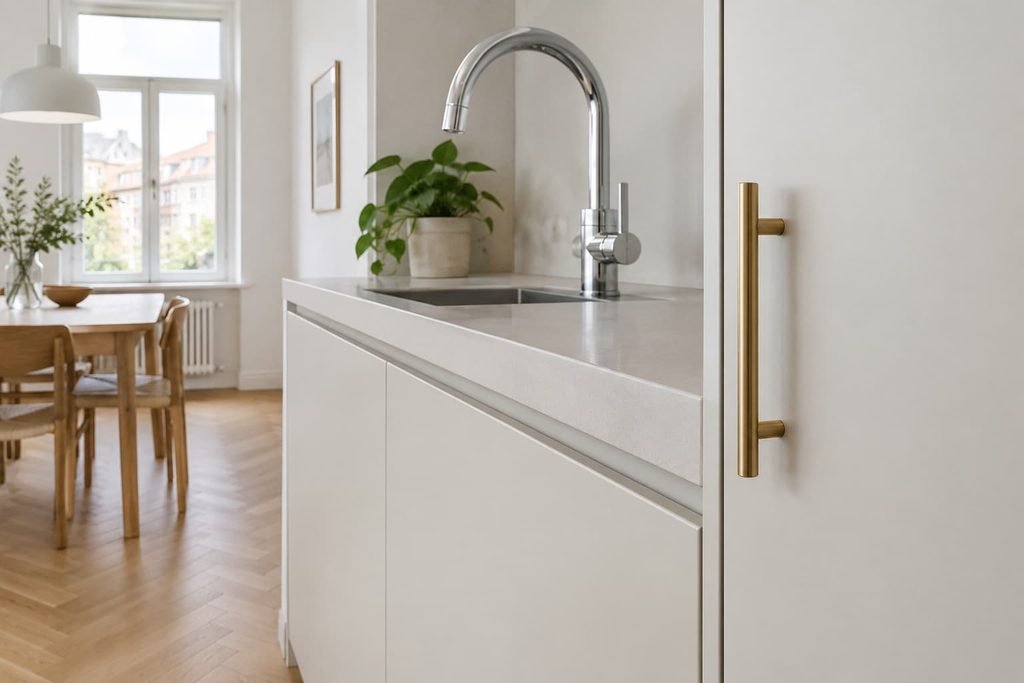
How Mixed Metal Finishes in Our Flat Pull the Eye Apart
The eye reads a metal through two cues at once: the colour cast, running from warm brass to cool chrome, and the shine, running from mirror gloss to dead-flat black. Two finishes may agree on one cue and still clash on the other.
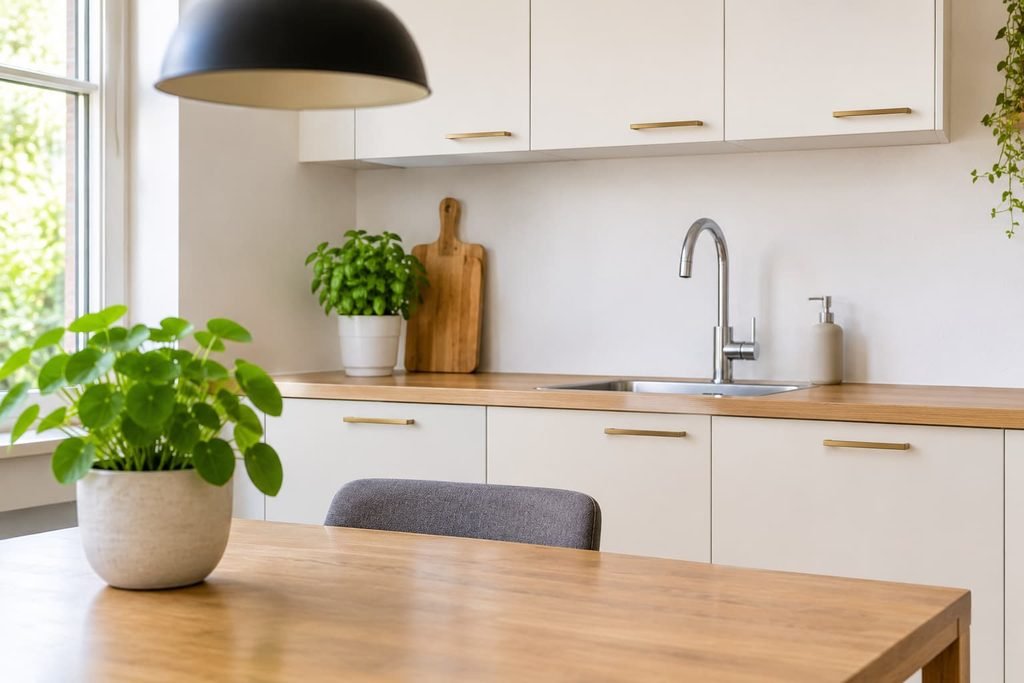
From the sofa, the Haarlem kitchen shows four finishes. Twelve brass bars of 12 × 1.2 cm show 173 cm² between them. A chrome tap shows about 72 cm², and three steel door handles show 84 cm². A matt black pendant shade shows around 600 cm². The total is 929 cm². Black holds 64.6% of it and brass 18.6%. Steel takes 9.0%, and chrome only 7.8%. Assume that a finish under roughly 10% reads as a stray rather than a decision.
Pairs, not pieces, are what the eye counts.
Four finishes give six pairs to reconcile, since 4 × 3 ÷ 2 equals 6, and a fifth would make ten. That’s why mixed metal finishes in our flat looked worse after every purchase. The usual mistake is buying one more finish to bridge the rest, which lifts the pairs from 6 to 10 and adds another stray.
A Squint and a Greyscale Photo: Counting Finishes in View
From your usual seat, list each metal object you can see without turning your head. Add each item’s position and finish beside it. Mark every finish as warm or cool, and mark any matt black separately.
Photograph the scene from that seat and switch the picture to greyscale. Glossy pieces turn into bright dots, and those dots show where your eye lands first. The colour version tells the other half, because yellow undertones sit beside bluish whites there.
Next, measure the visible face of each item with a tape and divide every total by the sum of all the faces, as in the 929 cm² example. A finish below about 10% earns a second look. Jot the totals down where you’ll see them when you shop. Then read the box on your bulbs, because a finish shifts with the colour of the bulbs lighting it. Your phone’s camera can’t be trusted on colour at night. Judge undertones by eye.
Do this once by day and once after dark.
Three Faults Behind Finishes That Seem Mismatched
Almost every case of mixed metal finishes in our flat has one of three faults behind it. Each fault is described by its symptom and its cause, then by three remedies that rise in effort.
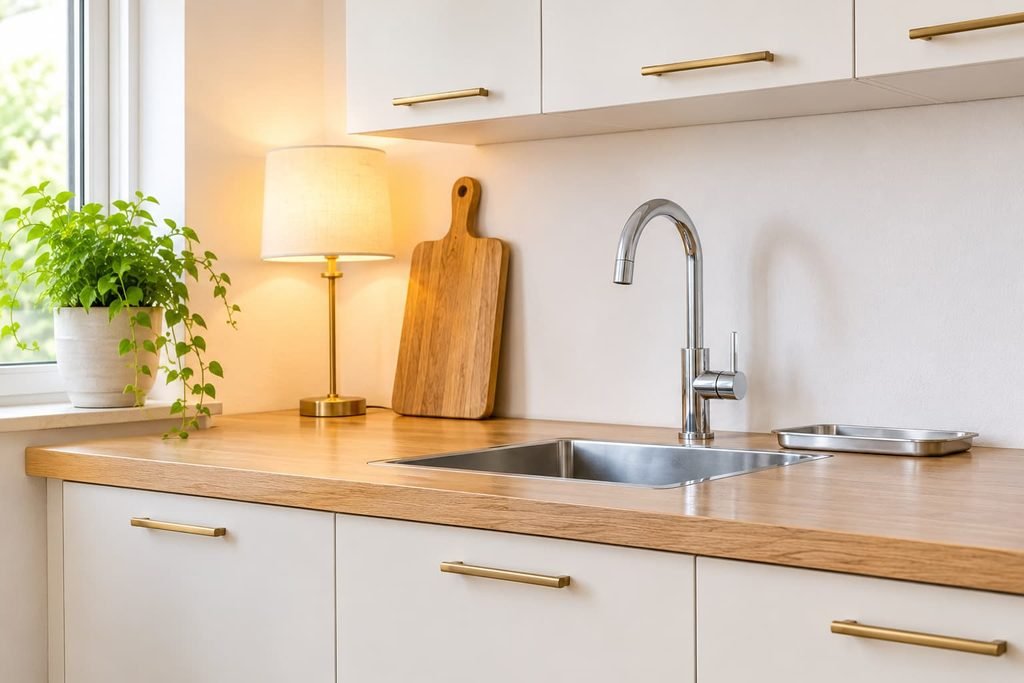
One finish appears only in tiny doses. Scale is the cause. Chrome holds 7.8% of the metal in view and steel holds 9.0%. Both read as strays. You can confirm it by covering the tap with your hand and noticing how much calmer the wall looks. Carry a chrome-coloured tray you already own, about 100 cm², to the tap. Chrome then climbs to 16.7%, though the stray merely gains company. Then gather a steel kettle and a tin near the door handles. Only then consider buying, and swap the three steel handles for black ones, which turns four finishes into three. Expect costs from nothing to one set of handles.
The metals look lit by different rooms. Colour temperature is the cause. Downlights at 4,000 K shine on the sink wall while lamps at 2,700 K light the table, a gap of 1,300 K. Chrome reflects whatever reaches it, which makes the tap look white and the brass look orange. Switch the downlights off after dark and watch the two metals drift together. Then shift a table lamp 60 cm towards the sink so that warm light reaches the handles. Last, fit 2,700 K bulbs in the downlights, which needs only a few bulbs. Keep every bulb in the room at that same temperature, or the gap returns.
The tap seems to argue with the handles. The cause is placement. The tap sits at 105 cm, the height of a standing eye, and the nearest brass handles are 40 cm away at most. That gap is small enough for one glance. Stand a brass chopping board or pan close to the tap, within that same 40 cm, to give the chrome a partner. Keep it out on the worktop, because the pull returns once it goes back in a cupboard. Shift the chrome soap dispenser well away from the handles. If the tension remains, buy two chrome-finish handles for the cupboards beside the tap.
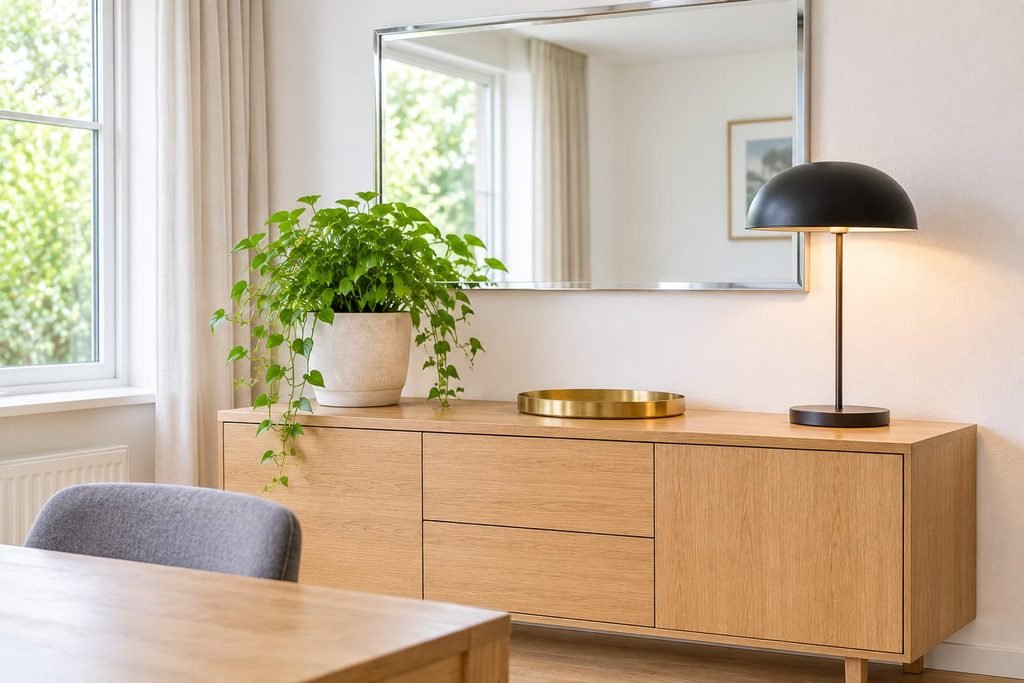
Mixed Metals in Our Flat: Keeping the Finishes Calm
Count the finishes before you buy anything. Two or three in view is a workable limit, with one finish taking most of the metal, perhaps 60%, and the others sharing what’s left. That split serves as a rough guide, and your own photo is the judge.
Bring an old handle or a spare screw to the shop and lay it next to the sample. Look at both under a bulb of the same colour as yours, because lighting changes how a finish looks. Photograph the result after each purchase, since the share of every finish moves with each item you add.
A rental calls for a different plan. Handles and taps normally belong to the building. Ask the landlord before swapping them. Loose items such as trays and lamps can be moved at will, and they carry most of the weight anyway.
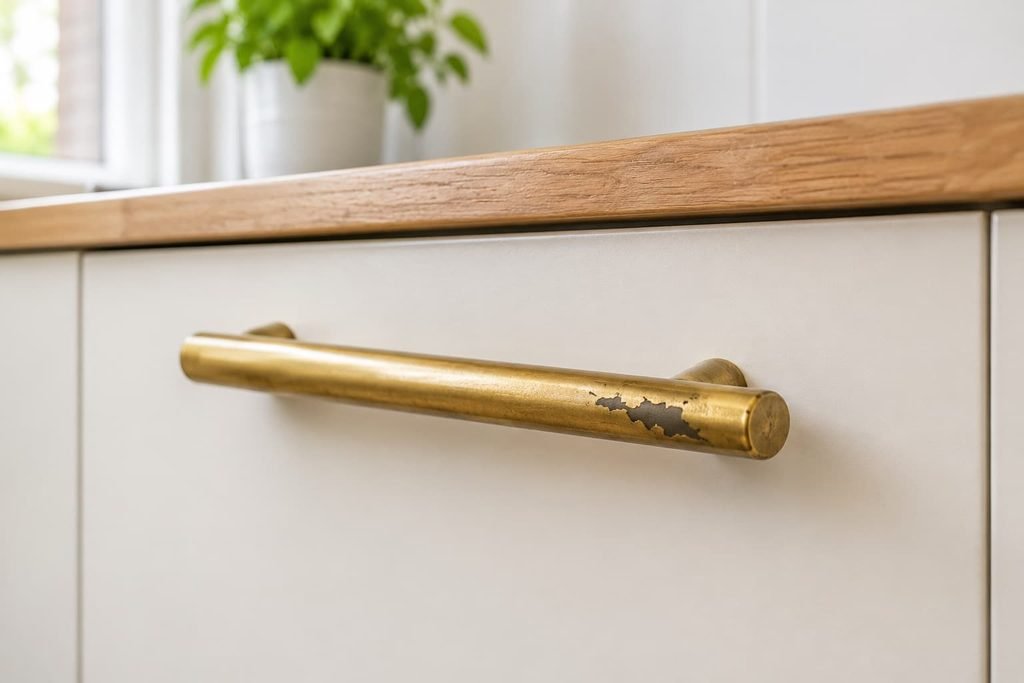
A Repair That Costs More Than It Saves
Plenty of people reach for a can of metal spray to paint every fitting one colour. It sounds tidy, and it rarely lasts. A handle gets touched about forty times a day, and the coat wears through at the edges within weeks. Taps heat and cool with the water. That makes paint lift. A flaking handle looks worse than the original mismatch. Landlords may count it as damage at checkout, and the deposit is a steep price for a tidier look. Fixes for mixed metal finishes in our flat don’t need paint, and each fault above has a gentler answer that you can undo. Taking the old fitting off first to spray it properly means a day without a tap, which few kitchens can spare.
Treat this as a diagnosis. The fittings were never wrong, and neither was your eye. A room reads as calm when its metals share a few clear tones and sit where the eye doesn’t compare them directly. Count the finishes, find the stray, then work on whichever fault applies. Begin with the tray beside the tap, since it needs no money and a minute of effort. Afterwards, take the greyscale photo again and put the two side by side. A week later, look once more. If the change holds, you’ve solved it. If a new stray has appeared, you’ll know which fault to test next.
Questions Readers Keep Asking
What actually causes the mismatch?
A mismatch usually combines a finish that appears in tiny doses, light of different colours on different metals and two finishes sitting within one glance. In our example chrome held 7.8% of the metal in view, and the two kinds of lighting differed by 1,300 K. Any single one can be enough.
Is there a quick fix?
Yes. Move a chrome or steel item you already own beside the tap, then switch off cool downlights after dark. Neither costs anything, and each works within minutes. If the tension remains, shift a lamp closer to the handles so that warm light falls on them.
Can this be fixed without renovation?
Largely, yes. Loose trays and lamps handle the opening steps of each fault. Only the handle swap needs a screwdriver, and it stays optional. A tenant can leave the fixed fittings alone and still rebalance the view. No building work is needed to see a difference.