Adhesive hooks keep letting go of the wall because a loaded hook pulls the strip down and also levers its top edge away from the surface. Glue resists a straight downward pull far better than it resists that outward peel. This guide explains how to tell which of three failures you have, then lists four repairs from the free one upwards, ending with work for a handyman. Shelf brackets and towel rings held by glue follow the same sum. Our example is a hallway in Utrecht where a winter coat and a bag hang on one hook. All numbers are samples. Weigh your own load and measure your own strip.
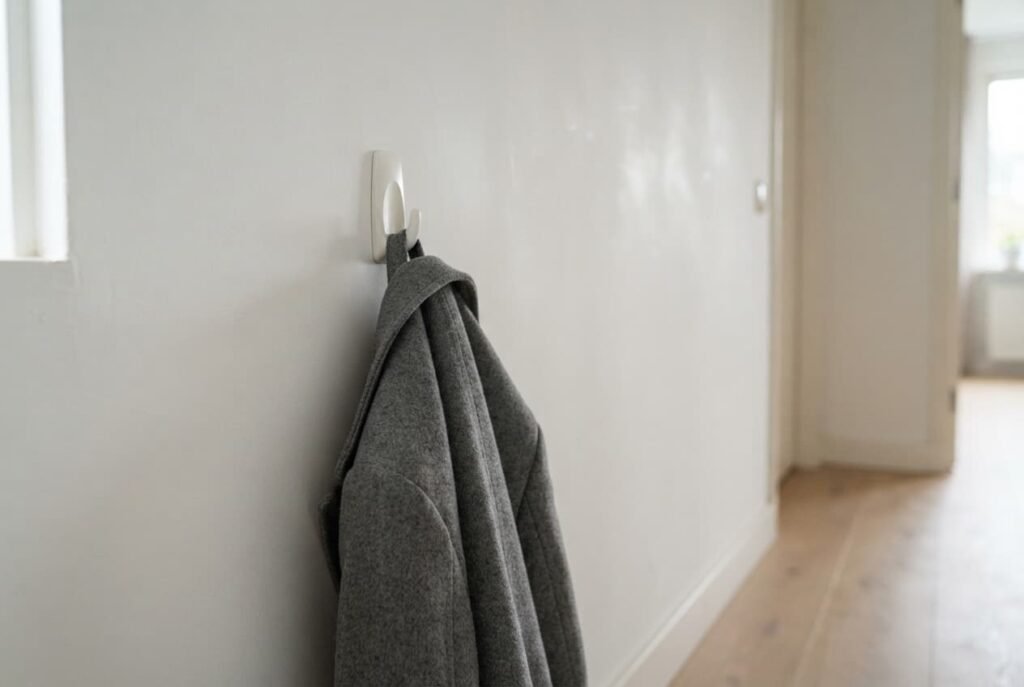
Why adhesive hooks keep letting go
A hook holds a coat a few centimetres away from the wall, and that gap turns the coat’s weight into a lever. Treat the lower end of the strip as a hinge. The weight pushes down at a distance d from the wall, while the upper end of the strip has to pull back with a force T to stop the hook swinging out. The sum is T = W × d ÷ h, where W is the weight and h is the strip’s height.
Femke hangs a load of 2 kg, which is W = 19.6 N. Her hook reaches d = 4.5 cm out and her strip stands h = 6 cm tall, giving T = 19.6 × 4.5 ÷ 6 = 14.7 N. That means the upper end of the strip must hold three-quarters of the load’s weight as a pull straight away from the wall, and adhesive is weakest in exactly that direction. Pulled along the wall it grips firmly. Pulled outwards it peels from one edge, like a plaster lifting off a knee.
Time finishes the job. Under steady load the glue creeps a fraction each day, which is why a hook can hold for three weeks and then drop on a quiet night.
Which version of the failure you have
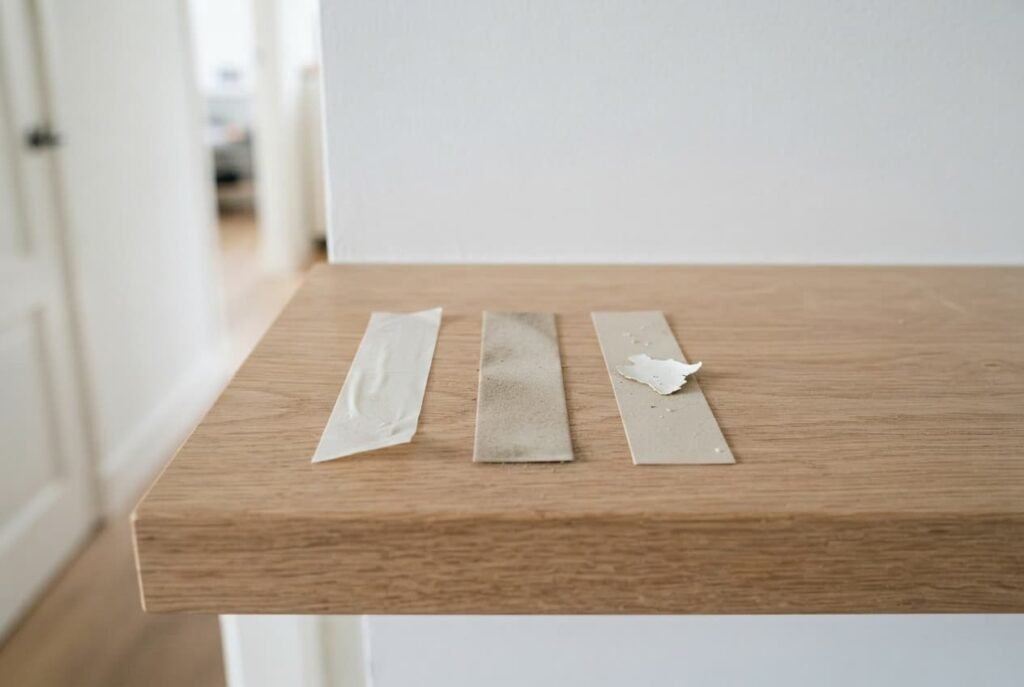
Check the strip you removed, because adhesive hooks keep letting go in three different ways and each one leaves its own evidence on the strip and on the wall.
Version one is the peel. The hook tilted before it fell, the top 2 cm of the strip is clean and stretched, and the lower edge is still sticky. The lever from the first section did this, and it often shows after a few weeks.
Version two is poor contact. The hook fell within about 48 hours of fitting. The sticky face carries dust or fibres, or shows a pattern of small patches where the wall never touched it. Something stopped the glue from bonding over the whole strip.
Version three is the wall itself. A thin film of paint, or a dusting of plaster, has come away stuck to the strip. The glue held, but the wall’s top layer didn’t.
Many failures show two versions at once. Write down every sign you find, then match them to the fixes below: version one points to fixes two and three, version two points to fix one, and version three points to fix four.
Four fixes for adhesive hooks that keep letting go
Clean the spot and press for 30 seconds. It costs nothing and targets version two. Wipe the wall with warm water that has a drop of soap in it, rinse with a clean cloth, then dry the wall completely, because a soap film is as bad as dust. Skip polish and oily sprays, which leave a film that the glue slides over. Press the strip from the centre outwards and leave it unloaded for an hour, which gives the glue time to flow into the tiny hollows of the paint. Clean contact can’t shorten the lever. A version-one hook will still peel from the top.
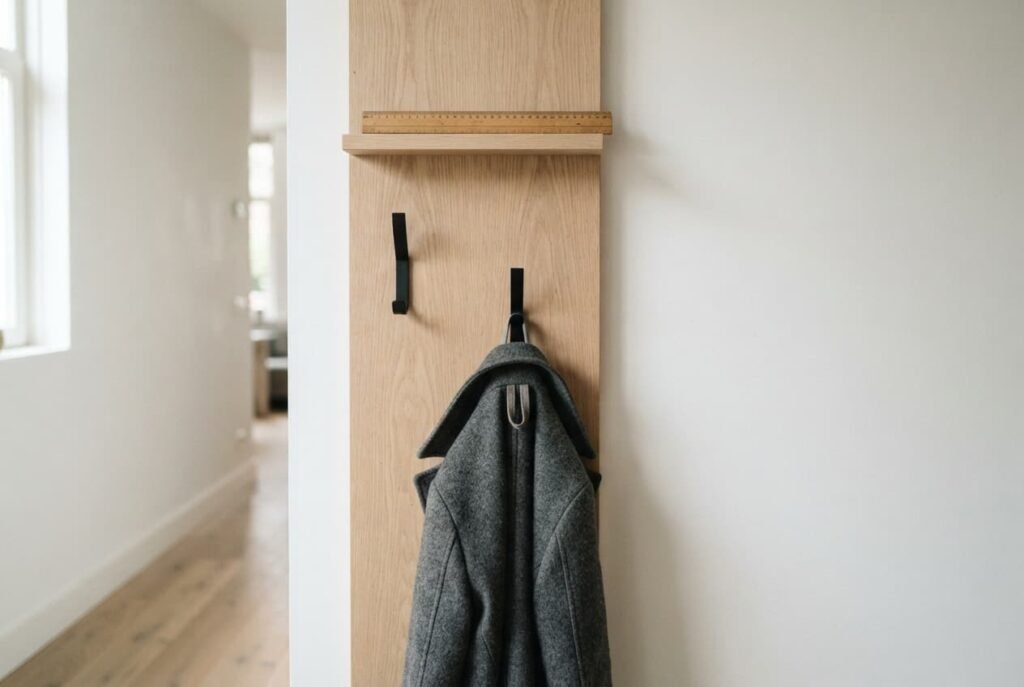
Spread the pull over a taller backing. It costs one more pack of strips and a board offcut. Because T = W × d ÷ h, raising h from 6 cm to 20 cm cuts the pull on the upper end from 14.7 N to 19.6 × 4.5 ÷ 20 = 4.4 N, which is under a third. Fit the board on two long strips, then screw the hook to the board. A board of that height can carry two or three hooks, which spares the wall extra marks. The wall needs 20 cm of clear height, and the board must sit flat.
Choose a hook with a shorter reach. This is a small purchase. Cutting d from 4.5 cm to 2.5 cm gives T = 19.6 × 2.5 ÷ 6 = 8.2 N, which is 44% lower. Measure your current reach with a ruler, taking the gap between wall and coat hanger. Compare it with the reach shown in product photos before you buy. A bulky coat may then rest against the wall, and a reach under 2 cm gets awkward for sleeves.
Fit a screw and plug instead. This needs a handyman visit of about 15 minutes per hook, plus your landlord’s written agreement. The plug carries the load inside the wall, which removes the peel altogether. It is the only dependable answer to version three, because glue can’t be stronger than the paint under it. Ask the handyman which plug suits your wall. A hole will stay behind when you leave.
What this hallway wall allows
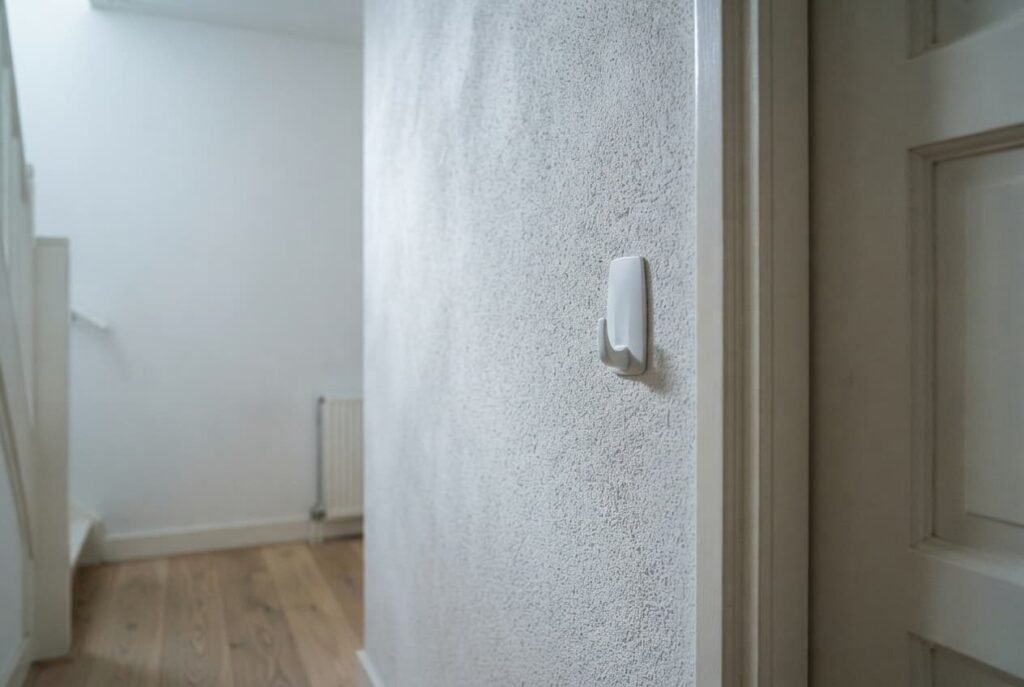
The hall in our sample sits in a block from the 1970s, with sprayed, textured plaster painted white. It also shares a cold stairwell wall. On this wall adhesive hooks keep letting go for reasons the strip can’t change. The texture means the glue touches only the peaks. A strip of 6 × 3 cm has 18 cm² of face and meets about 40% of it, which leaves 7.2 cm² of real grip.
The cold wall is the second limit. At around 12 °C in winter the glue stays stiff and bonds poorly. Fit hooks on a warm afternoon with the heating on. Beside the front door the wall has 25 cm of free width, plus a metre of height. A tall backing fits easily.
Drilling is a decision a tenant can’t make alone.
The fix that makes it worse
A hook rated for more weight is the standard answer, yet it often makes things worse. A bigger hook tends to reach further out. At d = 7 cm the same 2 kg load gives T = 19.6 × 7 ÷ 6 = 22.9 N, which is 56% more pull on the upper end than before. Hang a bag by its strap at the very tip of that hook and d reaches 9 cm, which doubles the original pull to 29.4 N. A rating usually describes a straight downward pull on a smooth surface, and a coat hook is never loaded that way. When adhesive hooks keep letting go, the lever matters more than the weight on the pack. Choose the shortest reach and the tallest backing that fit your wall.
Look at the strip you took off and name the version. Then work through the repairs above, starting with the free one. Weigh the load and measure d and h. Then put your own numbers into the sum. Check the hook after three weeks: if it tilts by even 2 mm, it has started to peel, and you can step up to the next fix before anything falls.
Questions and Answers
Can I reuse a strip that has already come off?
No. The glue layer has stretched and picked up dust. It can’t bond again. Fit a fresh strip on a cleaned spot. If paint came away with the old one, the strip wasn’t the problem. A screw and plug is the better answer.
What does the most reliable fix cost?
Cleaning is free. A taller backing costs about one more pack. A screw and plug costs a handyman’s visit. Repairing a patch of torn paint after a failure costs more than any of them. The free and small fixes pay for themselves quickly.
Why do hooks fail more often in a bathroom?
Steam leaves a skin of water on tiles and paint, and the glue bonds to that skin instead of the surface. Fit hooks on a dry wall at room temperature and ventilate after a shower. A screw and plug is steadier than any strip for heavy wet towels.