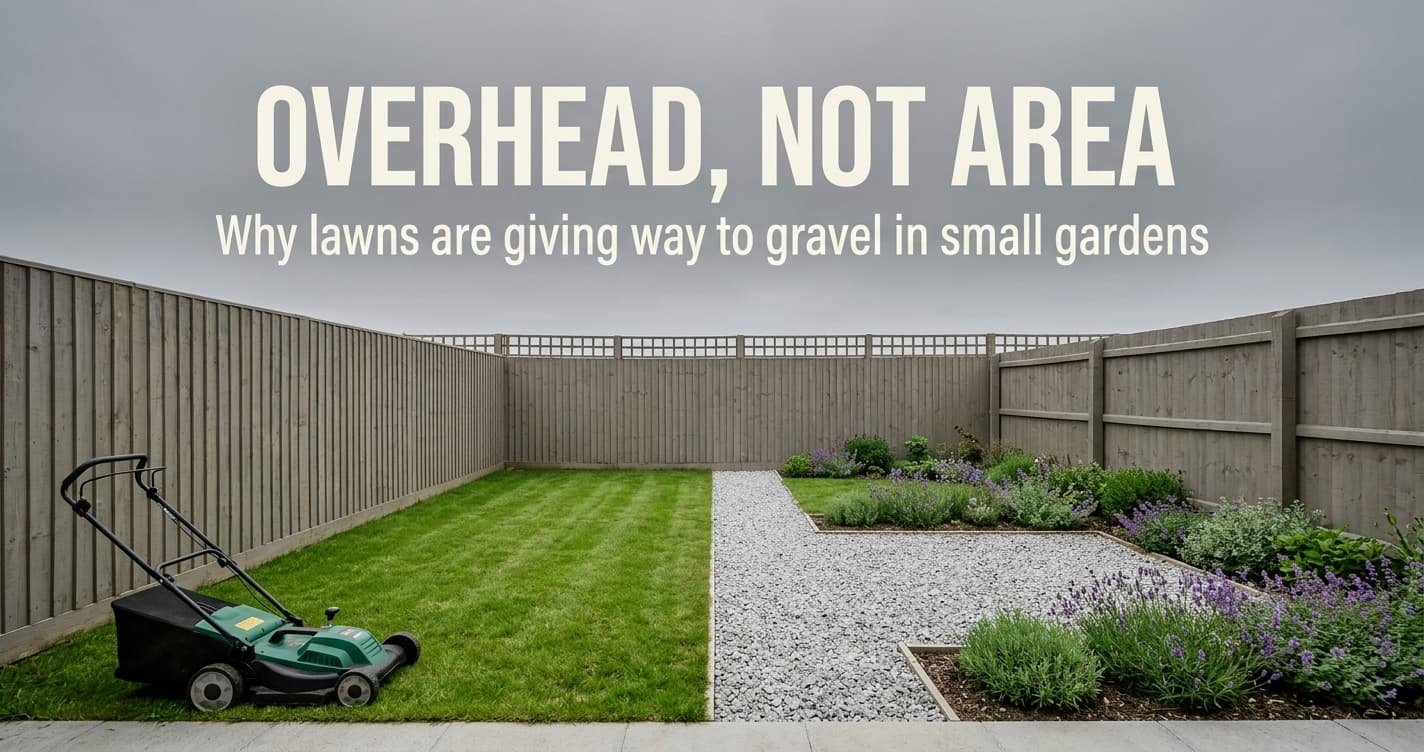
A mower deck 32 cm wide crosses a 16 m² lawn in about two minutes, and getting it out of the shed and back takes twenty. That lopsided pair explains why lawns are giving way to gravel and planting in small gardens. If your lawn is under about 20 m² and nobody plays on it, the swap pays off in hours and in water.
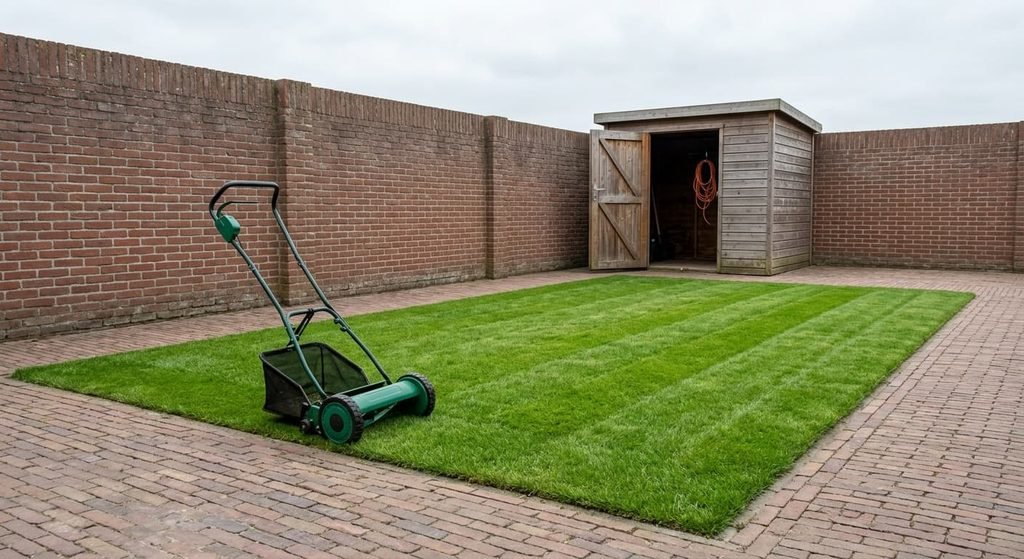
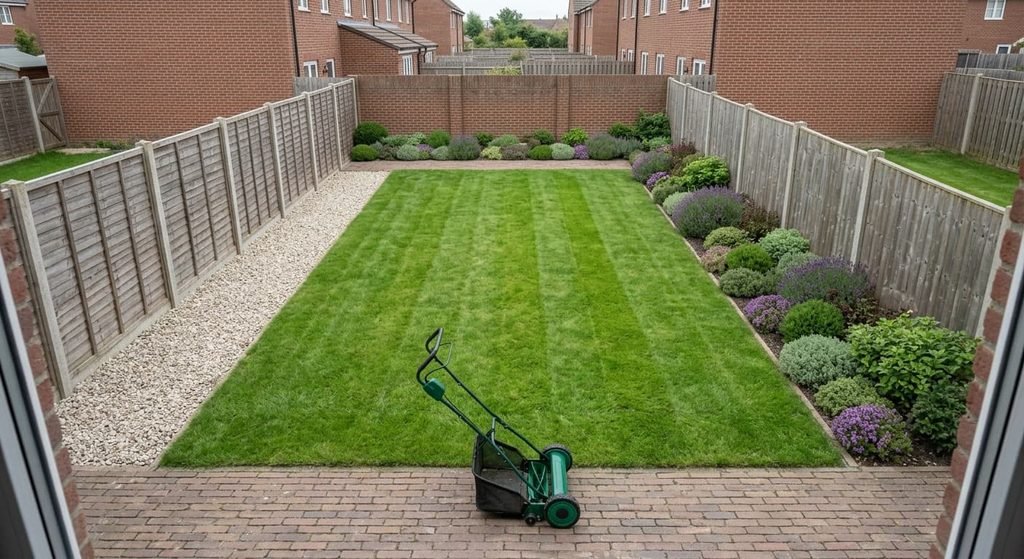
Every figure comes from a Dutch rear garden of 360 × 650 cm, which is 23.4 m². A terrace takes the first 200 cm, and a lawn of 16.2 m² fills the rest. Times and volumes are assumed round values.
How the lawn became the default, and why a small plot outgrew it
The lawn came from space. On a large plot one round with the mower covers a huge area, so the cost of fetching and cleaning the machine is spread thin. Assume 20 minutes of overhead per mow and a mowing speed of about 9.6 m² a minute, which suits a 32 cm deck at walking pace. A lawn of 200 m² takes 21 minutes of cutting plus the overhead, which is 0.2 minutes per m². A lawn of 16.2 m² takes 2 minutes on the grass plus the same 20, which is 1.3 minutes per m², over six times as much. That is how lawns are giving way to gravel in small plots: the overhead outgrew the lawn.
Grass also asked little at the start, and a green rectangle looked finished within a season. The deck shaped the layout further, because a blade that wide wants a plain, clear run. It covers bare soil in one pass of seed or turf, and one green surface suits any plot shape. Small gardens inherited that template without the scale that made it cheap.
The overhead stays when the lawn shrinks.
What happens where lawns are giving way to gravel and planting
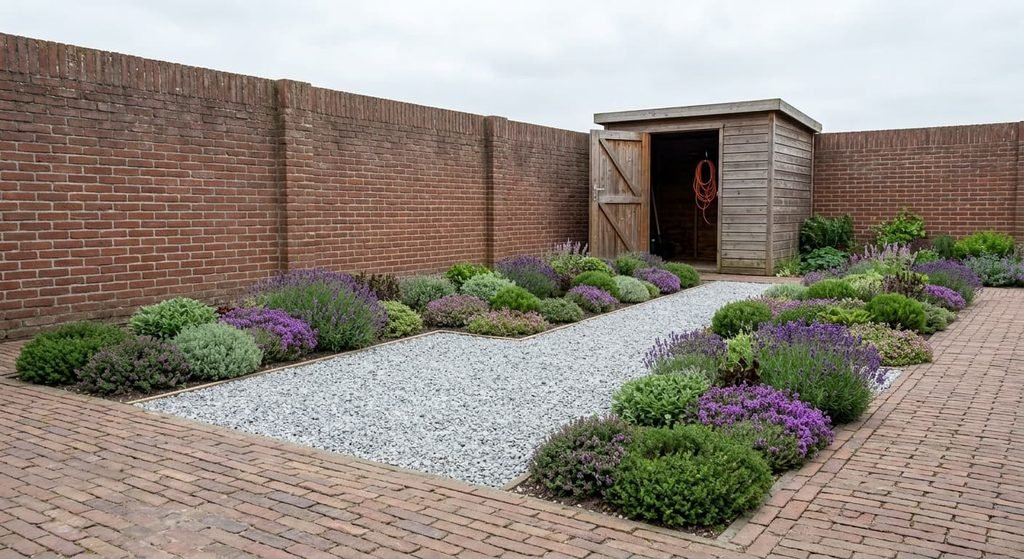
The shift in one line: a lawn of 16.2 m² mowed 26 times a year turns into 7 m² of gravel and 9.2 m² of planting tended about 8 times a year. Everything below unpacks it.
Time moves first. Twenty-six mows at 22 minutes come to 572 minutes, or 9.5 hours, and most of that is overhead. The new garden asks for two rakings of 10 minutes, four weeding sessions of 45 and two cut-backs of 60. That totals 320 minutes, or 5.3 hours, which is 44% less.
Water changes next. A lawn that stays green through a dry spell wants about 25 mm a week, and 1 mm over 1 m² is 1 L. So 16.2 m² takes 405 L a week, and three dry weeks cost 1,215 L. New planting of 9.2 m² takes roughly 10 L for each m² weekly in its first summer, so six weeks cost 552 L. Established roots then need far less. Rain covers part of this in a wet year, so treat the totals as a dry-year picture.
The surface changes third. Gravel 5 cm deep over 7 m² is 0.35 m³, or about 0.5 t at 1.5 t per m³. It drains at once, so a footstep after rain leaves no mark. Grass bruises and goes soft in the same hour.
The edge changes last. A lawn edge needs recutting several times a year. A gravel edge needs a board set 5 cm deep, once. Expect to pull a handful of weeds a month in season.
Who gains and who doesn’t
Where lawns are giving way to gravel, the move suits a household that sits in the garden more than it plays there. It suits a plot with 1.8 m fences, where grass thins in the shade of the boundary. It suits a family that travels in summer. Gravel and planting survive two weeks of neglect, while grass browns. Anyone who counts the mower as the worst chore gains too. Twenty-six sessions of 22 minutes is a lot of afternoon for a view.
A lawn earns its keep when somebody lies on it.
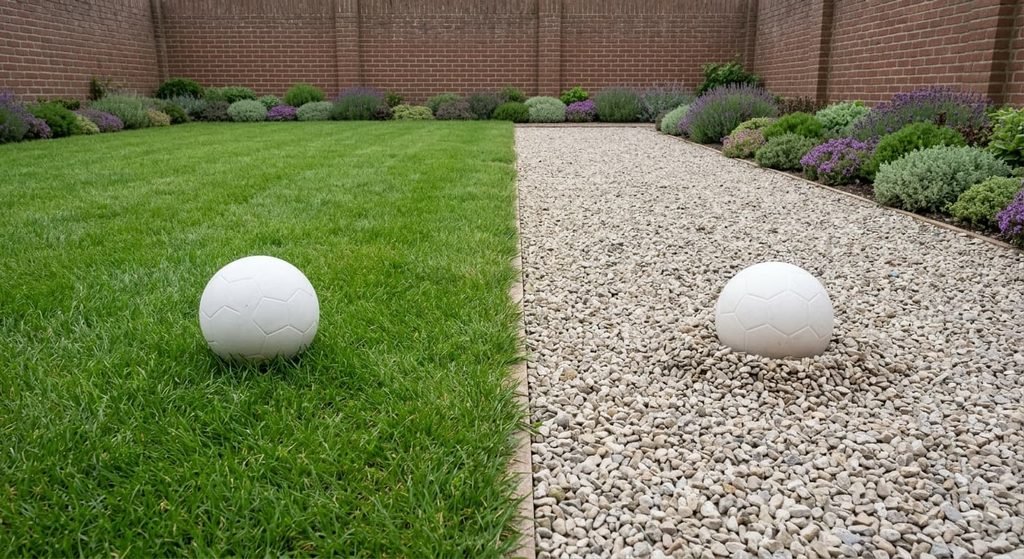
A child under ten or a dog that runs gives grass a job that gravel can’t do. Soft ground takes a fall, and a ball rolls true on grass but hops on stone. In that case keep the lawn whole. Shrinking it to 7.5 m² saves almost no time, because the 20 minutes of overhead stays. That’s the sum against a half measure.
Gravel has its own limits. Seeds land in the dust between the pieces, so a membrane under it slows weeds without stopping them. Stones travel indoors on soles, and a doormat catches most. Beds in deep shade need plants suited to it, and that choice narrows. A planted bed of 9.2 m² also needs making, which takes a weekend of digging that a lawn never asked for.
Are lawns giving way to gravel worth copying in your garden
The move pays when your lawn is under about 20 m² and no one plays on it daily. In the example it saves 4.2 hours a year and about 650 L in a dry spell. Neither number alters a life. What changes is the dread attached to the shed. A lawn between 20 and 40 m² sits in the grey zone, where the log described last decides.
The sums turn back toward grass as the lawn grows. At 40 m² a mow takes 4 minutes of cutting plus 20, which is 0.6 minutes per square metre, and the overhead share falls below the cutting share. I’d keep a lawn of 40 m² or more, however fashionable gravel looks. Your soil’s drainage is beyond this page’s reach, and a heavy clay patch changes the planting half of the plan.
The version that will date fastest
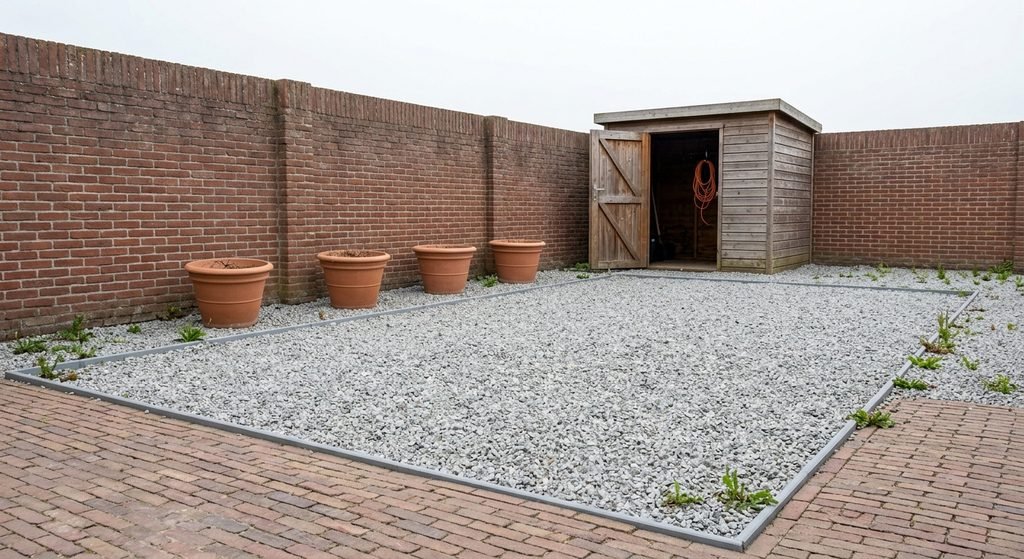
At its extreme, the trend means an all-gravel garden with a few pots. All 16.2 m² under stone is 0.81 m³, or about 1.2 t, laid over a sheet. Nothing in it holds rain, so every shower runs off to the drain. The pots dry out in a day of sun and need watering daily. Pale stone also throws light back at south-facing windows, which warms the room beside it. Weeds root in the dust that settles on the sheet inside a season. Noise underfoot and glare off pale stone make it a place to cross, never to sit.
Gravel laid 3 cm deep instead of 5 cm sinks into the soil within a couple of seasons, and the membrane then shows through. The moderate version keeps 9.2 m² of soil with planting and lays gravel only where feet fall: a path and a seating square of 7 m². It holds rain and survives a dry week. It ages well as the plants fill in. The all-gravel layout only gets older.
How to try it without committing
Try it over four weeks: log every mow in minutes and every time you sit on the lawn. Four mows at 22 minutes come to 88 minutes. If you sat on the grass twice, that’s 44 minutes per sit. Write the weather beside each entry, because a wet fortnight shifts both columns.
Keep going until the month closes before deciding, even if the first two weeks feel decisive. The log turns a feeling about the lawn into a ratio, and a ratio is easier to argue with than a mood. Add the minutes you spend edging, since those belong to the lawn too.
At two mows or more per sit, the lawn costs more attention than it returns. Full-year figures of 26 mows and 10 sits give 2.6 mows per sit. Lawns are giving way to gravel in small gardens for exactly this reason. Run both counts once, then the ratio decides. Below two, keep the grass. Mow it less often. Above two, start planning the new layout.
Questions readers keep asking
Should I keep my lawn or replace it?
Keep it at 40 m² or larger. Keep it too if a child or dog uses it daily. Swap it if it’s under about 20 m² and mostly looked at. Between those sizes, run the four-week log. Decide from the ratio of mows to sits.
Does gravel and planting suit a rented garden?
Partly. Gravel can be lifted and reused, and planting in large containers moves with you. Digging out turf needs the landlord’s agreement, so ask first. Check the lease for any rule on altering the ground. A removable gravel tray over the lawn is the cautious version.
How long does a gravel and planting garden last before it needs redoing?
The gravel sinks slowly into soil, so a thin top-up every few years keeps the depth. Planting fills in over a few seasons and then mostly needs tidying. Weeds are the real clock. A membrane and a yearly pull keep the layout intact.