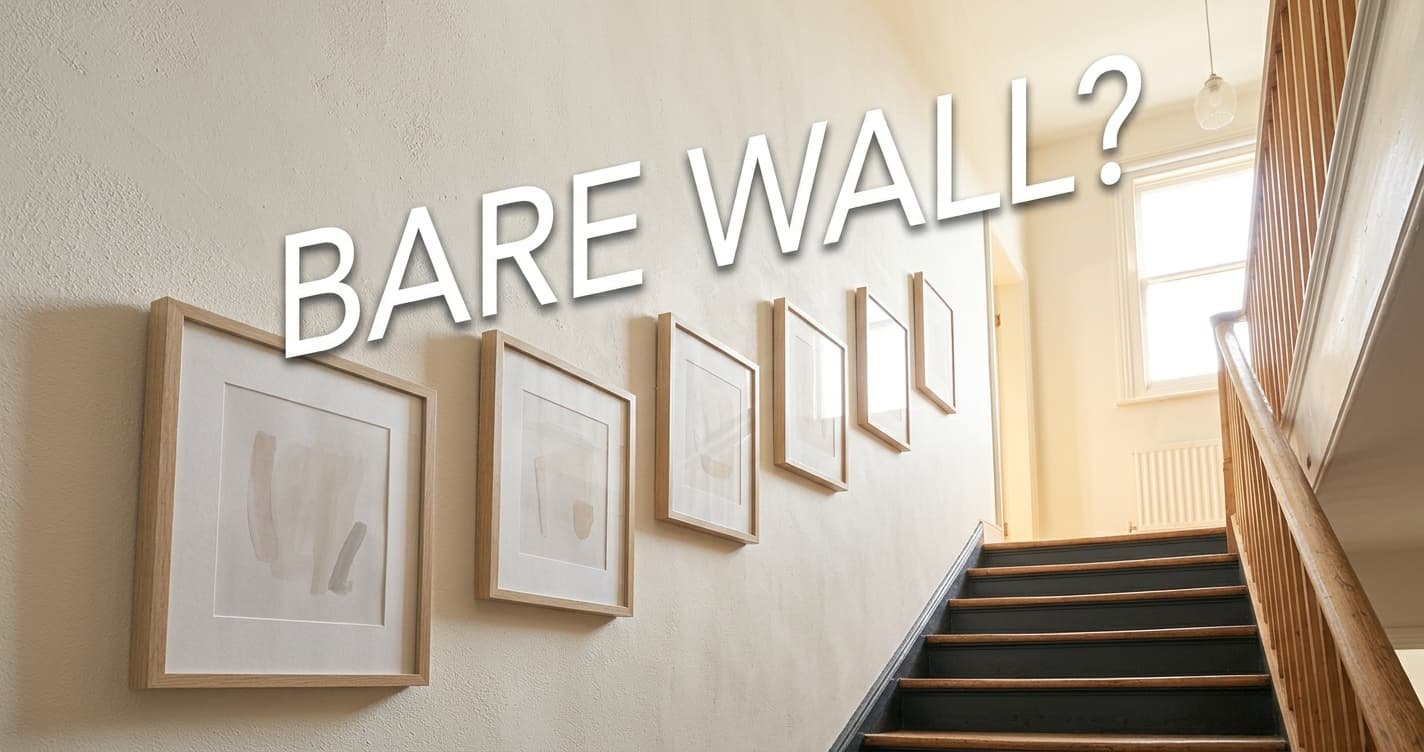
Why does a wall hold five frames and still look empty? A stairwell wall looks bare even with frames when you see them from the side while the stairs lift your eyes. Each frame shrinks to a sliver and drops below your sightline. The cause is geometry: where you stand to look, and how much the frames contrast.
The sums assume a Dutch staircase with 14 risers of 18 cm and goings of 23 cm, 90 cm wide, with the wall on one side. Five frames of 30 × 40 cm hang in a level row at 150 cm. Every size is an estimate, so check your own staircase against it before you move anything.
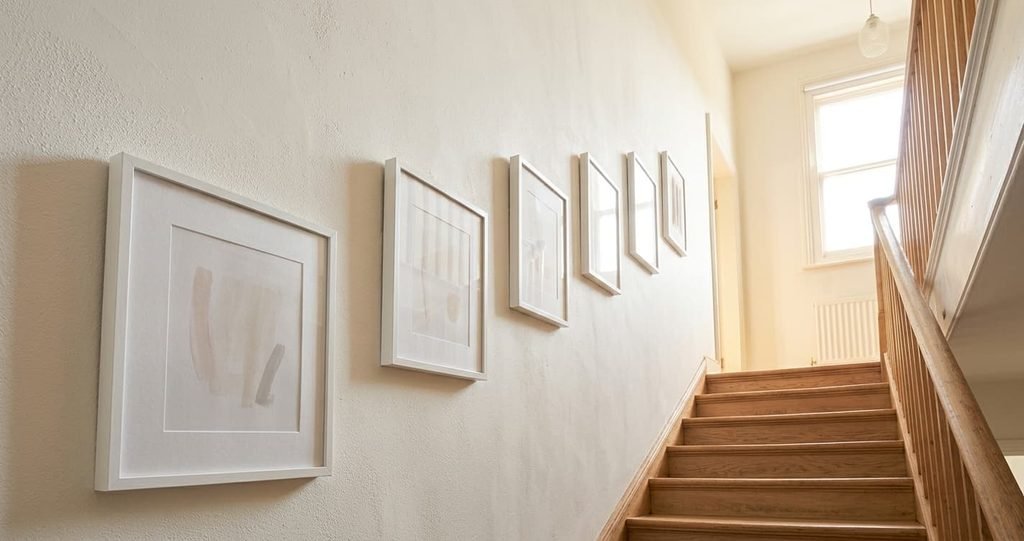
Why a stairwell wall looks bare even with frames: what is happening
Three effects stack up on a stair, and a stair wall is read at a slant while the eye line climbs 18 cm per step. You climb about 45 cm from the wall, so a frame three steps ahead, 69 cm away along the wall, sits at 57° from straight on. Apparent width follows the cosine of that angle, which is 0.55. A frame 30 cm wide shows as 16 cm. Six steps ahead the angle is 72°, the cosine 0.31, and the same frame shows 9 cm.
Distance shrinks the height too. A frame 40 cm tall spans 48° of your view when you pass it at 45 cm, and only 16° when it hangs six steps ahead at 145 cm.
Now the eye line. An eye at 160 cm above the tread rises 18 cm with every step. A row hung level at 150 cm sits 28 cm below your eyes on the first step and 136 cm below them on the seventh.
By step seven the row is at your hip.
Light adds the last piece. A stairwell rarely has a window, and pale frames on a pale wall have almost no edge to catch. Together the three explain why a stairwell wall looks bare even with frames.
Stairwell wall that looks bare even with frames: which fault is yours
Run three looks with your phone, in this order. They separate the three causes, and you can do them in ten minutes without a tape measure.
First, stand on the third step and look up the wall. Count the frames whose width looks less than half of what you’d see facing one. Several slivers point to the angle, and you’ll find the worst offenders furthest up.
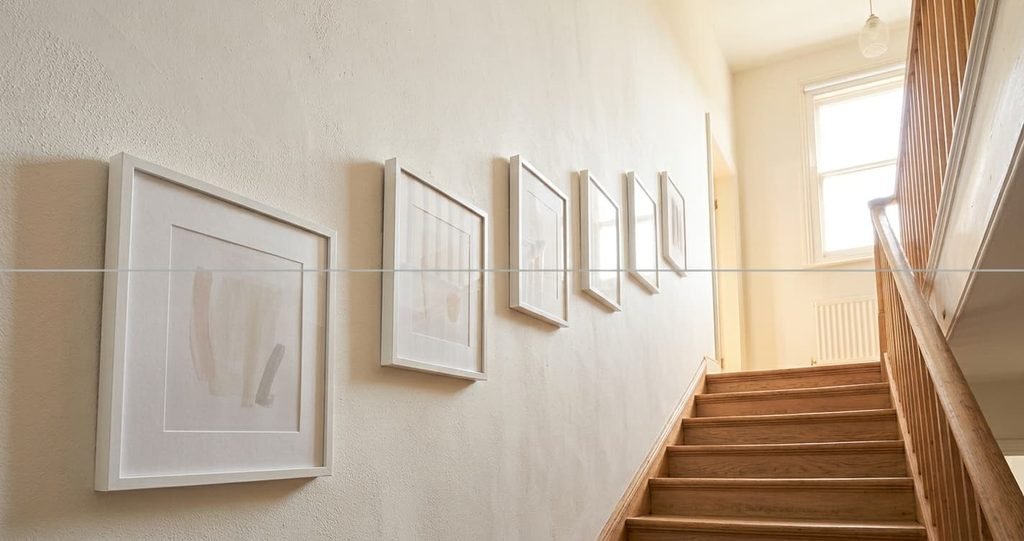
Next, shoot from the bottom step with the phone held at eye level, then draw a line across the picture at the height of the lens. If the frames drift below that line after the fourth step, the row is level when it should climb.
Last, turn that picture to black and white. Frames that vanish into the wall point to contrast. A frame that still reads clearly rules contrast out. Write down the step where each frame first looks under half its true width, because that step is the farthest point from which your layout can still be read.
The three faults, diagnosed
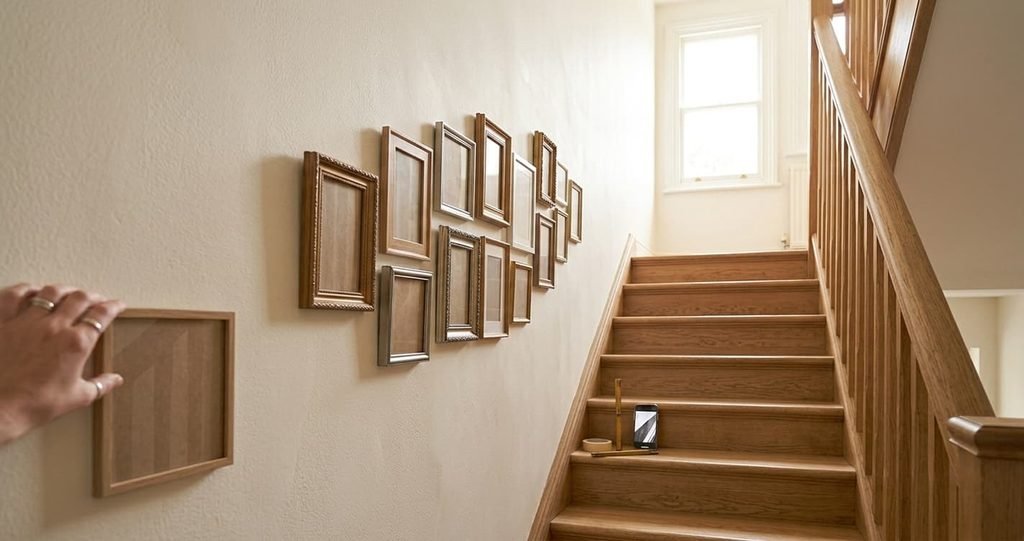
“From the stairs the frames look like thin slivers.” The cause is foreshortening. Width shrinks to 31% by the sixth step, while the height barely changes. Wide frames keep more of themselves, so a frame 60 cm wide shows 19 cm where one of 30 shows 9. Hang your widest frames within the first three steps, and pair the narrow ones with 4 cm gaps, because gaps shrink by the same factor and the pair reads as one piece. Put the largest piece on the landing wall, where you face it straight on. This rearranges what you own and costs nothing but an evening. If a frame has to stay far up the wall, give it a darker mat so its height does the work that its width can’t.
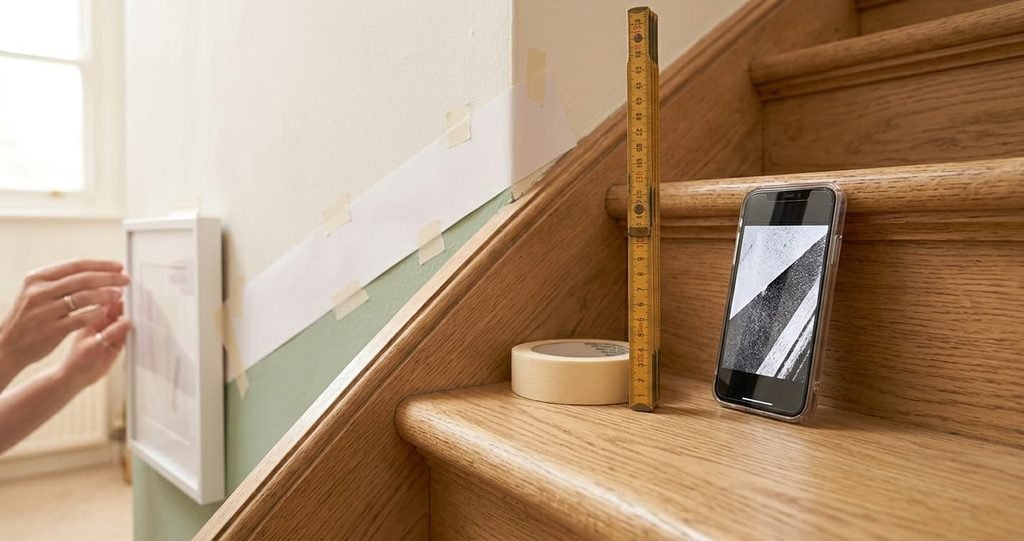
“The row is level while the stairs climb.” The cause is placement against the eye line. Frames at 150 cm sit near your eyes only on the first step, which is why a stairwell wall looks bare even with frames hung level. Rehang them along the pitch: 18 ÷ 23 gives a slope of 0.78, about 38°. Keep every frame centre 150 cm above the nosing line directly below it, which holds each frame about 10 cm under your eyes on every step. Start from the fourth step, where a level row is already 82 cm under your eyes. A paper strip cut to that slope and taped to the wall shows the line before you drill. Expect new holes and a little filler, so it costs an afternoon rather than money.
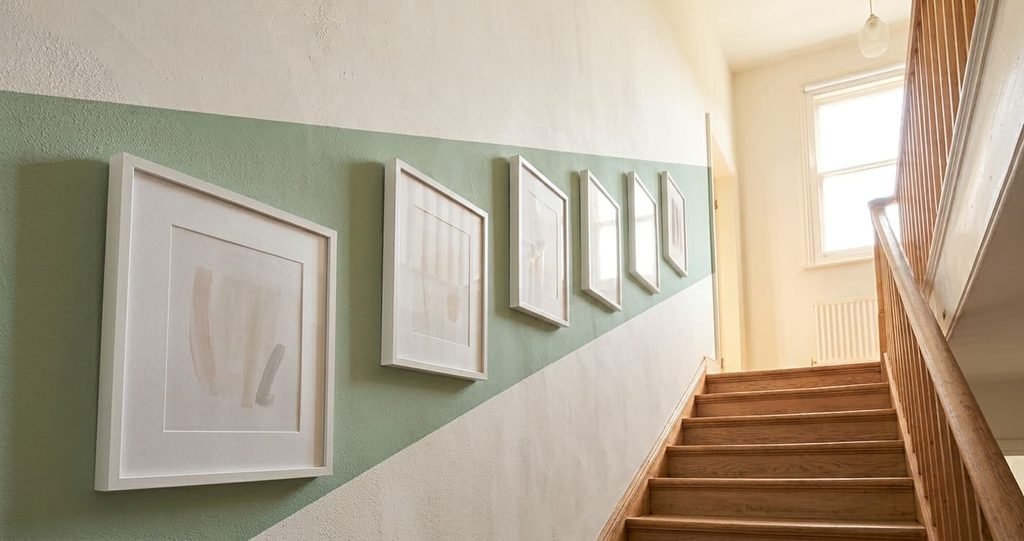
“The frames fade into the wall.” The cause is contrast. A white frame with a mat returns about 72% of the light falling on it, and a pale wall returns about 78%. The ratio is 1.08 to 1, and an edge that faint disappears in a dim stairwell. Paint a band 110 cm deep behind the frames, parallel to the pitch, in a mid-tone that reflects about 30%. The ratio becomes 2.4 to 1. The band covers about 3.5 m² and needs a tin of paint and masking tape. It darkens a strip of the stair, which is a fair price, since the frames now read from the landing. The band doesn’t change the angle or the height, so use it after the first two fixes.
What to check before you add anything else
Before a new frame goes up, run these checks, each tied to one of the three effects above. Hold it at its planned spot and look at it from the third step and the sixth. A frame that shows under 10 cm of width from the sixth step belongs nearer the bottom. Measure its centre against the nosing line and confirm 150 cm. Then photograph the spot in black and white and ask whether the edge still shows. Check that its wall band sits at least 2 to 1 in contrast with the mat. A piece that fails any check will join the others as a sliver, so fix the check before you drill. Keep a card inside a cupboard door with the numbers. They are 150 cm above the nosing and a contrast of 2 to 1.
The fix that isn’t worth doing
Adding more frames is the usual advice, and it falls short. If your stairwell wall looks bare even with frames, buying more won’t cure it. Five frames of 30 × 40 cm cover 0.6 m². Doubling to ten covers 1.2 m². At an average apparent width of 40%, the new frames still shrink, they still hang below the eye line and they still dissolve into a pale wall. The wall gains clutter and no presence, and the 3.5 m² band stays mostly empty either way. Each extra frame also adds two holes that you’ll have to fill when you finally rehang everything.
More of the same frame repeats the fault.
I’d stop buying and start moving. The pieces you own are enough for a stair wall, once they hang where the climber looks, at an angle that lets each one be read, with an edge that shows.
A stairwell wall that looks bare even with frames has two kinds of fault. Geometry shrinks the frames to slivers and drops them below your eyes, and low contrast then erases what is left. The fastest check is to stand on the third step and look up the wall. Slivers and a sagging row both show there in seconds, and you don’t need a tape to see them. Rehang along the pitch first and paint the band second. Buy something only after both. Your pieces were never too few, and what they miss is the eye of someone climbing, and that’s a fixable thing. Fix that and the wall stops looking bare, whatever the number of frames.
Questions readers keep asking
Why does a staircase wall look empty even with pictures on it?
You see the wall at a slant, so frames shrink in width. Your eye line also rises with every step, leaving a level row below it. Add pale frames on a pale wall and little contrast remains. Check the angle, the height along the pitch and the contrast, one at a time.
What is the fastest way to fix a bare stair wall?
Rehang the frames you own along the pitch of the stairs, with each centre 150 cm above the nosing line. Group the widest ones near the bottom, where you see them best. This costs filler and an afternoon. Do it before you buy another frame or any paint.
Can a bare stairwell wall be fixed without renovation?
Yes. Rehanging along the pitch needs no building work. A painted band of 110 cm raises contrast from 1.08 to 1 up to 2.4 to 1, and a piece on the landing gets read head-on. Only moving the staircase or adding a window would count as renovation.