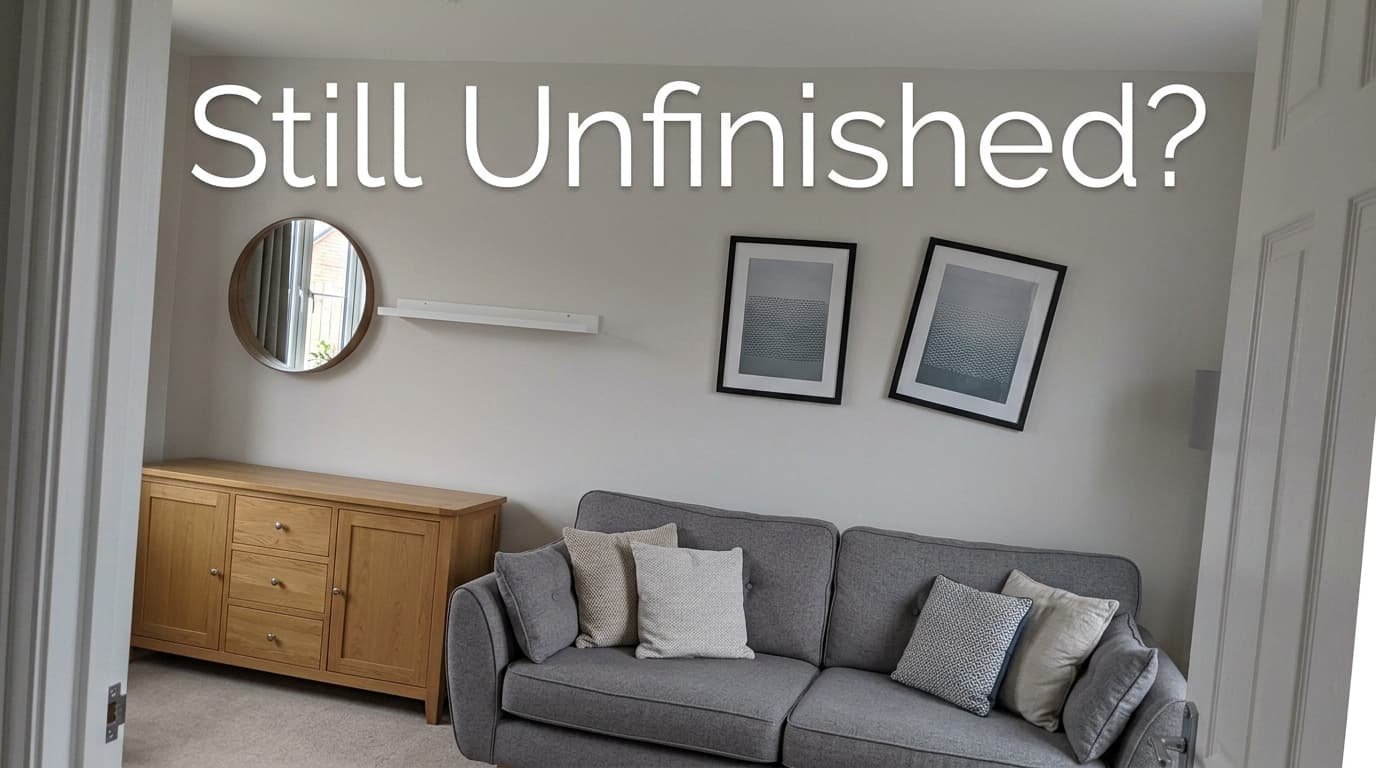
The mirror’s lower edge hangs at 120 cm and the shelf beside it ends at 128, and you see both from the sofa. Gaps like that explain what makes a living room feel unfinished even though every piece on your list is in place. I call each one a near-miss: two things that almost agree, close enough to look like an attempt and far enough to look like a slip. Three passes below find yours.
The example room is Dutch, 420 by 500 cm, with a 260 cm ceiling. The thresholds are working rules from this article, so measure your own room.
What makes a living room feel unfinished when nothing is missing
Your eye compares neighbours. Two edges at the same height read as one decision. Two edges 20 cm or more apart read as a deliberate step. Anything between 2 and 15 cm reads as a slip, and a near-miss looks like an attempt that failed, so the eye logs the room as unfinished.
The same logic runs on tone and size. Surfaces whose reflectance differs by less than 10% read as one finish, and a ratio of 2 to 1 reads as contrast. The middle range, from 1.1 to 1.9, reads as a slip. Sizes follow the pattern, using area. An exact match looks planned and a plain difference looks planned too, so only the almost looks accidental.
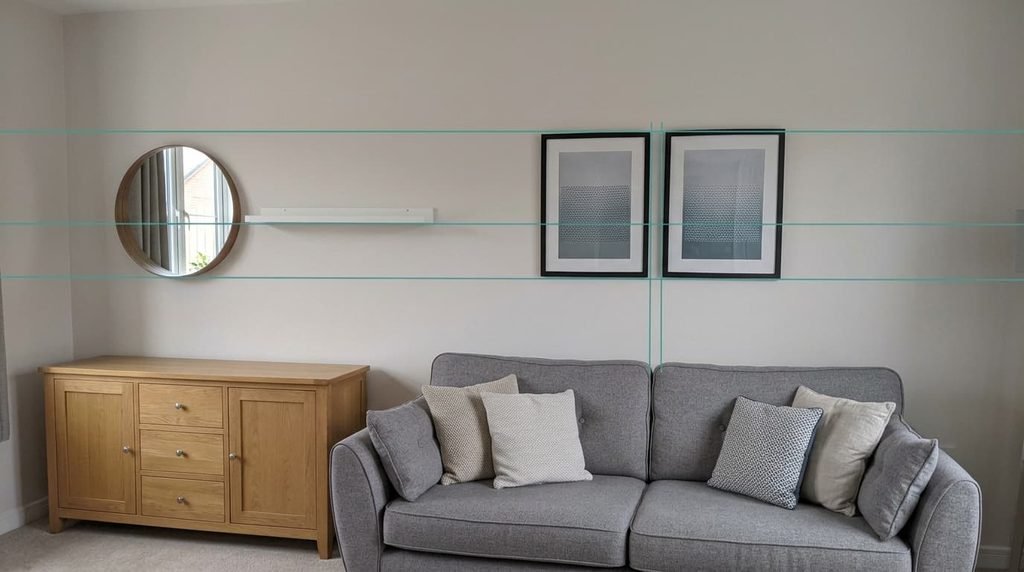
Here is the sofa wall. The sideboard top sits at 76 cm and the sofa back at 82. Up the wall, the mirror bottom is at 120 and the shelf top at 128, while two matching pictures have tops at 165 and 172. Of the five gaps between neighbours, three are under 10 cm, and those three are slips. At 3.5 m a 7 cm offset spans 1.1° of your view, so you register it without measuring. That’s why a living room feel unfinished long before anyone reaches for a tape.
Why a living room can feel so unfinished: three passes to find out
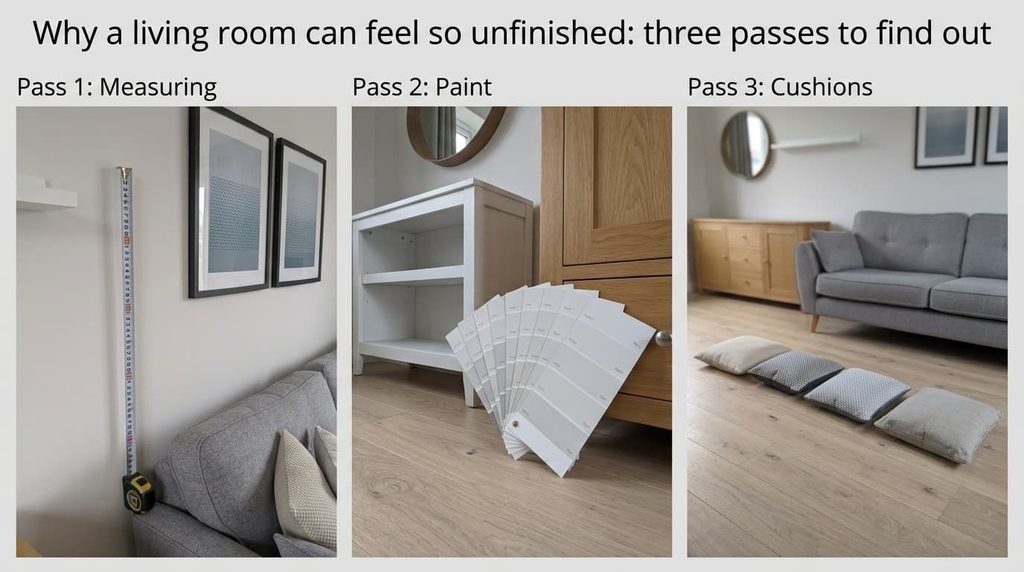
Take a tape, a set of paint-chart cards and a few minutes on the floor. Nothing here needs shopping.
For the edge pass, measure the height of every horizontal edge on the main wall, from the sofa back up to the picture tops. Include furniture backs and shelf boards, and skip anything below 70 cm. Write them in order and subtract neighbours. Each gap from 2 to 15 cm is a slip.
For the tone pass, hold paint-chart cards of known reflectance against the floor and the shelving, then against the large furniture. Daylight works best, because lamps tint the cards. Note the nearest card for each, then divide the lighter value by the darker one. A result between 1.1 and 1.9 marks a slip.
For the row pass, line up all the cushions and measure their widths. Square the ratio of any two neighbours to compare area. Pots on the windowsill count too, since they sit in the same view. A figure between 1.1 and 1.9 is a slip.
The three near-misses, diagnosed
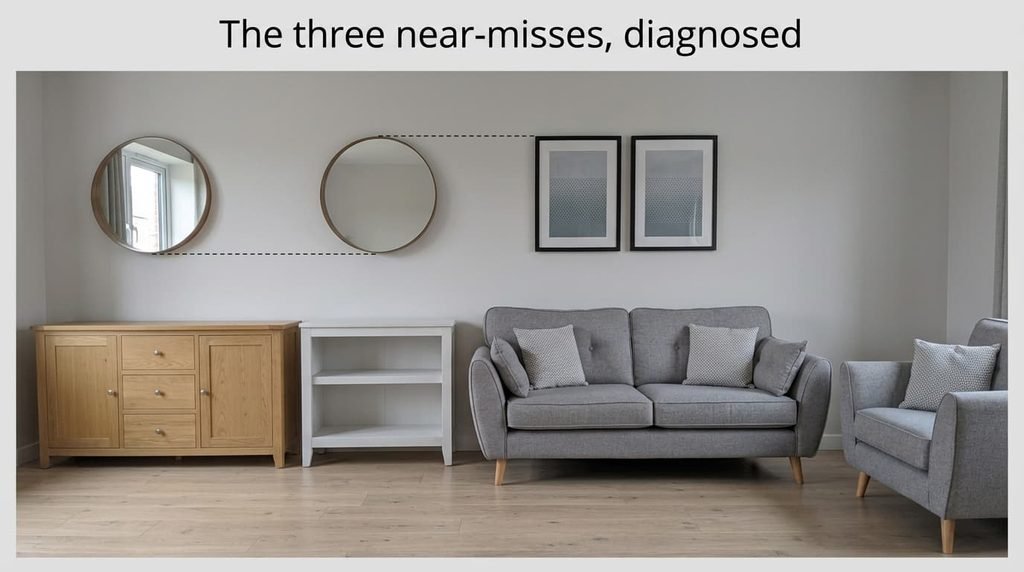
“The pictures and the mirror look slightly out of step, and we can’t say why.” The cause is height. The two pictures have their tops at 165 and 172 cm, and the mirror bottom at 120 sits 8 cm under the shelf top at 128. Mark each new position with a pencil dot and check it with the level on your phone. Hang the lower picture 7 cm higher, so both tops read 172, and lift the mirror’s hook by 8 cm so its bottom meets the shelf line at 128. The wall then holds four edges instead of six, and only the 6 cm gap between sideboard and sofa is still a slip, because both are fixed. It costs two minutes and some filler for the old holes.
“The sofa looks messy even though the cushions are tidy.” The cause is size. Five cushions sit on it. Two are 50 cm square and two are 45, with a fifth at 40. The area ratios between neighbours are 1.0, 1.23, 1.0 and 1.27, so two of four are slips. Keep the two 50s on the sofa and move the 45s to the armchair, and let the 40 go to a bedroom. Every neighbouring pair now matches, and any cushion that fits neither group goes to the spare room. It takes three minutes and nothing is bought. Expect a barer sofa, and that’s what a single clear decision costs.
“The shelves look like they came from another room.” The cause is tone. Oak flooring returns 35% of light and the TV unit 37%, a ratio of 1.06 that reads as one finish. The ash shelving returns 55%, which is 1.49 times the unit and a slip. Paint the shelving white at 85%. The ratio to the unit becomes 2.3 to 1, which reads as a choice. Two coats on 2 m² need about 0.33 L at 12 m² per litre, so a 0.5 L tin covers it. Test a 20 by 20 cm patch on the back panel and judge it after a day. Empty the shelves for a weekend while the paint dries. The ash grain disappears, and that’s the cost.
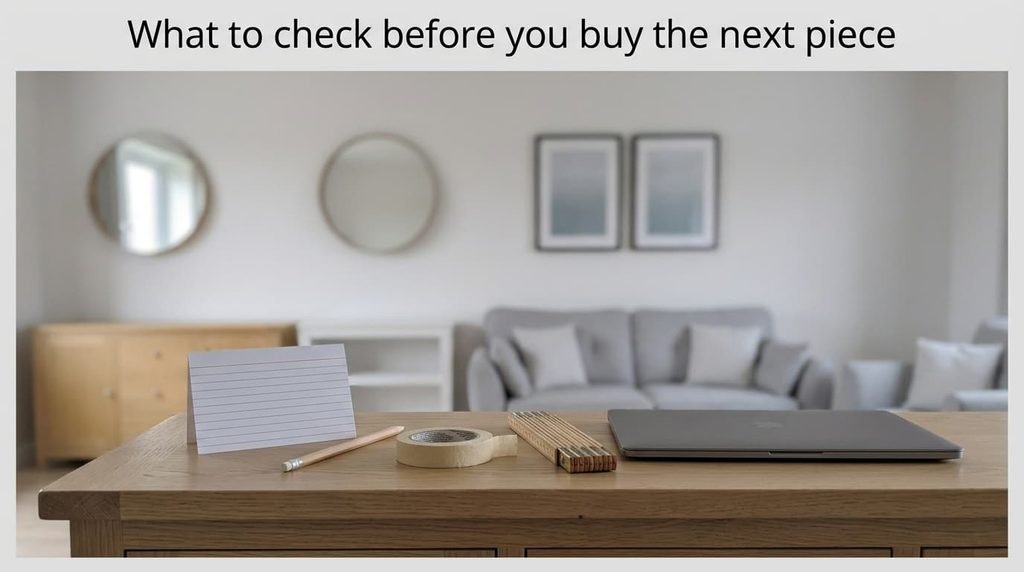
What to check before you buy the next piece
Before you buy the next piece, write down the nearest existing value and aim to match it or beat it. Match any new lamp to a line within 1 cm, or keep it 20 cm clear of every line. Cushions should equal an existing size or differ by a factor of 2. Finishes should come within 10% of a surface in the room or sit at twice the ratio. Nothing makes a living room feel unfinished faster than a purchase that nearly matches. The clear strips help too. On this wall only 97 to 105 cm and 143 to 150 cm sit more than 15 cm from every line, so a frame hung there stays clear.
Write your numbers on one card. You can’t buy a near-miss when the target sits in your pocket.
A card in a drawer beats a return trip.
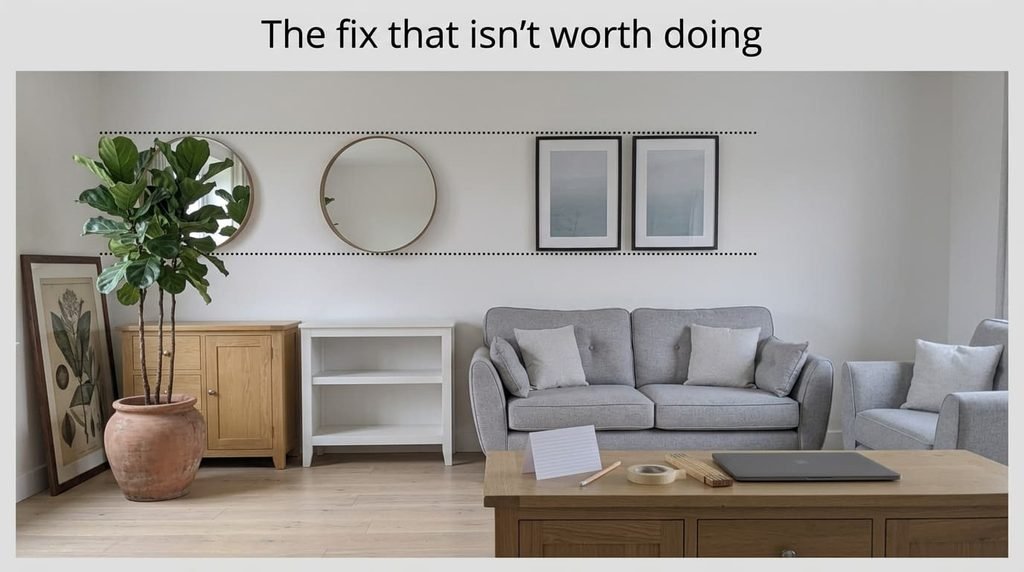
The fix that isn’t worth doing
Buying one more object to finish the room is the stock advice, and it backfires. Take the six edges on the sofa wall, from 76 cm up to 172. Within 15 cm of each, 111 cm of the 126 cm between 61 and 187 cm is covered, which is 88%. A plant or a frame therefore lands inside a slip zone nearly nine times in ten, and it brings its own edges and its own tone. Even a rug adds a slip: one at 20% beside the oak floor at 35% gives 1.75 to 1.
Another piece joins the near-misses.
You’re not short of objects, so more of them add pairs that almost agree. Fix the three pairs above first and the room will probably read as finished without the purchase.
Whatever makes a living room feel unfinished here, it is rarely a missing object. Three of five heights on the sofa wall were slips, two of four cushion pairs were slips, and one shelf finish sat at 1.49 against its neighbours. Re-hang two frames and regroup the cushions, then paint one set of shelves, and the slips fall from six to one. Keep the 6 cm between sofa and sideboard, because it is a fact of the furniture. Redo the edge pass afterwards and write the new gaps on your card. The whole job takes an evening and one tin.
Questions readers keep asking
What makes a room look unfinished when nothing is missing?
Near-misses between neighbours. Edges that differ by 2 to 15 cm, tones with a reflectance ratio of 1.1 to 1.9 and sizes with an area ratio in that range read as slips. In the example room, three of five wall gaps were slips, and each slip sits in plain view from the sofa.
Which change takes the least time?
Re-hanging a picture or a mirror by a few centimetres. It needs a tape and about two minutes, and it removed two of the three height slips in the example. Moving cushions between the sofa and the armchair takes about as long and costs nothing either.
Can I sort this out without redecorating?
Mostly, yes. Heights and sizes are rearrangements. Only the tone fault needed paint, a single tin of 0.5 L for 2 m² of shelving. If you leave the shelves alone, the other two fixes still cut the slips from six to two.