A smart thermostat starts on time, and the house simply arrives late. That’s why your smart thermostat heats the house later than the schedule says: an entry of 07:00 at 20 °C is a start time, and the climb only begins once the system has woken up. The quickest cure is to shift the entry earlier by the wait itself. The setting is a UK terraced house with the living room at 16 °C overnight and 8 °C outside. All rates and times here are rounded, so use a room thermometer and your own morning.
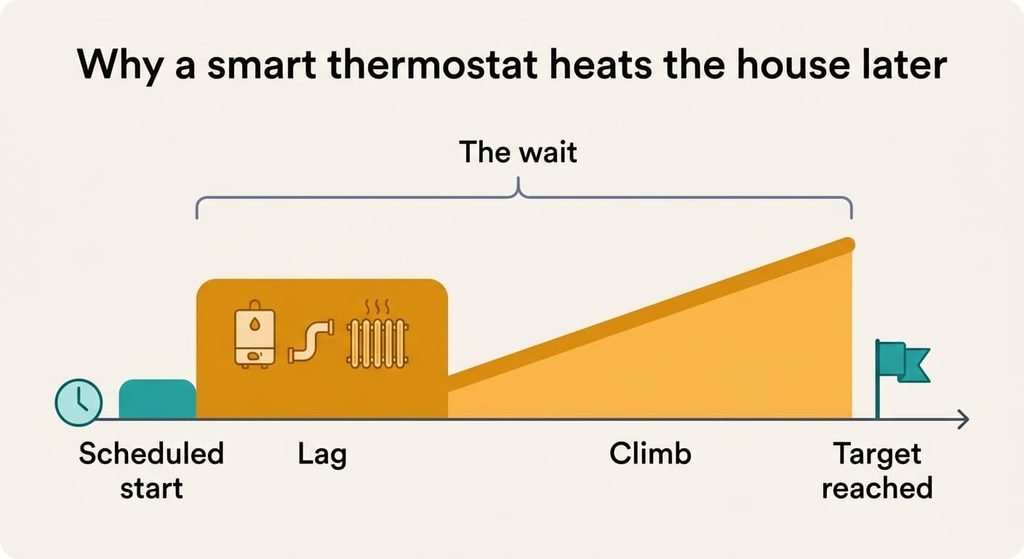
Why a smart thermostat heats the house later
A schedule entry is an instruction to begin, and the house reaches the target only after two delays have both run out. The first is lag. The boiler fires, then the water travels round the pipes, and the radiators warm last. That takes 15 minutes here. The second is the climb. The room gains heat at a steady rate, 2.4 °C per hour on an 8 °C morning, so a climb of ΔT degrees takes ΔT ÷ 2.4 hours.
Take the living room. It sits at 16 °C when the 07:00 entry for 20 °C fires. The climb is 4 degrees, and 4 ÷ 2.4 is 1.67 hours, or 100 minutes. Add 15 minutes of lag and the living room hits 20 °C after 115 minutes, at 08:55. The thermostat did exactly what you asked, and the house is nearly two hours late.
A colder morning stretches the wait. At 2 °C outside the rate falls to 1.8 °C per hour in the example. The climb then takes 133 minutes and the wait is 148, which puts the arrival at 09:28. A fixed entry can’t see the weather.
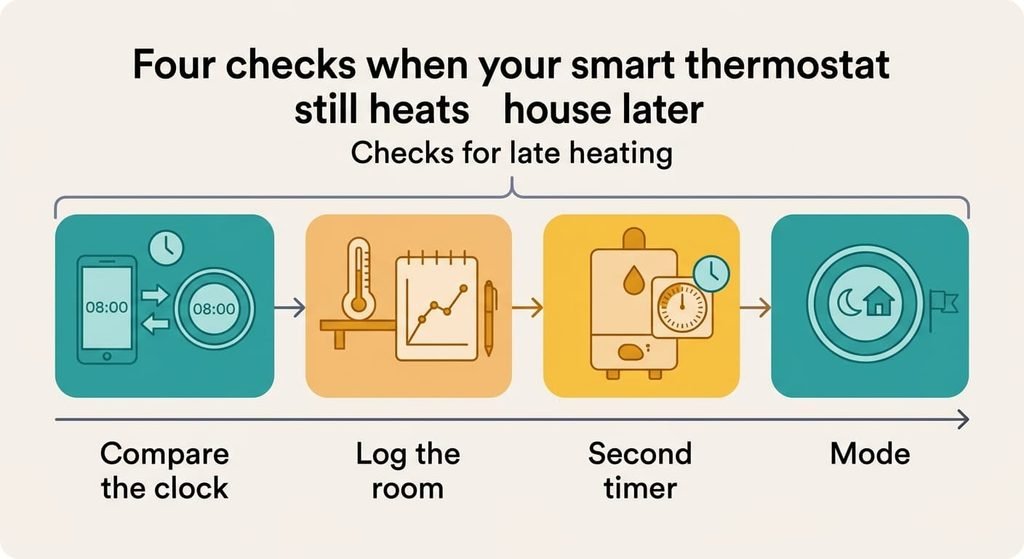
Four checks when your smart thermostat still heats the house later
Every check returns one reading you can write down. Run them on a weekday morning with a room thermometer on the living-room shelf and the app’s history open. Use one thermometer for every reading so the numbers compare fairly.
First, compare the clock. Read the time in the app, then compare it with your phone. A clock an hour out, which can happen after the autumn change, starts everything an hour late.
Second, log the room. Note the temperature at the scheduled start, then again every 30 minutes until it reaches the target. The first half hour usually shows no gain, which is the lag. After that the readings give you the rate in degrees per hour.
Third, look for a second timer. Check the boiler’s own programmer for a switch-on time, because a second timer is common in homes where an old programmer stayed in place when the smart thermostat arrived. If it says 08:00, a thermostat start at 05:05 is ignored until then.
Last, read the thermostat’s mode. A mode called away or eco may hold the room at a lower target until you arrive.
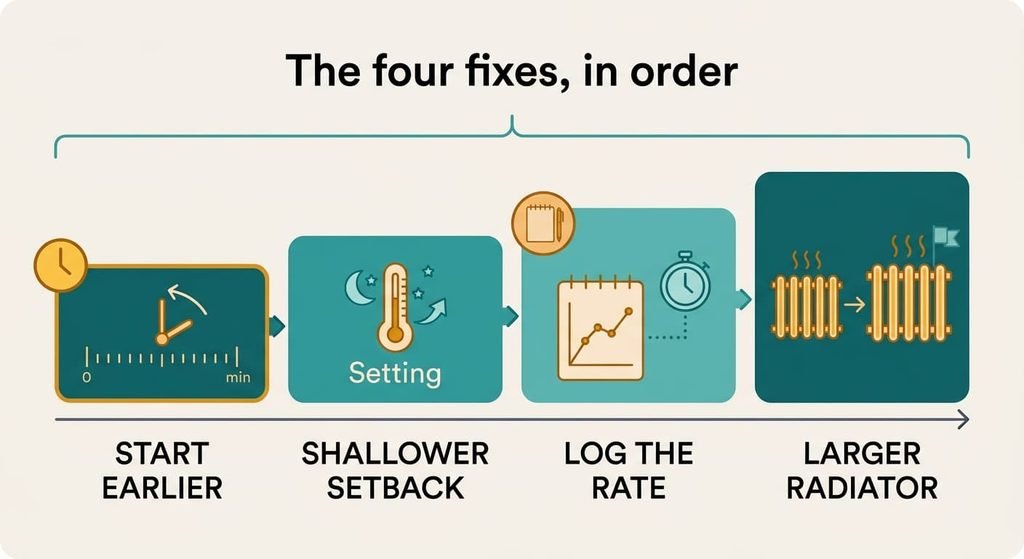
The four fixes, in order
When a smart thermostat heats the house later than planned, make one change. Then watch the next three mornings before you make another. Write down the arrival time each day so the effect shows up in your own figures.
Moving the schedule entry earlier by the whole wait costs nothing. In the example the wait is 115 minutes, so an entry that should reach 20 °C at 07:00 starts at 05:05. The loss is accuracy. A 2 °C morning needs 148 minutes, so one fixed start arrives late in a cold snap and early on a mild day, and you’ll want to re-time it as the weather turns. Keep your wanted arrival time in your notes, so you can always see how far the start has moved.
Raising the overnight setback from 16 to 17 °C is a setting. The climb shrinks to 3 degrees, which is 3 ÷ 2.4 = 1.25 hours, or 75 minutes. With the 15 minutes of lag the wait falls to 90, a gain of 25 minutes. The price is paid every night. Heat loss grows with the gap to the outside, and (17 − 8) ÷ (16 − 8) = 9 ÷ 8, so the house loses 12.5% more overnight. Check the meter reading after a fortnight, and return to 16 °C if the extra heat costs more than the minutes are worth.
Logging the rate for three mornings takes about ten minutes each. Read the room every 30 minutes and work out your own degrees per hour, so you use a measured figure and not my 2.4. Many thermostats can learn the lag themselves after a few days. Switch that on, then compare its start time with your log. The flat stretch at the start of the log is the lag, and the rise after it, divided by the hours that follow, is the rate. The catch is that a log holds only for the weather you logged, and a cold snap needs a fresh one.
Fitting a larger radiator in the living room is the purchase. Say 25% more output lifts the rate to 3.0 °C per hour. The climb becomes 4 ÷ 3.0 = 80 minutes, and with the lag the wait is 95 instead of 115. That’s 20 minutes for a plumber’s visit and a radiator that is 25% wider, so 100 cm of wall becomes 125 cm. It’s the smallest gain for the most money, so it comes last.
If none of that worked
If your smart thermostat heats the house later than the schedule says even after the four fixes, the cause sits outside the entry itself. Write down the clock reading, the boiler programmer’s switch-on time and the thermostat’s mode for one week, plus the room temperature at 07:00 each day. A mismatch between the app’s history and the room points to a sensor in the wrong place. Look at the heating history in the app for the morning in question. If it shows the heating switching on at 05:05 while the room stays flat for an hour, the lag is longer than 15 minutes, and the boiler’s flow settings are the next place to look. Resetting the thermostat to factory settings erases the schedule and the link to your home network, so write the settings down first.
Photograph the schedule screen before you reset anything.
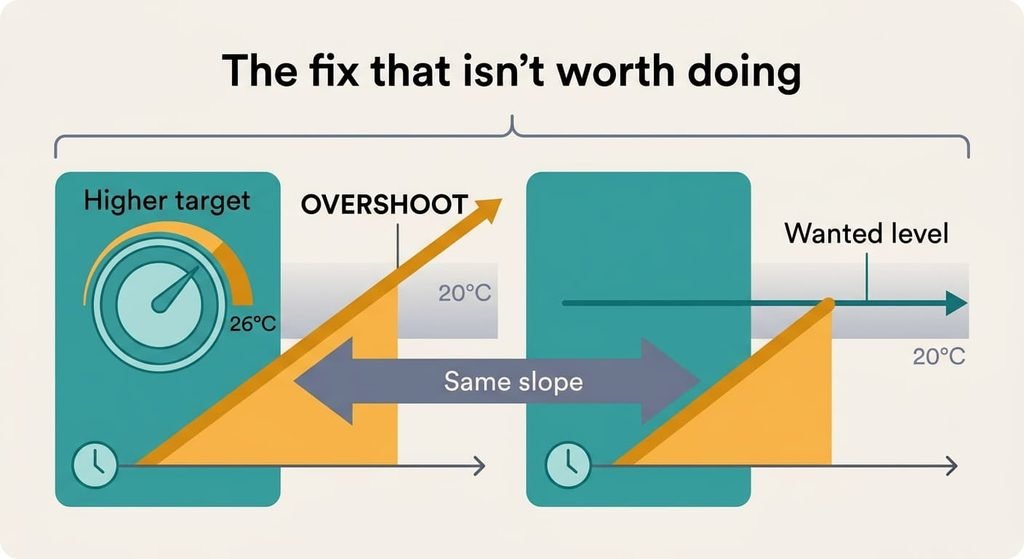
The fix that isn’t worth doing
Raising the target to 24 °C so the house heats faster is the common instinct, because a higher number feels like a harder push. The boiler runs at the same output either way, so the rate stays at 2.4 °C per hour. The room still passes 20 °C at 08:55 and keeps climbing. A smart thermostat heats the house later than you’d like whichever target you set, because the rate stays put. It reaches 24 °C after 8 ÷ 2.4 = 3.33 hours plus the 15 minutes of lag, which is 10:35. Heat loss grows with the gap outside, and (24 − 8) ÷ (20 − 8) = 16 ÷ 12, so you pay 33% more to hold the room four degrees above what you wanted. Those extra four degrees also arrive late, so the morning gains no comfort for the extra cost.
The target decides where heating stops, and the boiler alone decides how fast it climbs.
When your smart thermostat heats the house later than the schedule says, the entry is working as a start time. Measure the wait once, move the entry by that amount, and check again when the weather turns. Raise the setback only if the saving matters more than the extra heat overnight, and leave the radiator for last. Log one cold morning each month to keep the numbers honest.
Questions readers keep asking
Does a smart thermostat learn the lag by itself?
Many models adjust their start time after several days of readings. Switch that mode on, then compare its start time with your own log. A learned start follows the average morning, so a cold snap can still arrive late, and a manual earlier entry is the safer backstop until the log agrees.
Why is the house on time in the afternoon but late in the morning?
The climb is shorter. In the afternoon the room sits near 19 °C, so one degree takes 25 minutes at 2.4 °C per hour, plus 15 of lag. In the morning it starts at 16 °C and needs four degrees. The longer the gap to the target, the later the arrival.
Is a bigger radiator the only way to heat faster?
It’s the only fix here that raises the rate. The other three change the starting point or the start time. In the example, an earlier entry gives the same 07:00 arrival for no money, and a smaller setback gives a 25-minute gain, so test those two before you pay for new plumbing.