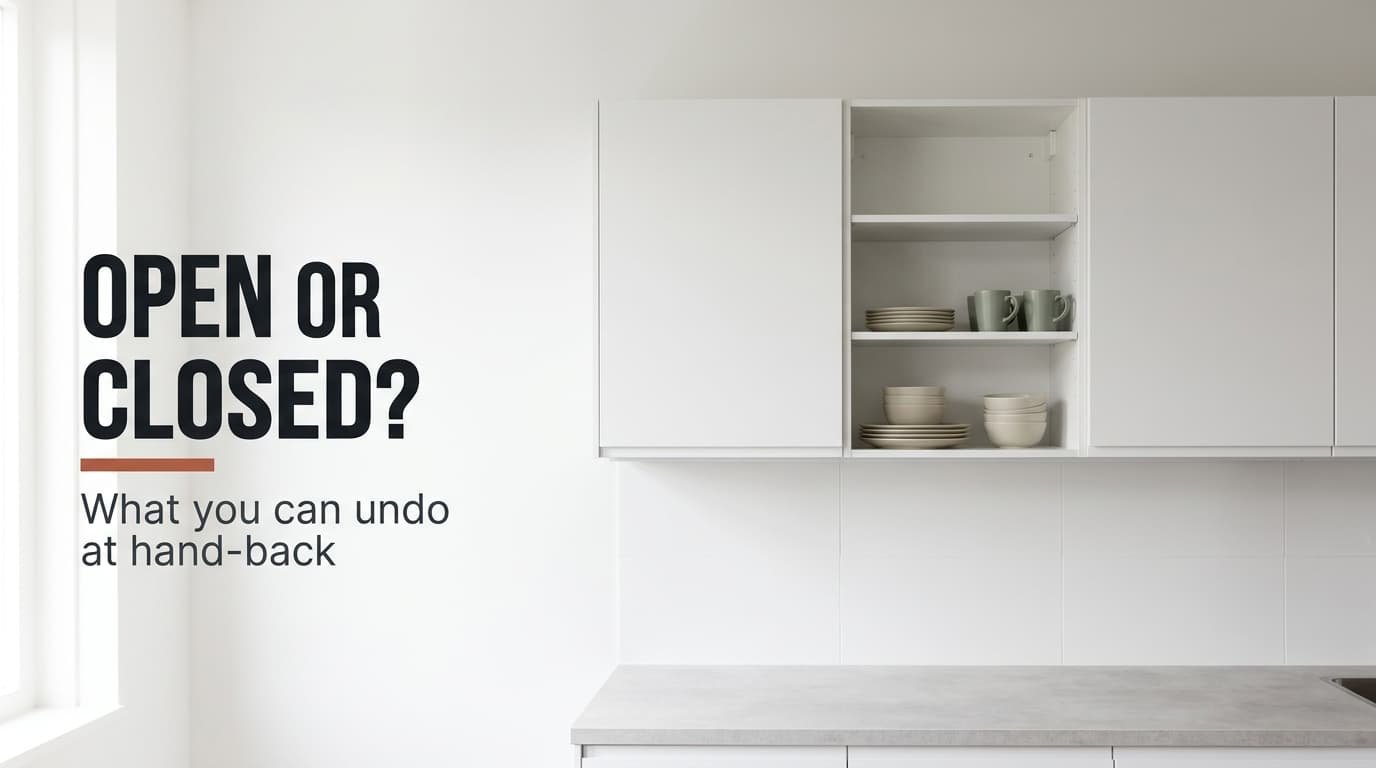
“I like the open look, but I’ll lose my deposit.” That worry sits behind most questions about open shelving or closed cabinets in a rented flat, and the answer depends on what you can undo by hand-back day. Count holes and minutes before you count taste. Our case is a Dutch rented kitchen with three wall cabinets above a 180 cm worktop. Each cabinet measures 60 × 70 cm at the front and 32 cm deep, with two doors. This is a question about your contract before it’s a question about style. Use your own cabinets as you read. The sum needs only a tape measure.
What decides open shelving or closed cabinets in a rented kitchen
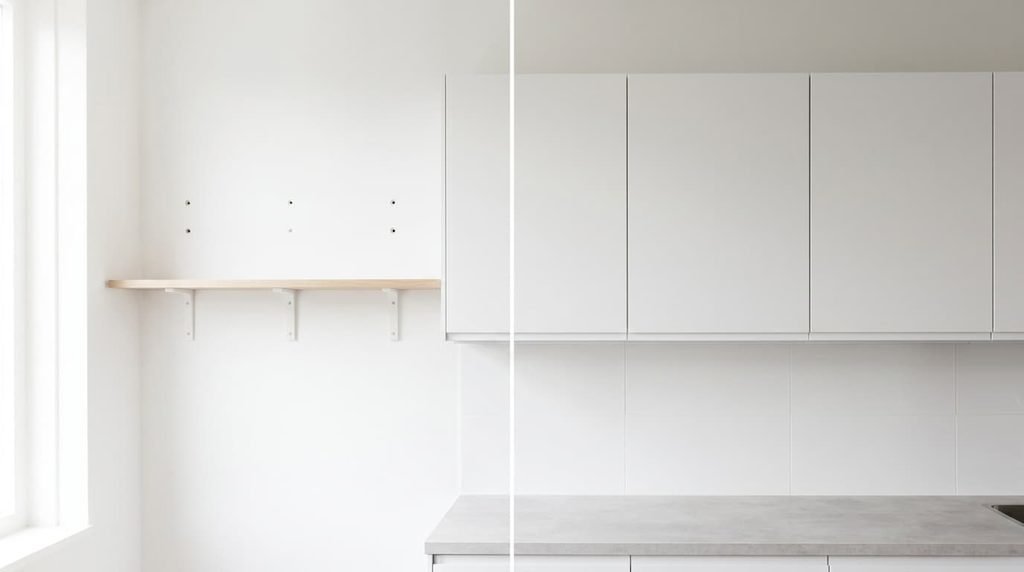
A rented kitchen is judged on the day you give back the keys, so the choice that matters is the one you can take back. A new shelf run of 180 cm needs three brackets and six holes. Assume ten minutes to fill and sand each hole, then touch it up, which makes 60 minutes of work. On a tiled splashback every hole is a damaged tile, and no tube of filler repairs that. The same sum holds for a shorter shelf. Two brackets still mean four holes and 40 minutes, so a smaller shelf cuts the bill by a third and no further. Closed cabinets left as they are cost 0 holes and 0 minutes.
Storage is the second ledger. Each cabinet holds 0.6 × 0.7 × 0.32 = 0.134 m³, so the three hold 403 litres. A shelf 180 cm long and 28 cm deep, with 35 cm of clear height above it, holds 1.8 × 0.28 × 0.35 = 0.176 m³, or 176 litres. That’s 44% of the cabinets’ volume.
Open shelving buys you the look and takes back 56% of your storage.
The lease decides the first ledger and your crockery decides the second. Read both before you choose a style.
Closed cabinets or open shelving: the hand-back ledger
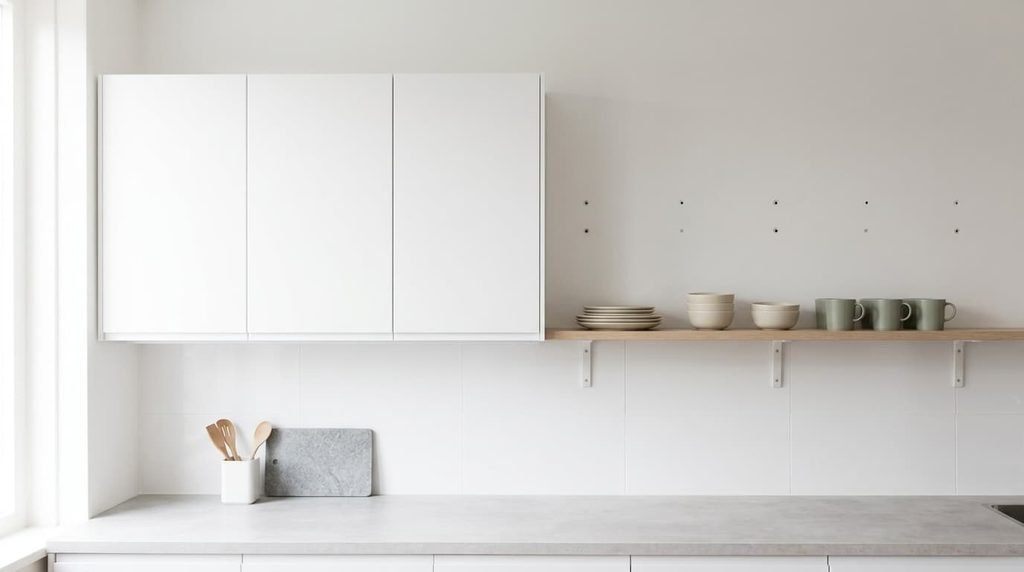
A fair comparison needs the same wall and the same kitchen on both sides. The table therefore fixes the three cabinets and the 180 cm shelf, along with the ten-minute hole repair. Hand-back minutes assume you do the repair yourself with filler and a sanding block, and every figure is an assumption you can replace. Change any of them and the first three rows move together.
| Question | New open shelf | Closed cabinets |
|---|---|---|
| Holes in the wall | 6 | 0 |
| Minutes to restore at hand-back | 60 | 0 |
| Storage volume | 176 litres | 403 litres |
| What the wall shows | One line of 180 cm | Three white boxes of 60 cm |
| Where everyday plates sit | In view on one shelf | Behind six doors |
| Time to fetch a plate | 0 seconds | About 2 seconds a door, 40 seconds a day at 20 fetches |
| Landlord’s consent | In writing, before you drill | Not needed |
Rows one to three hold numbers, and rows four to seven hold taste and habit. Settle the numbers first, because a lease that bans holes ends the shelf before the look comes up, and storage that shrinks by 56% ends it for any household that cooks.
Where open shelving wins
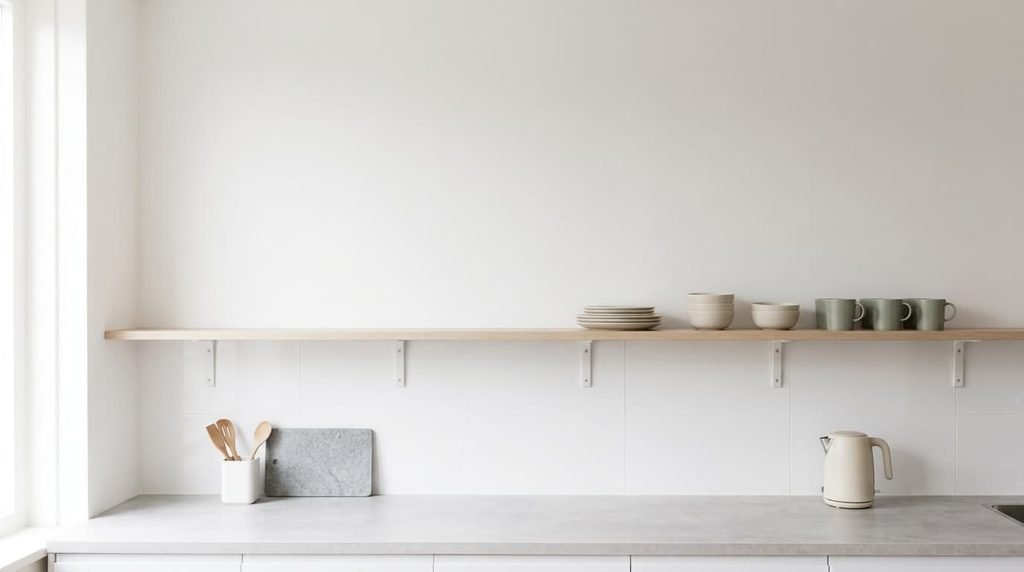
Open shelving wins when the kitchen has no wall cabinets, or when the lease lets you fix to the wall in writing. With no cabinets there’s no storage to lose, and 176 litres beats nothing. Put the bracket at each end and one at the middle, so the 180 cm board keeps a straight line. Fix the shelf so its underside sits 45 cm above the worktop, which clears a kettle. Choose a matt finish close to the wall colour, so the shelf blends in.
Depth counts for more than length. A dinner plate is 26 cm across, so a 28 cm shelf holds it with a 2 cm margin. A 20 cm shelf would let each rim hang over the edge.
Show only what you use daily. Twelve items on a shelf, in one colour family, read as a pattern. Forty items read as a shop display, and the shelf starts to look crowded the day you move in.
Ask whether the wall is masonry or plasterboard before you buy plugs.
Where closed cabinets win
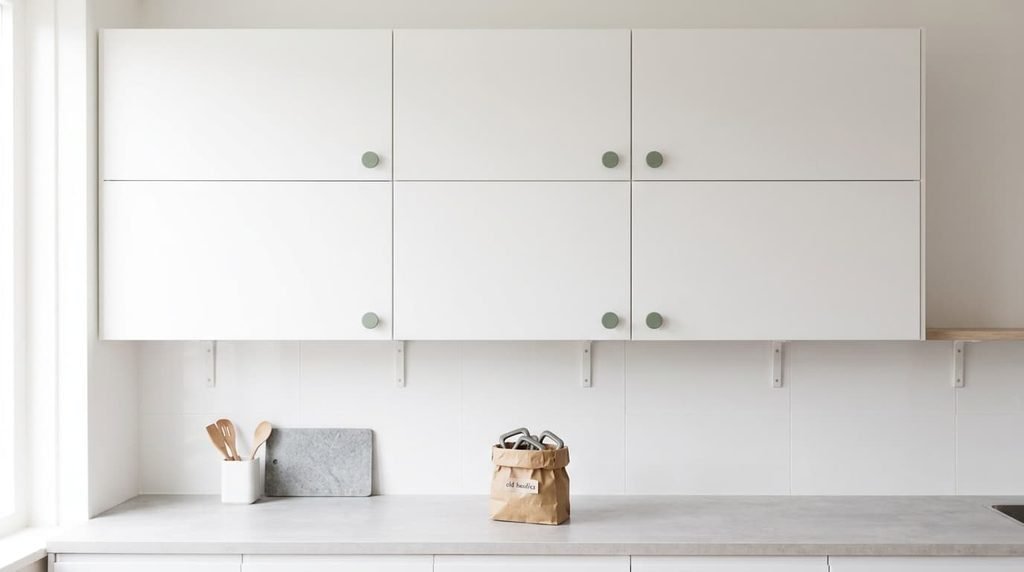
Between open shelving or closed cabinets, the doors win whenever wall cabinets already exist and the lease is silent or says no. They cost 0 holes and 0 minutes, and they keep all 403 litres. Six doors hide an odd collection of mugs and jars without any effort from you, so the kitchen passes an inspection the way you left it.
You can still change the look. Swap the six handles for matt sage-green ones that use the existing holes, and keep the old ones in a bag for hand-back. That adds 0 new holes and about 12 minutes of work. The kitchen then reads as chosen, not inherited.
The cost is that nothing is on show. Everyday plates sit behind six doors, so each fetch means opening one first. At 20 fetches a day and 2 seconds a door, that’s 40 seconds a day, or 20 minutes a month. It’s the price of a tidy wall. A door is also the cheapest way to hide a mismatched set of mugs, and swapping the handles on a quiet weekend takes an afternoon at most.
When neither is right
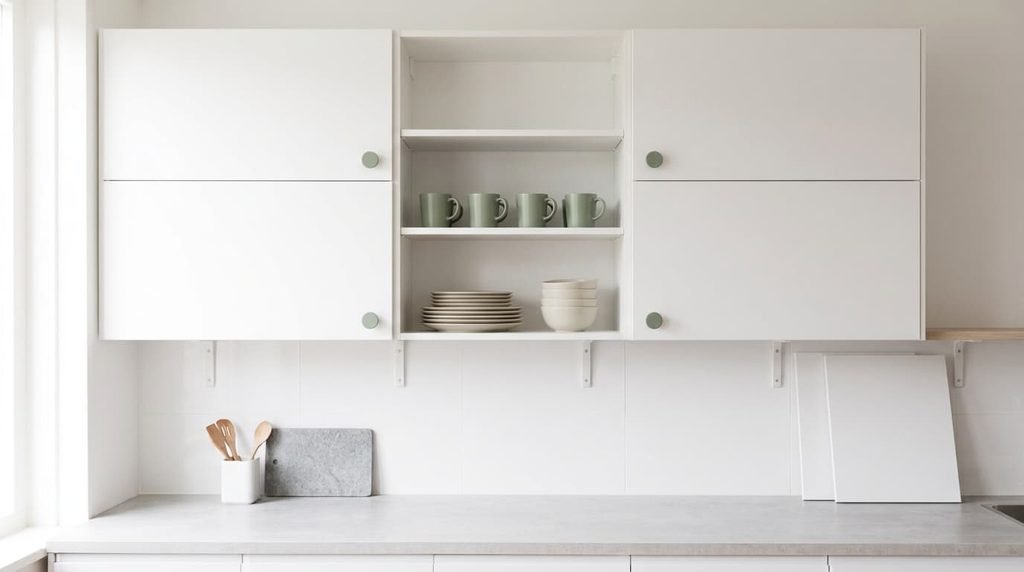
One bay with its doors off is the compromise. Choose it when open shelving or closed cabinets each fall short of what the lease and your crockery allow. Take the two doors off the middle cabinet and leave the other four. If the hinges clip off, that’s 2 minutes to remove and 6 to refit, a total of 8. The two doors stack 3.6 cm high and slide behind a wardrobe.
The open bay shows 60 × 70 = 4,200 cm² of interior, a third of the 12,600 cm² the three fronts present. Put a dinner-plate stack 26 cm wide and a bowl stack 16 cm wide on the lower shelf, which uses 42 of the 60 cm. Four mugs at 8.5 cm fill 34 cm of the upper shelf.
Check the interior before you commit. A chipped back panel or a row of old screw holes will show, and you can’t paint a rented cabinet.
How to decide in thirty seconds
Read the lease for the words “fixings” or “drilling”, then count your wall cabinets. When it says nothing, ask in writing. Keep the reply, because a one-line email is all the proof you’ll need at hand-back. If the lease allows fixings in writing and no cabinets exist, take the new open shelf, 28 cm deep. If cabinets exist, take closed cabinets, and open one bay if you want the look. To settle open shelving or closed cabinets in one line, compare hand-back minutes: 60 for a new shelf, 8 for one open bay and 0 for closed doors. Write the three numbers on the lease.
In the example the new shelf cost six holes and 60 minutes, and it took 56% of the storage. The open bay cost 8 minutes and two doors in a stack 3.6 cm high. Your cabinets and your lease will change both figures. Measure before you order any bracket, and write your own three hand-back numbers beside these. The shelf you can restore in an hour is a different purchase from the one you can’t.
Questions readers keep asking
Can I take cabinet doors off in a rented kitchen?
Usually, if you keep the doors and refit them before you leave. Check the contract for fittings and ask in writing. Clip hinges release in seconds, and a stack of six doors is 10.8 cm high, so it slides under a bed or behind a wardrobe.
How deep should a new open shelf be?
At least 28 cm, for 26 cm dinner plates with a 2 cm margin. For a 180 cm run with 35 cm of clear height, that gives 0.176 m³, or 176 litres, which is about 44% of what three cabinets of the example hold.
Which suits a tiled splashback better?
Closed cabinets, or one bay with its doors off, because both need 0 holes. A new shelf means drilling into the tiles, and a drilled tile can’t be repaired invisibly. If you still want the shelf, ask the landlord first. Then aim for the joints between tiles.