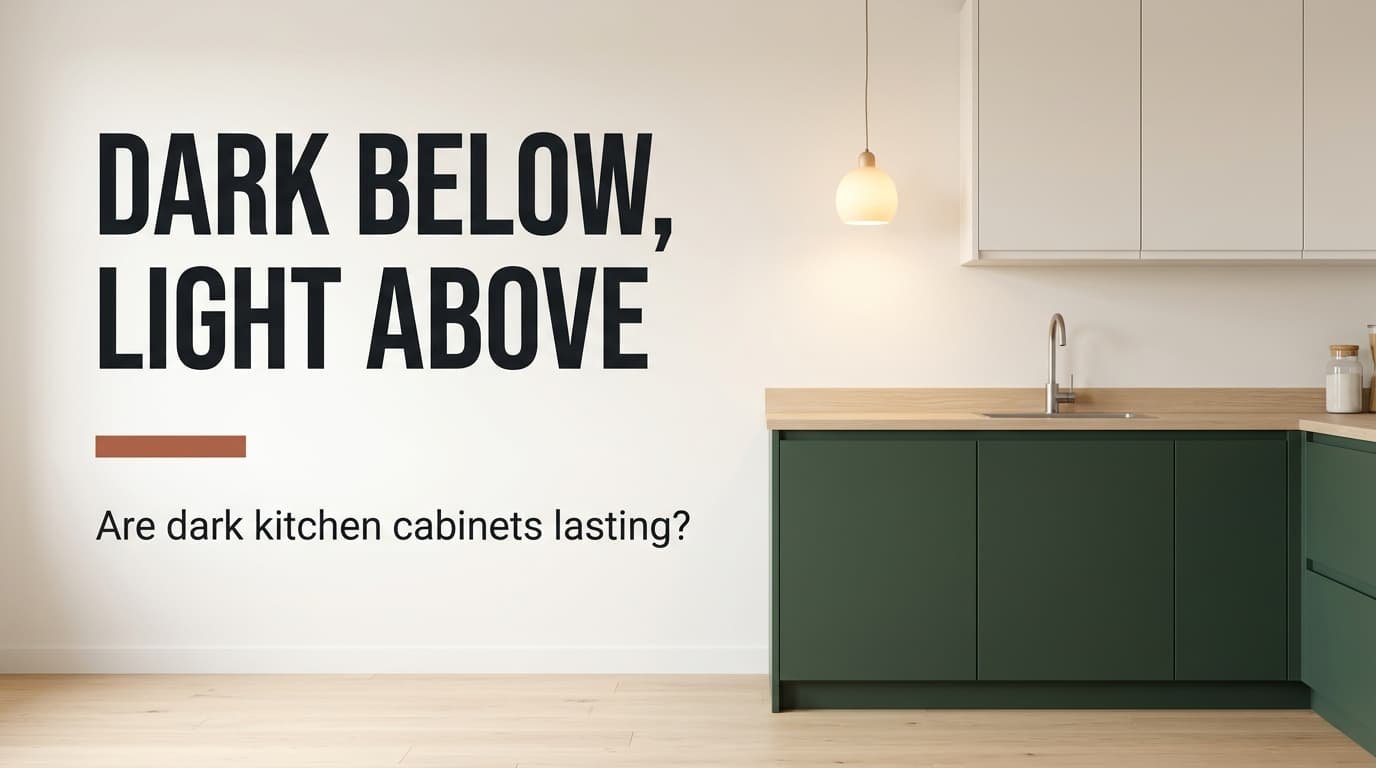
Are dark kitchen cabinets here to stay? The colour family looks settled, so a dark run of base units is a safe first change to make. Dark on every front will date. It removes about 33% of the room’s bounced light and then asks your lamps to make it up.
The numbers come from one Dutch kitchen of 3.0 by 4.0 m with a 2.5 m ceiling. It has 15 m² of cabinet fronts and a window of 1.2 m². No brand or showroom is named and no price appears. The change can be followed without them.
Where the dark kitchen came from
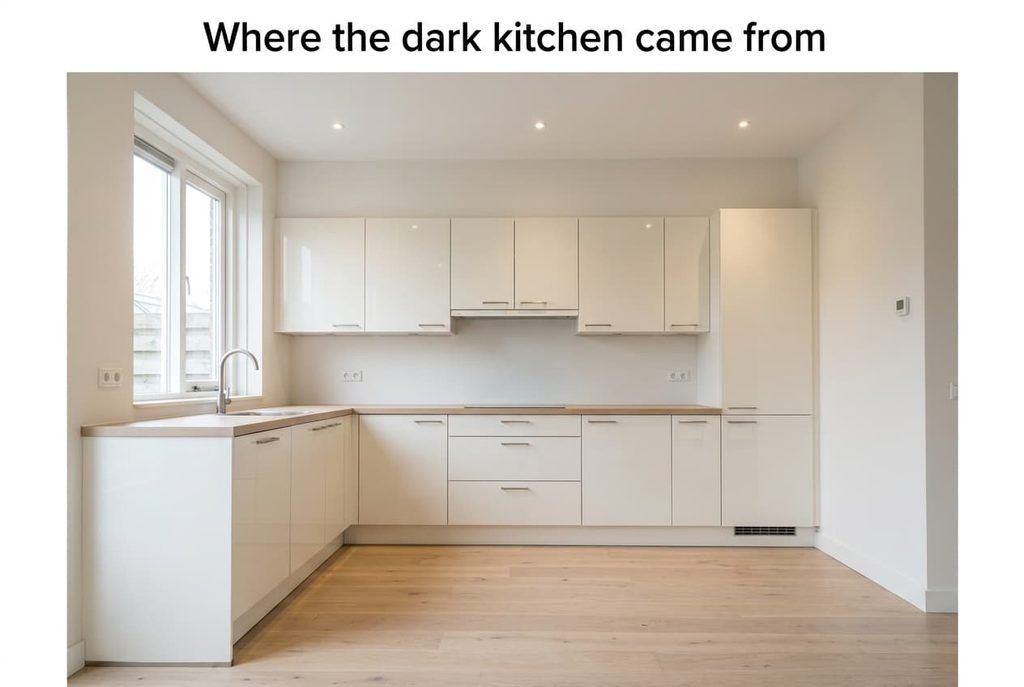
Through the 2000s and into the early 2010s, the standard kitchen front was white or cream, often with a gloss finish. Light fronts were the safe answer for a room that needed every lumen. Halogen lamps gave little light for the power they drew.
Two conditions moved. LED lamps gave far more light per watt, so a kitchen could carry a bigger lighting budget without a bigger bill. Open-plan living also pulled the kitchen into the sitting area, where a deep colour behaves like furniture and no longer reads as a work surface. In a Dutch winter the sun sets near 16:30, so a kitchen spends most of its cooking hours under lamps.
Matt paints followed. A matt finish hides fingerprints better than gloss does, which removed an old objection to dark fronts. Cabinet paints that cure hard enough for daily wiping widened the choice of dark colours further. The conditions explain the present, so no date is needed.
What actually changed, and are dark kitchen cabinets here to stay
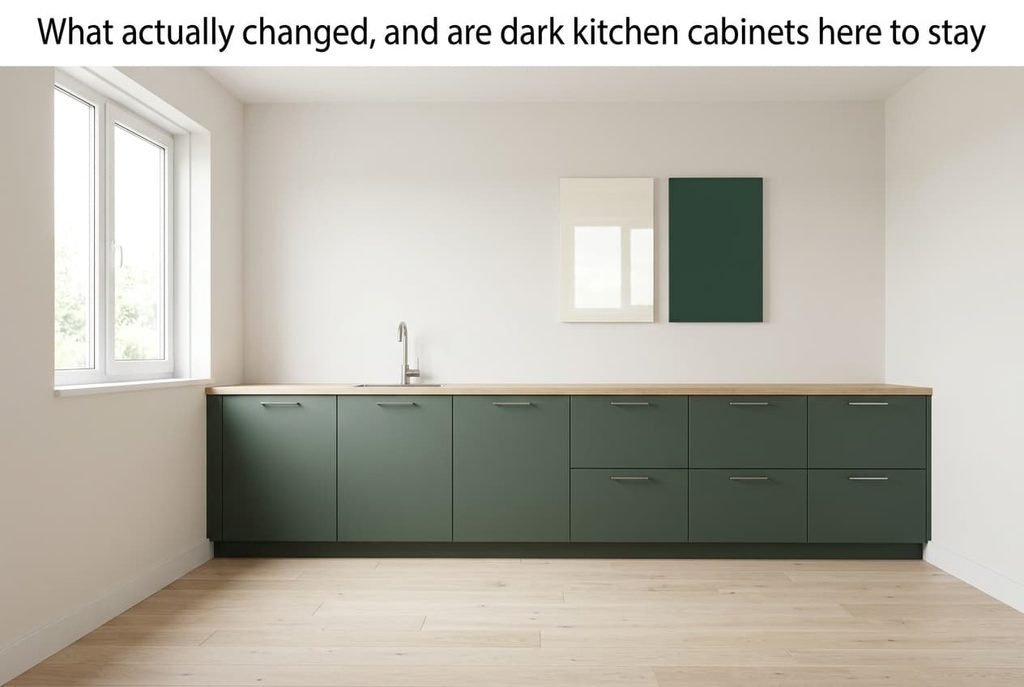
Three numbers moved. The first is reflectance, which fell from about 75% to about 8%. A front that returned three quarters of the light now returns less than a tenth. The second is sheen. A gloss finish measures around 80 gloss units at a 60° angle, and a matt one measures under 10. The third is area. The 15 m² of fronts is a quarter of the room’s 59 m² of surface, and that quarter went from one of the lightest tones to one of the darkest.
Reflectance drives the room’s light. Treat the kitchen as a box with a floor at 30%, a ceiling at 80% and 20 m² of painted wall at 70%. With white fronts the average reflectance of all 59 m² is 0.65, which multiplies the direct light 2.87 times through bounce. With dark fronts it falls to 0.48 and the multiplier to 1.93. That’s 33% less light on the room’s surfaces from the same lamps.
On a 300 lux room average, dark fronts leave 201. Restoring 300 takes about 49% more lamp output. Direct light from a lamp straight over the worktop doesn’t change, so the drop at the worktop is smaller than the room average. The model also ignores the window and the furniture.
Marks change too. A white front hides a film of dust. A dark one shows it as a grey bloom, and a rubbed patch on matt dark paint turns shiny.
Who it suits, and who it doesn’t
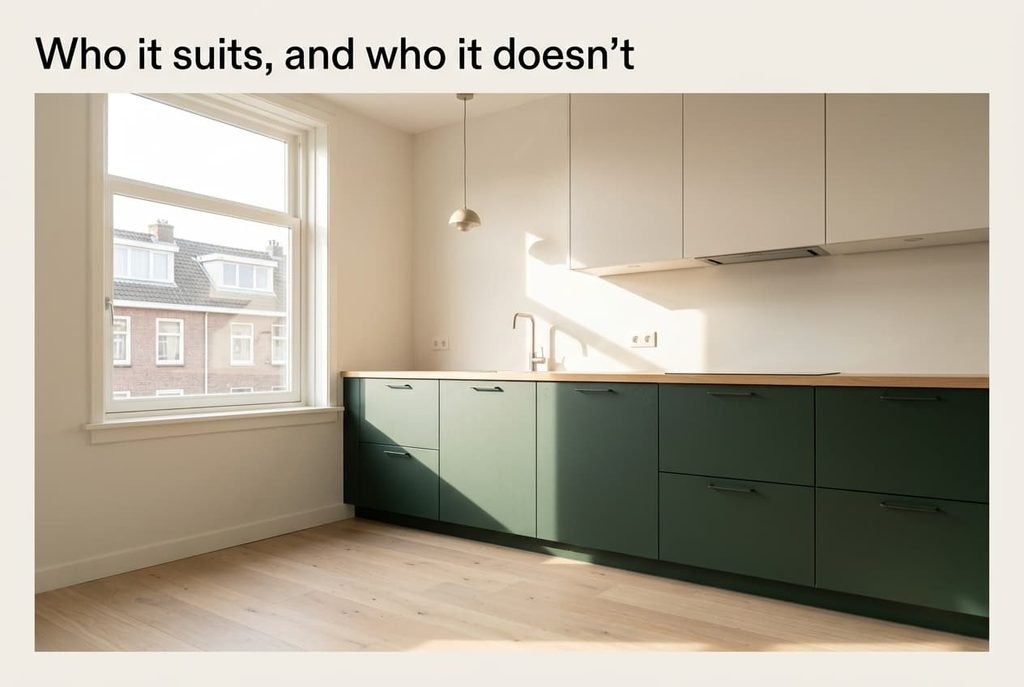
Dark fronts suit a kitchen with a window of roughly 10% of the floor area, which is 1.2 m² here. A south or west aspect helps. Afternoon light carries the colour, and the lamps come on late. A cook who works after dark under good lamps will cope too. A smear of grease turning into a shiny patch shouldn’t bother them.
They fit badly in a narrow galley with a small window. A window of 0.6 m², half the guideline, leaves less daylight to offset the loss. A north-facing kitchen compounds it, since its light is flat and cool. Households with young children will see every handprint on a dark matt front. Light pet hair shows on dark base units.
How the room is lit matters as much. A kitchen with spotlights over the worktop loses little, because direct light doesn’t depend on the fronts. One lit by a single pendant loses the most, since bounced light does most of its work. The verdict on dark kitchen cabinets here to stay holds only for a room with enough daylight and a lamp plan.
If you can’t picture your kitchen at 7 pm in January, you can’t judge the colour yet.
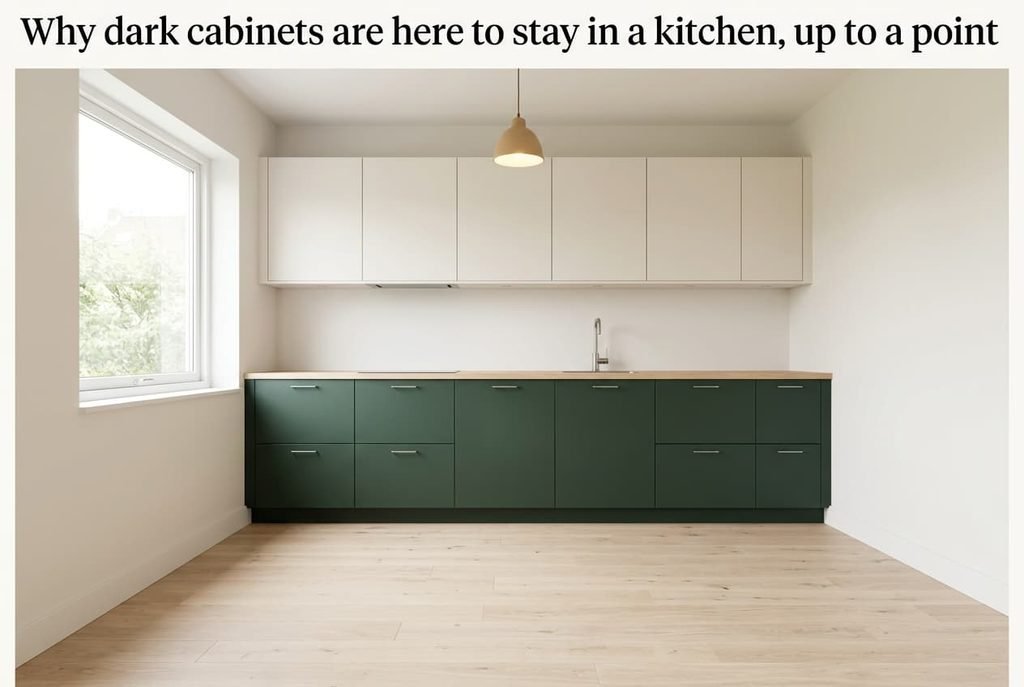
Why dark cabinets are here to stay in a kitchen, up to a point
Weigh it by the work involved. Painting existing doors costs a weekend and a tin, and the old colour comes back with another weekend. New fronts cost far more and can’t be undone. Ask what reversing it would cost before your next move.
I’d defend dark base units with pale wall units and a light worktop as the lasting version. The usual rule says a kitchen should be one colour throughout. Dark bases alone cover 4 m² and keep the average reflectance at 0.61, a multiplier of 2.54. That’s only 12% less light than all-white, and the room still gets its depth. Dating comes from commitments that resist reversal: a finish bound to one era, or one dark tone across the fronts and the worktop. Check the paint’s cure time before you start, since a coat that feels dry can take weeks to harden fully.
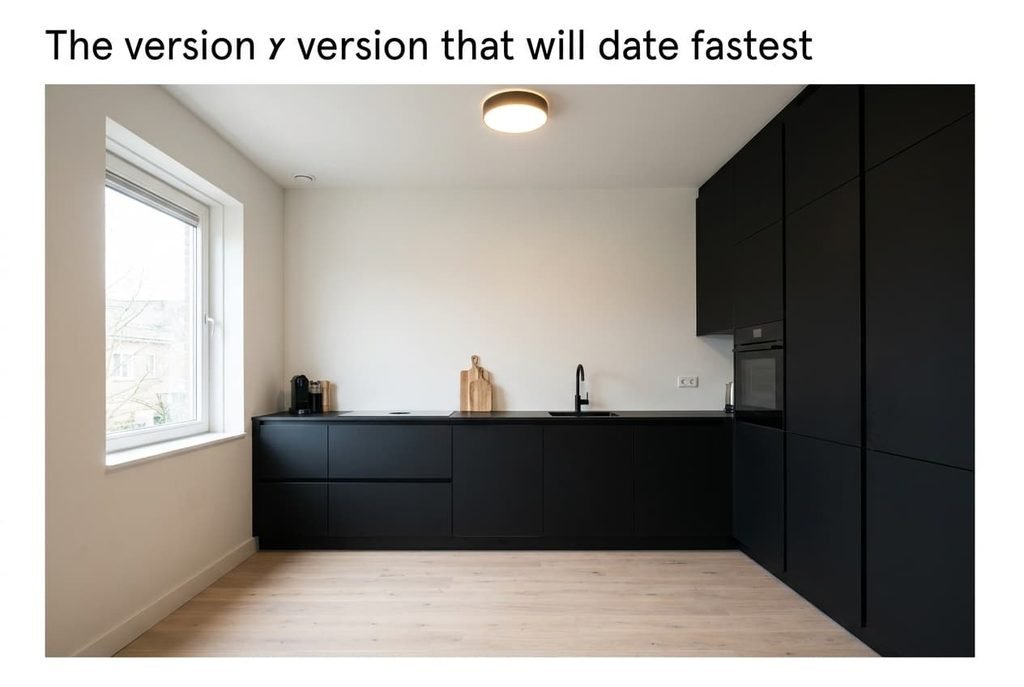
The version that will date fastest
The extreme end is matt black on every front plus a black worktop and tap. It adds almost no drama over a deep green, since going from 8% to 5% reflectance moves the multiplier from 1.93 to only 1.90. It adds a great deal of cost.
Every mark shows. Limescale reads white on a black tap, and crumbs read pale on a black worktop. That’s why the moderate version pairs dark fronts with a pale top. The room needs 49% more lamp output just to reach a normal level. A look built from one tone is tied to whichever period liked that tone. Dark kitchen cabinets here to stay does not mean every shade of dark.
The moderate version keeps the dark colour low, on units at 90 cm or under. The pale uppers carry the light back across the room, and you can change them later without redoing the kitchen.
How to try it without committing
Paint one test board of 30 by 42 cm in the dark colour and tape it to a door. Judge it for a fortnight, at dusk and under the lamps. Hold it against your worktop too, since colour reads differently beside a worktop than on a bare door. Then repaint a single door or the island and live with it before touching the rest. Swap the handles last, since a dark front with a pale handle changes the look for the price of a screwdriver.
If the board looks black in the evening, choose a shade with more colour in it.
The colour family is settled, and the light bill decides where it goes. On base units, dark costs only 12% of the room’s light. Dark kitchen cabinets here to stay is a fair verdict for that version. On every front the room loses a third of its light and the look ties itself to one period. Test a board for a fortnight, then paint one door before you commit.
Questions readers keep asking
Should I keep my white kitchen or change it?
Keep it if it’s sound and bright. A white kitchen holds its value because it returns 75% of the light. If you want depth, paint the base units only and leave the uppers white. That costs a weekend and undoes easily. It keeps the room’s light at about 88% of the all-white level.
Who do dark kitchen cabinets suit best?
Cooks with a decent window and good lamps. A south or west aspect helps. A window near 10% of the floor area keeps the daytime fine. Small galleys and north-facing rooms lose the most. They have the least light to spare for a surface that returns under a tenth of it.
How long will dark cabinets stay in style?
The colour family looks settled, so a dark base run is unlikely to look wrong soon. The version most likely to date is the all-black one with matching worktop and tap. Choose the moderate version, and you can repaint the doors without redoing the kitchen.