Dinner ended two hours ago and the sofa still smells of fried onions. That’s a ventilation sum and not a cleaning failure, and you can change the sum. Cooking smells linger long after dinner since the air in a space open to the kitchen is replaced only once every two hours, while fat droplets settle into soft furnishings and leak back out. Four fixes below are ordered from free to professional, each with the mechanism it uses and what it can’t do. The sample flat sits in the Netherlands, holds 70 m³ of shared air and runs on assumed figures throughout. None of the numbers are measurements.
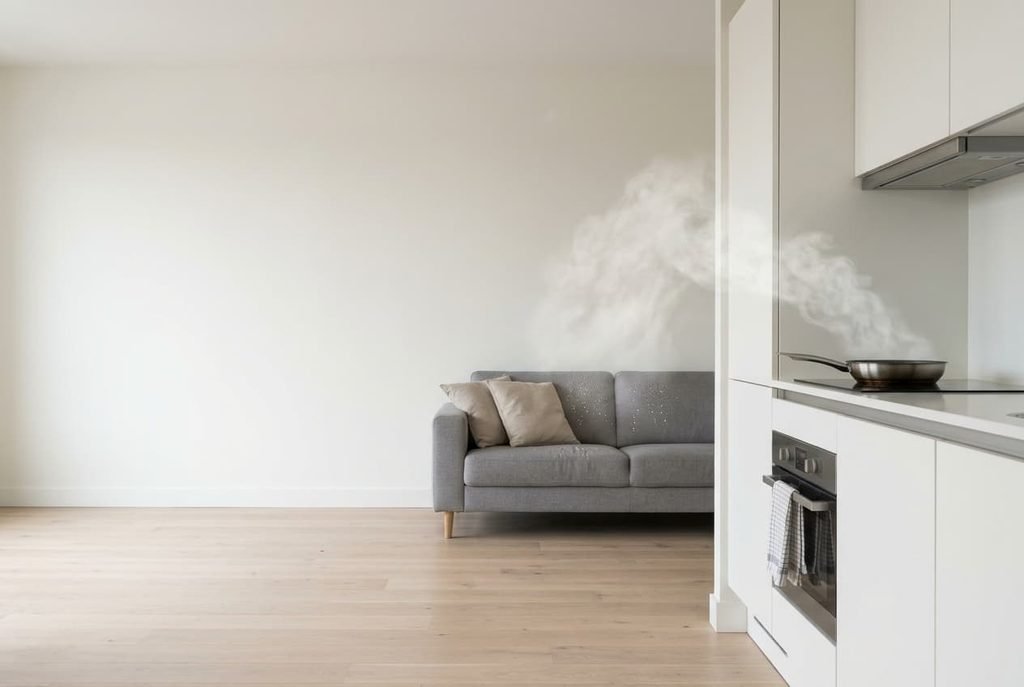
Why cooking smells linger long after dinner: the mechanism
Two things carry a smell. Vapour mixes into the air, and fat droplets from the pan settle on every surface. The vapour leaves when the air is replaced, and the droplets leave far more slowly. That difference in speed explains why a room can seem fine at ten o’clock and sour again at breakfast.
Treat the vapour first. A living room of 360 × 500 cm under 250 cm of headroom holds 45 m³, and the open kitchen adds about 25 m³, so the shared air is 70 m³. With a closed window and no fan, assume the room changes its air 0.5 times an hour. Smell fades as exp(−0.5 × hours), and it stays noticeable until about 10% of the peak remains. That takes ln(10) ÷ 0.5, which is 4.6 hours.
The settled droplets act as a second source that refills the air for a full day or longer, because fabric holds grease and releases it slowly over a full day. Assume soft furnishings hold 20% of the cooking load. That share keeps the room smelling after the air itself has cleared. A closed window overnight worsens things, as the released grease has nowhere to go.
Two sources mean two separate clocks.
Which kind of cooking smells linger long after the dinner
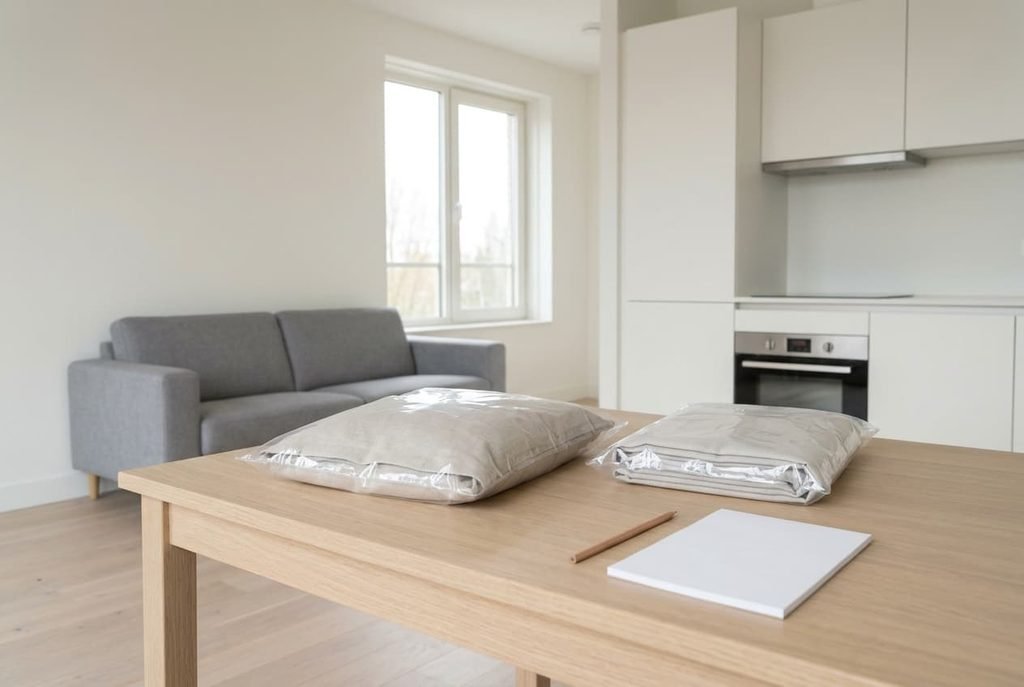
Confirm the version you have before you fix anything. Take a clear plastic bag and seal a cushion cover or a curtain hem in it for one hour in a closed room. Unseal it and sniff, then score it from 0 for nothing to 3 for strong.
If the air smells strong but the fabric scores 0, the vapour is the problem. Fixes 1 and 2 will solve most of it. If the fabric smells strong the morning after, with windows open all night, the droplets are the problem, and the fix is on the soft surfaces. A smell that’s strongest right beside the kitchen and weaker at the far wall points at poor capture near the cooker. Walk the room slowly after dinner and note where it peaks.
Most flats have both, and the bag test shows the split in one hour. Repeat it the next morning and again two days later. A score that falls from 3 to 1 within a day means the fabric is releasing slowly and the air is the larger part of the problem.
Four fixes, from free to professional
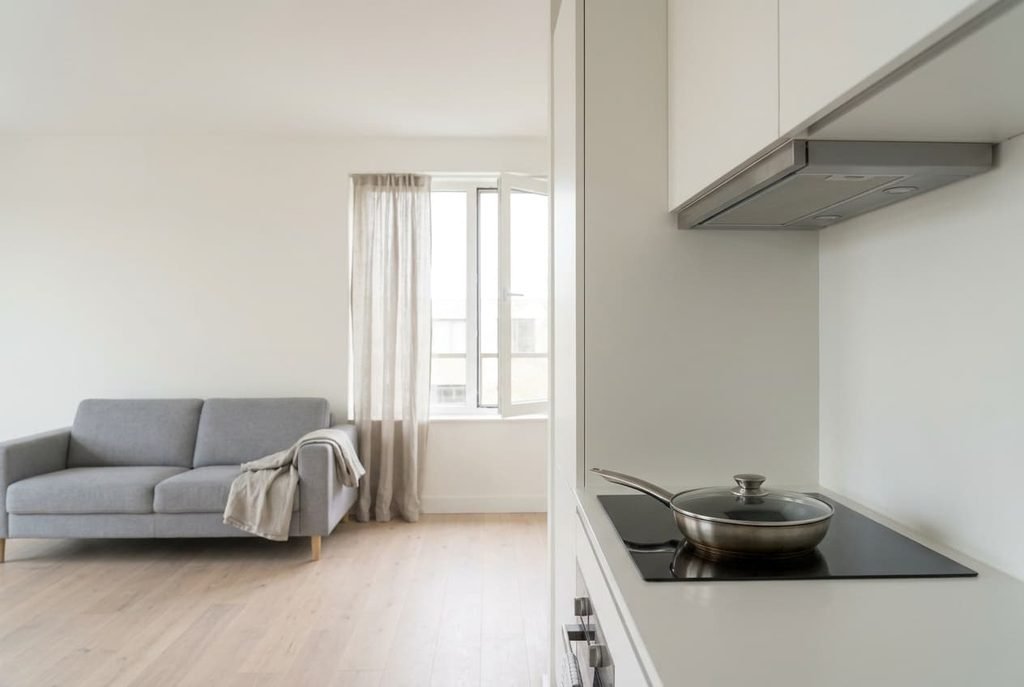
Capture it at the pan. Put a lid on while frying and run the extractor on its highest setting, starting before the oil heats and for 15 minutes after the pan comes off the heat. This removes the load before it spreads. Why do cooking smells linger long after dinner even with a hood running? Because part of the load escapes in the first minutes, before the airflow has built up. Assume the hood captures 60% of the grease and vapour, so the room receives 40% of the load, and the clearing time to 10% falls from 4.6 hours to ln(4) ÷ 0.5, or 2.8 hours. It costs a little electricity. The limit: a recirculating hood only filters and returns the air, so it captures grease but not much vapour.
Dilute it with a cross-draught. Open a window on each side of the flat for 10 minutes straight after serving. This swaps the air quickly. Assume the draught reaches 6 air changes an hour, so after 10 minutes exp(−6 × 10/60) leaves 37% of the vapour, meaning 63% has gone. It costs a little heat. The limit: a flat with windows on one side can’t make a cross-draught, and a single open window achieves perhaps one change an hour. Winter makes the cost real, because you’re heating the street for those minutes.
Remove the reservoir, the fabric. Wash the throw and the cushion covers every two weeks. Add the curtain hem nearest the kitchen to the same load, and keep one spare set so a wet one never leaves the sofa bare. This empties the second source that the settled droplets create. It costs a second set of covers, which is the first purchase on this list. Dry them fully on a rack or outdoors, since a damp cover smells of its own and undoes the work. The limit: it doesn’t touch the sofa body, and a thick upholstered sofa still holds some grease.
Vent it outside. A hood ducted through the wall removes 90% of the load at the source, which leaves the room with 10% and so nothing above the 10% line. It needs a professional to fit it and the landlord’s written permission. Only this fix takes the smell out instead of moving or diluting it. The limit: it carries a build cost and a lease condition, and it needs a wall to go through.
What this room can’t change
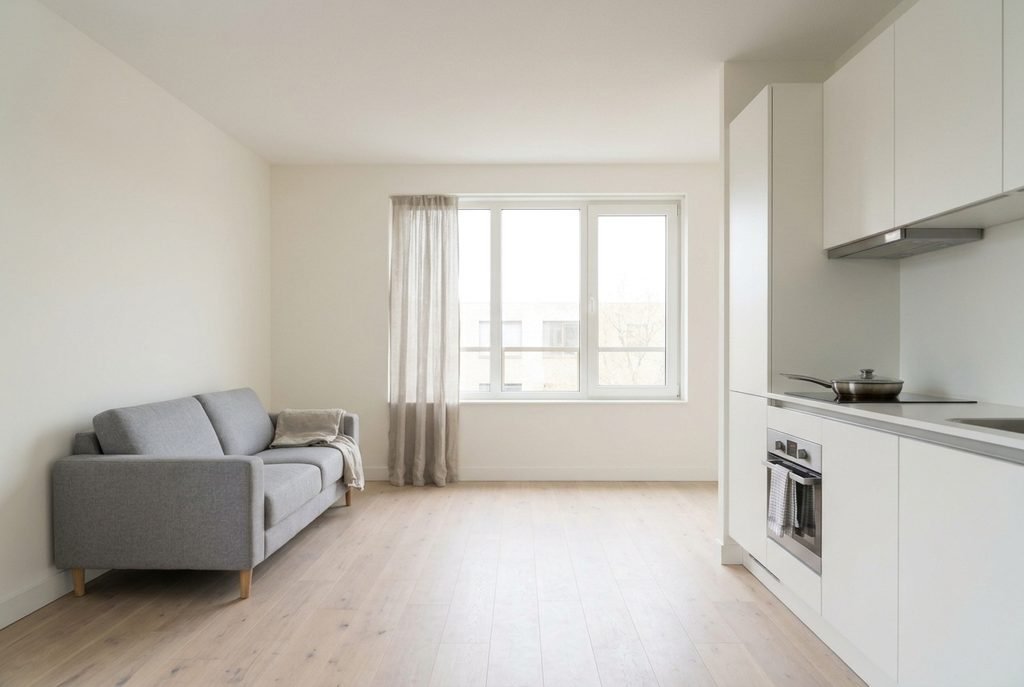
A few limits come with the flat. The kitchen is open to the living room, so no door can seal the smell in, and the 70 m³ shared air is fixed. By the floor plan the sofa sits 240 cm from the hob, which puts it inside the zone where settled grease collects fastest. The windows are on one wall, which rules out a true cross-draught, so fix 2 is weaker here than in the example.
Fixes 1 and 3 carry more of the load where cooking smells linger long after dinner in a flat like this, and a single open window helps only slightly. The hood is recirculating and owned by the landlord, so fix 4 stays closed until you ask. Treat these as fixed and put your effort where the flat allows it. Wishing for a door won’t seal an open plan. A lid and a washed cover will always shorten the evening.
The fix that doesn’t work
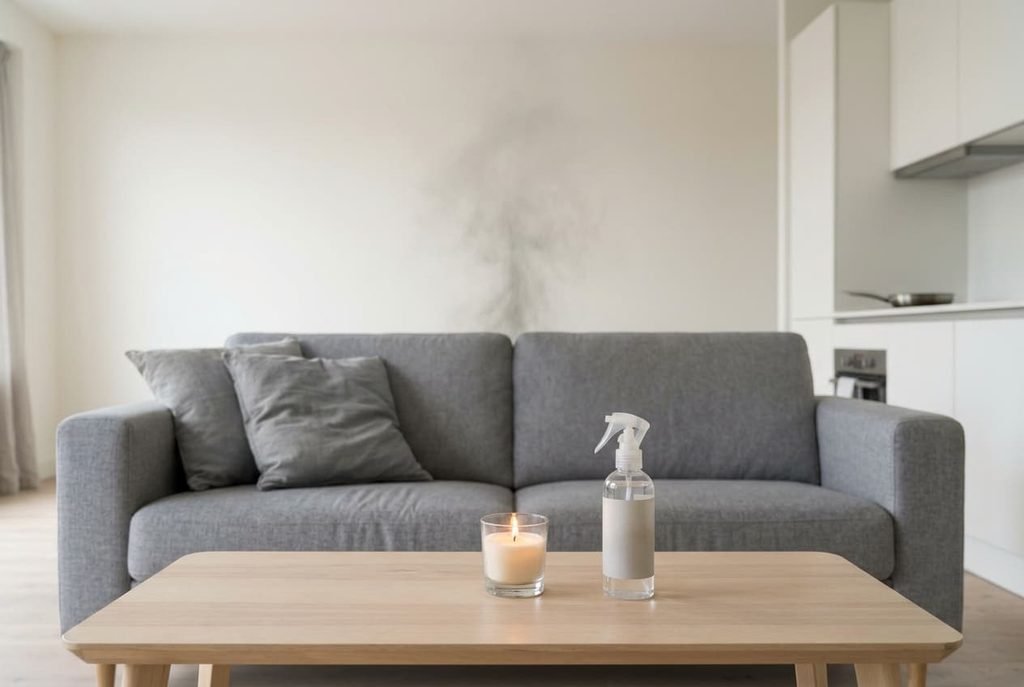
Burning a scented candle or spraying a freshener feels like action, but it changes nothing in the sum. It adds its own molecules to the air, so the room holds both the cooking vapour and a perfume. Your nose adapts within minutes, and that adaptation is why the trick feels like it worked. The clearing time stays at 4.6 hours, and the fabric now holds two smells. Worse, the perfume itself clings to the same soft surfaces, so you’ve added a second thing to wash out. A candle burned every evening also leaves soot on the ceiling above it, and the bag test the next morning will still score a 3.
The same goes for leaving a bowl of vinegar out. It adds a smell without removing one, so the sum stays where it was.
Covering a smell never takes it away.
Four things shorten the sum, and each one acts on a different part of it. One captures the load at the pan. Another replaces the air. A third empties the fabric reservoir, and the last vents outside. If cooking smells linger long after dinner, change one of those four and check again the next evening. Score the cushion bag on both evenings to see the change.
Questions readers keep asking
Can this be fixed at all in a rented flat?
Mostly yes. Fixes 1 to 3 need no landlord and no tools, and only the ducted hood needs permission. Most flats improve clearly from capture at the pan and a spare set of washable covers, and the bag test will show it. Most flats get a clear improvement from capture at the pan and a spare set of washable covers.
How much does it cost to get rid of cooking smells?
Fixes 1 and 2 cost almost nothing beyond a little electricity and heat. The spare covers are a modest one-off purchase, and the ducted hood is the only fix that costs real money. Start free and stop when the bag test comes back clean.
Why does only the sofa smell?
A sofa is the biggest soft surface near the kitchen, so it collects the most settled droplets. The fabric then releases them for hours after the air clears. Wash the covers if you can, and keep the sofa away from the cooker’s side.