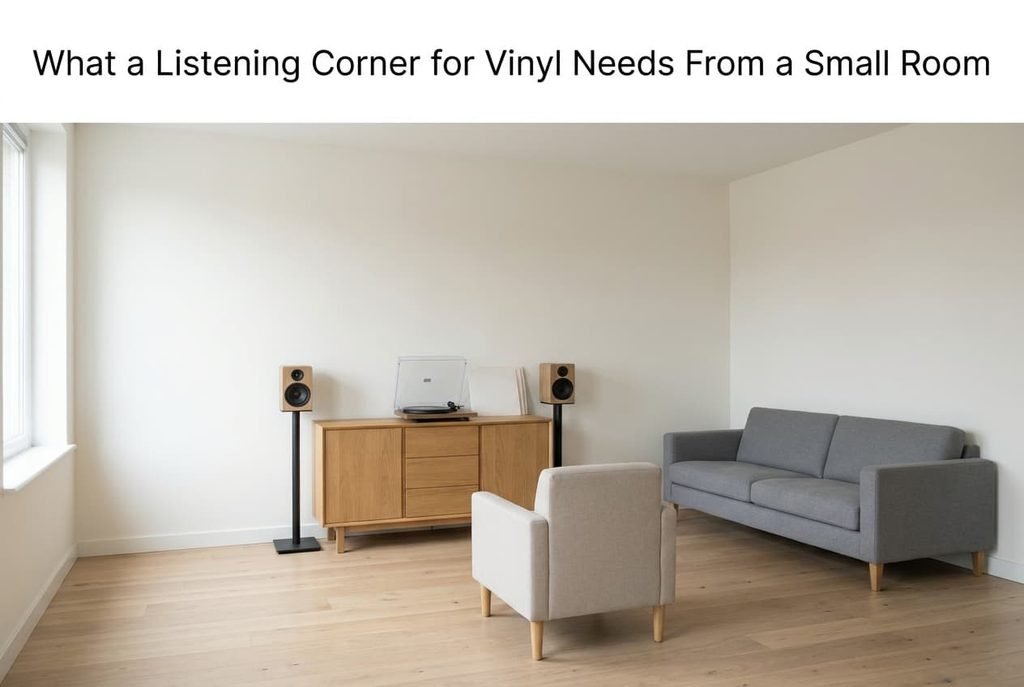
A turntable and a pair of speakers look small until you try to seat a person in front of them. The sound wants distance, the records want a steady shelf, and the sofa already owns the floor. Lay the plan out on paper first and the answer comes quickly. Fitting a listening corner for vinyl into 330 × 470 cm comes down to two distances and one shelf. The room is a flat in Rotterdam, with a ceiling 250 cm high and a window on one short wall. The sofa measures 200 × 90 cm. Each speaker measures 22 × 26 × 40 cm.
What a Listening Corner for Vinyl Needs From a Small Room
Stereo works as a triangle. The speakers form the base, and your ears form the tip. Assume the sound stays steady when the ear distance is 0.9 to 1.3 times the gap between the speakers. Outside that range the music either collapses into one point or splits into two lumps, and no amount of tuning repairs the geometry afterwards.
The room limits the base first. Each speaker wants 50 cm from a side wall, because bass swells when a cabinet sits close to one. A 330 cm wall therefore allows at most 330 − 100 = 230 cm between them. That figure fixes the seat. With a 230 cm base, your ears belong between 207 and 299 cm from the speaker fronts. Measure to the ears, not to the sofa back, because the 25 cm between the two decides whether a plan passes.
The seat is therefore decided before a single piece of furniture moves.
The record deck needs the quietest spot in the flat, because the needle reads every footstep as well as the groove. Timber laid on joists carries those steps well. The deck belongs against a solid wall. Its shelf mustn’t bounce when you stamp beside it. Set the top at a height of 80 to 100 cm, which lets you lift the lid without stooping.
Four Places for a Vinyl Listening Corner
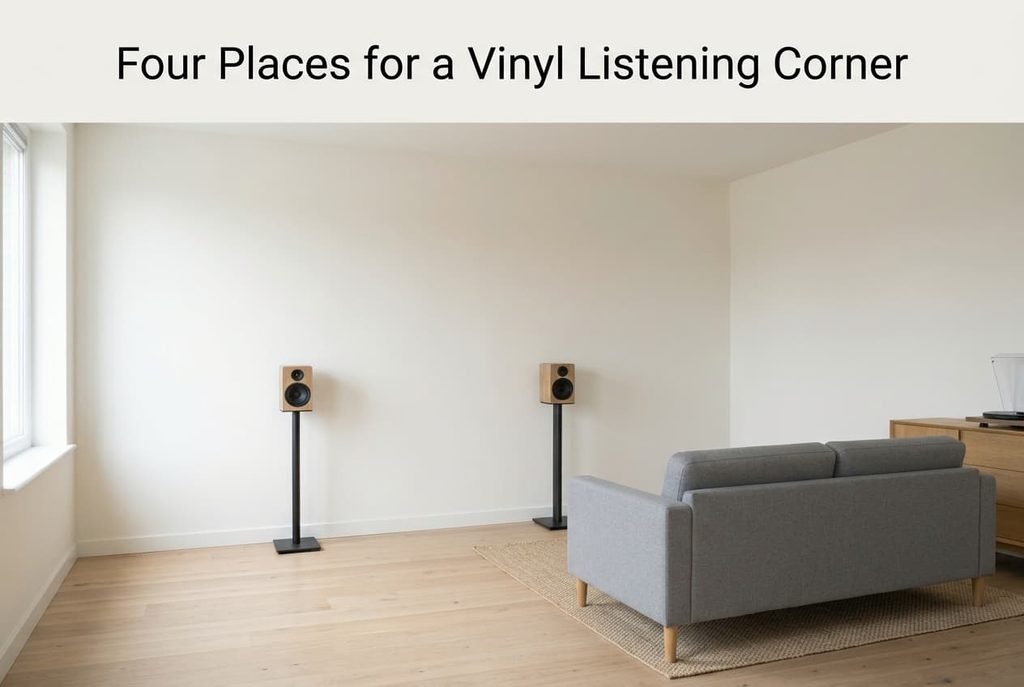
Every layout of a listening corner for vinyl sets the fronts 30 cm clear of the wall, with the ears 25 cm ahead of the sofa. The gap stays at 230 cm unless a plan says otherwise.
– Short wall, sofa on the far wall: the speakers flank the window and the sofa stands against the opposite wall. The ear distance is 470 − 30 − 25 = 415 cm, which is 1.8 times the gap. The sound drifts apart.
– Short wall, sofa pulled forward: the same speakers, but the sofa floats 100 cm off the far wall. The ear distance drops to 315 cm, a ratio of 1.37, just past the limit. The gap behind the sofa becomes a walkway.
– Long wall, sofa opposite: the speakers stand 230 cm apart along the 470 cm wall. The sofa faces them across the 330 cm width. The ear distance is 275 cm, a ratio of 1.2, the best of the four.
– Armchair at the tip: one chair sits 150 cm from speakers set 150 cm apart, a ratio of 1.0. The sofa keeps its place. The chair wants 60 cm of free floor behind it.
Our flat fails the first plan and passes the third. The other two sit in between.
Where a Record Corner Goes Wrong
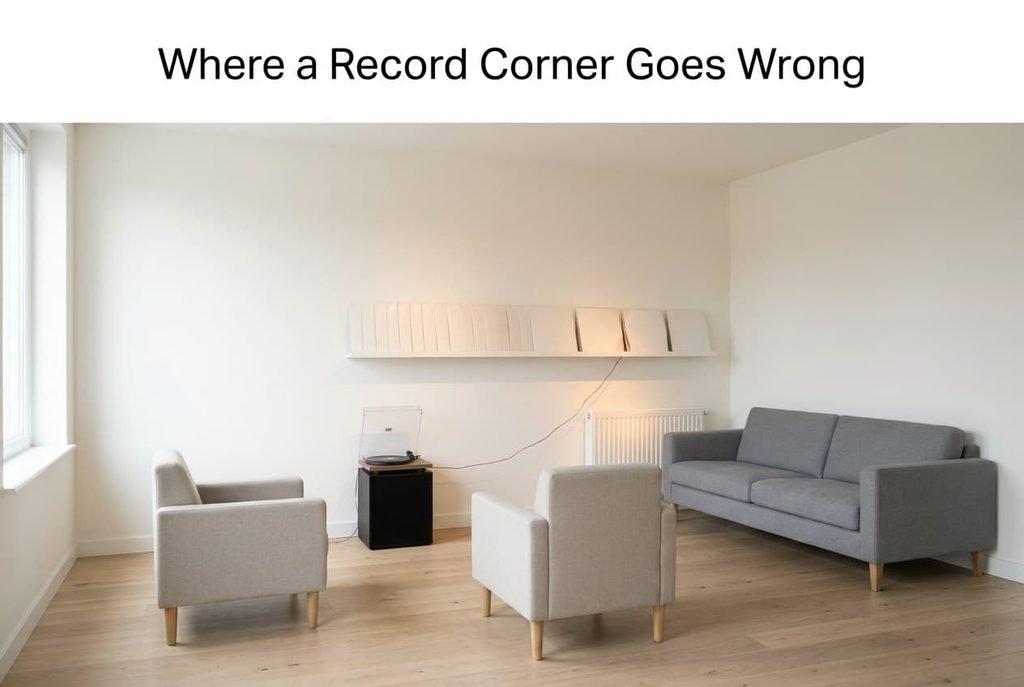
Putting the deck on top of a speaker cabinet feeds bass straight into the needle, and the hum that follows sounds like a fault in the amplifier. Give the deck its own shelf at least 60 cm from either speaker. Or lift the speakers onto stands and leave the deck on the sideboard. A cabinet isn’t a table, and a listening corner for vinyl needs a surface that stays still. Its walls shake whenever the bass plays, and the needle feels every shake.
Standing the speakers on the floor aims the high notes at your knees. Seated ears sit near 100 cm, and a 40 cm speaker on a 60 cm stand puts the tweeter at roughly 96 cm. A stand of that height is cheaper than an amplifier upgrade, and you’ll hear the improvement at once. It also keeps the speaker clear of any rug.
Squeezing the speakers into the corners boosts the low notes until they boom. Leave 20 cm behind each cabinet and the 50 cm to the side wall that the earlier sum assumed. If a bookcase stands in a corner, move the speaker, not the bookcase. A full case also soaks up some of the high notes.
Parking the record shelf above a radiator warms the sleeves, and vinyl bends in sustained heat. A 120 cm run of records holds about 200 albums at 0.6 cm each. Keep that run at least 50 cm from any heat source. The radiator valve should stay within reach.
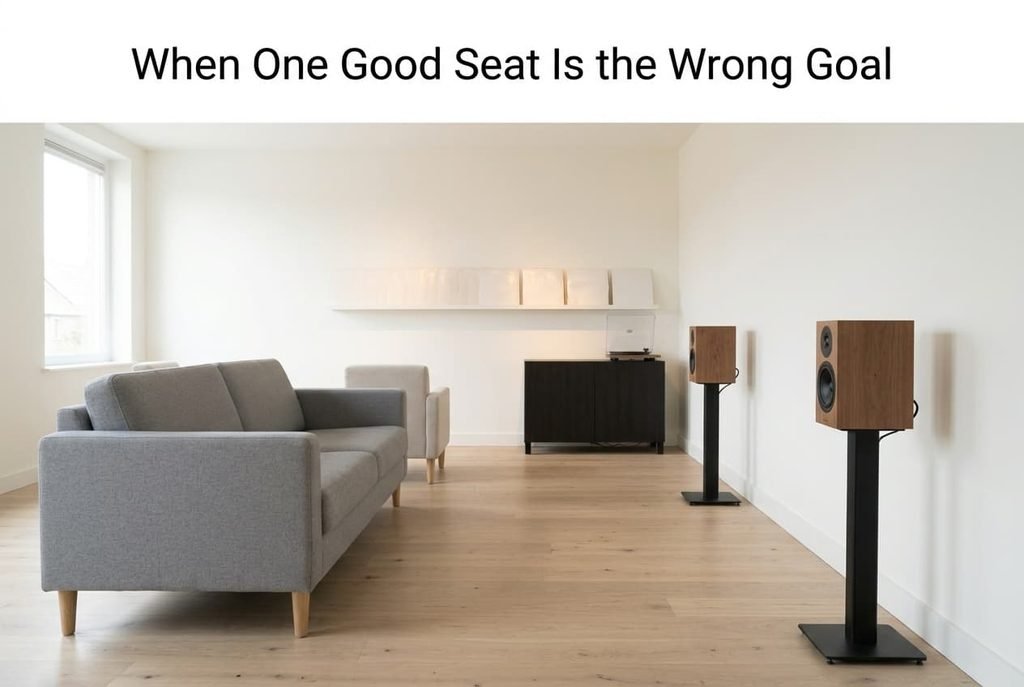
When One Good Seat Is the Wrong Goal
Most advice treats the centre of the sofa as the only good place to sit. With three people on a 200 cm sofa, the side seats sit about 65 cm off the centre line. Take the long-wall plan, where the gap is 230 cm and the ears sit 275 cm from the speakers. The left seat is then 280 cm from the near speaker. It’s 329 cm from the far one. That’s a difference of 49 cm, roughly 1.4 milliseconds, with a level gap near 1.4 dB.
Those numbers are small. A side seat loses a little of the precise centre, though the music stays full and balanced. Plan the corner around the person who plays the records. Everyone else hears the same sound from where they happen to sit.
Nobody on the sofa ends up hearing a worse record than the person in the middle.
The rule matters more for one person in an armchair, where the seat is fixed and the distance can be exact. Do most of your listening in the background while you cook or read? Then spend nothing on the triangle. Put the speakers wherever the room is calmest, and keep their cables out of the walkway.
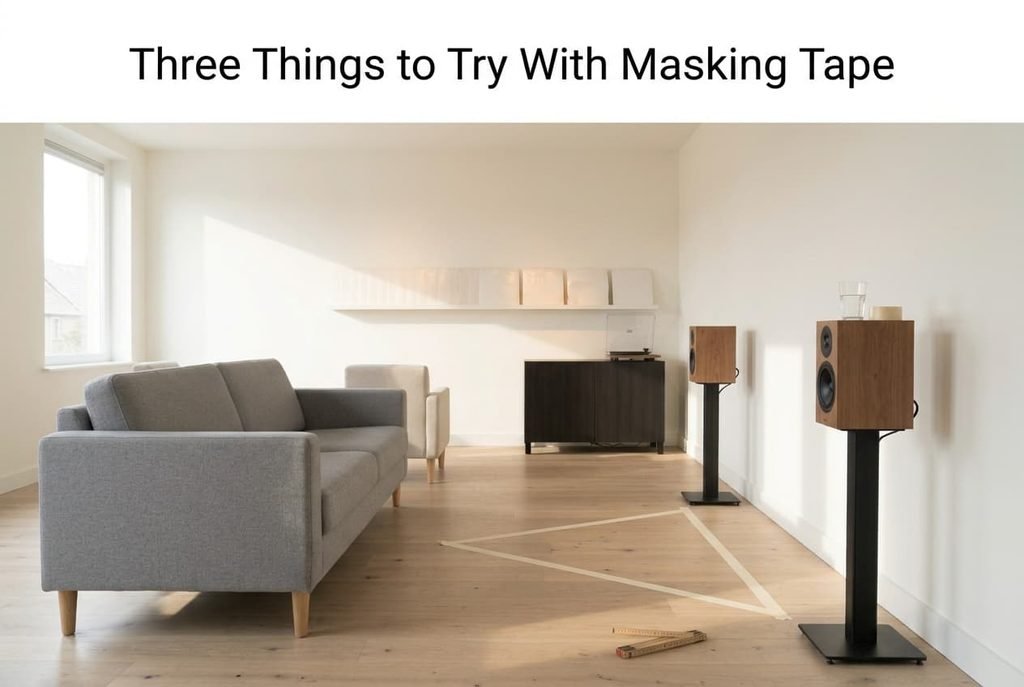
Three Things to Try With Masking Tape
1. Use tape to mark the speaker spots and the seat. Sit down and look along the triangle. If the ear distance leaves the 0.9 to 1.3 range, shift the seat by 20 cm and look again.
2. Set a glass of water where the deck will stand and stamp lightly three steps away. If rings spread across the surface, move the shelf to a solid wall, or brace it, before any records go on it. Lay a spirit level on the shelf as well, because a tilt of even 1 mm across the platter pulls the needle towards one groove wall.
3. Raise the lid of the deck to its widest and measure the free space above. It should be at least 40 cm. Then trace the cable path to the nearest socket, since a cable across the walkway gets pulled.
You’ll know a listening corner for vinyl has worked when the tape triangle feels right from the seat and the glass stays still. Tape settles the first question, and water settles the second. Neither test takes more than ten minutes. Order the shelving last, since a bracket is hard to reverse. A strip of tape lifts in a second. A bracket leaves holes in a wall you rent, and a landlord won’t thank you for them.
Questions Readers Keep Asking
How far apart should the speakers be?
As far as the room allows while staying 50 cm from the side walls. In a 330 cm room that means up to 230 cm. Then place the seat between 0.9 and 1.3 times that distance away. A wider base makes a bigger sound, but only if the seat can step back.
Does the turntable need its own shelf?
Yes. A deck that shares a surface with a speaker picks up bass through the wood. One on a bouncy floor picks up footsteps. Give it a solid wall shelf, or a heavy sideboard that’s level and clear of both speakers. The water test in the list above shows whether it passes.
Can the sofa stay where it is?
Often. In a room 330 cm wide the long-wall plan keeps the sofa as the listening seat, and the armchair plan leaves it untouched. Only the plan with the sofa at the far end fails, because the seat sits too far away.