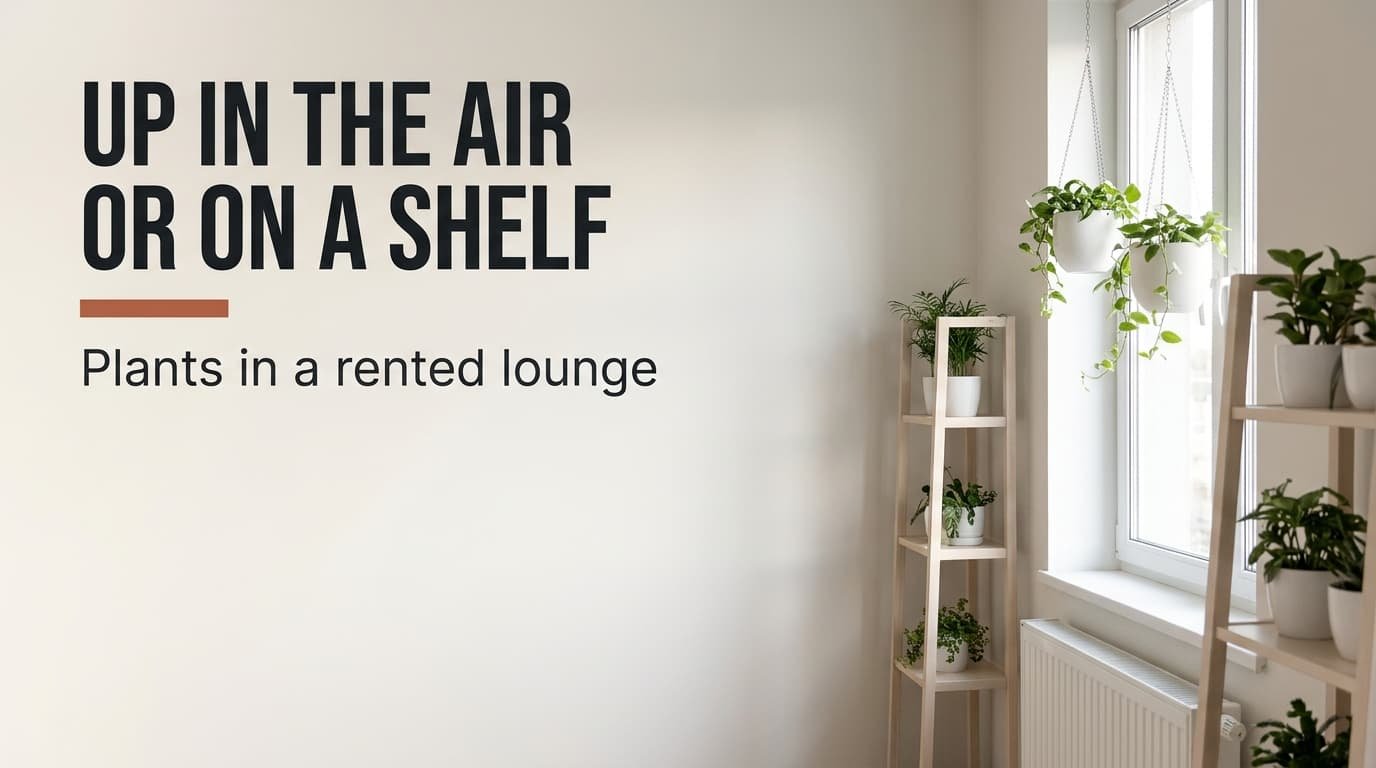
Houseplants ask for light and water, and they ask to stay put once you’ve placed them. Hanging planters or shelf plants meet those asks in different ways. The difference shows in how far each pot sits from the glass, in the load it puts on a ceiling and in how far you reach with a watering can. Both options are tried here in a Rotterdam flat. The living room is 340 × 480 cm and 250 cm high. A window 180 cm wide fills the short wall, and a radiator sits beneath its sill. The figures are assumptions for that flat, so swap in measurements from yours.
What Decides Between Hanging Planters or Shelf Plants
Start with light, because it falls away faster than most people expect. On a bright overcast day, assume a reading of 4,000 lux at the glass. A rough model gives lux ≈ 4,000 × 30 ÷ (30 + distance in cm). At 15 cm that is about 2,700. At 45 cm it is 1,600, and at 1 m it is 920. A leafy plant wants somewhere near 1,000 to keep growing. The distance from the glass matters more than the holder, so the better option is whichever gets the pot nearer to the window.
Weight is the second test. A pot 18 cm across, holding wet compost, weighs about 2.5 kg. Two of them make 5 kg on a single hook, and the fixing in the ceiling should be rated for three times that, so 15 kg. A hook means a hole, and in a rental that needs the landlord’s agreement first.
Reach is the third test, and it’s the one people skip. A pot you can’t touch without a stool gets watered late, and a plant that waits until it droops loses its lowest leaves first. Walk from the tap to each spot and count your steps before you commit.
Measure the distance to the glass before you choose either holder.
Hanging Planters and Shelf Plants Compared Row by Row
Here are hanging planters or shelf plants compared on seven points that count in this room. The figures come from the model above and from ordinary pots, so measure your own window and compare. Most rows can be verified using a tape and a kitchen scale. The two light rows need a light-meter app as well.
| Point | Hanging planters | Shelf plants |
|---|---|---|
| Distance from glass | about 15 cm | about 45 cm |
| Light at that spot | about 2,700 lux | about 1,600 lux |
| Fixing | one ceiling hook rated for 15 kg | none, a freestanding unit |
| Floor used | 0 m² | 0.24 m² |
| Pots held | 2 | 6 |
| Watering | step stool, 300 ml per pot | from the floor, saucers needed |
| Worst failure | a full pot falls from 2 m | the unit tips if top-heavy |
Light is the row that favours hanging, and capacity is the row that favours the shelf. Read the table downwards and tick the rows you care about. A rental with a strict no-holes clause turns the Fixing row into a veto, and a toddler in the house does the same to the Worst failure row. Treat a veto row as final, whatever the other rows say.
Hanging Planters: Where They Win
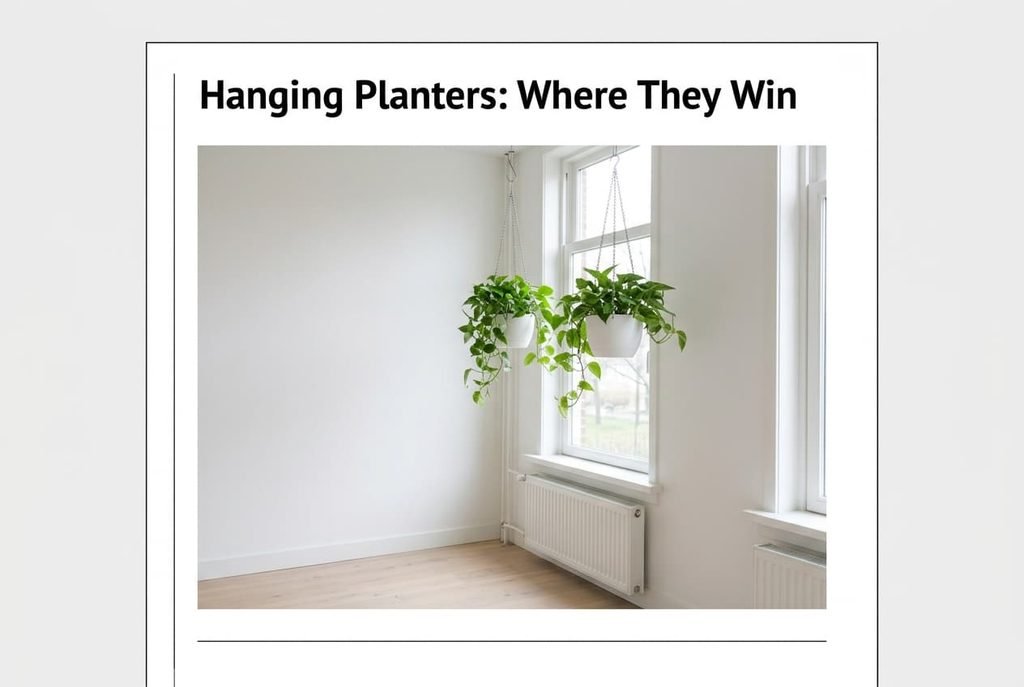
A hanging pot takes the best spot in the room for free. Hung 15 cm off the glass it gets about 2,700 lux, which is two thirds more than a shelf can manage at 45 cm. It uses no floor, so the 0.24 m² that a shelf would claim stays open for the sofa. With 30 cm of chain and a pot 20 cm tall, the base sits at 200 cm, inside the window’s height of 85 to 225 cm.
The costs are real. The warm air near the ceiling dries the compost, so check the pots every five days instead of every seven. Each watering of 300 ml has to happen on a step stool, or you lift the pot down and take it to the sink. Trailing stems reach down about 40 cm, so the leaf tips hang at 160 cm, which is below the head of a tall adult. Keep them out of the walkway, and the head-height problem disappears. Two pots is a sensible ceiling for one hook, since 5 kg is already a lot to ask of a plug in plasterboard.
Shelf Plants: Where They Win
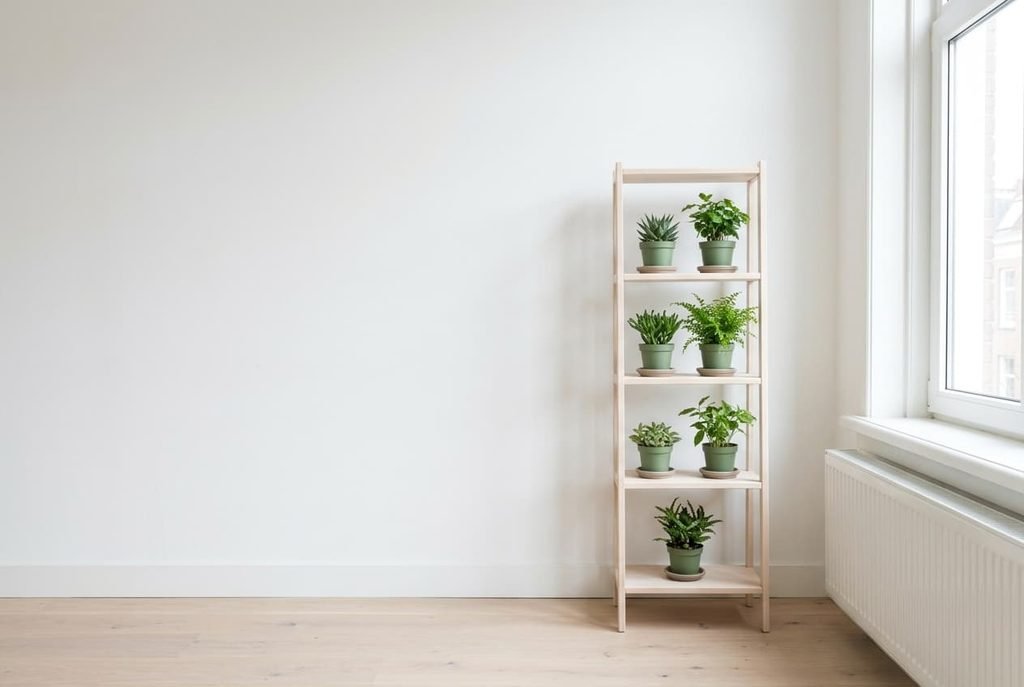
A freestanding unit measuring 80 × 30 cm holds six pots of 14 cm. It stands on 0.24 m² of floor, about 1.5% of this 16.3 m² room, and needs no hole in anything. You reach every pot from the floor. Watering is quick and needs only a small jug. When a plant sulks you move it one tier, whereas a hook leaves the pot where it hangs.
Light is the price. The unit stands 10 cm off the wall and its front plants sit roughly 45 cm away from the glass, which gives 1,600 lux against 2,700 for a hanging pot. That is still enough for a leafy plant. The top tier and anything beyond 1 m falls below it. Put the heaviest pots on the lowest tier, because six pots of 1.2 kg add 7.2 kg and a high load makes a unit top-heavy. Saucers keep water off the wood. A strap to the wall settles the tipping risk, though it brings back the hole.
A shelf with the heavy pots low is steadier than any strap.
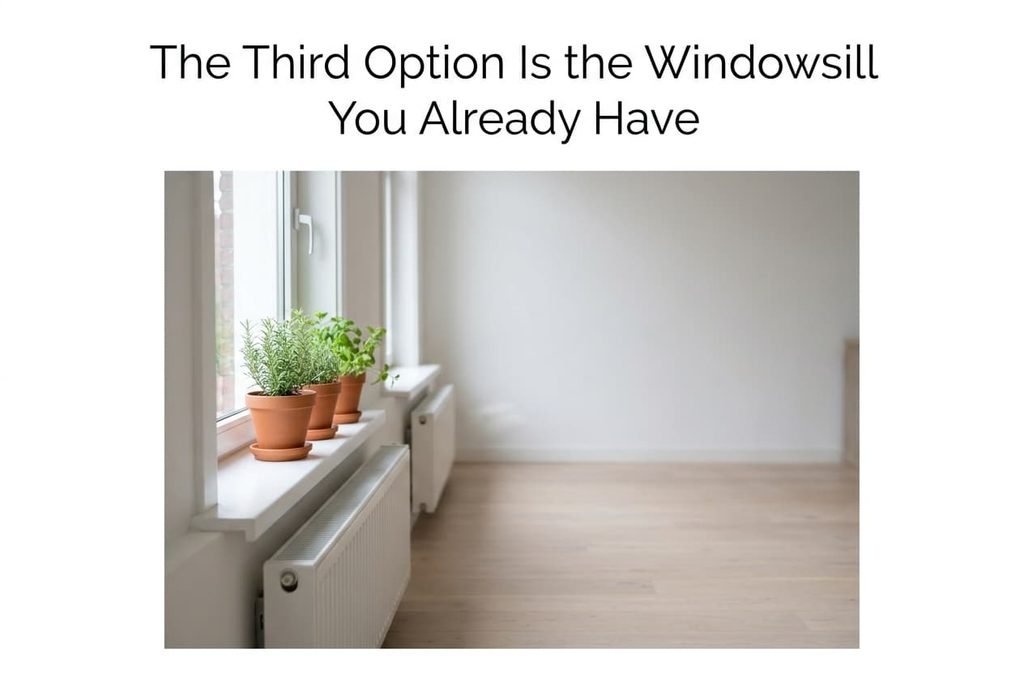
The Third Option Is the Windowsill You Already Have
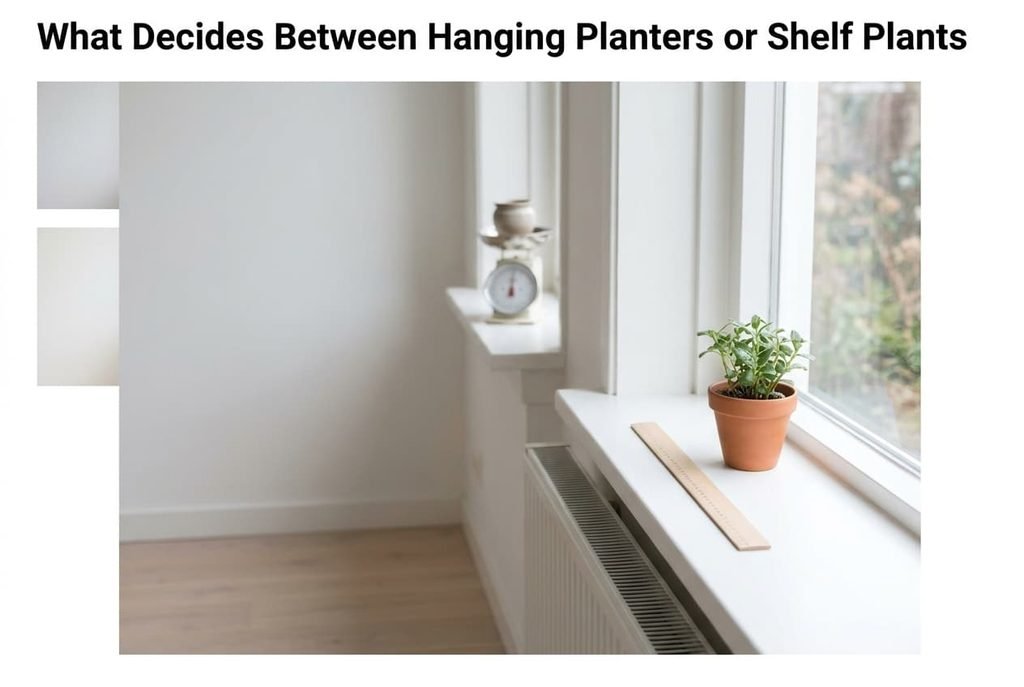
The sill is 12 cm deep and 180 cm long. Because it touches the glass, the reading there is the full 4,000 lux. Three pots of 11 cm fit along it, they cost nothing to place, and there is no hole to drill. A choice between hanging planters or shelf plants isn’t always needed, because the plants that most want light may already have the best place in the room.
The sill beats both options for light and loses on capacity, since three small pots is all it holds. Cold is its weak point. A leaf touching glass on a winter night can be damaged, and the radiator beneath dries the compost from below. Pull the pots 5 cm back from the pane at night and lift them if the radiator runs hard. On this window the sill holds only small plants. Cuttings and herbs suit it better than a trailing vine. Rotate each pot by a quarter every week so the plant grows evenly.
Which One to Pick
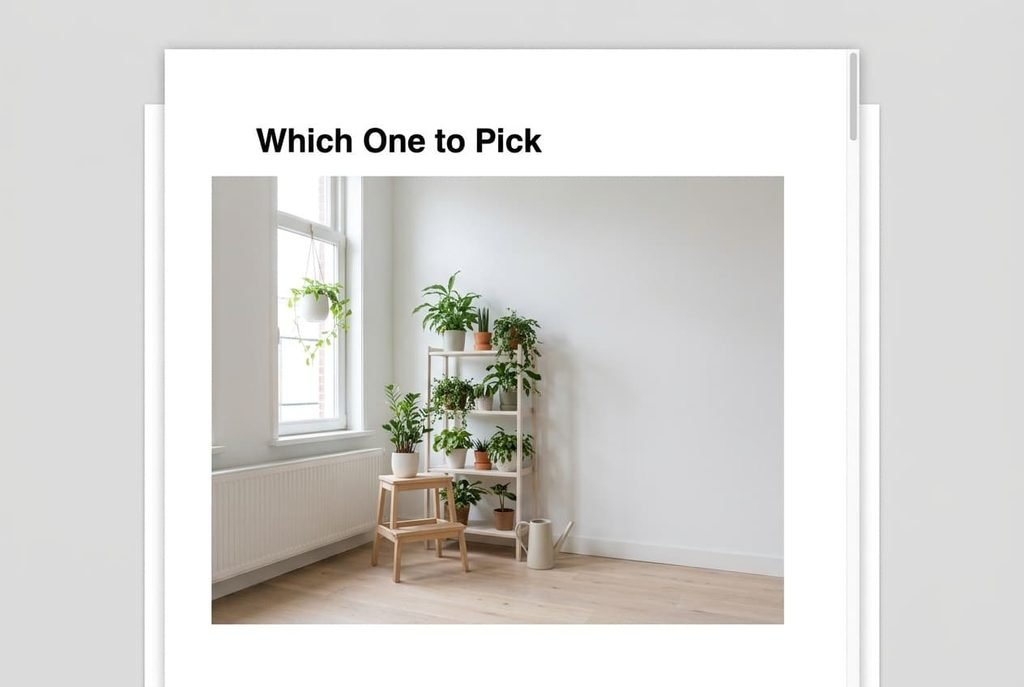
If you may drill a solid ceiling and the window is wider than 120 cm, choose hanging planters. Two pots at 15 cm from the glass get the best light the room offers, and the floor stays free. Fit a hook rated for 15 kg, hang the pots clear of the walkway and keep a step stool nearby.
If you can’t drill, or you want more than three plants, choose shelf plants. The unit needs no hole and holds six pots. Every one is within reach. Stand it so the front row sits no deeper than 50 cm behind the pane, and keep a saucer under each pot.
Plenty of rooms use both, with the sill holding the light-hungry plants and a shelf carrying the rest. Whichever you choose, measure the distance to the glass first. Hanging planters or shelf plants only pay off when each pot gets near enough to the window to grow. Two quick measurements settle the question in under an hour, the pot’s distance from the glass and its weight on the scale, so buy nothing until you’ve tested the spot.
Questions Readers Keep Asking
Which lasts longer?
The shelf unit, usually, because nothing hangs from it. A hanging planter is only as sound as its hook and chain, and both need an occasional check. Inspect the hook twice a year and replace a chain that shows rust. A pot cracks on either holder only if you drop it.
How often does each need watering?
Hanging pots dry faster in the warm air near the ceiling, so check them about every five days. Shelf pots on a lower tier usually need a drink every seven days. Test the compost with a fingertip down to the first knuckle, and water only when it feels dry at that depth.
Which suits a household with small children?
Shelf plants on the lower tiers are within reach, so keep the heavy pots down and the unit steady. A hanging pot sits high out of little hands, though a 2.5 kg pot falling from 2 m is serious. A hook rated for 15 kg and a clear walkway make it safe enough.