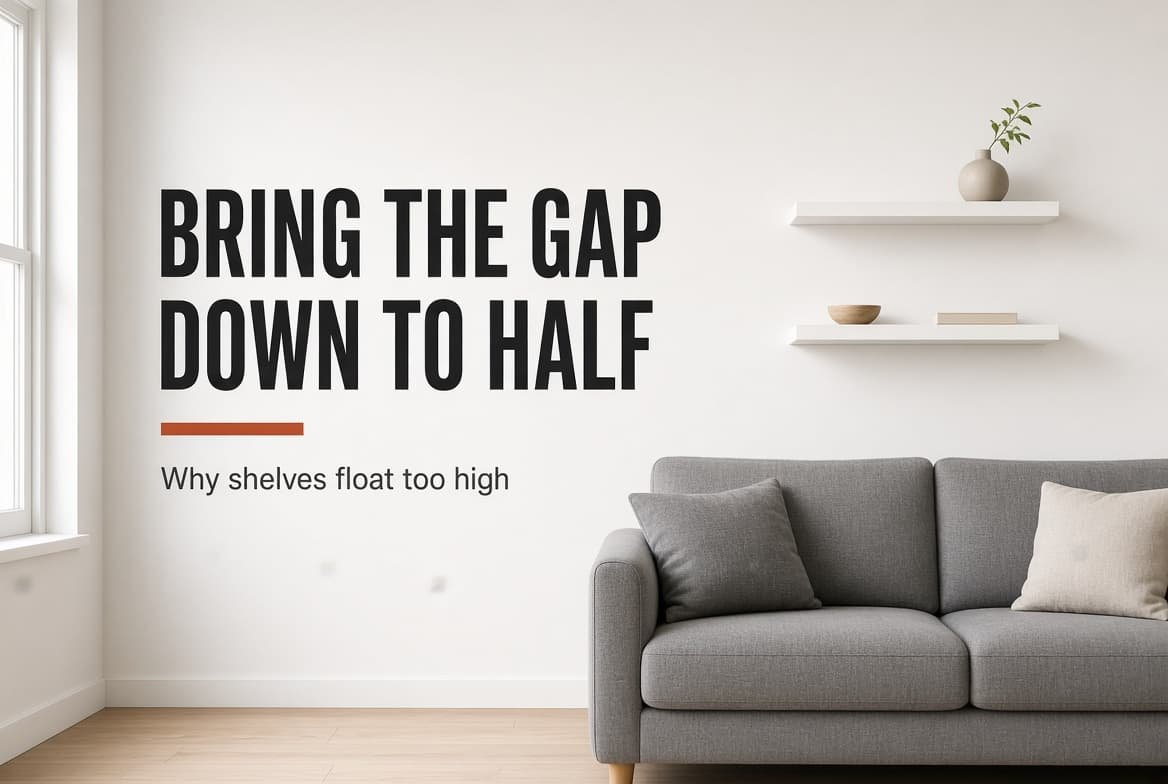
A wall 340 cm wide, a sofa of 220 cm and two shelves hung exactly level should add up to a finished corner. Instead the eye sees two small boards drifting up the wall with nothing joining them to the seating below. If your floating shelves look too high above the sofa, neither the tape measure nor the spirit level will show you why. This page traces the drift to its source and offers a five-point look from the doorway. Next come three measurable faults, each with a remedy that starting with a free change and ending in a bought item, and it ends by naming one repair that costs more than it repays.
When Do Floating Shelves Look Too High Above a Sofa?
The eye groups things by distance. Objects close together read as one unit, and objects with a wide gap between them read as strangers. Take a sofa with a back 85 cm high and two shelves of 60 cm each, with their top surface at 150 cm. The gap between sofa and shelf is 65 cm, which is 76% of the sofa’s own height. The shelves cover 120 cm of a 220 cm sofa, or 55%, and each is painted the same white as the wall.
Most owners blame the boards, yet the drifting look comes from the gap and the missing link, not from the shelves themselves. Catalogue photographs hide the problem, because a lamp there ties the shelves to the furniture. Your wall has no such link.
Viewpoint plays a part too, since from the sofa the gap sits above your head and is hard to judge, while from the doorway it shows as an empty band 65 cm tall.
The misdiagnosis costs time. People take the shelves down and re-hang them in the same spot, with fresh holes to fill, yet the wall still looks stranded, because the gap hasn’t changed.
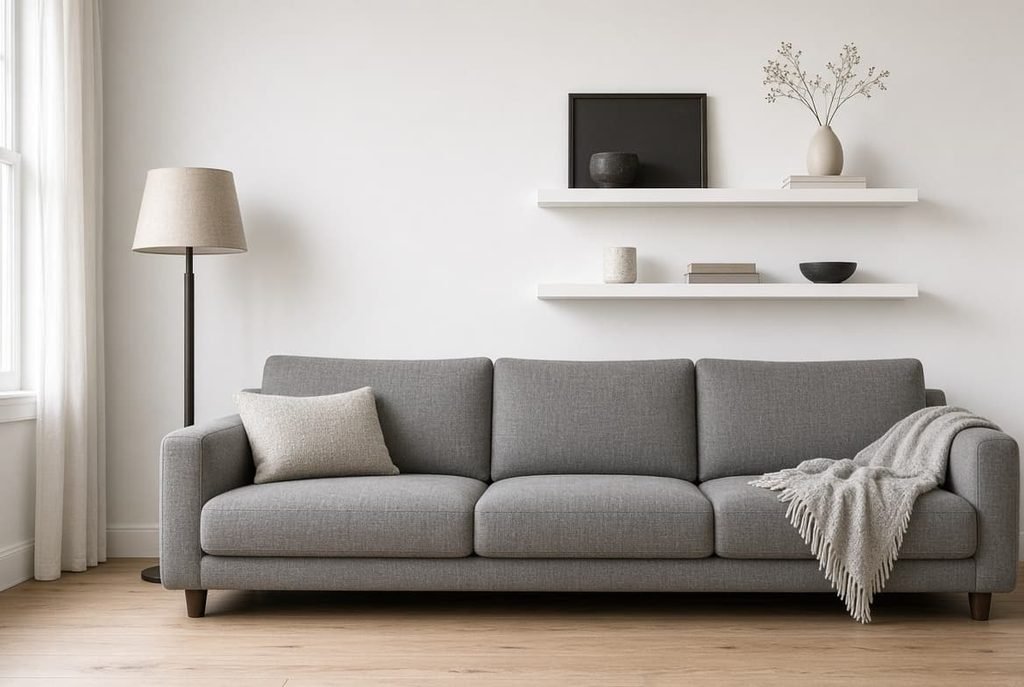
A Five-Point Look at the Wall and the Shelves
Stand at the doorway, about 3 m back from the seating, and study the wall for a full minute before you touch anything. Then work through five points in order.
1. Gap: is the space above the cushions’ top edge wider than half the back’s height? Half is 42 cm here, and the gap is 65.
2. Run: do the boards together cover close to 70% of the seat’s width? A 55% share looks timid.
3. Tone: can you pick out the shelf edge from the doorway, or does it melt into the wall?
4. Centre: does the line’s midpoint match the sofa’s midpoint, or sit nearer one arm?
5. Ties: does a lamp or a tall plant link the shelf height to the furniture beneath?
Two or more misses mean the problem is the relationship, and a new shelf won’t cure it. If floating shelves look too high from the doorway but right from the sofa, the viewpoint explains it. The faults below then apply in a milder form.
Three Faults That Make Floating Shelves Look Too Far Up
The boards run too short for the sofa. Two boards of 60 cm cover only 55% of a 220 cm seat, so they read as ornaments rather than part of the furniture. Each board was sized to the objects it carries, and the seating never entered the sum. Start by moving a tall lamp or plant to the sofa’s far end. The line of objects then reaches around two thirds of its width, which costs nothing. Next, hang the two boards 3 cm apart, so they form one run of 123 cm. Buying comes last: a single shelf of 150 cm reaches 68% of the seat. That is the dearest move, and it makes sense once the free moves have had their turn.
The shelf nearly matches the wall’s tone. A white board on a white wall has a tone gap of about one step. The edge vanishes, and the objects look scattered across the plaster. The no-cost option is to group the objects by height and colour, which makes a visible block. Rearranging helps next. A large dark frame hung behind one end of the run gives the eye an edge to hold. Should you spend, an oak shelf lifts the gap to about four steps. A tin of paint for a panel behind the shelf does the same, as long as the lease allows and the patch can be painted over on leaving.
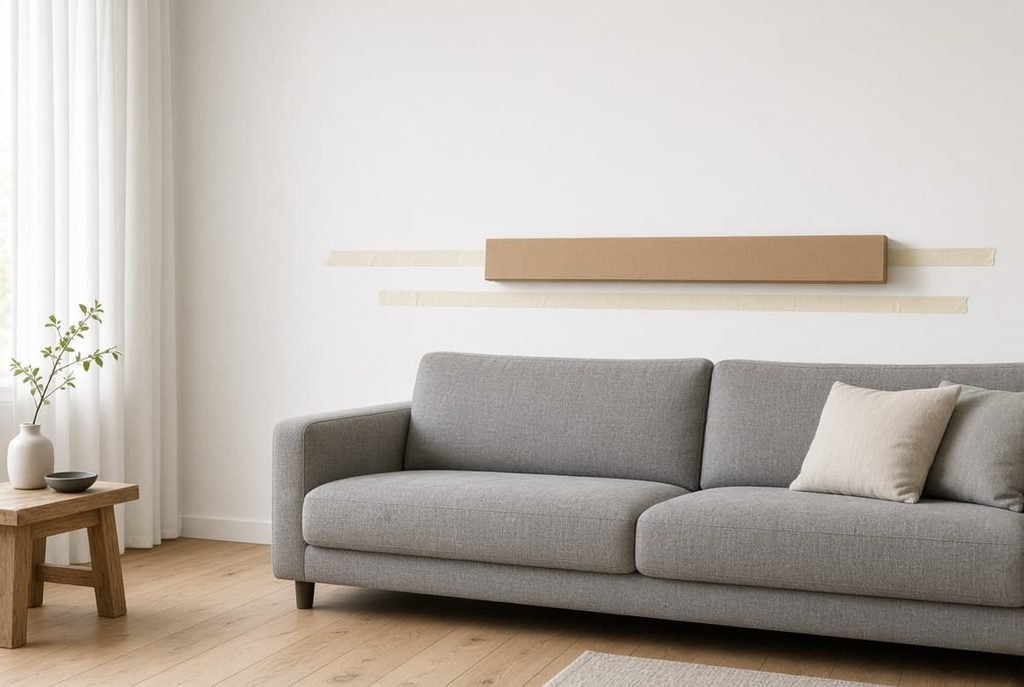
The gap above the sofa is too big. A gap of 65 cm is 76% of the back’s height, well over the half that the eye accepts. The height came from a stock figure for eye level, and the furniture was left out of the sum. Run masking tape level at a height of 125 cm, which makes the gap 40 cm or 47% of the back, and keep it up for a week. Rearranging means hanging the boards at that height, leaving a palm’s breadth of clearance above a person who leans back. The purchase is filler and a dab of paint for the old holes, which is the smallest bill of the three.
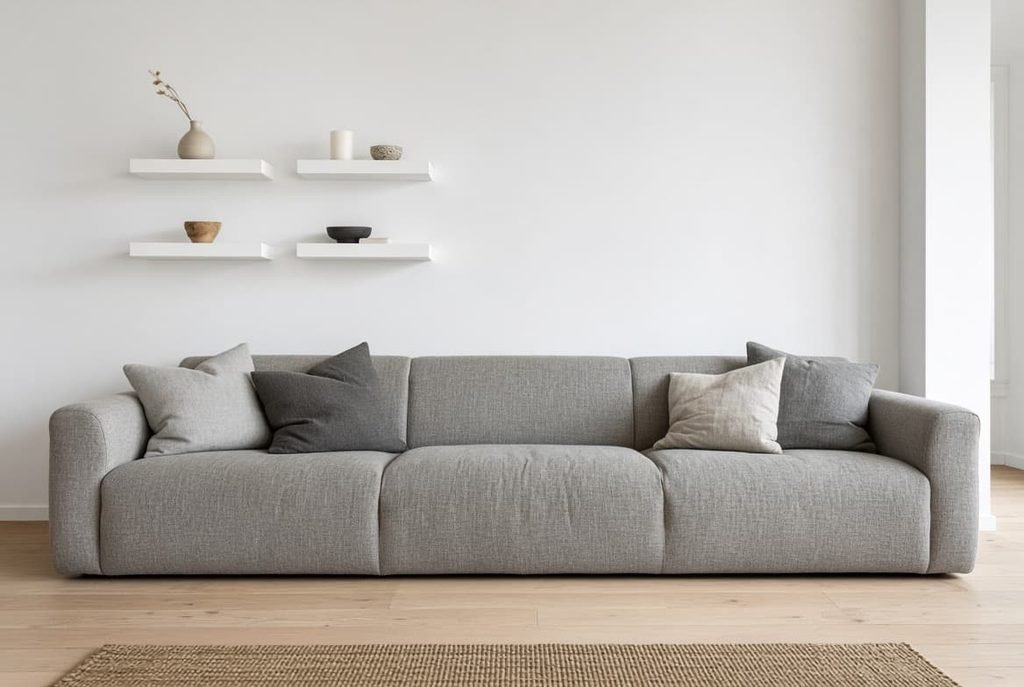
How to Hang Shelves So the Gap Stays Right
Plan from the sofa upward instead of from the ceiling downward. Measure the back and add about 40 cm, then mark that height first. Cut a cardboard template the length of the run. Tape it up and check it from the doorway.
When floating shelves look too high at 150 cm, they often look right at 125 cm with no other change. Lean back on the sofa before you drill, and keep the board a hand’s width above your head. Place a lamp or a plant at one end, so a link exists from day one.
Check again after a month. Furniture shifts, and a sofa moved 20 cm along the wall puts the centre line out.
Recheck the tone as well, since a board that read well in winter light can fade in summer.
The Fix That Isn’t Worth Doing
Many owners reach for adding a third and fourth shelf to fill the empty wall, and it seldom helps. More boards at the same height make a taller stack of small objects, while the distance to the seating stays at 65 cm. The wall looks busier without looking tied together, and every extra board means another set of holes in a rented wall.
A longer stack buries the real fault. The gap is the fault, and a full row of boards can’t close it. Lower the existing boards first, and add a new one only once the first two look settled. Painting the whole wall dark is a close cousin of this move: it lowers the contrast but leaves the gap exactly where it was, and a rented wall must then be painted back.
If your floating shelves look too high above the sofa, mark the wall with tape at 125 cm this evening and live with that line for a week. Tape is free, and it shows you the right height before a single hole is drilled. Most rooms settle with one change and a lamp, because the eye wants a link and a smaller gap. Take another look from the doorway on the eighth day, and only then pick up the drill. If the line still looks wrong, go back to the five points and find the one that failed. Write the new height on the wall in pencil, under the tape, so a second measuring day isn’t needed.
Questions Readers Keep Asking
Is it a quick fix, or does the wall need repainting?
Usually quick. Mark the new height with tape, shift one object over to the sofa’s end, then look from the doorway. Many rooms settle with just that. Repainting matters only when shelf and wall share a tone and the shelf edge disappears from across the room.
Do I need to renovate to correct it?
No. Re-hanging shelves leaves small holes that a tub of filler closes, and the other fixes need no tools. Check the lease before drilling again. A tall plant or lamp ties the shelf height to the sofa without touching the wall at all.
What causes the problem most often?
The gap above the sofa, measured against the sofa’s own height. People hang shelves at a stock height from the floor and ignore the furniture beneath. Measure from the sofa back instead, and a gap near half its height makes the shelves feel attached to the seating.