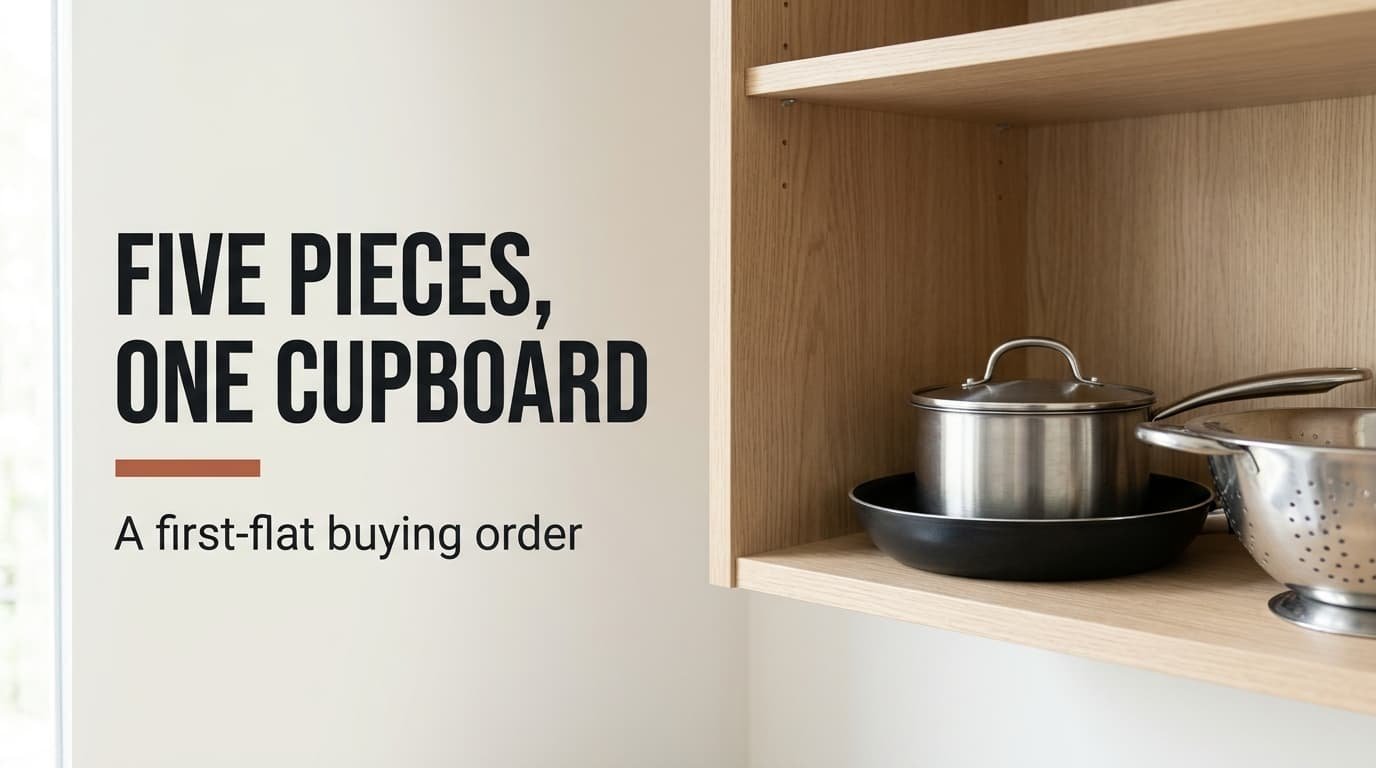
Five purchases cover most cooking in a rented kitchen, and the order you buy them in matters more than the label on any of them. Our example is a kitchen of 4 m² in Utrecht with an induction hob and a single cupboard of 60 × 50 cm. The cook owns a kettle and a wooden spoon, nothing more, and cooks for two on most evenings. Buy in the order shown, and stop on the evening a meal for two comes out of one pan without sticking. Measure your own cupboard before trusting any figure here.
Cookware for a First Flat Kitchen Starts With the Meals You Cook
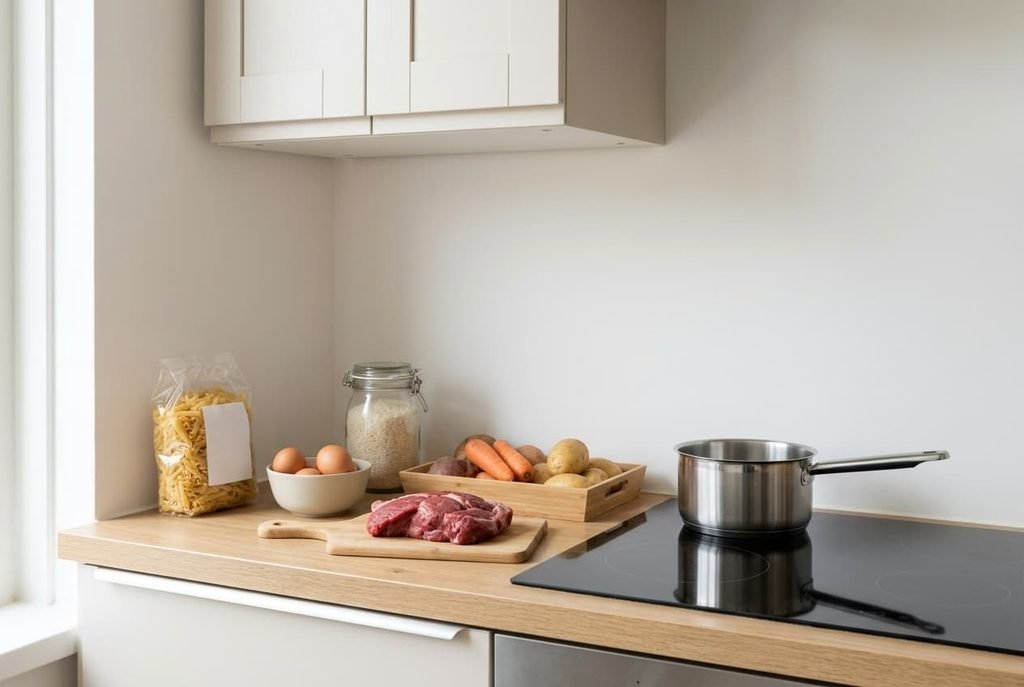
Cooking in a first flat reduces to a few meals. Our cook makes five. Pasta with sauce and eggs with vegetables fill the weekdays. The weekend brings a stew and a tray bake, and rice goes with either.
List the five meals you cook most before buying a single pan, since the list tells you which pieces can wait. Write each meal beside the vessel it needs and circle any vessel that appears twice. Our cook’s list showed the saucepan serving pasta and rice, the frying pan taking eggs and vegetables, and the oven tray carrying the bake. That settled the buying order before a shop visit. Someone who only boils and fries needs just two purchases.
The hob sets the second limit. Induction needs a magnetic base, which a fridge magnet will confirm, and a base much wider than its ring leaves a cold rim. Our rings are 21 cm, so no pan base should pass 25 cm.
The cupboard sets the third. The pans must nest into a space of 60 × 50 cm on one shelf, 40 cm high. A set that outgrows the space ends up on the hob all week, where it catches grease.
Five Purchases for a First Flat Kitchen, Dearest Mistake First
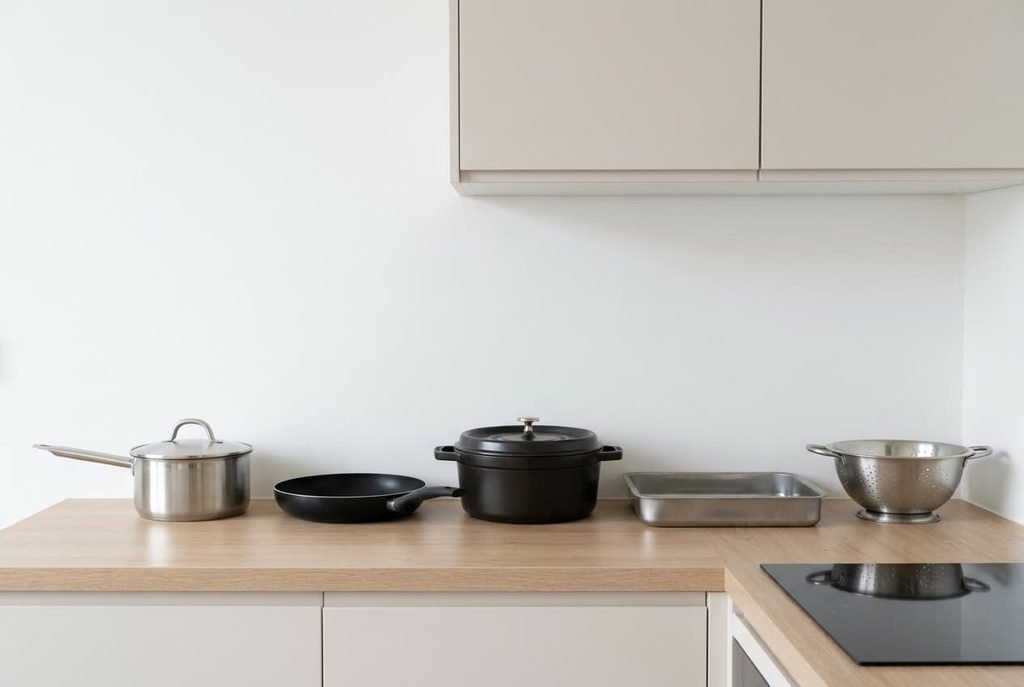
1. A 2 L stainless saucepan with a snug lid comes first because rice and pasta both need a deep pot, and sauces do too. Tier: BUY ONCE. A base of layered metal at least 3 mm thick spreads heat evenly, whereas a thin base scorches sauce at the centre within a month. Welded or riveted handles stay tight for decades. In the shop, set a ruler on edge across the base to see that it’s flat, then pull the handle hard. Reject any pan whose base rocks or whose handle twists.
2. A 24 cm frying pan with a non-stick coating comes second. Eggs and vegetables go in it daily. Tier: BUY CHEAP. Every coating wears out within a few years whatever the price, so a plain pan with a flat base and a bolted handle costs less per year than a dear one you’d hesitate to replace. Set it on the counter and confirm that the base doesn’t spin. A base that bows when hot sends the oil to the rim and leaves the centre dry.
3. A 3.5 L casserole with a heavy lid ranks third, for the weekly stew. Tier: BUY ONCE. A lid weighing about 1 kg keeps the steam inside, so a stew needs no extra water. Thick walls then hold an even heat for two hours. Enamel over cast iron chips if it’s knocked, so look at the rim for thin spots. Set the lid down gently: a good one seats with a dull thud and doesn’t rattle.
4. A steel roasting tray of 35 × 25 cm takes fourth place for the tray bake. Tier: MID. Steel at least 1.5 mm thick stays flat at 200 °C, whereas a thin tray bows and tips the fat toward one corner. The oven is 40 cm wide, so the tray clears it by 5 cm. Push on its centre with a thumb. A tray that flexes in the shop will warp at home.
5. A steel colander of 24 cm finishes the set. Tier: BUY CHEAP. Plain steel with rim holes costs little and wears out only if it’s dropped. Check that the feet hold it steady in the sink and that the handles don’t flex. A colander the width of the saucepan nests inside it, which saves a slot on the shelf.
Why the Casserole Is the Item to Scale Down
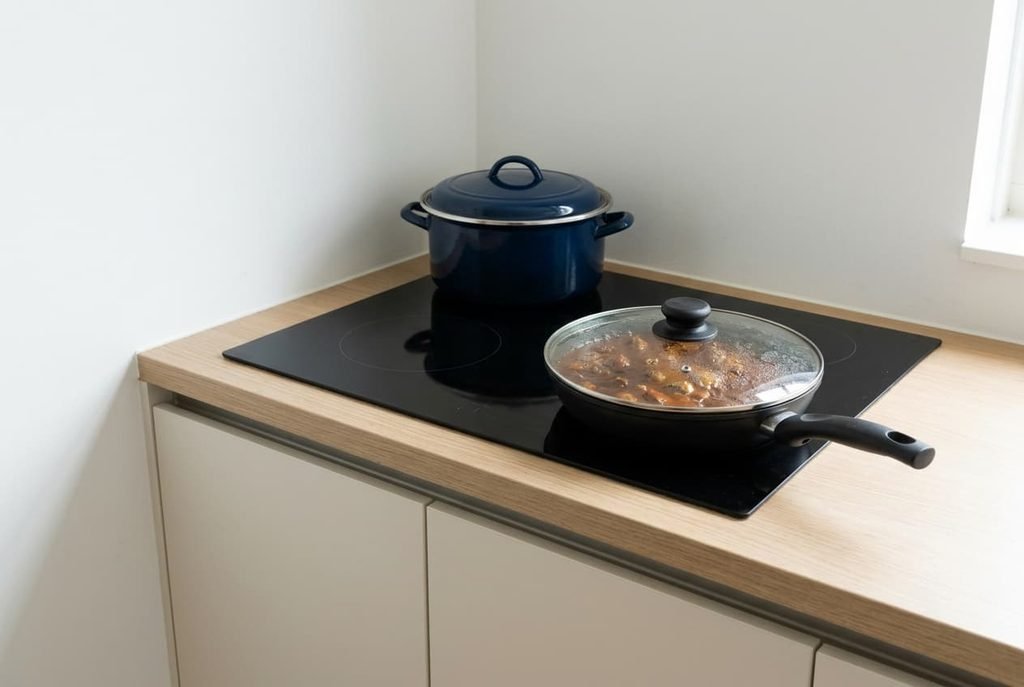
Of all the cookware for a first flat kitchen, the casserole is the piece that most readily goes. A stew for two takes about 1.5 L, so a pot of 3.5 L is over twice what you need. It’s also heavy. At 4.5 kg it outweighs the other four items put together, which come to 2.7 kg, and lifting it full from a 200 °C oven is the risk a first-time cook least needs.
A lid for the frying pan does most of what the casserole does, and it costs far less. Braises and a stew for two both fit beneath a lid in a pan 24 cm wide and 6 cm deep. The pan also lives on the hob, so no lifting is involved.
The casserole makes sense only where you cook for four or more.
Cook the stew in the lidded frying pan for six weeks. If it comes out right every time, the casserole stays on the shop shelf, and the saved money buys a better saucepan.
Habits That Keep the Pans in Good Shape
Cookware for a first flat kitchen keeps its value only while the five pieces stay flat and clean. Let a hot pan cool for five minutes before water touches it, because a sudden chill can bend the base. Cook non-stick on medium heat and never preheat it empty.
Use wooden or silicone tools on any coating. A metal fork scratches it in one meal, and scratches spread.
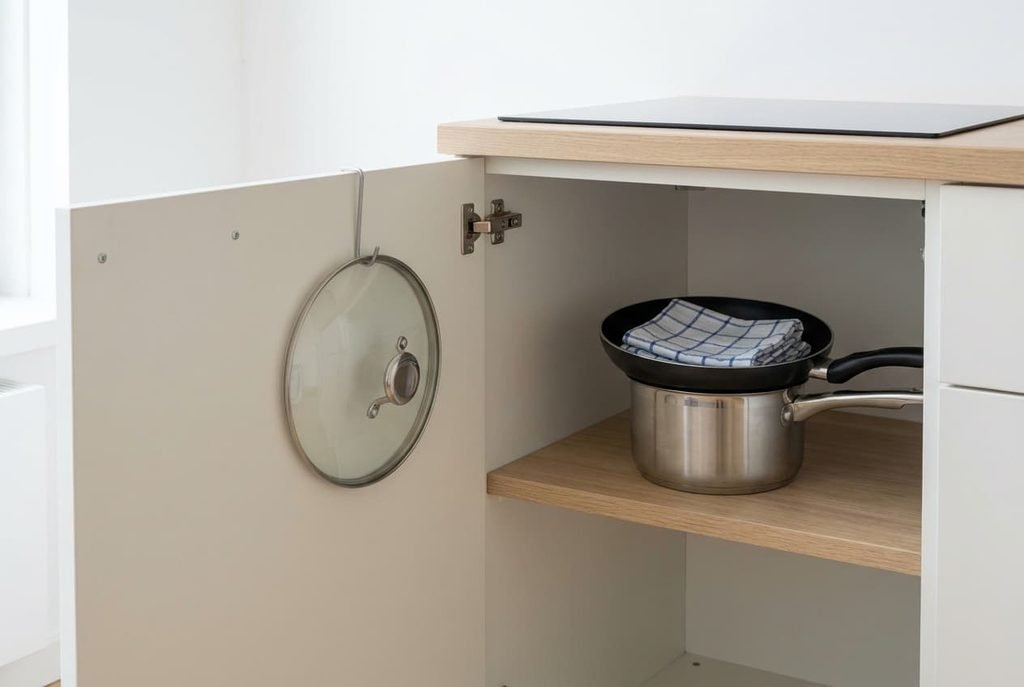
Wash by hand with a soft cloth, then dry the base so it doesn’t spot. Dry each lid separately, since water trapped beneath it leaves a ring on the rim. Stack the frying pan with a folded tea towel inside it, so nothing rubs the surface. Hang a lid on a hook inside the cupboard door if the shelf is tight. Keep a small cloth in the cupboard for wiping grease off each rim before stacking, since grease left on a base burns onto the next hob ring.
Check the pans every spring and replace the one that lags.
What to Skip
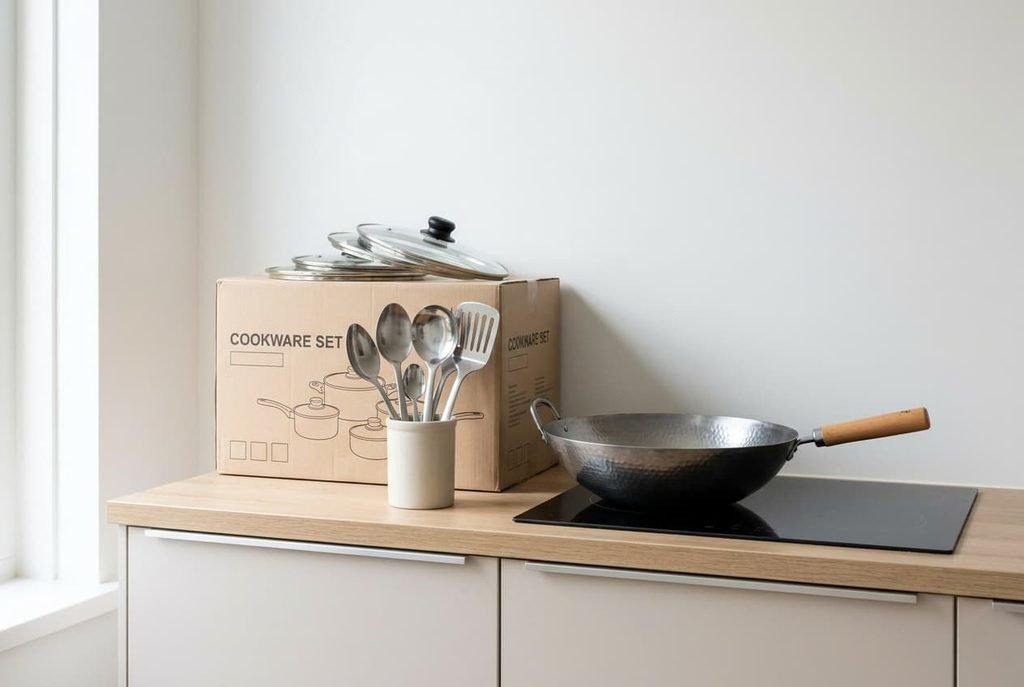
Skip the 12-piece boxed set, because six of its twelve pieces are lids and spare utensils that a small kitchen never uses. You pay for three saucepans of nearly the same size and a stack that needs a whole shelf of 60 × 50 cm. Most cooks use two pans from such a set and leave the rest in their slots.
A steamer insert tempts too, yet a colander over the saucepan does the same job. An omelette pan and an egg poacher fail on the same grounds, since the frying pan already makes the dish. Leave out a wok as well, because a 21 cm ring can’t heat a base of that width.
Stocking the cookware for a first flat kitchen works once five pieces cover the five meals on your list. Stop buying there, and move the savings to a saucepan that outlasts the rest. Each season, take the pans out. Cook the same meal in each to see which one lags. Replace that pan, then close the cupboard. Keep the list of five meals taped inside the door, since it settles every impulse buy before it reaches the till.
Questions Readers Keep Asking
How many pieces do I need to start?
Two: the saucepan and the frying pan. They cover pasta and rice as well as eggs and most sauces, which is the bulk of first-flat cooking. Other pieces serve rarer meals, so add one when that meal turns up. Watch which dish feels awkward before buying more.
Which piece should I buy first, and which can wait?
Start with whichever piece a bad choice would damage most. A thin saucepan scorches every sauce, so it goes first. The frying pan follows within a week. The tray and the colander wait until a recipe calls for them, and the casserole waits longest.
How do I judge a pan in the shop?
Hold it level and press the base against a ruler. A good base lies flat with no gap. Lift it by the handle, then twist the handle gently. Feel the weight too, since a heavier base usually means thicker metal that spreads heat more evenly.