A washing machine that walks across the kitchen floor is losing an argument with its own spin, and one fault rarely explains the loss. The drum and the feet both play a part, and so does the floor under them. This page follows one machine, 60 cm square, in an alcove on the second floor of an older block in Haarlem. Three tests identify the cause, and four fixes follow, arranged from free to a carpenter’s visit. Every fix works on a separate mechanism. The numbers describe one sample kitchen, so measure yours before copying anything.
Why a Washing Machine That Walks Across the Floor Moves
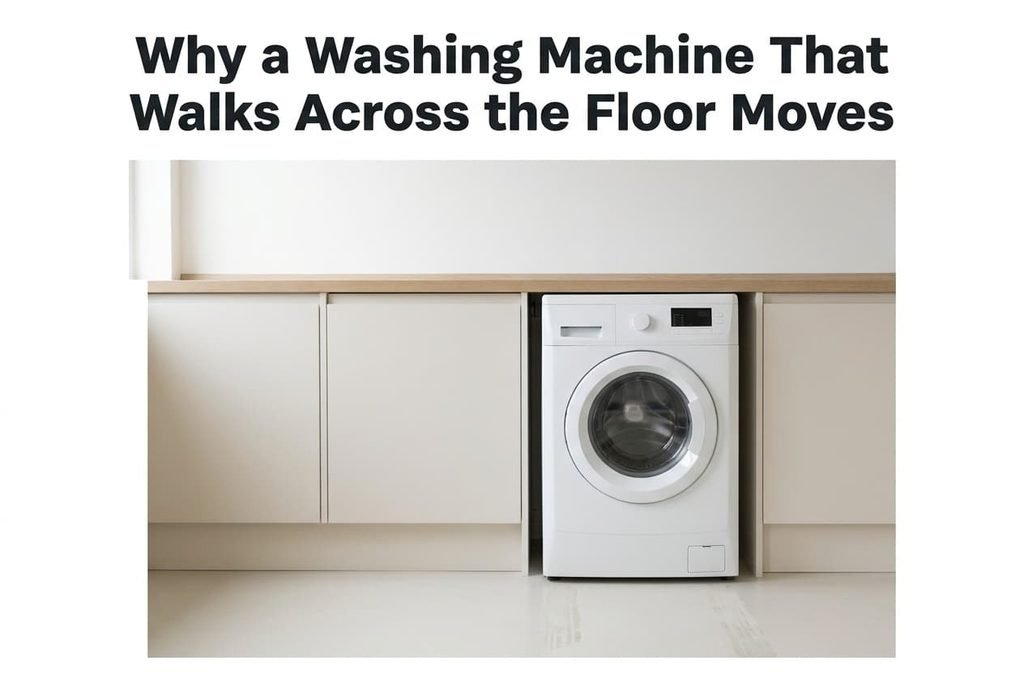
At full spin the drum turns about 20 times a second. A clump of wet towels weighing 1 kg, pressed against a drum wall of 20 cm radius, then pulls sideways with roughly 3,100 N, equal to the weight of about 320 kg. The machine weighs 65 kg. Its springs and dampers soak up most of that pull. What they leave behind reaches the feet as a shove on every turn.
The feet decide what happens next. When all four carry weight, friction holds the machine still. Most walking starts with one foot that carries no weight, because the machine then rocks on the other three, and each rock slides it a little further.
The load adds its share. A clump forms within minutes and drives the spin harder every second, whereas a light mixed load spreads out and pulls far less. The floor adds its share too. Timber under a second-floor kitchen flexes, so the machine pushes against a surface that gives way and then springs back.
Each cause leaves a different sign, and the next section teaches you to read them.
Confirming Which Washing Machine Walks Across the Floor
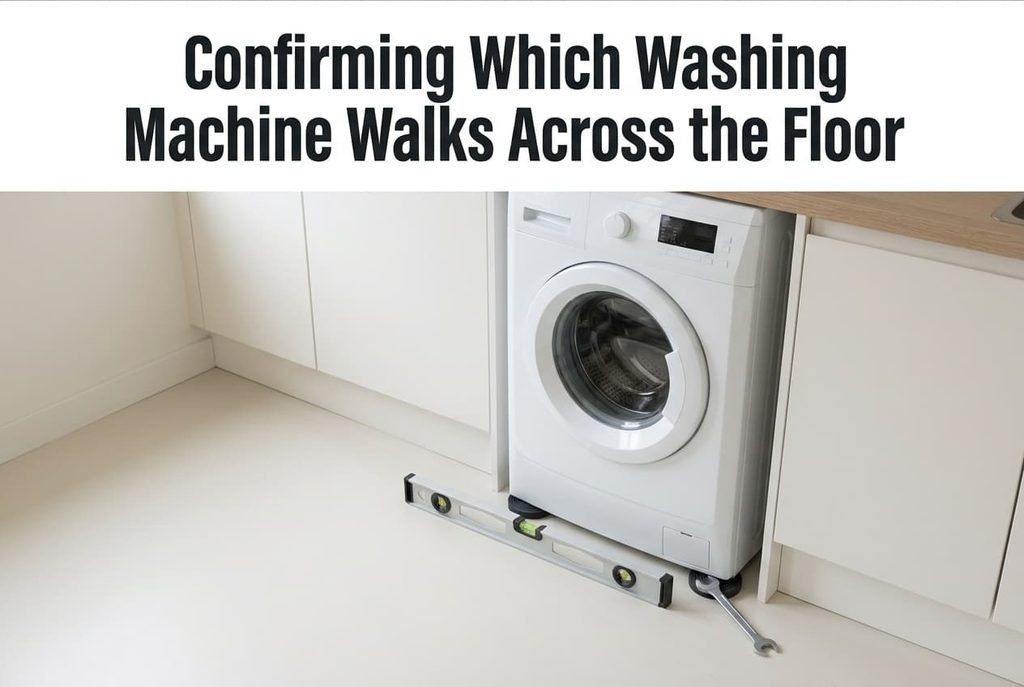
Three tests show which cause carries the blame. Empty the drum first, and write each result on a separate line, so every fix can be compared with the last.
The first test uses your hands. Stand at the front and press down on the top corners, one diagonal pair at a time. Any rocking means a foot is loose. The second test uses the load. Run a spin with 4 kg of mixed small items spread evenly. A machine that stays put with that load but wanders with towels points to the load. The third test uses a spirit level. Rest it on the floor beside the machine during the spin and watch the bubble. A twitching bubble means the floor is moving too.
A washing machine that walks across the kitchen floor can show all three signs together. Log how far it travels in one spin. Ours moves 6 cm per spin, and the hoses allow just 10 cm.
A rocking foot sends you to fix one. A lumpy load points to fix two, and a twitching bubble to fix four.
Four Fixes When a Washing Machine Walks on Spin
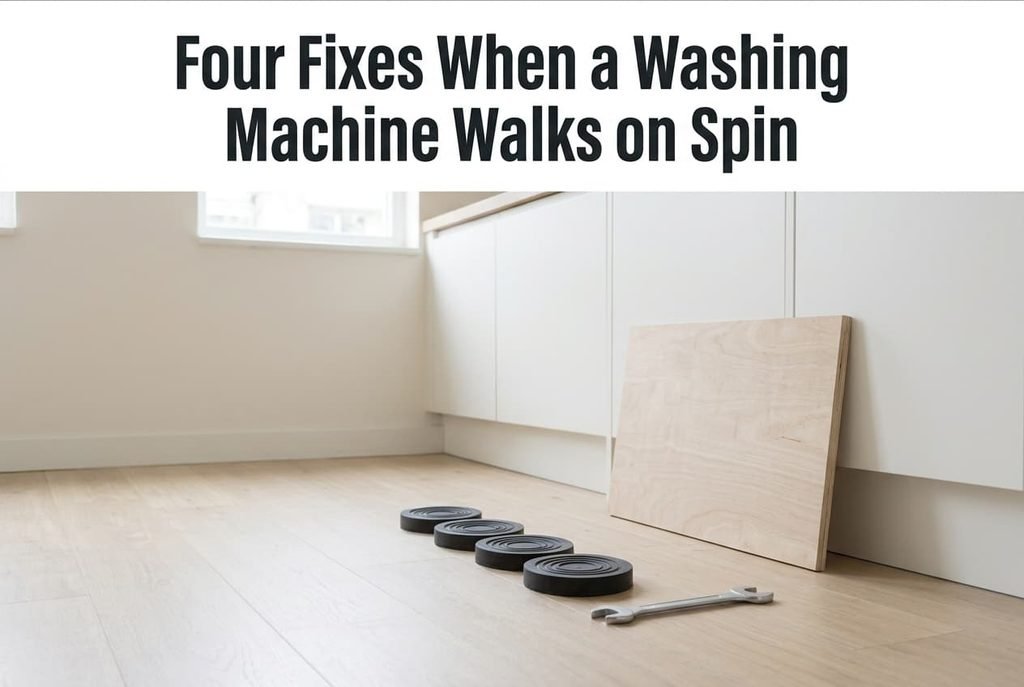
Level the feet and lock them: the free fix puts weight back on all four feet. Turn each foot until the diagonal push no longer rocks the machine. Then tighten the lock nut against the base so the setting holds. Set a spirit level across the lid to confirm it sits flat. Check the back for shipping bolts, since those hold the drum rigid and cause violent walking if they were left in. This costs a spanner and ten minutes. The limit is the floor, because level feet on a moving floor still move, and a twitching bubble will outlast this fix.
Spread the load and slow the spin: this fix is free too, and it shrinks the shove itself. Mix large and small items so towels can’t form one clump. Fill the drum to about two thirds. Choose 1000 rev/min over 1200, and the pull falls to 69% of its old size, since force rises with speed squared. Run the first test spin on the slower setting and compare the distance. The price is damper laundry. A bulky item such as a duvet still needs the slower spin and a lighter load.
Put firm anti-vibration pads under the feet: the first purchase damps what the springs leave behind. A pad of dense rubber absorbs part of each shove and adds grip, so the machine slides less. The cost is small. The limit is height, since each pad lifts a foot by about 1 cm, so the level needs resetting. A soft pad on a thin floor lets the machine bounce, so choose a firm pad and press your thumb into it at the shop.
Stiffen the floor under the machine: the professional fix tackles the flex. A carpenter screws a panel of 18 mm plywood across three joists. That spreads the load and makes the boards act like a plank instead of a drum skin. It’s the priciest option and needs the landlord’s consent. Ask the carpenter to check the joist direction first, since a panel laid across the joists works best. The catch is the alcove, because a panel wider than the opening won’t fit, and it raises the machine by 2 cm, which may foul the worktop above.

What Your Own Kitchen Allows
Our alcove is 62 cm wide, which leaves 1 cm of clearance at each side. A panel or a pad can’t be wider than that opening, and the machine has nowhere to retreat. Treat the width as fixed.
The hoses set a second limit. They give 10 cm of slack. A machine that walks 6 cm per spin has used most of it after two washes. A hose pulled tight can split at the tap, so slide the machine back after every cycle until the cause is cured.
The floor sets the third. Timber on joists 40 cm apart flexes a little under an adult, and the bubble test showed it moving with the spin. In this kitchen a washing machine that walks across the kitchen floor is partly the floor’s doing, so the first three fixes can only reach so far.
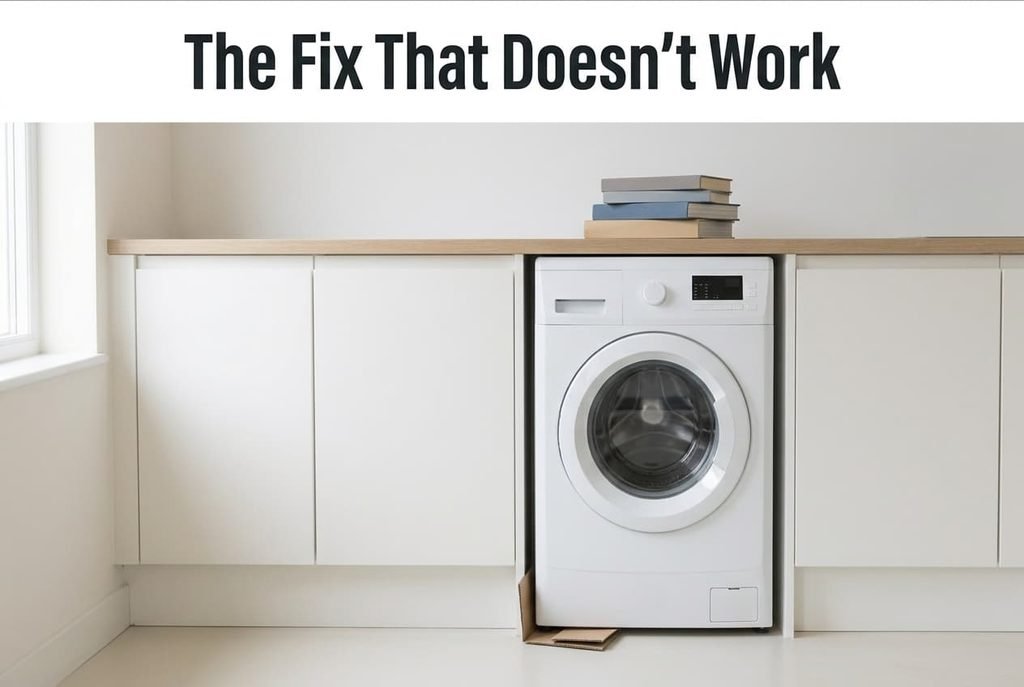
The Fix That Doesn’t Work
Folding cardboard under the short foot is the usual first reach, and it lasts roughly a week. The cardboard compresses within a few spins. The foot lifts again, and the walk returns. It conceals the true fault, because the machine now sits level for the wrong reason, and nobody checks the load or the floor.
Piling weight on top of the machine fails as well. Extra mass raises the pull along with the grip, and it loads springs built for the drum alone. A strap tied to the cabinet fails for the same reason: the machine tugs on the cabinet door, and the hinge screws give way first.
A towel stuffed between the machine and the wall deadens the noise for a while, yet the shoves continue behind it and the hoses keep stretching.
If a washing machine that walks across the kitchen floor lives in your own alcove, begin with the diagonal push tonight and let it choose your first fix. Work down the list one step at a time, and run a single spin after each. Stop when the machine stays put through a full towel load. Most kitchens settle after fixes one and two. The pads and the plywood are for stubborn cases.
Questions Readers Keep Asking
Can a walking machine be fixed at all in a rented kitchen?
Usually yes. Levelling the feet and spreading the load need no permission, and neither does a pair of firm pads. A stiffened floor needs the landlord’s consent, though it’s rarely required. Most machines that wandered 6 cm per spin settle to a few millimetres after fixes one and two, which is hard to notice.
What does each fix cost, in relative terms?
Fixes one and two cost nothing but time. Pads cost a modest sum, about the price of a good set of tea towels. The carpenter’s panel costs noticeably more, and it needs permission. Start with the free fixes, because each later step works only on a level machine.
What is the most common cause?
A foot that carries no weight, often because shipping bolts were left in or the feet drifted after a move. The diagonal push finds it in a minute. It beats a heavy towel clump as a culprit, because a levelled machine absorbs the clump, whereas a rocking one slides on the first lurch.