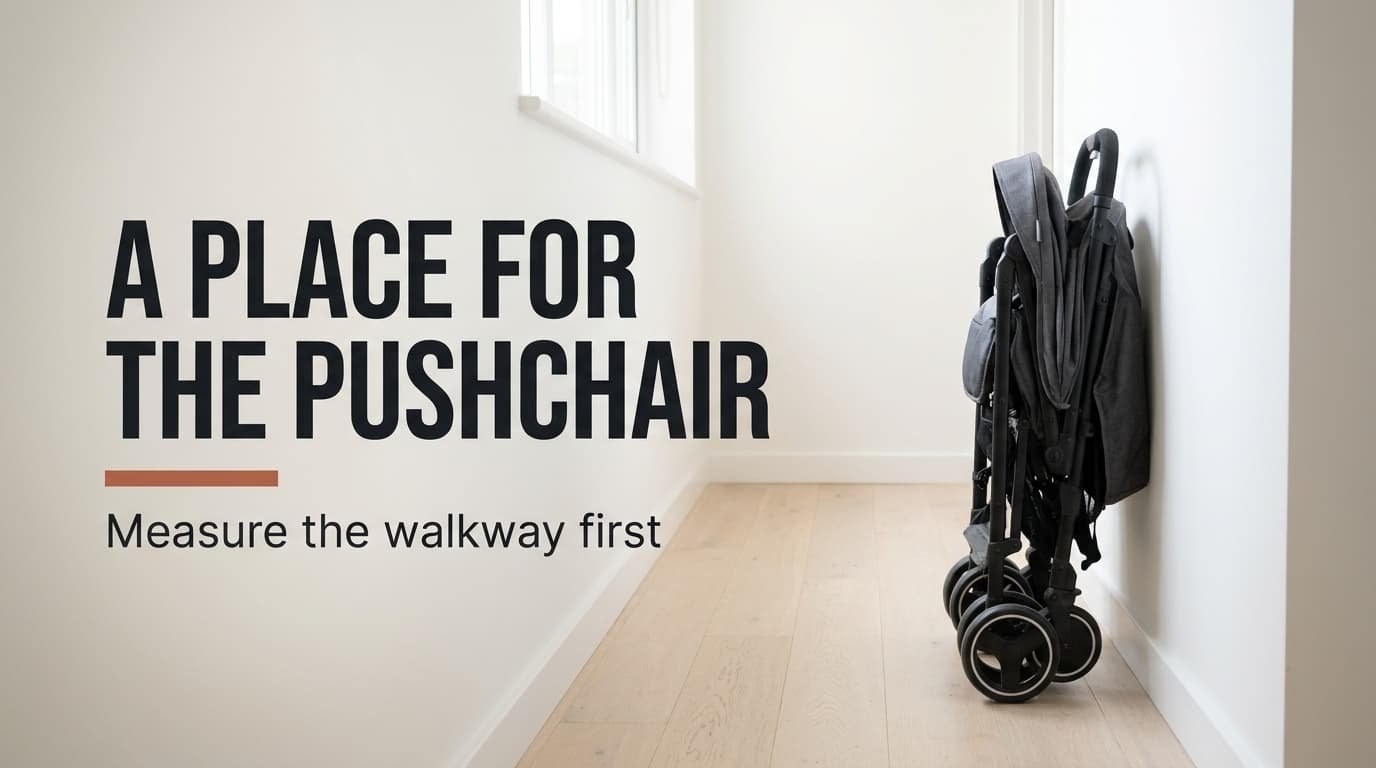
Every outing begins with the same shuffle. You fold the pushchair, wedge it against the hall wall and turn sideways to squeeze past with a bag. In a small flat with nowhere to store a pushchair, the hall pays for it, because the folded frame leaves less walkway than one adult with shopping needs. Our example flat is in Amsterdam, with an entrance hall 1 m across, and the walkway comes up 8 cm short. Every size here is assumed, so measure your own frame and hall before you buy anything. No make or price appears, and the remedies climb from free to built.
What Happens in a Small Flat With Nowhere to Store a Pushchair
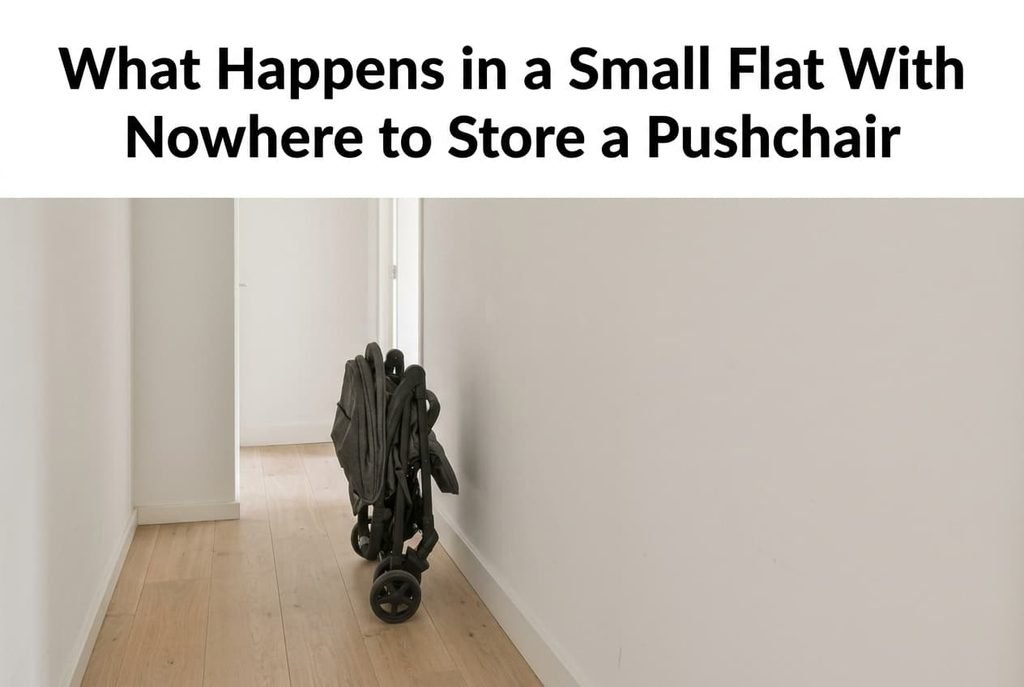
A folded pushchair is a box standing in a corridor. Ours is assumed to be 55 cm wide and 38 cm deep, standing 80 cm tall. Stood on end beside the longer wall, narrow side facing you, it claims 38 cm of the width. An adult with a bag in hand needs about 70 cm: shoulders take 50 cm and the swinging bag takes another 20 cm.
Across a hall of 100 cm the walkway beside the frame shrinks to 100 − 38 = 62 cm. The deciding comparison is the walkway left beside the folded frame set against the 70 cm you need, and the two differ by 8 cm. Turn the frame so its wide face looks into the hall and the walkway drops to 100 − 55 = 45 cm, which is 25 cm short.
Length matters less. Along the wall the frame covers 55 cm of the 380 cm hall, or 14%. So the hall still has room, yet none of it sits where you walk. That’s the squeeze. Add the real habit to the sums: each outing means a pass out and a pass back, so a 62 cm walkway gets squeezed through about 4 times a day.
Confirm Which Version of the Problem You Have
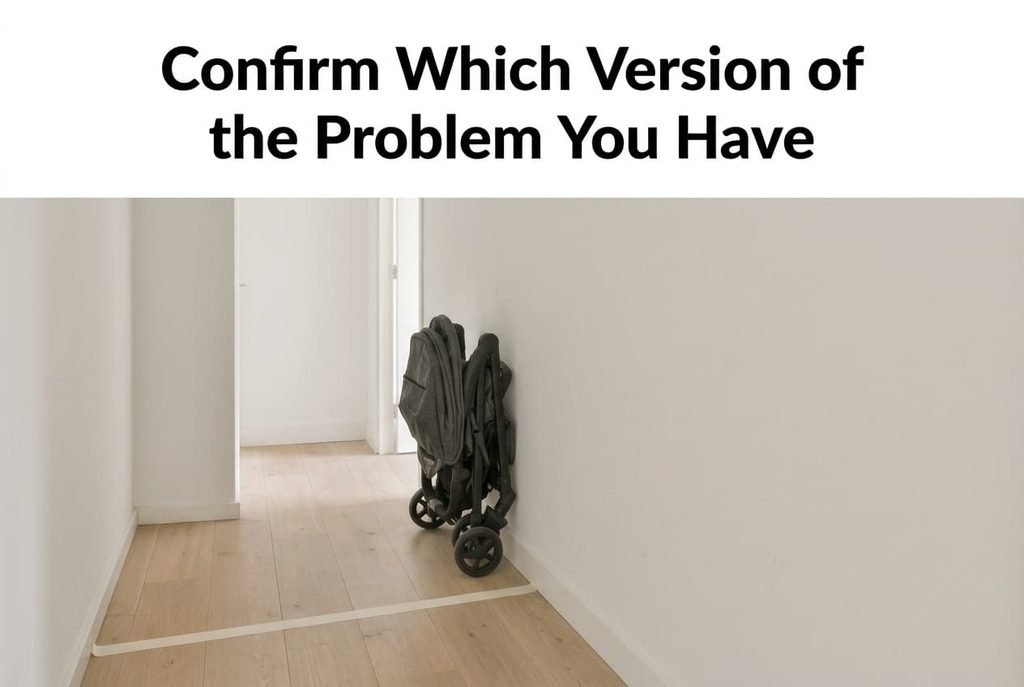
Three short tests tell the versions of a flat with nowhere to store a pushchair apart. First, measure the hall at its narrowest point and the folded frame at its deepest, then subtract. A result under 70 cm means width is the culprit, and the fixes that follow apply in order. Use a tape and not your eye, since a few centimetres hide easily at floor level.
Second, park the frame where it usually stands and open every door off the hall as far as it goes. A door that stops against the frame points to position, so write down which one it was. Sliding the frame 55 cm along the wall may settle it before anything else changes.
Third, walk through with your usual bag in one hand. Suppose it brushes the frame although your sums say you clear. Then a handle or a strap sticks out further than your tape showed. Count the true depth again with everything attached. Halls often show tests one and three at once, so descend the list of fixes until the walkway reaches 70 cm.
Where to Store a Pushchair, From Free Fixes to Built Ones
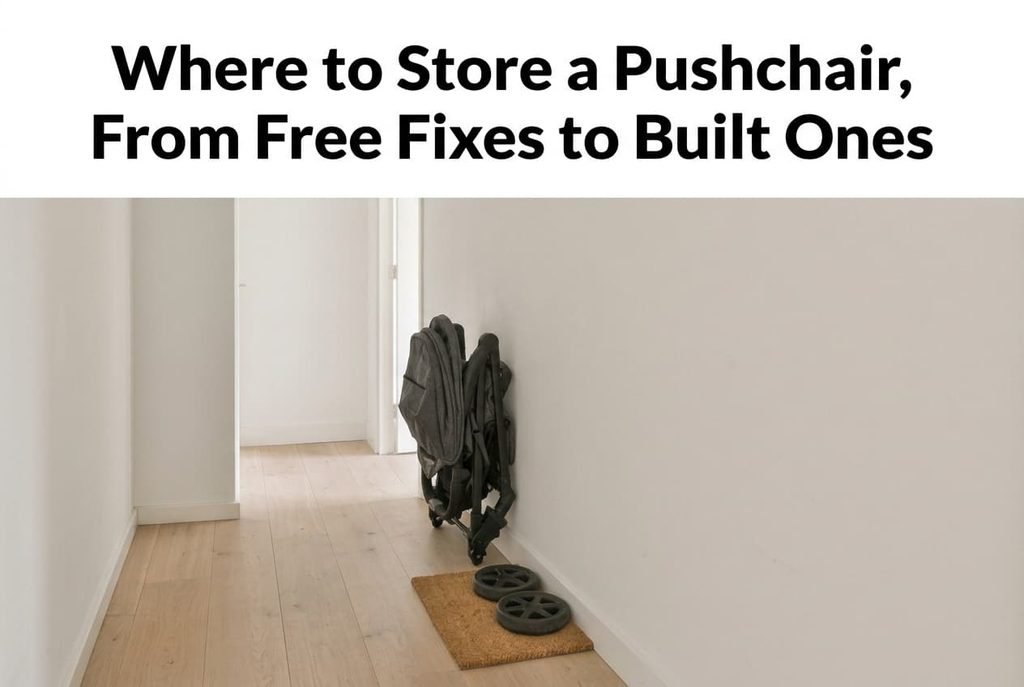
Take both rear wheels off before you park it, which shrinks the depth. Many frames have quick-release wheels, so check yours. Without them the frame stands 30 cm deep in our sums, 8 cm less. The walkway becomes 100 − 30 = 70 cm, which matches what you need, and the squeeze ends. In a flat with nowhere to store a pushchair this is the free move to try first. It costs a minute at each end of an outing, and two outings a day add up to 2 × 60 s × 365 = 43,800 s, about 12 hours a year. The margin is zero, so one bag on the handle undoes it. Give the wheels a home too, or they roll under the radiator.
Stand it in a corner of the lounge under a fitted cover, which removes it from the route altogether. The lounge is 420 by 360 cm, or 15.1 m², and the frame covers 55 × 38 = 2,090 cm², about 0.21 m². That’s 1.4% of the floor, and nobody walks through a corner, so the 70 cm rule stops applying. It costs a cover of about 60 by 45 cm and 90 cm tall. Street grit rides in on the wheels, so wipe them at the door. You also carry the frame 5 m on every outing.
Ask for a place in the building’s shared store, which moves the pushchair off your floor completely. Your flat gives up 0 m². It needs permission from the owners’ association or the landlord, and the spot has to take a lock. Each outing then starts downstairs, so you can’t change plans from the sofa and fetch it. A house rule that bans stored items in common areas ends this idea at once.
Have a carpenter convert the hall coat cupboard, which gives the frame an enclosure sized to it. The interior measures 62 by 40 cm, and the frame at 55 by 38 cm fits with 7 cm spare in width and 2 cm in depth. The shelves and rail come out and a floor stop goes in. Expect a few hours of carpenter time and some materials, and find the coats a new home first. With 2 cm to spare, a bag left hanging stops the door from closing. If you rent, get the landlord’s written yes first.
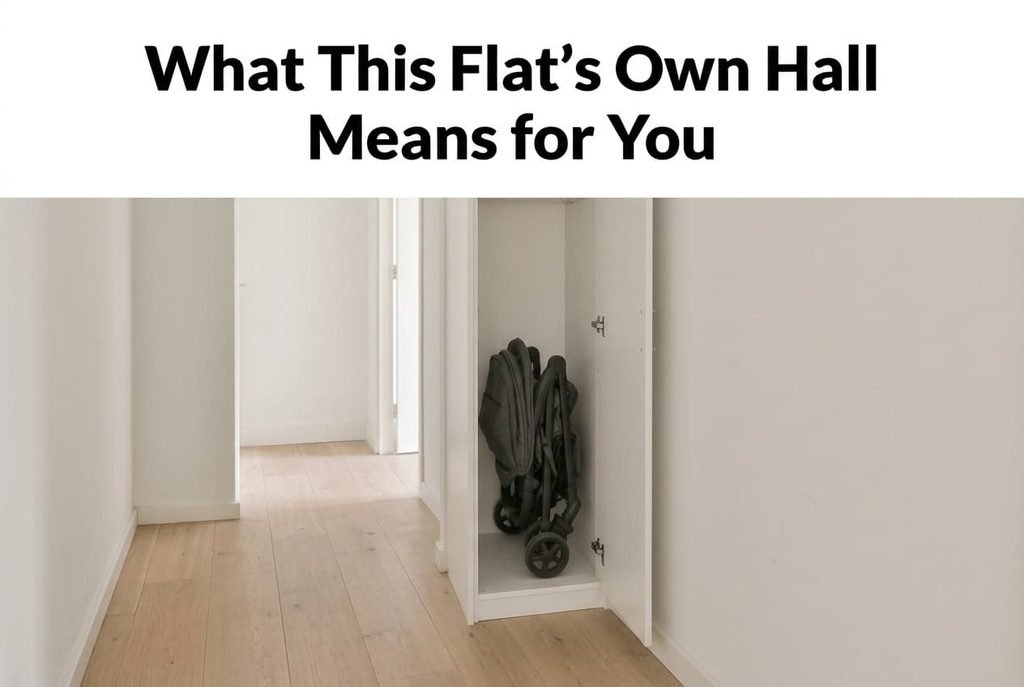
What This Flat’s Own Hall Means for You
Some things here can move, and some can’t. The frame and its wheels can change, and a cover is the only object you might add. The hall can’t. Its width stays at 100 cm because a load-bearing wall runs down one side, and its 380 cm length stays too. Nothing on the plan lets you widen the walkway, so every choice is about the frame.
The coat cupboard goes 40 cm back before it meets a party wall shared with the neighbours, so deepening it by 5 cm isn’t possible. Its door is 62 cm wide and the lounge door takes 83 cm of the same wall. That leaves 380 − 62 − 83 = 235 cm of free wall, and the frame needs 55 cm of it, about 23%.
Fixed figures go on the plan first, and everything else gets drawn around them.
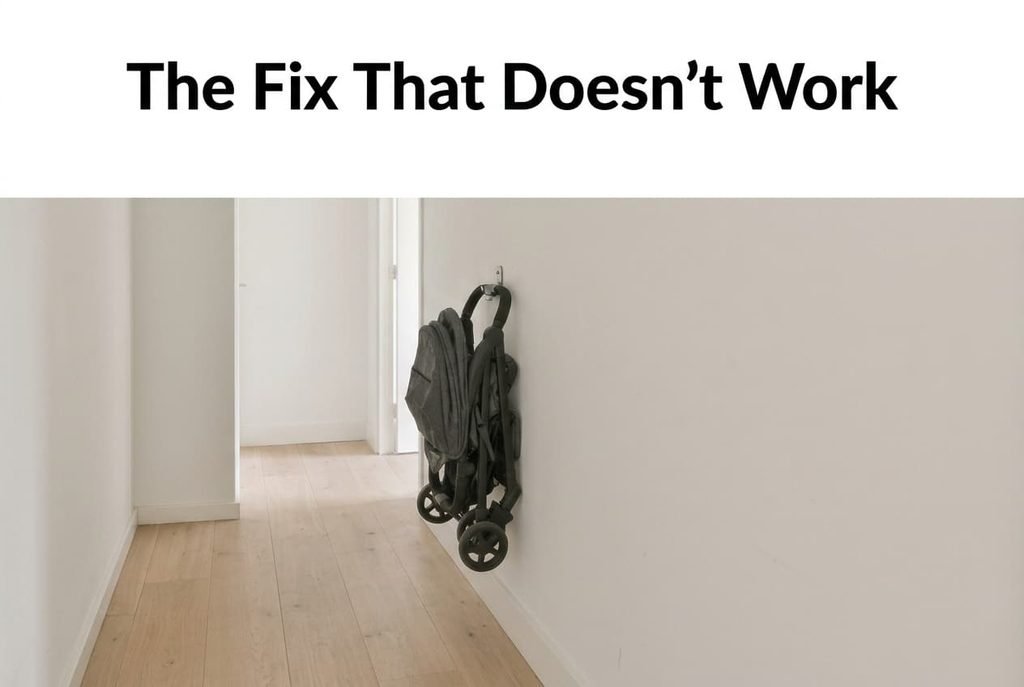
The Fix That Doesn’t Work
Hanging the folded pushchair on a wall hook seems the natural answer, but it works at the wrong height. A frame hung by its handle from 100 to 180 cm still juts 38 cm into the hall, and that band is exactly where shoulders and bags travel. The walkway at that height stays 62 cm, the shortfall stays 8 cm, and the frame now swings when you brush past. Hooks also mean drilled holes in a rented wall, which you’ll have to explain when the tenancy ends. Each brush past the frame tugs at the fixing too, and a stronger hook leaves the geometry alone.
A cover in the hall protects the fabric and leaves the 38 cm untouched. A lighter second frame kept in the hall leaves the shortfall where it was, since depth stays the same.
Depth and place decide this, not weight.
Try the wheels first and the corner second. A flat with nowhere to store a pushchair needs 8 cm back, and the wheels supply them. Measure the folded depth tonight and take the wheels off tomorrow. Next, carry a bag through the hall before spending a thing. A zero margin stays honest only when nothing hangs from the handle. Check after a week whether your bag still brushes anything.
Questions Readers Keep Asking
Can a narrow hall ever work as the parking spot?
Only if the walkway beside the folded frame stays at about 70 cm or more. In our hall that happens just with the wheels off, at exactly 70 cm. Anything narrower means the frame must get smaller or go elsewhere. Measure your hall at its tightest point, because that’s where the squeeze begins.
How much should I spend on solving this?
Spend in proportion to what you gain. Wheels off cost nothing but 12 hours a year, and the lounge cover is the only purchase in the first three fixes. Carpenter time is the largest outlay, so keep it for a flat where no corner or shared store exists.
Why does my hall still feel blocked with the wheels off?
Usually something hangs from the handle. A bag sticking out 15 cm lifts the real depth to 30 + 15 = 45 cm, and the walkway falls to 100 − 45 = 55 cm, which is 15 cm short of the 70 you need. Hang the bag somewhere other than the frame.