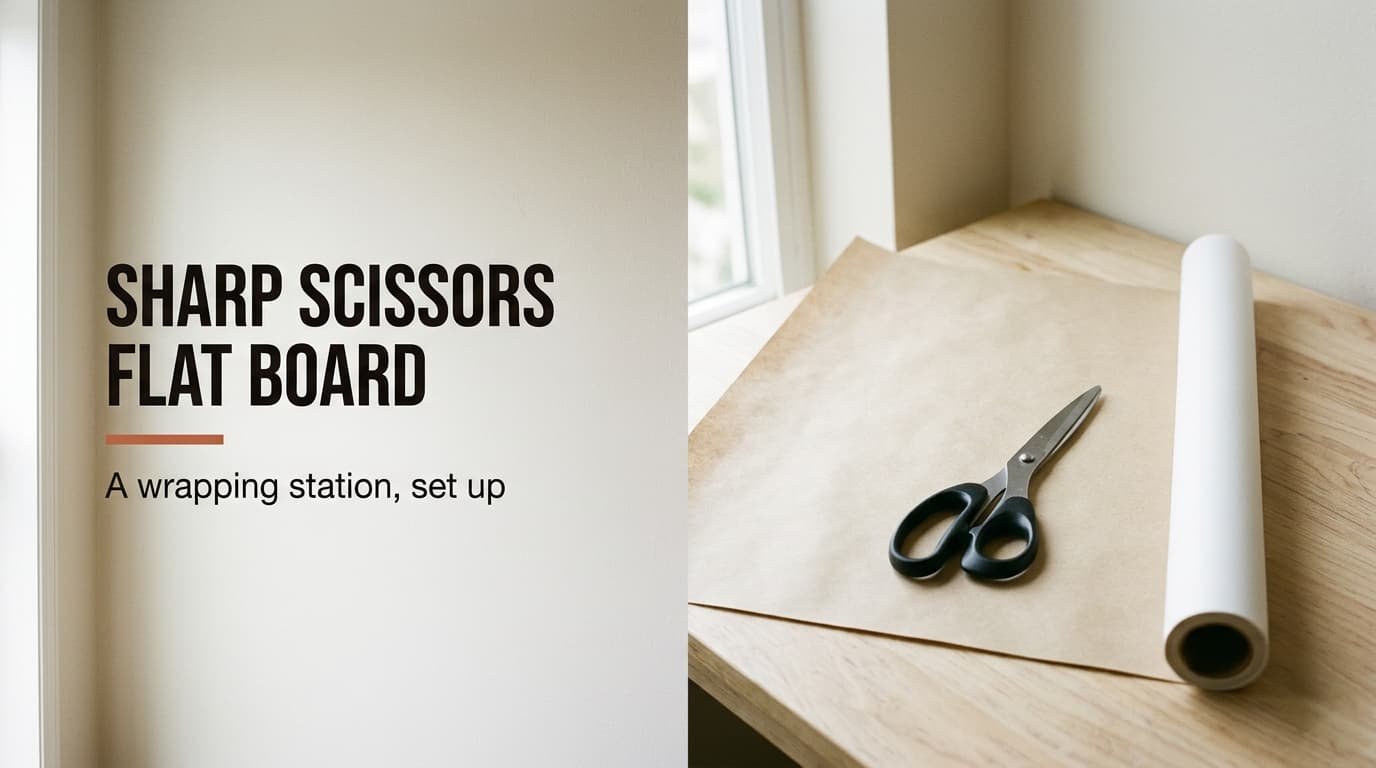
Why does a gift in good paper still look crumpled at the corners? Usually the cut was ragged and the surface was too small to lay the sheet flat. Five purchases build a gift wrapping station in a small flat, and the scissors matter more than the other four together. Our case is a Groningen living room with a 160 cm dining table beside a sideboard that has 90 cm of spare shelf. Follow the sequence below until a box takes six minutes rather than nine. All figures are samples, so measure your own.
What Decides a Gift Wrapping Station in a Small Flat
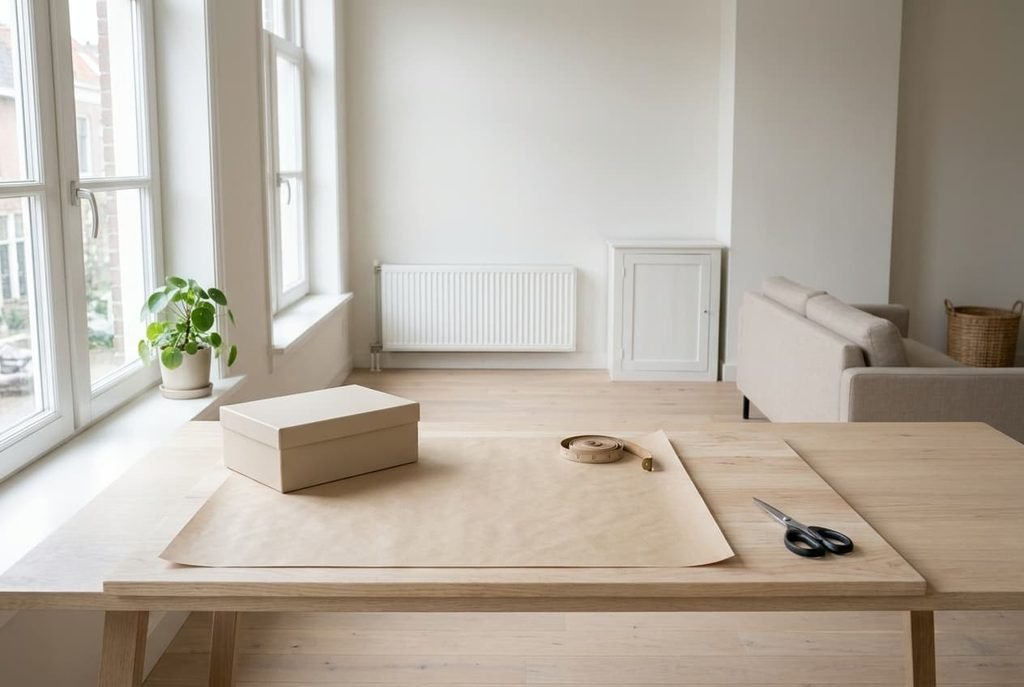
Wrapping is a measuring job dressed up as a craft. Take a box of 30 × 25 × 10 cm. The paper must go once round its 25 × 10 cm cross-section. That is 2 × (25 + 10) = 70 cm, plus 3 cm of overlap, so 73 cm. The other direction covers the 30 cm length and half the height at each end, 30 + 10 = 40 cm. The sheet is therefore 73 × 40 cm, or 2,920 cm², and a roll 50 cm wide leaves 10 cm to spare.
How straight that sheet is cut sets the finish. A crooked edge shows at every fold, and nothing bought later hides it. Fourteen gifts a year at six minutes each with a clean cut come to 84 minutes, against 126 minutes at nine. That’s 42 minutes saved. Paper adds up as well. Fourteen sheets of 0.73 m make 10.2 m, or 3.4 rolls of 3 m, so four with a little waste.
Two limits come with a small flat. The station has to vanish when the last bow is on. A sheet 73 cm long also needs a flat surface of at least 75 cm. Settle the cutting tool and the surface before anything else.
Five Purchases in Order, Dearest Mistake First
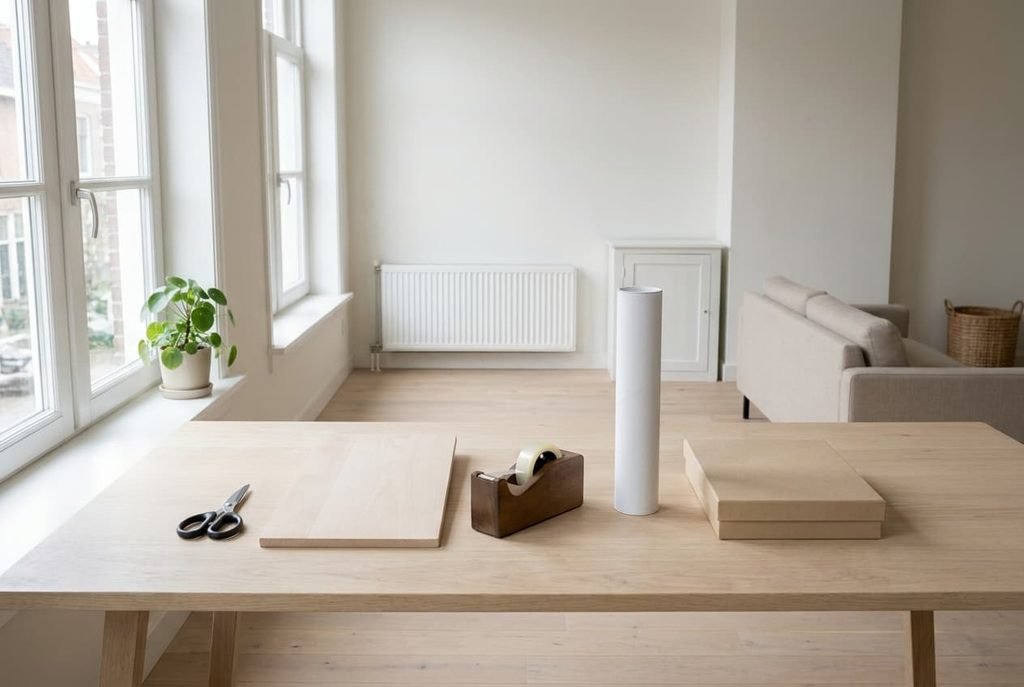
1. Paper scissors with 10 cm blades come first, as every later purchase builds on a cut edge. Tier: BUY ONCE. The two blades should meet along their whole length with no gap, and the pivot should feel tight. A loose pivot lets the blades part, so the paper folds into the gap instead of being cut. Slice a strip of thin paper from heel to tip at the counter and look for a clean line. Reserve the pair for paper, since card dulls the edge faster than any other job.
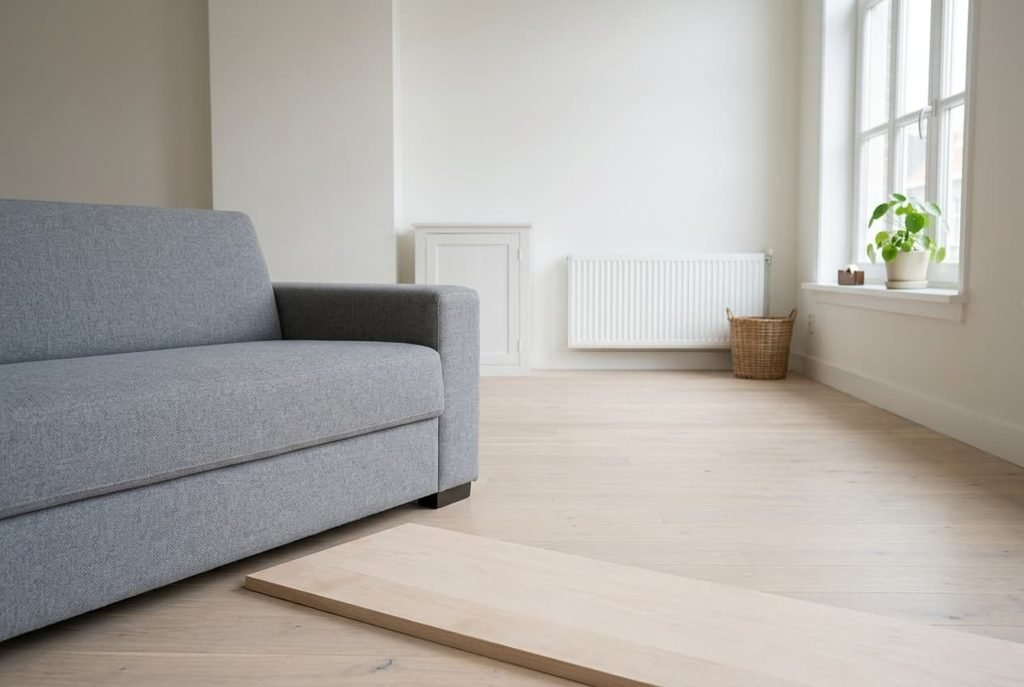
2. Next comes a rigid work board of 90 × 60 cm, because the 73 cm sheet needs somewhere flat to lie. Tier: MID. A solid core stays level across the span. A hollow board dips in the middle and drags the sheet out of line. Press a palm on the centre and watch for sagging. A matt face lets paper grip, and a thickness near 8 mm still slides under a sofa with a 9 cm gap.
3. Third is a weighted tape dispenser for 19 mm tape, since a slipping dispenser undoes a straight cut. Tier: MID. A base of about 250 g stays put when one hand pulls the tape. A light plastic base slides across the board and tears the strip crooked. Pull sharply with one hand to test it. Choose a metal cutting edge, because plastic teeth chew the tape.
4. Fourth is a tall roll holder. It’s 20 cm square and 55 cm high. Tier: BUY CHEAP. Its job is only to keep rolls upright, so a rigid one-piece body with no seams has nothing to split. A holder shorter than the 50 cm rolls lets them lean, and a leaning roll crushes its end. Check the height against your longest roll before paying, because a roll sold wider than 50 cm needs a taller holder.
5. Last is a lidded flat box for ribbon and spare sheets. It measures 60 × 40 cm in plan and stands 12 cm high. Tier: BUY CHEAP. Corners folded from one piece of board outlast glued ones. Press the middle of the lid, because a lid that bows never stays shut. The box slides under a bed beside the board, so a gift wrapping station in a small flat keeps everything in one place.
Why the Roll Holder Is the Item to Scale Down
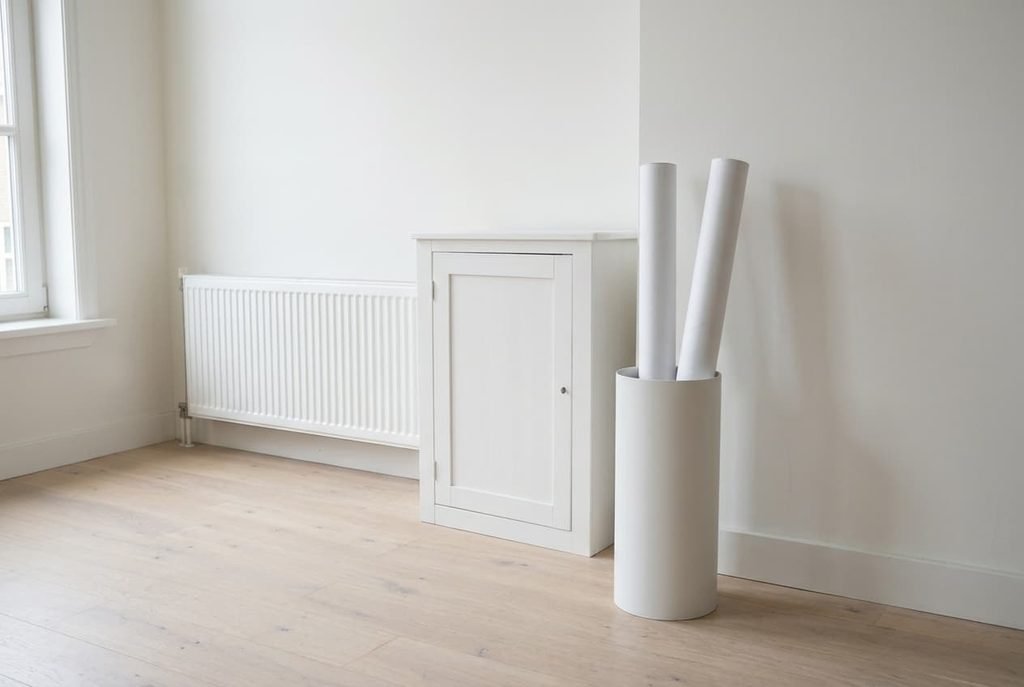
The holder is the easiest purchase to drop from a gift wrapping station in a small flat. You use about four rolls a year, so no more than two sit in storage at any time. Two rolls of 5 cm across need a footprint of 10 × 5 cm. A holder 20 cm square claims 400 cm² of floor to store them. In our room the free floor beside the sideboard is 30 × 30 cm. The holder would leave 5 cm each side and still block the cupboard door.
The umbrella stand you already own will hold two rolls upright, and a tall carrier bag does the same job behind a sofa. A bag 55 cm high keeps the rolls straight, and costs nothing. The holder changes nothing visible, and the umbrella stand returns to its old job when the paper runs out. Buy the holder only if you stock more than four rolls, as happens when paper is bought for the whole year, and you’ll know that by January.
Keep the saving for the scissors and the board, since both change how a gift looks.
Habits That Keep a Wrapping Station in a Small Flat Tidy
Do the year’s gifts in as few sessions as you can. Setting up and clearing away takes about five minutes each time. Four gifts in one session cost 4 × 6 + 5 = 29 minutes. Four sessions of one gift each cost 4 × (6 + 5) = 44 minutes, so batching saves 15.
Cut the sheet before you touch the tape. Measure with the box itself, laying it on the paper and marking the overlap with a fingernail. Crease each fold against the edge of the board, because a sharp crease needs no extra tape.
Collect the offcuts in the carrier bag as you go. Slide the board under the sofa and put the scissors in a drawer, so the station is gone within three minutes. Leave the lid off the box while you work, and the spare sheets stay within reach.
Return the dispenser to the box once you finish, so it can’t roll off a shelf.
What to Skip
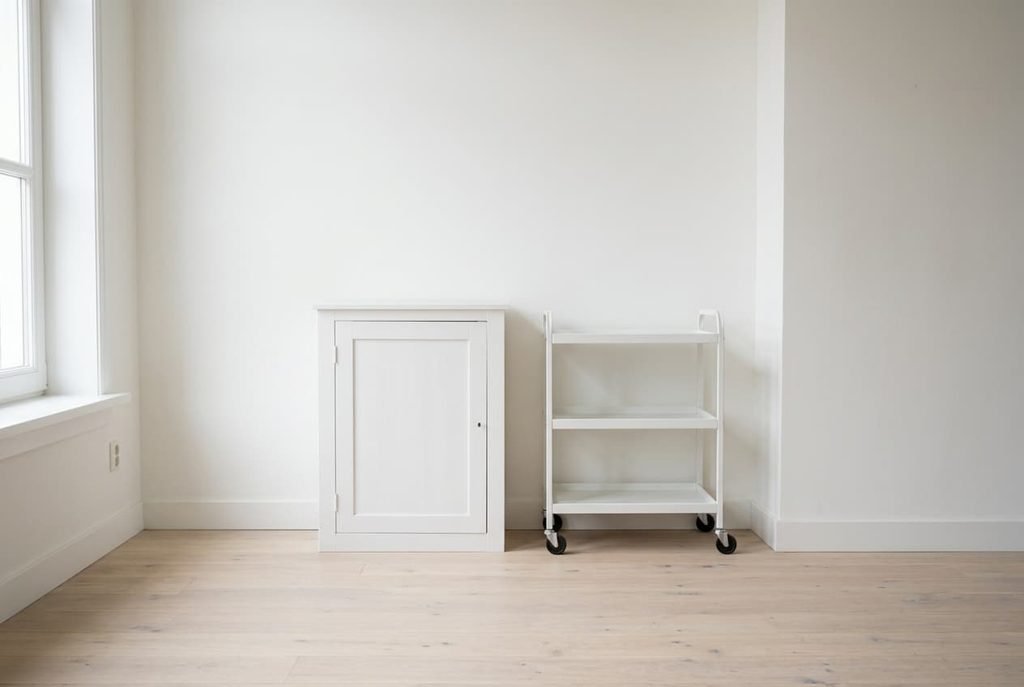
Skip the wrapping trolley, which claims 1,800 cm² of floor all year for 84 minutes of use. A trolley measuring 45 × 40 cm doesn’t fold, and it stays out in a flat where every wall is spoken for. Skip bow-makers and ribbon sets, since one spool of ribbon covers a year of gifts. Skip a rotary cutter and a ruler set too: the edge of the box and the edge of the board already give a straight line. Bundles of pre-cut sheets fit one box size only, and the 73 × 40 cm sheet above won’t be among them. A second pair of scissors adds nothing either, because the first already does the cutting.
Stop buying once a box takes six minutes with straight corners. The scissors and the board come first in nearly every flat, and the rest can wait. What lasts is a corner that disappears in three minutes, not any single item on the list, and you’ll feel the difference within a month. Put the savings into sharper scissors, then mark a date to check the pivot. A gift wrapping station in a small flat needs very little to work well.
Questions Readers Keep Asking
How many pieces do I need to start?
Two: the scissors and the board. They give you a straight cut and a flat surface, and that’s where most of the finish comes from. Add the dispenser when the tape starts to slide, and leave the rest until a season of wrapping shows what annoys you most.
When in the year should I buy them?
Buy the scissors and the board a month before the busiest gift season, so that you can test them on spare paper. The dispenser can follow. The holder and the box can wait until you know how much paper you actually use. A quiet month gives you time to compare.
How do I judge scissors in a shop?
Open them fully and close them slowly, looking for a gap along the blades. Cut a strip of thin paper from heel to tip, and the line should be clean with no fold in the paper. Feel the pivot, because wobble there becomes ragged edges within weeks.