A mirror cabinet or open mirror spends the same patch of wall in two different ways, one by standing 14 cm proud and the other by rising higher. Our sample is a Dutch bathroom of 160 × 220 cm with a basin 60 cm wide. Its rim stands at 85 cm and its tap spout at 100 cm. The cabinet gives 39 L behind a door of glass, whereas the open version gives one shelf with room for nine bottles in its front row. Count your own items before you choose. Treat each figure below as a sample until your tape measure replaces it.
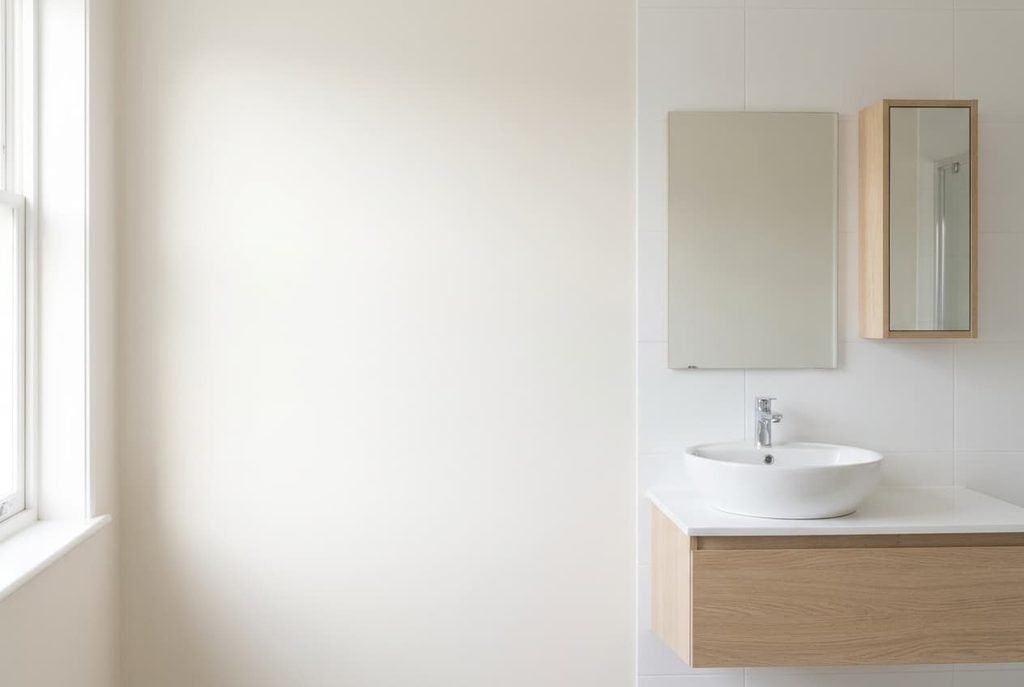
Mirror Cabinet or Open Mirror: What the Wall Band Allows
Start with the wall, because the products come second. The free band above the basin runs from the spout at 100 cm up to 200 cm. That’s 100 cm of height over a width of 60 cm. Our ceiling stands at 240 cm, which leaves 40 cm above the band. Your hand needs about 20 cm of air below anything that hangs there, which puts the lowest edge at 120 cm. Each design spends that band either as depth or as height, and everything below follows from that split.
The glass has a second job, which is to show the crown of the tallest person at the basin. A flat mirror reveals the crown when its top edge is halfway between eye height and crown height. Eyes sit about 11 cm below the crown in our sample. The top edge may therefore be at most 5.5 cm lower than the crown. Whether a mirror cabinet or open mirror suits a household can hinge on that single figure. A cabinet topping out at 185 cm serves anyone up to 190 cm, and a glass reaching 200 cm serves anyone up to 205 cm.
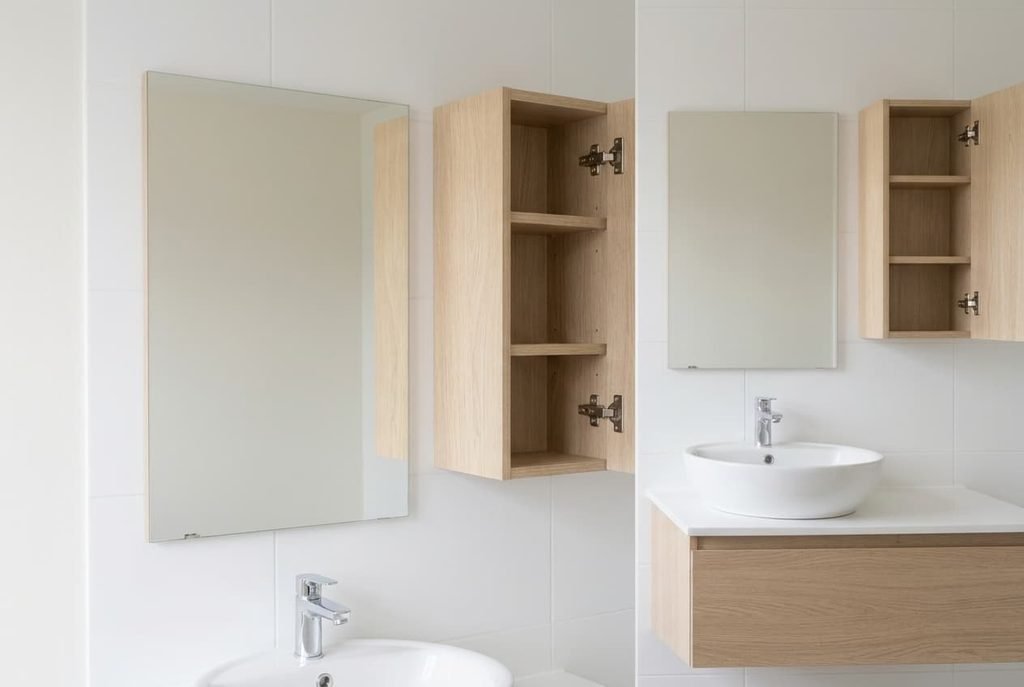
A Mirror Cabinet Against an Open Mirror and Shelf
Both designs share the 60 cm width. The cabinet is 65 cm tall and 14 cm deep, and every panel of its body is 2 cm thick apart from two inner boards of 1.5 cm. The open version is a plain glass of 60 × 67 cm hung from 133 cm, above a shelf 60 cm wide and 12 cm deep, its top face at 120 cm. Bottles get 13 cm of clearance between shelf and glass.
| Property | Mirror cabinet | Open mirror with shelf |
|---|---|---|
| Glass area | 3,900 cm², door 60 × 65 cm | 4,020 cm², glass 60 × 67 cm |
| Tallest person whose crown shows | 190 cm | 205 cm |
| Depth added to the wall | 14 cm over the whole face | 12 cm, shelf only |
| Bottles of 6 cm in a front row | 27, in three compartments | 9, on one shelf |
| Tallest item that fits | 19 cm in a compartment | 13 cm before it covers the glass |
| Holes in the wall | 2 | 4 |
| Dust and splashes | Doors keep them out | Open to both |
The glass areas differ by only 3%. The deciding factors are the count of items and how tall your household is, because one option holds three times as many bottles while the other lets taller people see their crowns.
The Cabinet Behind the Glass: Strengths and Limits
Strip off the 2 cm panels and the inside measures 56 × 12 cm. The clear height is 58 cm once the two boards take 3 cm. The three compartments therefore stand about 19 cm tall each. Volume comes to 56 × 12 × 58 = 38,976 cm³, which is 39 L. Nine bottles of 6 cm lie along each compartment, which makes 27 in all.
The strength is concealment. Doors close on the clutter and keep out dust. A cabinet also needs only two holes for its hanging plate, a smaller bill when you rent.
The limits are projection and tall items. In our sample you put your nose 22 cm off the wall when you lean in to check a tooth. A cabinet face at 14 cm leaves 8 cm of room for your face, where plain glass would leave nearly all 22 cm. Anything taller than 19 cm, such as a can of spray, can’t stand upright in a compartment. The door also tops out at 185 cm, which caps the tallest visible crown at 190 cm.
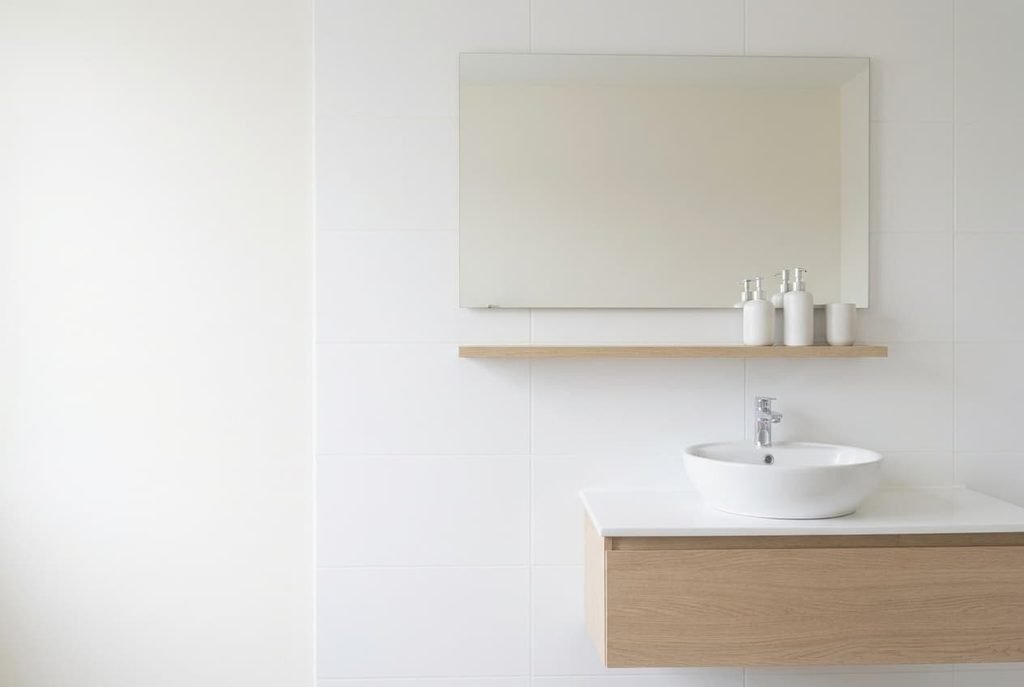
The Open Glass With a Shelf: Strengths and Limits
Hung from 133 cm, the glass of 60 × 67 cm reaches 200 cm and covers 4,020 cm². That’s 3% more than the cabinet door, but the real gain is the top edge. It lets anyone up to 205 cm see their crown, which a cabinet capped at 185 cm can’t do.
The shelf holds less. Its clear run of 56 cm takes nine bottles of 6 cm across, with a second row behind them that your hand reaches only by lifting the first. Standing space of 56 × 12 × 13 cm comes to 8.7 L. A mirror cabinet or open mirror with a shelf therefore splits the storage unevenly, the open side holding roughly 22% of the cabinet’s 39 L.
The limits are display and fixings. Everything on the shelf is in view and has to look tidy. Anything that slips falls 35 cm onto the basin. The glass takes two holes and the shelf brackets take two more, four in all.
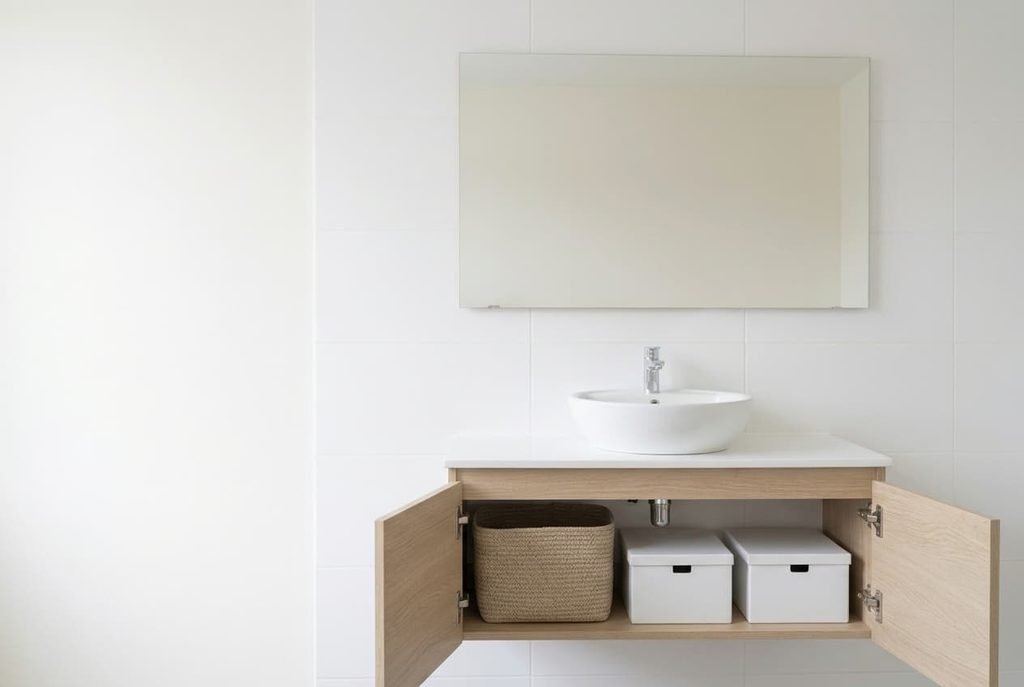
A Third Route: Keep a Plain Mirror and Store Below
Before you buy either, measure the cupboard under the basin. Take the clear space only, ignoring the pipes. If it comes to 40 × 25 × 25 cm, that’s 25,000 cm³, or 25 L. Such a volume means the cupboard may already hold 64% of what the cabinet offers, and it takes a 22 cm spray that the cabinet’s compartments can’t.
A plain mirror then needs only the size that shows your crown. A frameless glass of 60 × 70 cm hung at 130 cm reaches 200 cm and needs only two holes. Its top edge matches the open version, which keeps crowns up to 205 cm in view. The rim keeps a cup for the brush and paste, while the lidded boxes live below. Heavy refills sit better on that floor than on any board hung from tiles. The door hides them, and the wall above can stay quiet. Close the door with the boxes in place and watch it latch.
Leave the bathroom alone if it already works.
Which One to Choose for Your Bathroom
Tally the bottles on your basin rim today and find the tallest. A mirror cabinet or open mirror stands or falls on those two numbers.
If you count nine items or fewer and none stands above 13 cm, choose the open mirror with its shelf. The whole front row stays in view, and the glass rises to 200 cm, which shows crowns up to 205 cm.
If you count ten or more, or a single item stands 14 to 19 cm tall, choose the cabinet, provided the tallest crown at home is 190 cm or lower. A taller person points to the open glass instead, and the overflow goes under the basin.
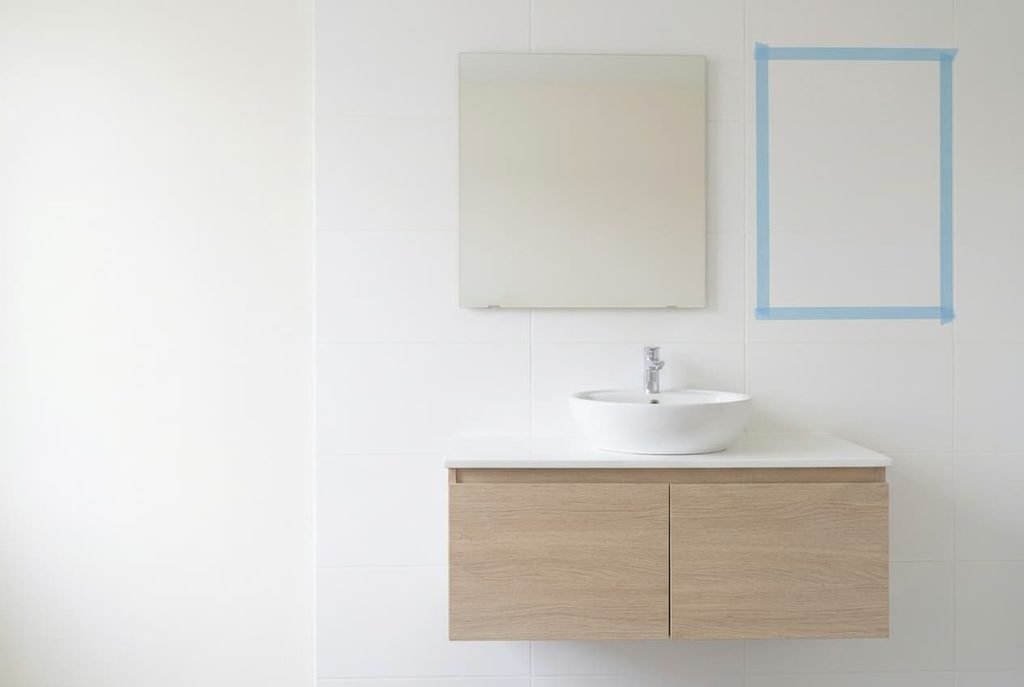
Stand at the basin through a normal evening with a rectangle of 60 × 65 cm masked on the tiles, its lower edge 120 cm up. Lean in as you do for a close look, then hold a ruler from your nose to the wall. Subtract 14 cm for the cabinet, and what remains is the room your face would really have. Keep the tape up for seven days before any drilling.
Questions Readers Keep Asking
How long does a bathroom mirror last on the wall?
Years, if the edges stay dry. Water creeping behind the glass can darken its coating at the rim. A cabinet adds hinges that wear first. Tighten their screws each spring. Open glass has nothing that moves, but the shelf brackets carry the load of every bottle and need the same check.
Which one is easier to keep clean?
The cabinet. Its doors hold back dust and splashes, and you wipe the inside monthly and the glass when it smears. Open shelves collect dust and splashes alike, which calls for a weekly cloth, and bottles on the rim leave rings that you must lift each time you clean the shelf.
Which suits a rented bathroom with tiled walls?
The cabinet usually does, because it needs two holes where the open version needs four, and every hole in a tile is a repair. A lease that forbids drilling points to neither. Keep the present mirror and let the cupboard under the basin carry the storage.

