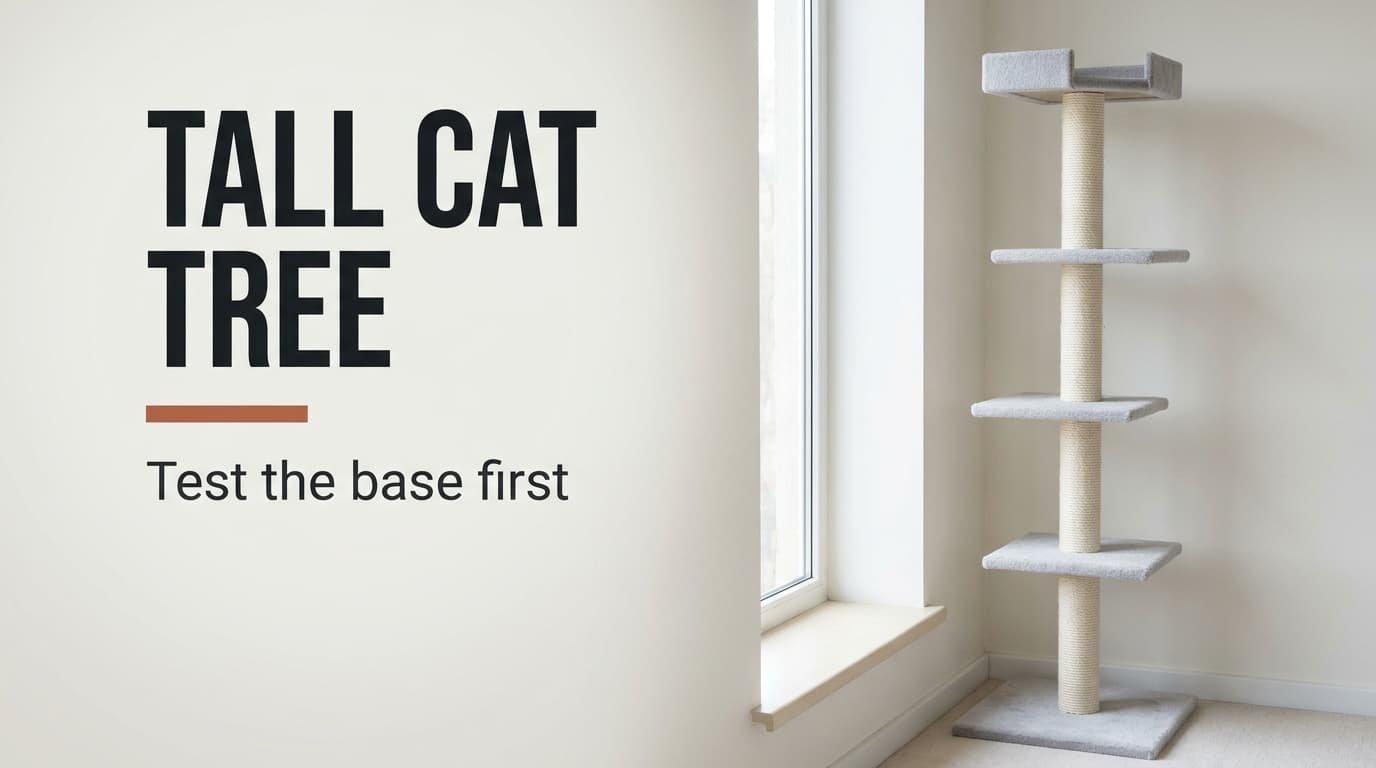
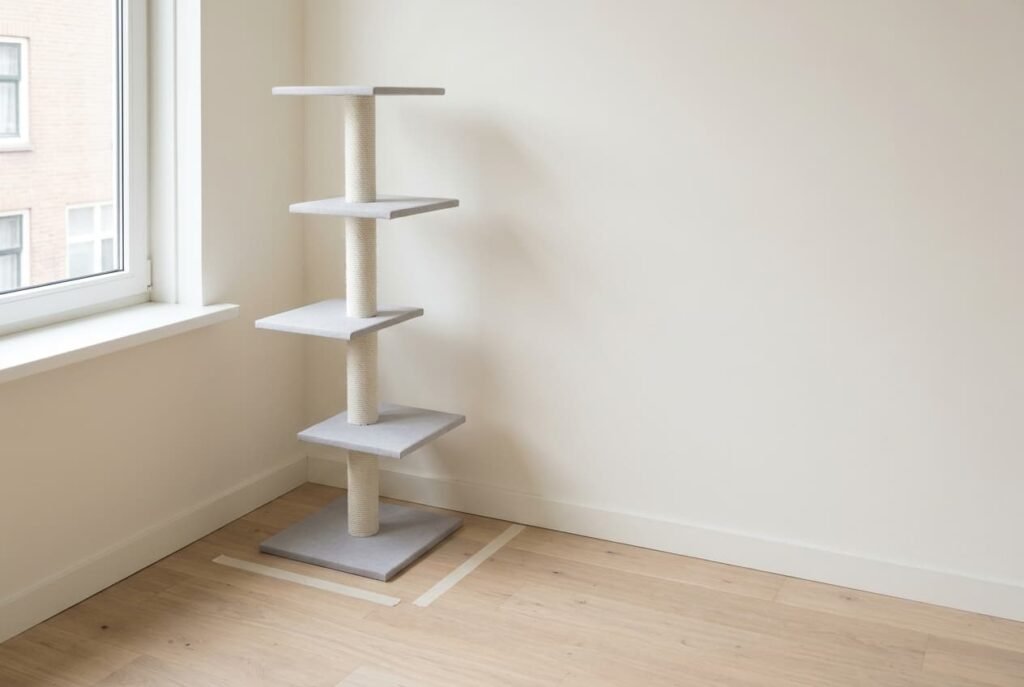
A tall cat tree belongs in a corner where two walls stop it tipping, beside a window sill at a comfortable step height and outside the route you walk daily. Our sample is a Utrecht rental with a 360 by 480 cm lounge and a sofa 90 cm in depth. The tree stands 160 cm high on a square base 50 cm along each side and weighs 14 kg. All of these sizes are assumed. Swap in your own. A drill is off limits in a rental, which means the position has to do all the work.
Why a Tall Cat Tree Needs Three Measurements Before Anything Else
Tipping comes first. Once it stands free, a tall cat tree overturns when a push at the top wins against its own weight. Put the centre of mass 70 cm up, over a base 50 cm wide, which makes the half-width 25 cm. The tree’s weight is 14 × 9.81 N, which is 137 N. Its turning effect at the base is 137 × 0.25 = 34 N·m. The 160 cm top perch gives a lever arm of 1.6 m. A push of 34 ÷ 1.6 = 21 N therefore tips the tree. Assume a 5 kg cat lands on that perch and delivers 25 N sideways. A base 70 cm wide lifts the overturning push to 30 N, enough to hold the same landing. The wider base takes 0.49 m² instead of 0.25 m², which is 2.8% of our 17.3 m² room against 1.4%.
Weight decides the spot before looks do.
Reach comes next. Assume a comfortable step of 40 cm between perches, which gives four platforms in 160 cm. A window sill at 85 cm puts the third platform, at 120 cm, just 35 cm above it. A sill 70 cm above the lowest platform wastes the whole climb.
Floor space around the base is the final measurement. Allow 60 cm in front for the jump down. Keep 90 cm free for people to pass, since 90 cm leaves 45 cm to spare beyond a 45 cm shoulder width.

Four Places for Tall Cat Trees in the Room
Each spot is judged on tipping, then step height, then walkway. Looks only break a tie.
– East corner beside the window: two walls block a fall in two directions. A cat leaping on from the room side pushes the tree towards the walls, which hold it. A leap along either wall meets the other wall. The sill at 85 cm lines up with the third platform for a 35 cm step. The sofa end stays 120 cm away, which leaves 30 cm to spare over the 90 cm walkway. Birds on the street keep the cat busy all afternoon. We chose this spot.
– North wall behind the sofa end: one wall protects one side only. A landing from the long side of the wall pushes the tree sideways, and nothing stops that. The route to the kitchen door also narrows to 70 cm, which is tight for anyone with a tray or a laundry basket.
– Beside the television: the 160 cm top perch puts a landing cat within 30 cm of a glass edge, and the tree blocks part of the screen from the best seat on the sofa. Cat hair would also collect on the speaker grille.
– Free-standing as a room divider: no wall helps. The tree blocks the straight path from doorway to window, and every visitor walks around it. It also stands 180 cm from the nearest wall, where nothing stops a fall.
Four Mistakes That Make the Whole Thing a Nuisance
Trouble usually begins on delivery day with a shortcut. Each of these is harder to reverse than to prevent.
Choosing by height alone. A 200 cm tree of the same weight on the same 50 cm base tips at 34 ÷ 2.0 = 17 N, which is easier to push over than the 160 cm tree at 21 N. The extra height only lengthens the lever. Widen the base to 70 cm or pick a corner, and the tipping push climbs again.
Leaving the tree in the walkway. With 70 cm between tree and sofa, only 25 cm remains beside a 45 cm shoulder width. Anyone carrying a tray turns sideways. A 90 cm gap doesn’t. Guests will also pass the tree without brushing its fabric, which keeps the cat’s route undisturbed. Bring the shopping to the kitchen once with the tree in place, and you will know.
Setting the top perch beside fragile things. A cat can land 20 to 30 cm away from where it took off. A shelf of ornaments 30 cm from the top platform invites a knock. Keep lamps and glass 60 cm or more away from the highest platform, and the breakages stop.
Planning to bolt it to the wall. A bracket needs holes that a landlord hasn’t agreed to. A corner gives most of the same protection without marking the plaster. It costs nothing, and moving out leaves nothing to fill. Look at your tenancy terms before reaching for a drill.
Mark the footprint on the floor before you order anything.
When the Quietest Corner Is the Wrong Corner
Common advice puts a tall cat tree in the quietest corner, away from the household. In our room that’s the north-west corner, 4 m from the sofa. A tree there gets climbed rarely, because cats prefer a lookout with a view of the people in the room. That corner lacks a window, which removes the sill step and the main reason to climb.
I’d defend the corner nearest the sofa and the window, though it sits in plain view of the television. The cost is a large object you see every evening. A plain tone matching the paint behind it makes it recede, and a lamp standing at the far end balances the room. The tree still sits between two walls, it keeps the 35 cm step to the sill and it leaves the walkway as it was.
The quiet corner works in one case. If the cat dislikes visitors, a retreat there can suit it, and a second small post by the window can serve everyone else. The extra post costs a little floor, but the 50 cm footprint is a fair trade for a calm cat.
Three Checks Before the Tree Arrives
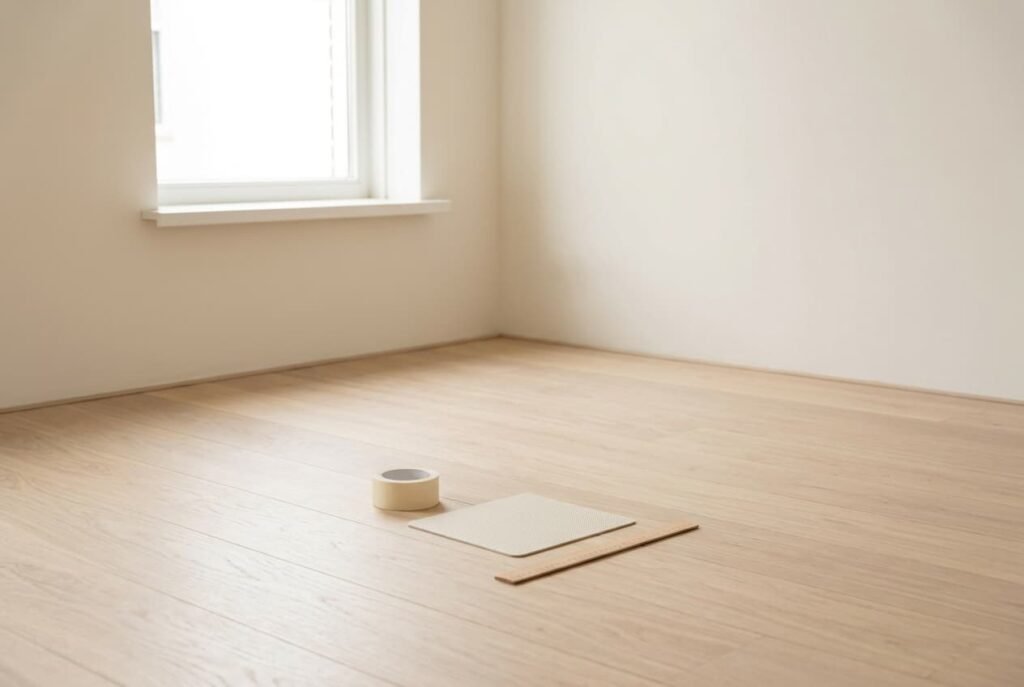
1. Mark the 50 by 50 cm footprint in the east corner with tape. Add the 60 cm landing strip and the 90 cm walkway to it, then leave the marks down for a day. Move the sofa end if anyone brushes the line, since a walkway that feels awkward on night one won’t improve with a real tree.
2. Note the sill’s height. Compare it with the platform heights in the listing for a tall cat tree, because a step of 35 to 40 cm between sill and platform suits a cat’s stride. Request each platform’s height from the seller, not only the overall height.
3. Push a loaded box of 14 kg against the corner to check that it doesn’t slide on the floor. Add anti-slip pads under the base if it does. A smooth floor can let a base creep a few centimetres each week.
A tall cat tree rewards a day of tape on the floor, and it rewards a measured base more. Settle the tipping question first and the step from the sill second. Finally, walk the walkway with a loaded tray and note anywhere it brushes the tree. Once a cat has taken to a position, moving the tree upsets everyone. Choose carefully on the first attempt.
Questions Readers Keep Asking
How tall can a cat tree be in a small room?
Height matters less than the base. A 160 cm tree on a 50 cm base tips at 21 N, while the same tree on a 70 cm base needs 30 N. Buy the tallest tree whose base you can give floor space to, and keep 90 cm clear for walking around it.
Which wall suits this kind of tree best?
A corner, because two walls block a fall in two directions. Beside the window is better still when the sill sits within 40 cm of a platform height, which gives the cat a lookout. A wall alone protects only one direction of fall.
Does sunlight affect where the tree should go?
Yes. A window perch grows warm in afternoon sun, and fabric fades over the years. Pick a platform away from the hottest hours, then choose a plain tone matching the paint behind it, and the tree blends into the room rather than shouting from it.