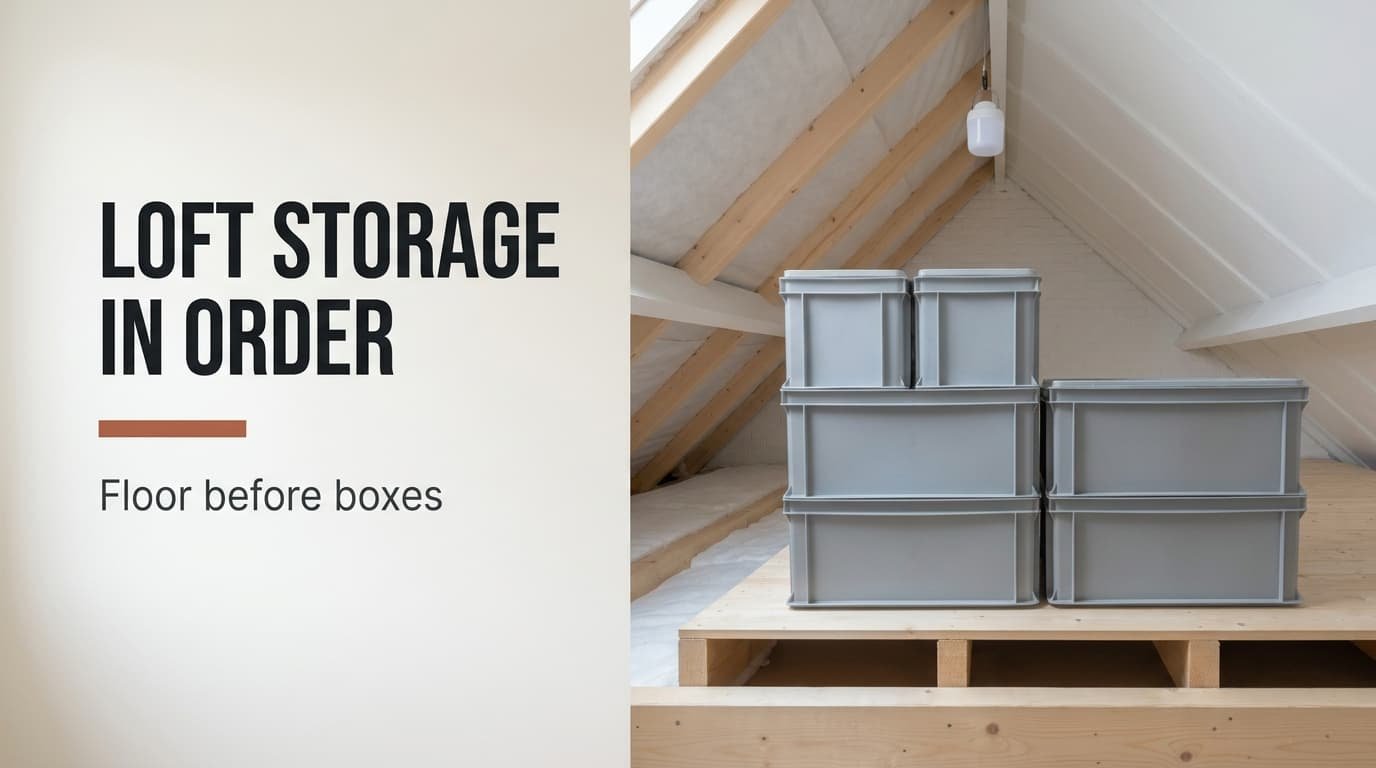
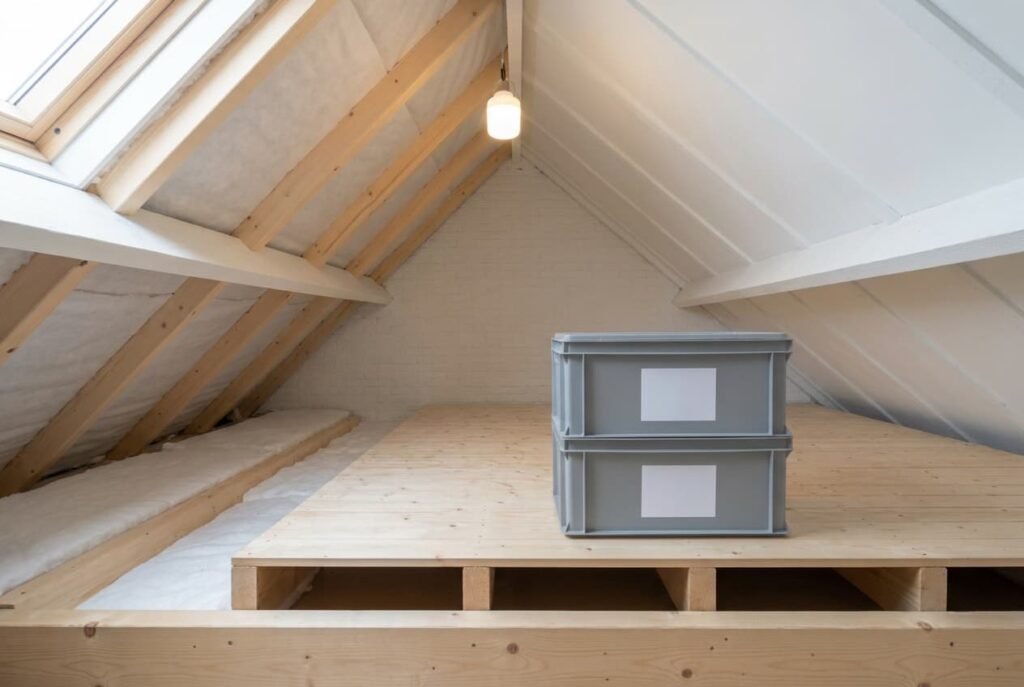
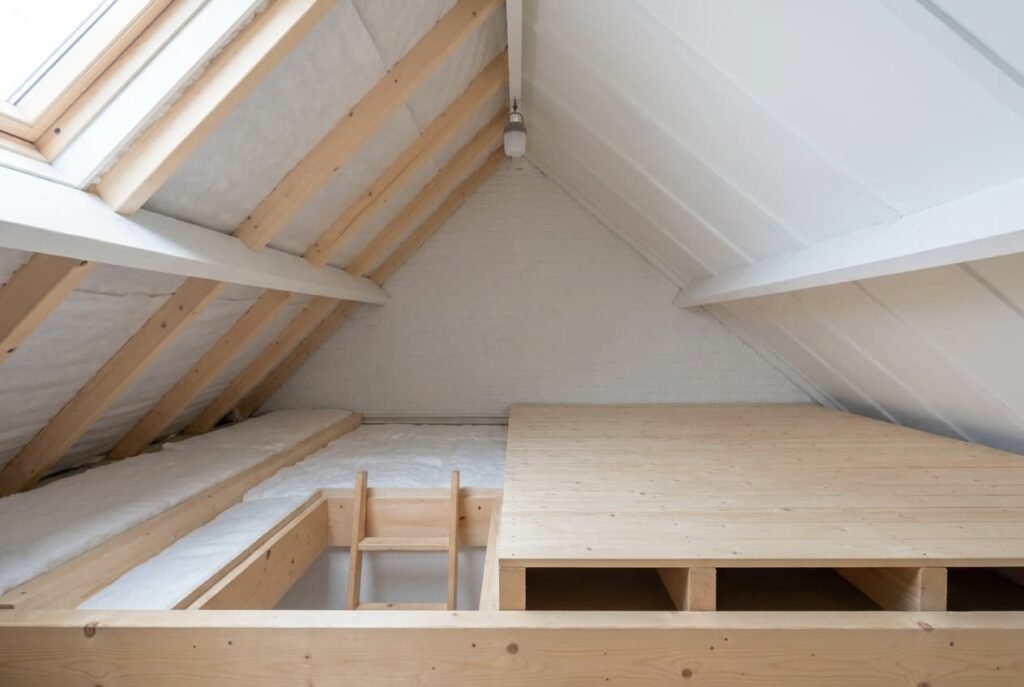
Most lofts turn into a heap beside the hatch, and the heap grows because nothing was bought in a sensible order. Keeping things used once a year up there works only when the floor arrives before the boxes, and the boxes before the light. This guide takes a Dutch terraced house through five purchases. The hatch is 60 cm square, with a platform of 120 × 120 cm beside it. Every purchase comes with its measurements, a tier showing how much effort it earns and the construction fault worth rejecting. Costs appear as tiers only, and these numbers are assumed samples.
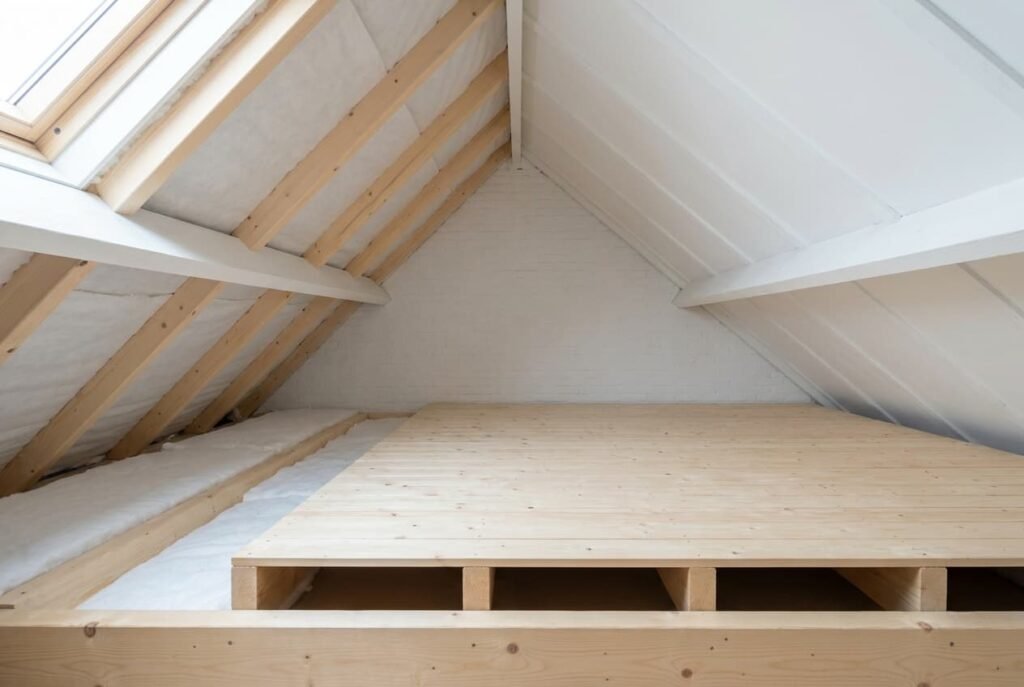
Why the Floor Comes First for Things Used Once a Year
Loft insulation works by trapping air, and a board laid straight on top squashes that air out. Our insulation is 20 cm deep. Bearers of 20 cm lift the platform clear of it. The layer keeps its full thickness and the heat stays in the house.
The floor comes before anything else for a second reason. Ceiling joists carry a ceiling, not a storeroom. We’ll assume a modest 100 kg per square metre, and you should ask a surveyor before going beyond it. Our platform covers 1.2 × 1.2 = 1.44 m², which gives a limit of 144 kg.
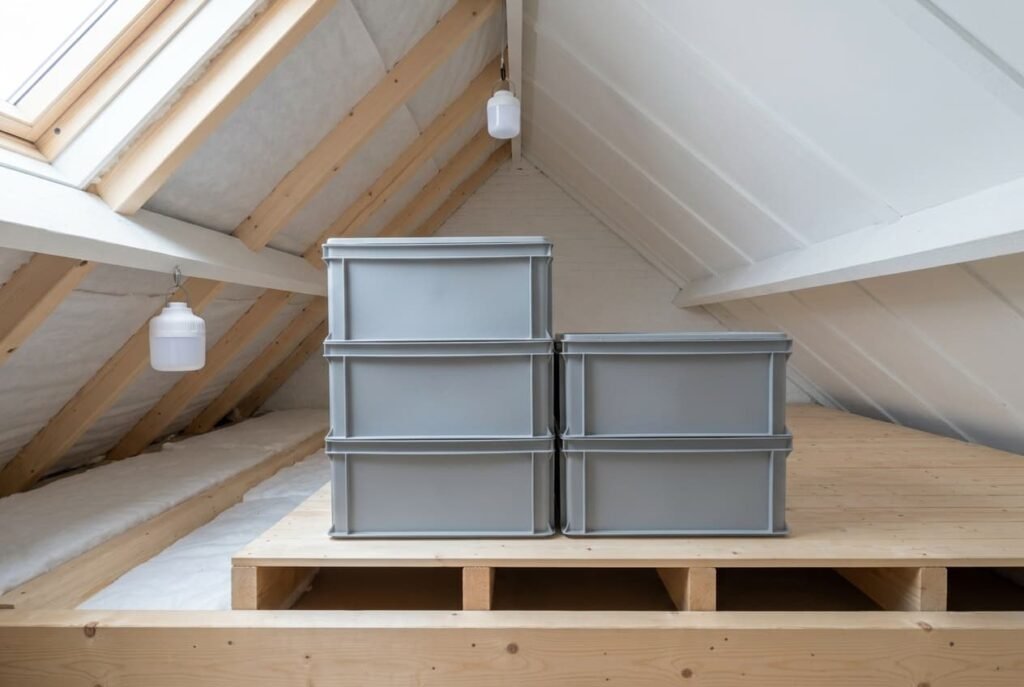
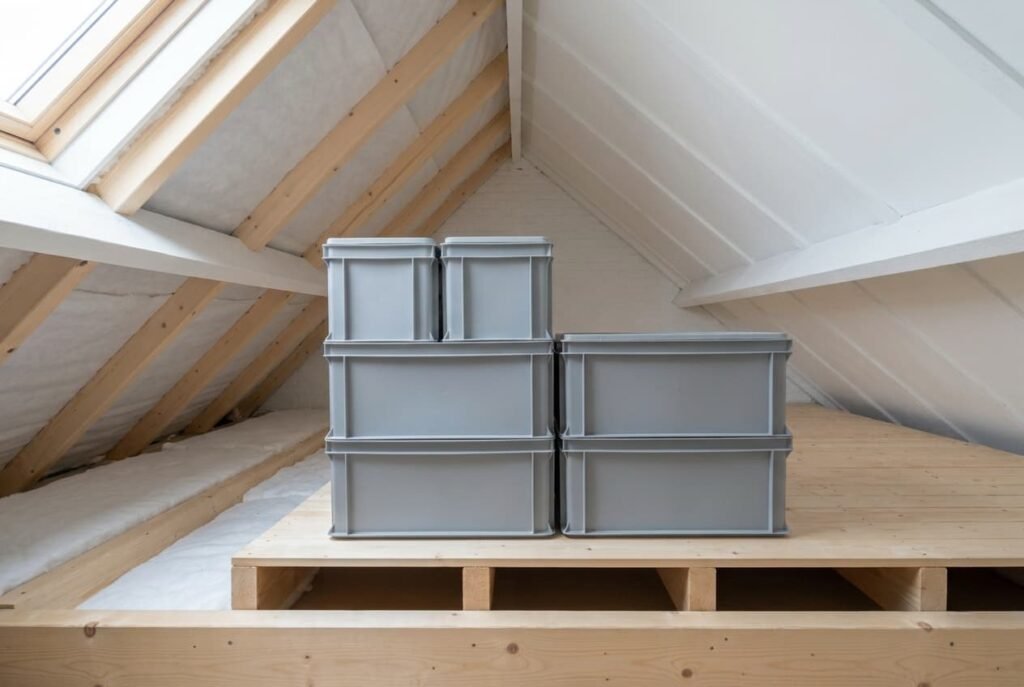
Now the sum. Boards of 22 mm weigh about 14.3 kg per square metre, which is roughly 21 kg for the boards. Five boxes at 8 kg each add 40 kg. The total is 61 kg, or about 42% of the limit. Our 280 litres of belongings fill five boxes of 60 litres at 93%, and those boxes take 3 of the 7 box footprints on the platform. Keeping things used once a year in a pile on bare insulation fails both tests, and a floor of the right strength decides every later purchase, because the boxes are chosen to suit it.
Buying Things Used Once Each Year, in Order
1. Tongue-and-groove boards, 22 mm thick, cut to a 120 × 120 cm platform on 20 cm bearers. They lead the list: each later item stands on them, and the platform claims 1.44 m² of roof space. Tier: BUY ONCE. A thin board flexes between bearers set 40 cm apart, and a 15 mm board bends about three times more than a 22 mm one under the same load. Reject boards with square edges, since they step against each other at the joints and catch a toe.
2. Five lidded boxes of 50 × 40 × 30 cm, each holding 60 litres. They come second because the hatch sets their size: end-on, the 40 × 30 cm face has a diagonal of 50 cm and passes through the opening with 10 cm to spare. Tier: MID. The lid and the corners take the strain, which means the walls need some thickness. A loaded box should stay near 8 kg for the climb. Reject lids that clip on two sides only, since they pop when another box sits on top.
3. A battery lamp with a hook, one only. It follows the boxes because a label means nothing in the dark. Tier: BUY CHEAP. A lamp only has to light about 4 m² of floor. Reject a switch on a trailing cord, which you can’t reach with a box in your arms.
4. A hygrometer, one, placed on the platform. It goes fourth, once the boxes are in position, because it measures the air they sit in. Tier: BUY CHEAP. It shows a trend rather than a laboratory figure. A trend is all the decision needs. Reject a model with no reset button, because a reading that drifts can’t be trusted.
5. A pack of waterproof labels and one index card. They go last because a label needs a box to sit on. Tier: BUY CHEAP. A label is only paper with glue on the back. Reject an adhesive that lifts in a cold roof space, because a label on the floor helps nobody.
Where to Spend Less: The Number of Boxes
The common plan buys eight boxes, and that is too many. Our things come to 280 litres, and 280 ÷ 60 gives 4.7, which rounds up to five boxes. Eight boxes hold 480 litres, which is 71% more room than the things need.
Things used once a year tempt a buyer to add boxes for fear of running out, yet the numbers say five boxes cover them. The extra room doesn’t stay empty. A half-empty box invites a second heap, and every box added raises the weight on the platform. Three extra boxes at 8 kg each push the total from 61 kg to 85 kg, or 59% of the limit, for no gain in what you can find.
Put the spending into the floor and the lid design.
Fit to the hatch and steady stacking beat a fancy box on wheels, which can’t climb a ladder. If one item is awkward, such as a tent pole bag, give it a strong bag of its own and leave the box count alone. Five boxes and three footprints keep the way to the hatch open.
How to Judge the Result After a Year
Run three short tests when the year is up. Name a box at random and fetch it, timing yourself. Then climb to the hatch with the lamp lit and read three labels from there. If any needs a closer look, rewrite it in larger letters before the next season. Two minutes for the round trip means the layout works. Longer means the labels or the lamp need a change.
Read the hygrometer in winter and again in summer. We’ll assume 65% as the line where fabric starts to take on moisture. A reading above it for several weeks means textiles belong downstairs. The tent is the first to move.
Press a board with your hand beside a bearer and then in the middle. The middle should feel as firm as the edge. A dip of 3 mm or more across 40 cm points to a board that’s too thin.
Two or more boxes left waiting in the hall mean the loft can’t take them yet.
What to Skip
Skip vacuum bags for duvets and coats. They crush the filling flat, and it won’t recover its loft. Skip cardboard boxes too, because a roof space swings from cold nights to warm afternoons. Card softens in that swing and invites pests.
Skip a freestanding shelf unit, which puts the load onto four small feet. A ceiling joist dislikes a point load far more than a spread one, and the platform spreads it.
Skip a second platform, since the things used once a year already fit on the first. The hatch is the real limit: the opening is only 60 cm square, and a bigger floor serves nothing that it won’t pass.
Skip a fitted ladder upgrade unless the old one is loose. It adds cost and takes wall space.
The whole job is arithmetic and a sensible sequence. Start with the boards this weekend and carry up one box at a time. Put the heaviest at the platform edge nearest the hatch, because your back will thank you on the way down. The lamp can wait until the floor feels right. The hygrometer and the labels follow it, and the weekend’s work is done. Label every box on two sides, and the tag will face you from either direction.
Questions Readers Keep Asking
How many boxes does a loft need?
Count the litres you want to store and divide by 60. Our 280 litres need five boxes, and eight would be 71% more room than the things fill. Buy the five, add a sixth only after a full year shows a real gap, and keep each loaded box near 8 kg.
In what order should I buy things?
Start with the floor, then the boxes, then a lamp. A hygrometer and labels follow. The floor sets the load limit, the hatch sets the box size, and the lamp makes labels readable. Buying boxes before the floor often means returning a box that stacks badly or can’t reach the platform.
How do I judge a box before buying it?
Press the lid down with both hands and lift the box by one handle. A good lid stays shut and the handle doesn’t creak. Check that the end-on face is under 60 cm on its diagonal for your hatch. Then stack two empty ones and push; a box that slides loose will do so in the loft too.