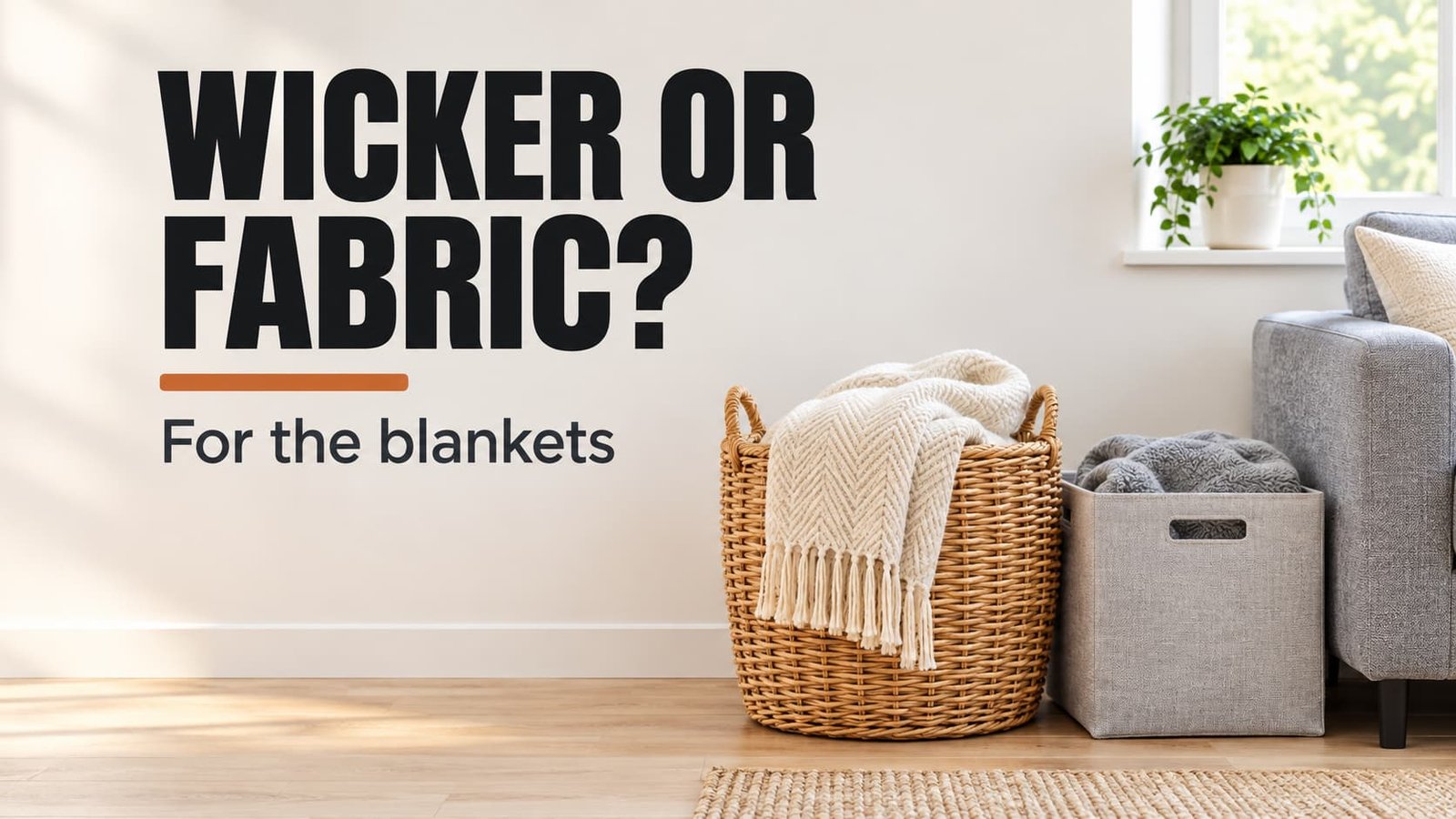
A wicker basket or a fabric bin can both clear blankets off the sofa, though they differ in weight and in airflow. Wicker holds its shape and breathes through its weave. Fabric is lighter and sags once half the blankets are gone. Here the case is a family house in Haarlem, with a space of 64 cm by 56 cm beside the sofa and five wool throws. Every throw folds to 50 by 30 by 8 cm, which is 12 litres. Treat the numbers as samples. No brand appears. Read on to see which container fits your own corner.
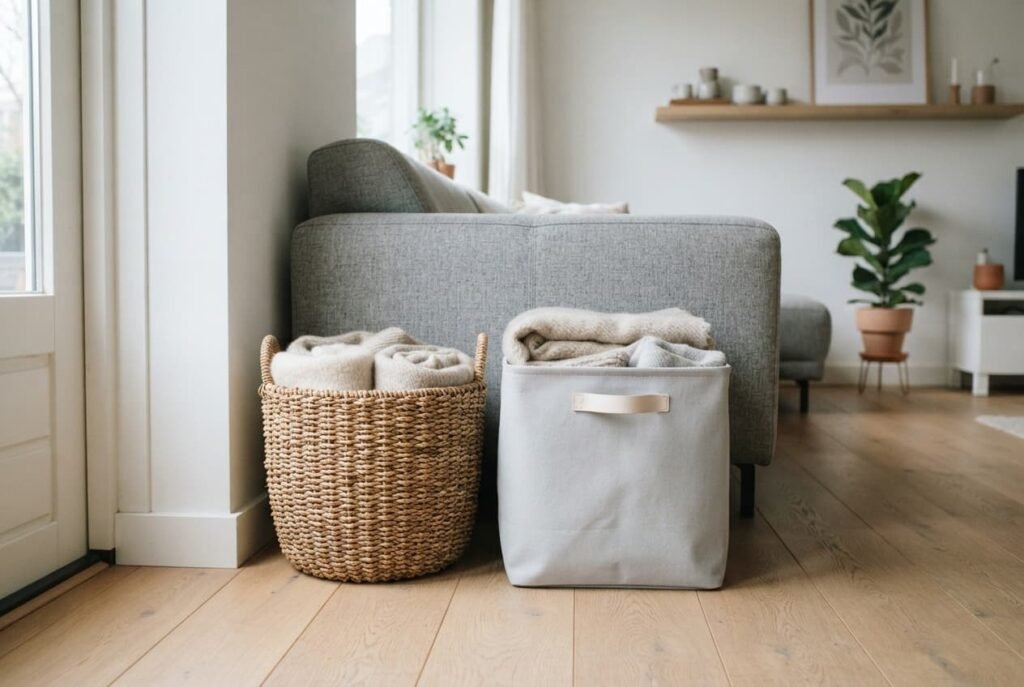
What Sets a Wicker Basket or a Fabric Bin Apart for Blankets
Begin with the shell. Wicker is a rigid weave of cane or willow, and its walls stand upright with five throws inside or with none. A fabric bin has a soft shell, normally stiffened with board panels and often foldable. Full, it keeps a square outline. Half empty, it sags at the corners. Weight follows the same divide, at about 2.5 kg for our basket and 0.8 kg for our bin. Neither one is built for sitting on. Treat both as storage rather than seating. Either can take a lid, and the lid changes dust and airflow more than the material does.
Then consider air and dust. Strands leave gaps in a weave, and household dust drifts through them along with the air. Closed cloth keeps most dust out once its lid is on, and it passes air more slowly. Wool kept for months likes a little airflow, which a lidded bin still gets whenever you open it.
Size settles the remainder. Our round basket measures 50 cm in diameter and 40 cm in height, giving 78.5 litres. Our bin is a cube of 40 cm, giving 64 litres. Five throws need 60 litres, which fills 76% of the basket and 94% of the bin. A sixth throw would need 72 litres, which only the basket could hold.
Two Containers Compared Row by Row
Measure your own space and one folded throw before leaning on any row below. The figures come from our sample room, and yours will differ. A tape and bathroom scales are all you’ll need, and ten minutes covers the lot.
| Point | Wicker basket | Fabric bin |
|---|---|---|
| Shape and size | round, 50 cm diameter, 40 cm high | cube, 40 cm along every edge |
| Volume | 78.5 litres, with room for a cushion or two | 64 litres, with little room to spare |
| Five throws (60 litres) fill | 76% of it | 94% of it |
| Floor covered | 0.196 m² | 0.16 m² |
| Weight when empty | about 2.5 kg | about 0.8 kg |
| Walls when half full | stay upright | fold inward |
| Dust and snags | dust passes the weave and loose wool can snag | most dust stays out and the lining is smooth |
Shape and weight divide a wicker basket or a fabric bin more sharply than any other row, with 2.5 kg against 0.8 kg and walls that stand against walls that fold. Pick the row you’d resent most after a winter of daily use, and let it decide, because the other rows can be worked around with a liner or a rolled towel.
Where the Wicker Basket Wins Beside a Busy Sofa
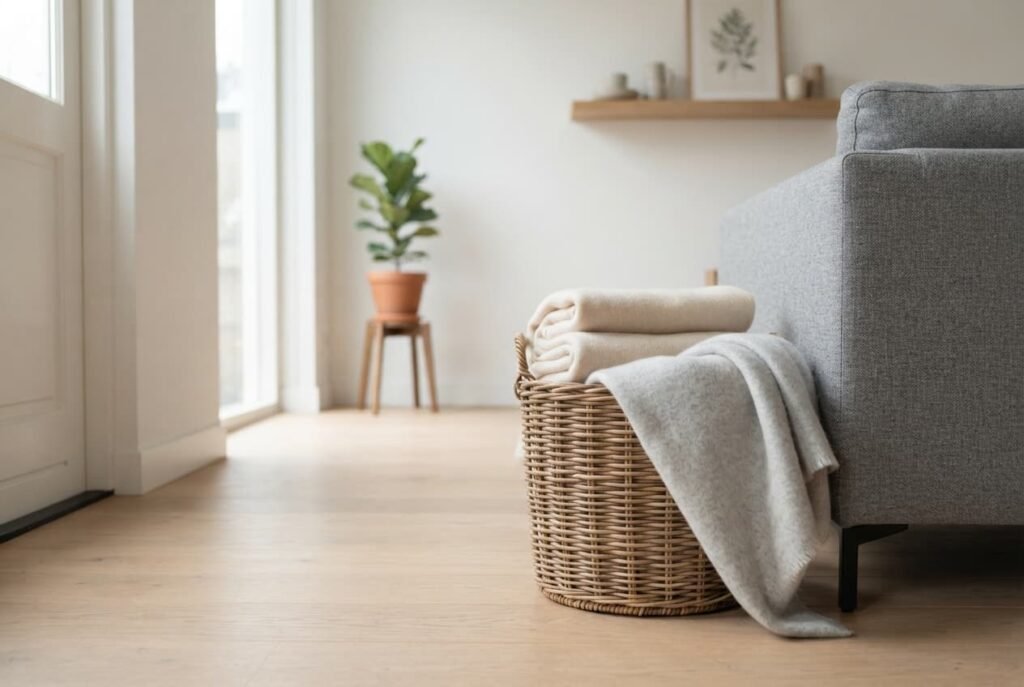
A wicker basket or a fabric bin beside a busy sofa gets lifted dozens of times a week, and wicker wins on shape. Five throws pile to 30.6 cm inside the basket, since 60,000 cm³ ÷ 1963 cm² gives that depth. Use up two and the pile falls to 18.3 cm, though the walls still rise 40 cm and the next blanket waits where your hand expects it.
Airflow helps as well. Wool that sits all summer in a closed container can pick up a stale smell. A weave keeps air moving, which means a throw lifted out in November seldom needs airing.
The frame endures too. Cane or willow kept out of direct sun and radiator heat holds up for years, and a lid can double as a tray for a mug.
Two catches come with it. Rough strands can snag a loose knit, and dust drifts through the weave. An old cotton pillowcase as a liner stops the snags, and a lid keeps out the dust. Full, our basket weighs 8.5 kg, made up of 2.5 kg of frame and 6 kg of throws.
Where the Fabric Bin Wins in a Tight Gap
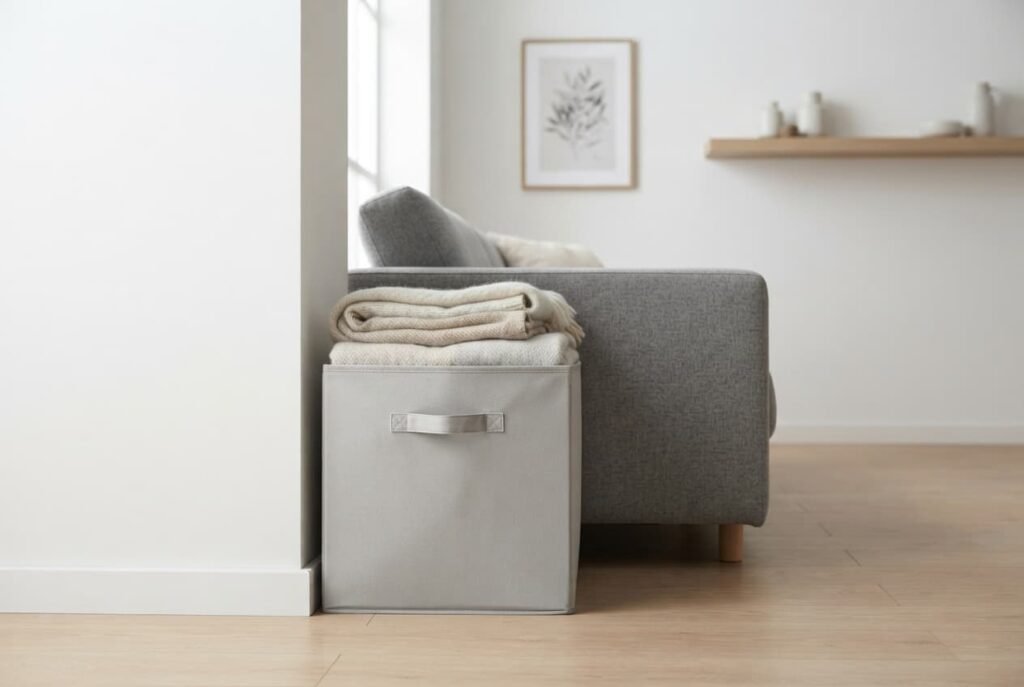
A wicker basket or a fabric bin packed into a tight gap is judged on floor space, and the bin wins. Our space measures 64 cm by 56 cm, which is 3584 cm². The basket covers 1963 cm², about 55% of it, and leaves 14 cm sideways and 6 cm behind. The bin covers 1600 cm², about 45%, and leaves 24 cm sideways and 16 cm behind. That 16 cm lets a vacuum nozzle reach the skirting.
Lifting matters when you move a full container every day. The bin and its throws weigh 6.8 kg, against 8.5 kg for the basket. Cloth handles also spread the load across the panel.
A bin also folds flat when summer sends the throws to a wardrobe, and an empty one slides behind a door.
Expect one flaw. A half-empty bin sags, and the top blanket sinks below the rim. A rolled towel standing in one corner props up the walls at no cost, and the smooth lining doesn’t snag a knit.
The Third Option Is a Shelf You Already Have
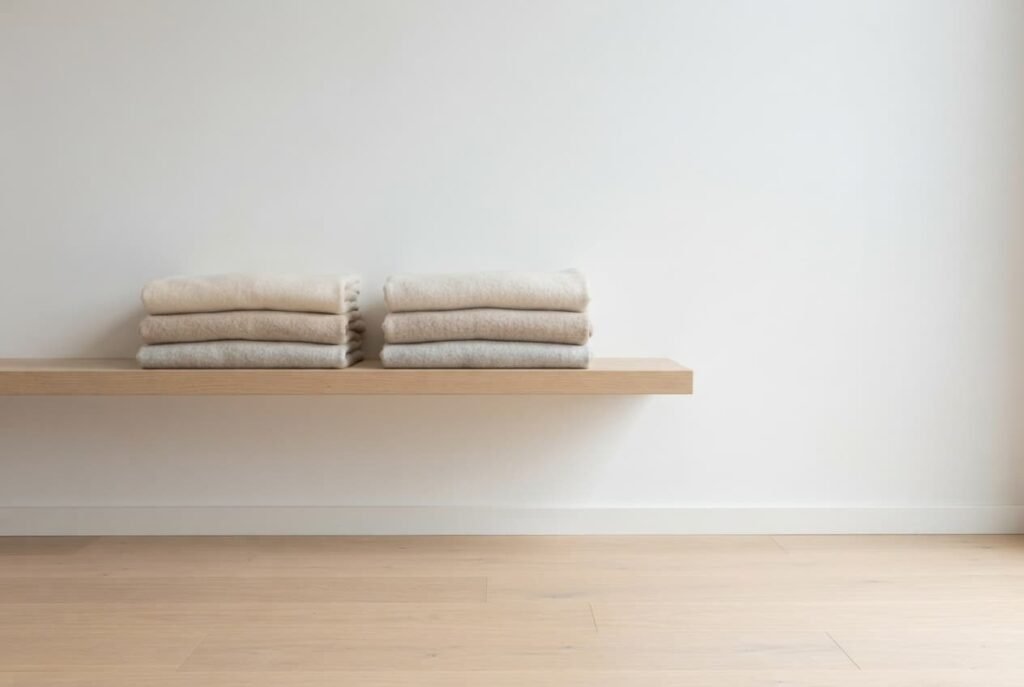
Neither container may be needed. A shelf of 100 by 32 cm with 28 cm between boards takes two stacks of three throws, since each throw is 8 cm thick and a stack of three reaches 24 cm. That’s room for six throws, one more than our five, with no floor taken at all. Don’t skip checking the board for sag with a straight edge, because six throws weigh 7.2 kg. Fold every throw to the same width and the stacks stay square.
Dust stays off the blankets and every throw shows at a glance. A shelf at hand height spares anyone bending down.
Before spending anything, watch one evening. Note where the blankets end up and whether anyone trips over them. If they already live somewhere that works, such as a wardrobe shelf or the foot of a bed, leave them there and buy nothing. A container only helps once the throws lie around the room and the corner beside the sofa stands empty.
Which to Pick: Fabric Bin or Wicker Basket
Two branches settle most living rooms, and each comes with a cost worth accepting first.
If your space is under 70 cm wide or you lift the blankets daily, pick the fabric bin. It leaves 24 cm spare in our corner and weighs 6.8 kg full. Accept the sag and prop the walls with a rolled towel. Choose one with a firm base board so the bottom doesn’t bow.
If the blankets sit for weeks and you want them to breathe, pick the wicker basket. It stands upright and passes air. Accept 8.5 kg when full, and line the inside with cotton to stop snags. Stand it clear of the radiator, where dry heat splits the strands.
Before buying either, fold one throw. Note its three sizes, multiply by the number you own, then compare the litres with the label. Trace the container’s base on newspaper and lay it down for seven days. Where it gets in the way, shift the plan along the wall, and you’ll see within days whether the spot works. A paper outline costs nothing and saves a return trip with a bulky parcel.
Questions and Answers
Which one lasts longer?
Wicker lasts longest when it stays out of direct sun and radiator heat, because dry strands crack at the bends. A fabric bin holds up as well as its seams and base board do, and a heavy full bin can pull its handles loose. Lift either one from underneath when it’s full.
How do I keep either one clean?
Vacuum a wicker basket with a brush head every month, and wipe the rim with a well-wrung cloth. A fabric bin needs its dust brushed off. Spot-clean the cloth, and check the label before any machine wash. Air the blankets themselves twice a season, whichever container you choose.
Which suits a living room with a cat?
A cat will scratch an open weave and may nap on a bin lid. A closed fabric bin with a snug lid is the better bet, since claws find no strands to pull. If you pick wicker, keep the lid on. A cotton liner stops loose threads catching.