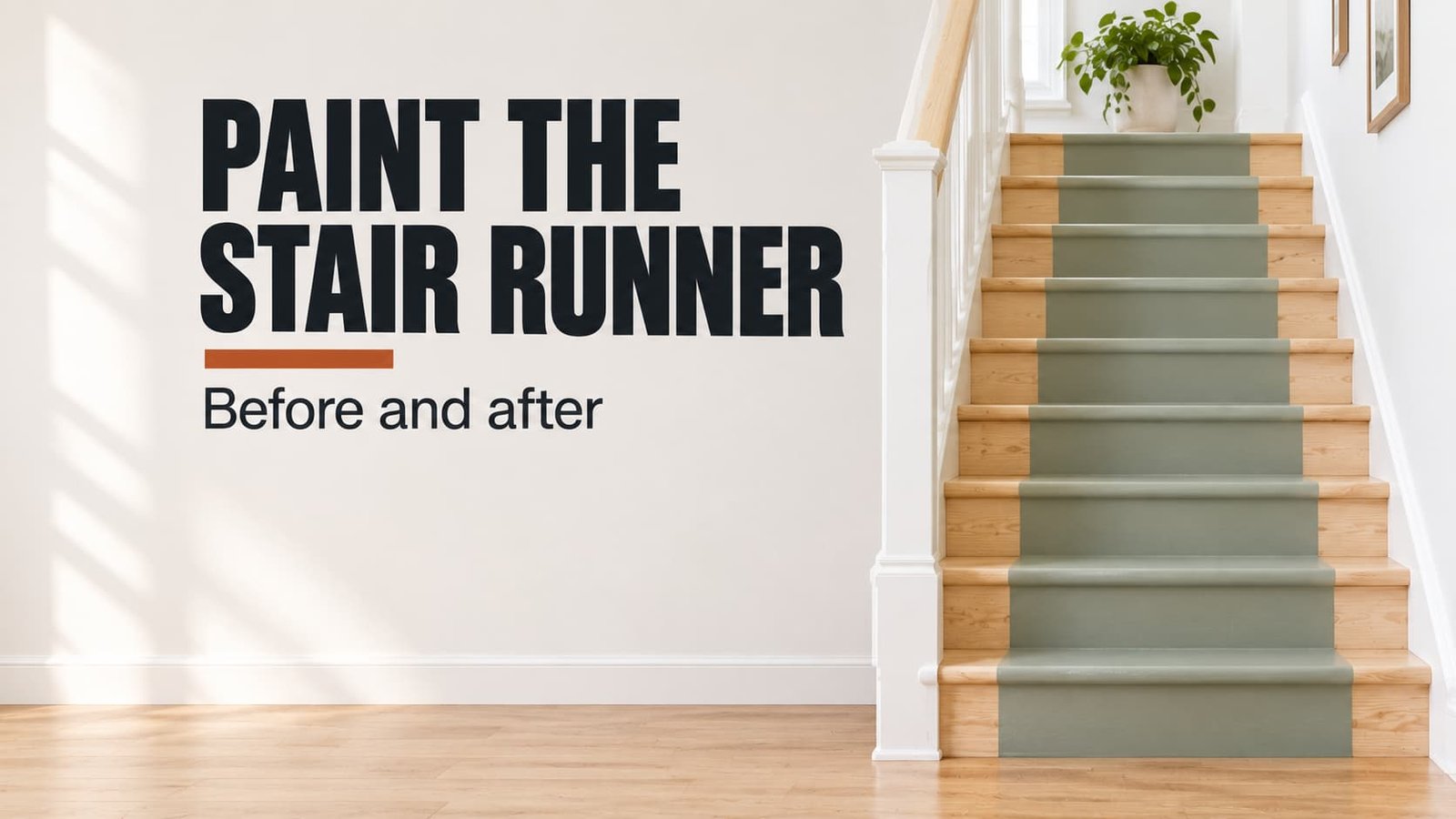
A painted stair runner on wooden stairs is a band of colour in place of a strip of carpet, and the swap shows up in centimetres. Below come the before and after figures. The motives behind the trend follow, then the cost in noise and wear, then a one-week tape trial. A version taken to its limit gets a warning near the end. The sample stair has 15 treads in a Utrecht terrace, with 80 cm of width and 24 cm of depth on each tread and a riser height of 18 cm. Check your own stair before you borrow any figure, and get consent from the owner if you rent.
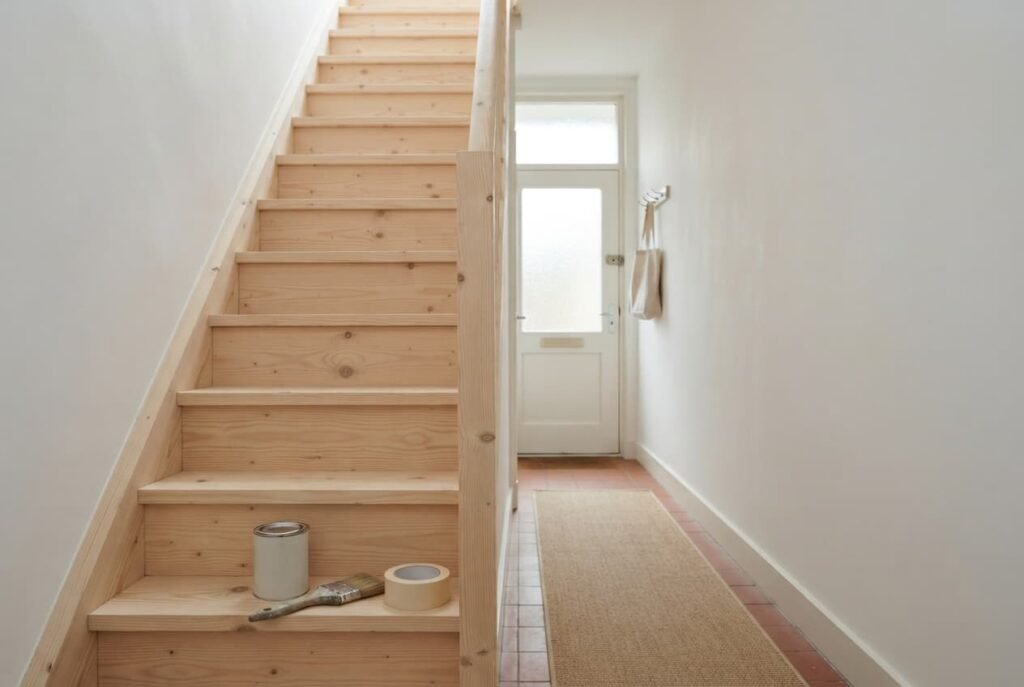
A Painted Stair Runner on Wooden Stairs: The Short Version
A runner is a band that follows the middle of a stair. It crosses each tread and climbs each riser. Carpet makes that band from pile fixed with rods or tacks. Paint makes it from a stripe of colour on the bare wood, with tape holding the edges straight until the coat dries.
On the sample stair the carpet strip is 60 cm wide. Bare wood shows for 10 cm at either side. The painted band is narrower at 50 cm, and the wood on each side grows to 15 cm. Both take the same route: 24 cm over the tread and 18 cm up the riser. Over 15 steps that route runs 15 × 42 = 630 cm, or 6.3 m, for either material.
Thickness is where the two part company. Carpet and its underlay stand about 10 mm proud of the wood, whereas a coat of paint is well under a millimetre. That leaves the stair with the profile its joiner cut.
Both styles read as a centre line framed by plain wood.
What a Painted Runner Changes on Wooden Stairs, in Numbers
Begin with the surface covered. A band crosses 24 + 18 = 42 cm of wood on every step. The carpet strip, at 60 cm wide, covers 60 × 42 = 2,520 cm² a step, which comes to 37,800 cm² or 3.78 m² over 15 steps. The 50 cm painted band covers 2,100 cm² a step and 31,500 cm² in total. Across the sample stair, covered area falls by 17%, from 3.78 m² to 3.15 m².
The frame of bare wood widens. Each side moves from 10 cm to 15 cm, and the visible share of the 80 cm width climbs from 25% to roughly 38%.
Thickness shifts the rise at the foot and the head of the flight. Carpet lifts every tread by 1 cm, yet the hall floor below and the landing above stay where they were. The bottom rise therefore grows from 18 to 19 cm, and the top rise shrinks to 17 cm. Paint leaves both at 18 cm.
Fixings drop to nothing. Fifteen rods on 30 brackets mean 60 screw holes in the timber, while the painted band needs none.
Materials and tape make up the rest. At an assumed spread rate of 10 m² to the litre, two coats over 3.15 m² need 3.15 × 2 ÷ 10 = 0.63 L, with about 0.32 L of primer under them. Masking both edges of every step takes 2 × 42 × 15 = 1,260 cm of tape, which is 12.6 m.
Why Households Choose Paint Over a Carpet Runner
Drilling is the first reason. Rods need brackets, and many leases don’t allow holes. Soft pine also loses its grip on a screw once it has been drilled and refilled. A painted stair runner on wooden stairs asks only for tape and a brush plus a free weekend.
Dust is the second. A carpet strip leaves a narrow gap along each side where grit gathers, and its pile holds fine dirt. A painted tread wipes clean with one pass of a cloth.
Hidden timber is the third. Lifting an old carpet often reveals sound pine below. The wood is already there, and a stripe lets the grain show at the sides while the colour carries the centre.
Colour is the fourth. A band can echo the hall wall or the front door, which a bought runner rarely matches exactly. Dutch terrace halls are narrow, and one repeated shade lets the stair belong to the hall.
Cost of error is the sixth. A badly placed rod leaves holes in the timber, whereas a badly placed stripe is repainted in an evening, and beginners tend to prefer the second kind of mistake.
Even rises are the quiet fifth reason. With no 10 mm of carpet, the flight keeps the same rise at the bottom and the top, which suits anyone who counts steps in the dark.
What You Give Up
Sound goes first. Bare timber under paint rings with each footfall where carpet would’ve muffled it, and a stair beside a bedroom can sound louder at night.
Wear is next. Feet land along a strip about 25 cm across, running down the centre of each tread, and that strip scuffs before anything else. A tin of the finish kept for patches takes care of it.
Grip comes third. A glossy coat can feel slippery under socks. Choose a satin or matt floor finish and check that the label names stairs among its uses.
The last cost is permanence, because paint can’t be lifted like carpet. A runner comes up in an afternoon. Sanding 15 treads back to bare wood takes about 4 hours at a sample pace.
Drying adds a cost of its own. At an assumed 8 hours between coats, painting alternate steps keeps one lane open but doubles the number of sessions.
The Extreme Version
Take the idea to its limit and the whole stair is painted edge to edge in glossy dark. Each step then carries 80 × 42 = 3,360 cm² of paint. Fifteen steps total 50,400 cm², or 5.04 m². That is 60% more than the sample band of 3.15 m², and two coats take 1.0 L.
No bare wood is left, and the 15 cm frame vanishes with it. The tape lines vanish too. The step edges then lose the crisp outline that made the stripe look deliberate. A painted stair runner on wooden stairs needs that frame in order to look like a runner at all.
Gloss records every footprint and every scuff, and it’s slipperiest exactly where feet land. The finish hides every line of grain that made the timber worth keeping. Re-sanding such a stair doesn’t stop at the treads, since it cuts through paint on every surface, and the hours climb well past the 4 of the band.
A band with a clear margin of wood gives the same effect without those drawbacks.
Who It Suits
A painted stair runner on wooden stairs suits a straight, sound flight at least 70 cm wide, since anything narrower leaves under 10 cm of frame either side of a 50 cm band. Warped or heavily filled treads gain little, because paint reveals every flaw, and a flight that is very narrow gains little too.
Mark the band in tape for a week ahead of the first brushstroke. Stick two lines on three steps 50 cm apart. View them at breakfast and once more after dark. Keep the paint if the stripe still pleases you after seven days, and lift the tape if you’ll never miss it.
Write the band width and the date on the lid of the tin so a later patch matches. Measure again before buying, because your stair will differ from the sample and the 17% change in covered area will move with it. A band checked against tape costs one weekend, and it’s easy to judge from the bottom step. Then paint with a clear view of the result.
Questions and Answers
Should I keep my carpet runner or paint the stairs?
Keep the carpet if it’s in good condition and you like a quieter stair. Paint makes sense when the carpet is worn or its brackets are damaging the wood. Tape the band across three steps for a week before choosing, and judge it from breakfast to bedtime.
Which stairs suit this look?
Straight, sound wooden flights at least 70 cm wide suit it best, because the width leaves a margin of bare wood either side of the band. Warped treads and heavy filler gain little, as do very narrow stairs. A flight beside a bedroom will sound louder than it did with carpet.
How long will a painted band last?
The finish ages with the stair. The centre strip of each tread scuffs soonest, and a patch with the same finish repairs it. Whether the look stays popular is for you to say. Rate it on how much you enjoy the stair today, not on any forecast.