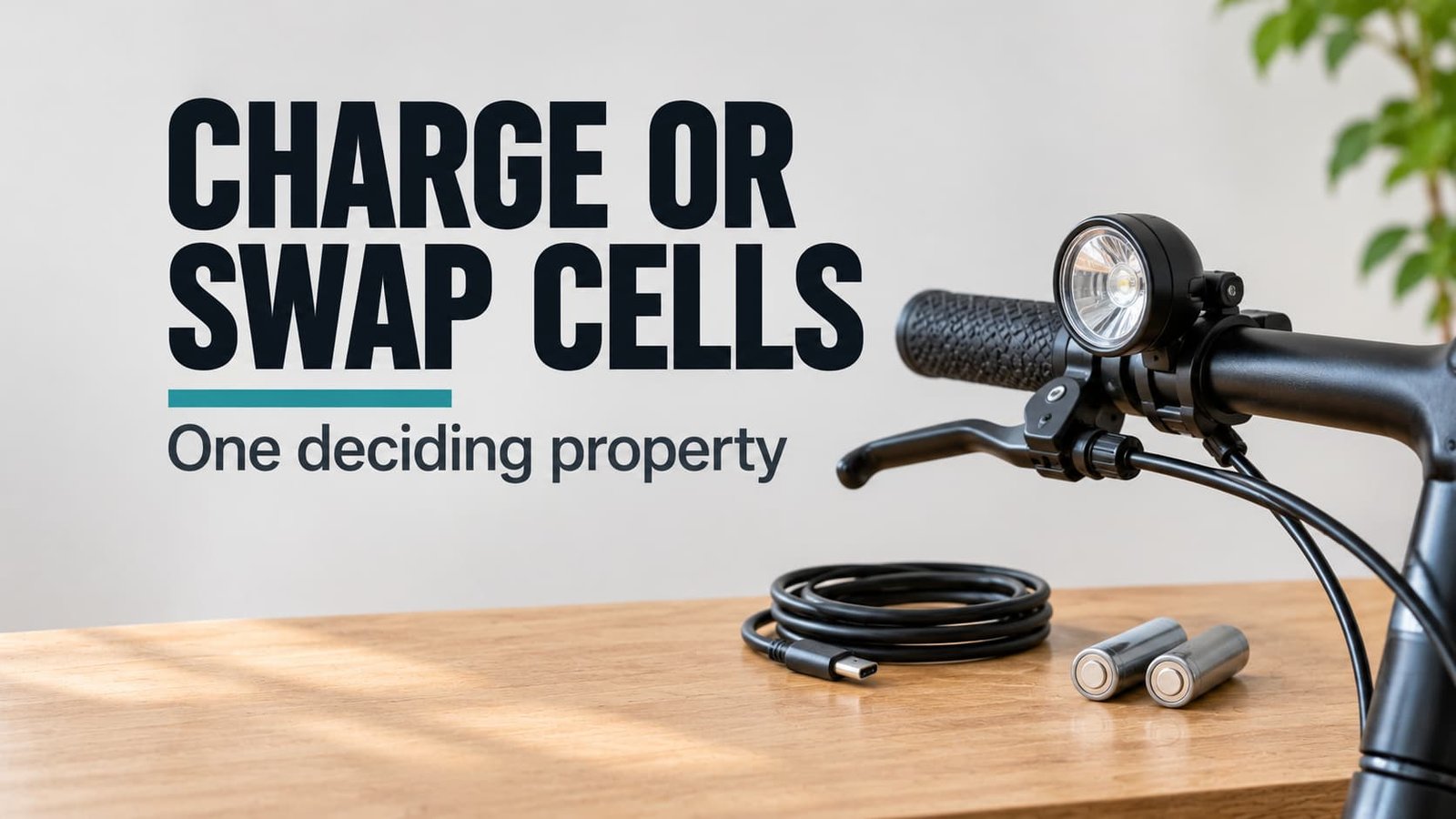
A rechargeable or a battery bike light will both show the way home, yet the real choice concerns the moment a light starts to fade. The rechargeable light wins on daily routine and the battery light wins on how fast a flat light is put right. The verdict is conditional, and one property decides it: what you can do on the road when the light dims. Our example is Owen, who rides 12 km each way through Sheffield in the dark from late October to March. Every runtime here is an assumed sample, and a real light should be timed before any sum is trusted.
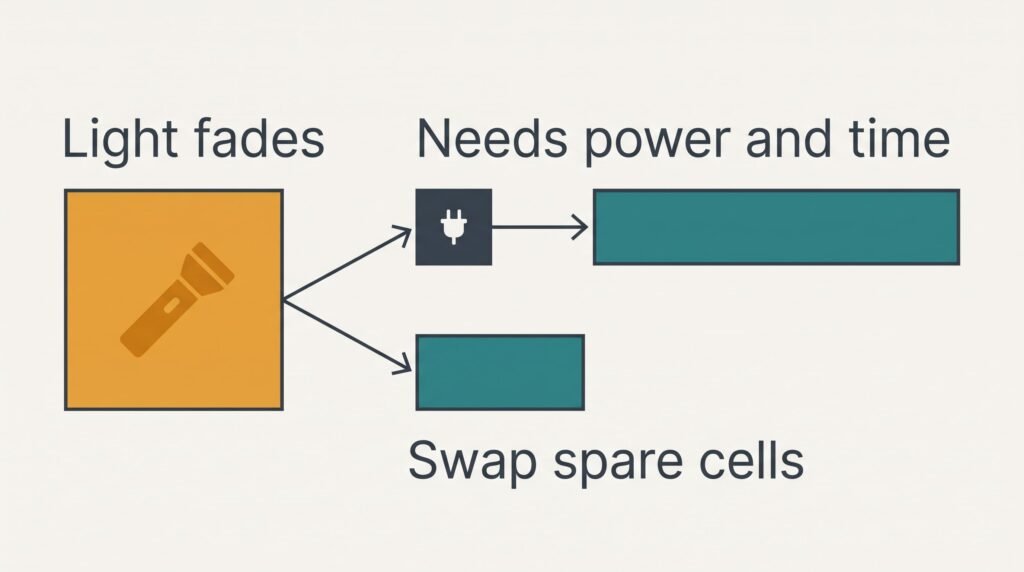
Why a Rechargeable or a Battery Bike Light Comes Down to the Fade
Both kinds of light carry a limited store of energy and spend it at a steady rate. Each one fades eventually. The useful question is what you can do about it when it happens at kilometre nine of twelve. They part company over how a flat light is refilled. Owen would prefer never to meet that question at all. His habits decide the answer more than either light’s specification does.
Owen’s ride takes 40 minutes at 18 km/h. He is in the dark for 80 minutes a day, or 400 minutes across five days, which is 6.7 hours a week.
A rechargeable light with an assumed 4 hours on its steady setting covers 240 ÷ 80 = 3 rides per charge. A battery light with two replaceable cells and an assumed 20 hours covers 1,200 ÷ 80 = 15 rides per set.
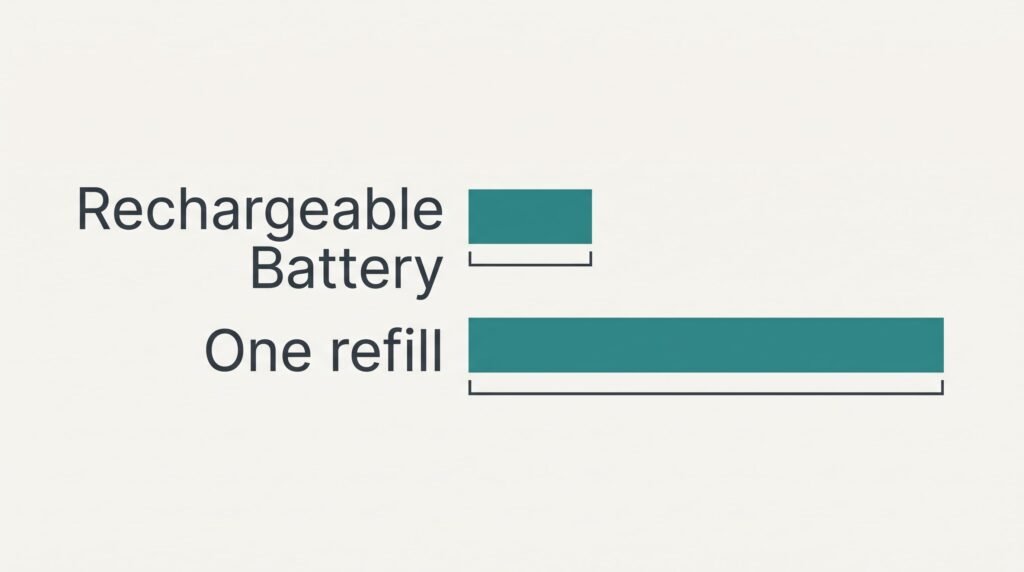
Refilling is where they part. A flat rechargeable light needs a wall socket or a power bank and about 3 hours, again assumed, to refill from empty. A flat battery light needs a spare set and about a minute, and that set weighs only 24 g. Neither figure is a rating from a maker. Time your own light with a stopwatch before you plan a week around it.
Rechargeable or Battery: Bike Light Compared Row by Row
| Point | Rechargeable light | Battery light |
|---|---|---|
| Runs on | a built-in cell that is filled through a cable | two replaceable cells that you fit and swap |
| Steady-setting run (sample) | 4 hours on one full charge | 20 hours on one fresh set |
| Rides per refill at 80 minutes | 3 rides before the next charge | 15 rides before the next swap |
| Refills over 26 winter weeks (130 rides) | about 44 charges | about 9 sets of cells |
| Weight with a spare (sample) | 70 g, plus a power bank if carried | 74 g: 50 g light and 24 g spare set |
| When it fades on the road | needs a power source and a few hours | swap the cells in about a minute |
| Warning before it fades | often a charge indicator you can check | often a gradual dimming you can see |
The surprising row is weight, because once a spare set of cells rides in the bag the battery light totals 74 g against 70 g for the rechargeable light, a gap of only 4 g. On its own at 50 g the battery light looks 20 g lighter, which hides the cost of carrying the spare set.
Where the Rechargeable Light Wins
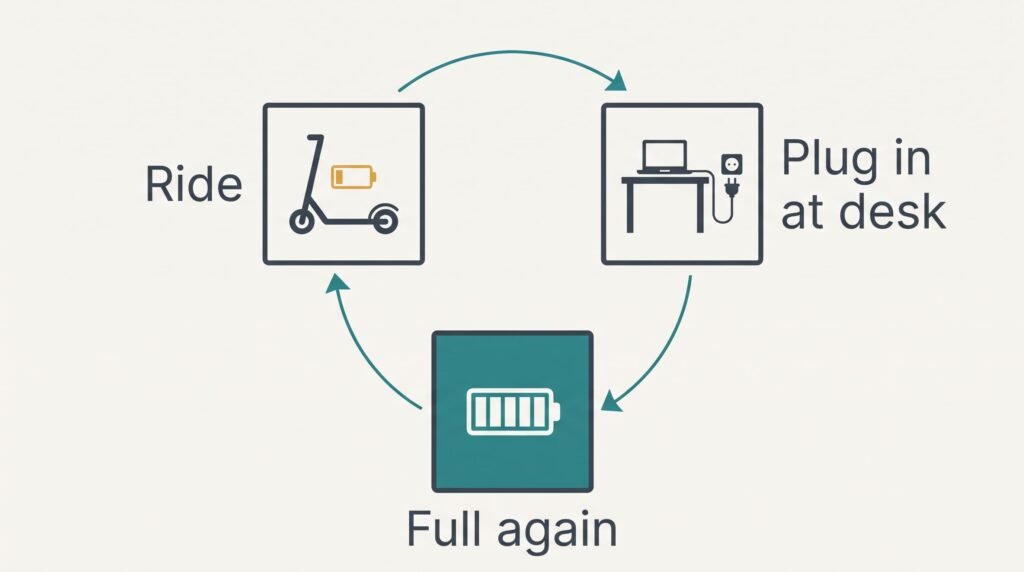
A rechargeable light asks for the least thinking when you ride every working day and have a socket at the other end. Plug it in at the desk and the 8 hours of a working day dwarf the assumed 3 hours it needs. Each ride uses 80 ÷ 240 = 33% of a charge. The light therefore starts every journey with at least two thirds of its energy left.
That routine means 130 short plug-ins across the 26 weeks, one per working day, rather than 44 full charges. Each plug-in costs the few seconds it takes to push in a cable.
There are no cells to buy and nothing to stock. The 9 sets of cells the battery light would eat through never enter the house, and no used cells are left to dispose of.
Many rechargeable lights also show their charge level with a small indicator, which turns a surprise on the road into a glance before leaving. When the cable lives at your desk, the choice of a rechargeable or a battery bike light favours the first.
Cold can shorten a charge in January, which argues for a larger margin.
Where the Battery Light Wins
Distance from a socket is what lifts the battery light. Its spare set of 24 g rides in a pocket, and the swap takes about a minute at the roadside. The rechargeable light, once flat, can’t be refilled there without a power bank.
Forgetting costs it less. Owen’s battery light needs attention only 9 times in 26 weeks, once every three weeks, where a rechargeable needs a decision roughly every third day. Miss a plug-in on Tuesday and Wednesday’s ride starts with a light that may fade within 80 minutes.
Away from home, the gap grows. A weekend trip with no socket suits cells that have been counted into the bag beforehand. For a rechargeable or a battery bike light on a trip like that, spare cells make the lighter plan.
Many battery lights dim gradually rather than cutting out, which gives a rider several minutes of warning. That behaviour varies. Test your own light on a quiet road and record how long the dimming lasts before the light stops.
When Neither Light Suits
Some riders are better served by a third option. A dynamo light removes the refill question, because the wheel’s own turning makes the power while the bike moves. For Owen that means light for the whole 80 minutes without a plug or a cell. His 130 winter rides add up to about 173 hours of light that never needs refilling.
Dynamo lights come with their own trade-offs. They need fitting, and a light that powers down at a stop may rely on a small reserve to stay lit for a short wait. Many include such a reserve, though it’s worth confirming with your own set.
If your rides stay on lit streets and last only minutes, a small clip-on light may be enough. Reflectors alone are no substitute where the rules expect a lit bike after dark. Check your local rules before choosing a rechargeable or a battery bike light, or a dynamo set instead.
Which to Pick
Each choice carries a cost, and the two branches name it.
If you ride daily and can plug in, choose the rechargeable light. It starts each journey with two thirds of a charge or more, and it needs no spare parts. Accept the habit of topping it up at work, plus the occasional forgotten plug-in that leaves a flat light at seven in the morning.
If you ride far from any socket, choose the battery light. It’s back in action in about a minute with the 24 g spare set. The 9 sets across the winter are easy to count in advance. Accept the cells to buy and carry, and the chance that the spare set is the one you left at home.
Run a two-week trial with your own light and count how many rides one refill covers. Time the dimming on a quiet road and write down how long the warning lasts. Then decide with the figures in front of you. If you forget to plug in twice in those weeks, change to cells. Carry a spare set of 24 g, and a flat light stops being a problem.
Questions and Answers
How much effort does each light need over a winter?
Across 26 weeks of five rides, the rechargeable light needs about 44 full charges, or one plug-in per working day if you top up at work. The battery light needs about 9 sets of cells. Count your own rides to see which habit you can keep.
What happens if the light fails mid-ride?
A battery light is back in about a minute if a spare set is in the bag. A rechargeable light needs a power bank or a socket and about 3 hours to refill. Carry a small backup lamp on any ride where a long wait would be a problem.
Which suits a short commute in lit streets?
Either works, and habit should decide. A rechargeable light suits a rider who already charges a phone each night. A battery light suits a rider who prefers to forget about charging for weeks. If the streets are well lit and rides are short, a small clip-on light is enough.