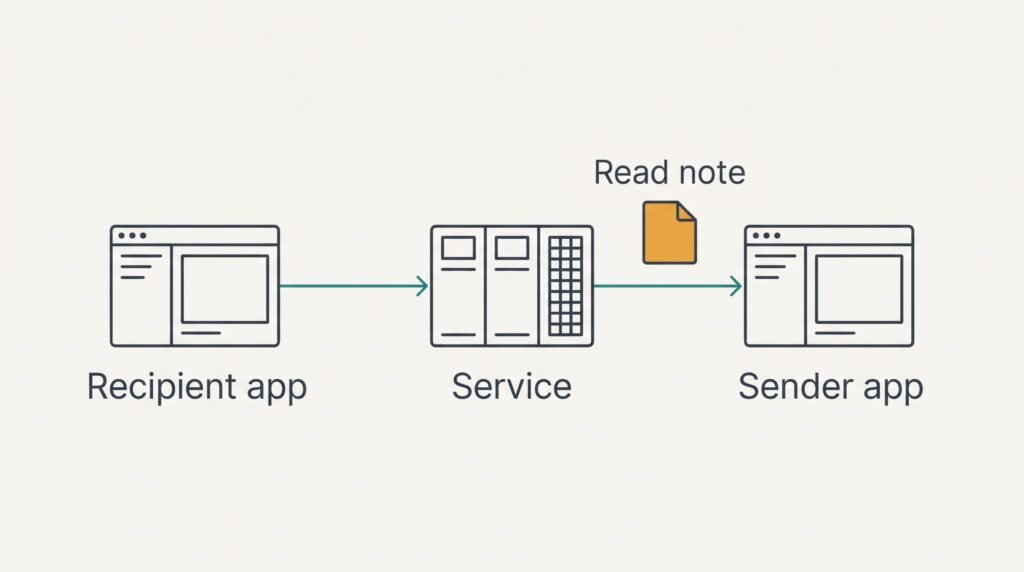
Does a read receipt know you have opened a message? It knows only what your own app tells it. When the conversation is on screen with the message drawn in it, the app sends a short note through the service, and the sender’s app swaps a delivered mark for a read mark. No camera or timer takes part. Our example is one message from Maya in Cardiff to her brother Idris in Leeds. Every time and delay is a sample for illustration. Real apps differ in what they count as opened. Use this as a model of the idea.
Does a Read Receipt Know You Have Opened a Message? The Short Answer
In one sentence, the recipient’s app reports showing the message to the service, which relays that report to the sender. Two reports exist. A delivered note says the message reached the phone. A read note says the app displayed it. Each one is a tiny packet that carries a message number and a status, and typically none of the words. The sender’s app only listens for these notes. It matches each one against its own list of sent messages and updates the mark beside the matching number.
The short answer leaves things out. It doesn’t say what counts as displayed, because every app decides that for itself. Opening the conversation usually counts, while a lock-screen preview often stays outside the count and some apps treat it differently. Timing is skipped as well: the note leaves the phone only when a connection exists. A read mark can therefore lag behind the moment of reading. Nor does the answer cover the sender’s side, where a setting can hide the mark altogether. Treat it as the skeleton and the sections below as the details that fit around it.
One Message From Send to Seen
Maya sends “Are you coming on Friday?” to Idris at 19:42:00. Every time below is assumed.
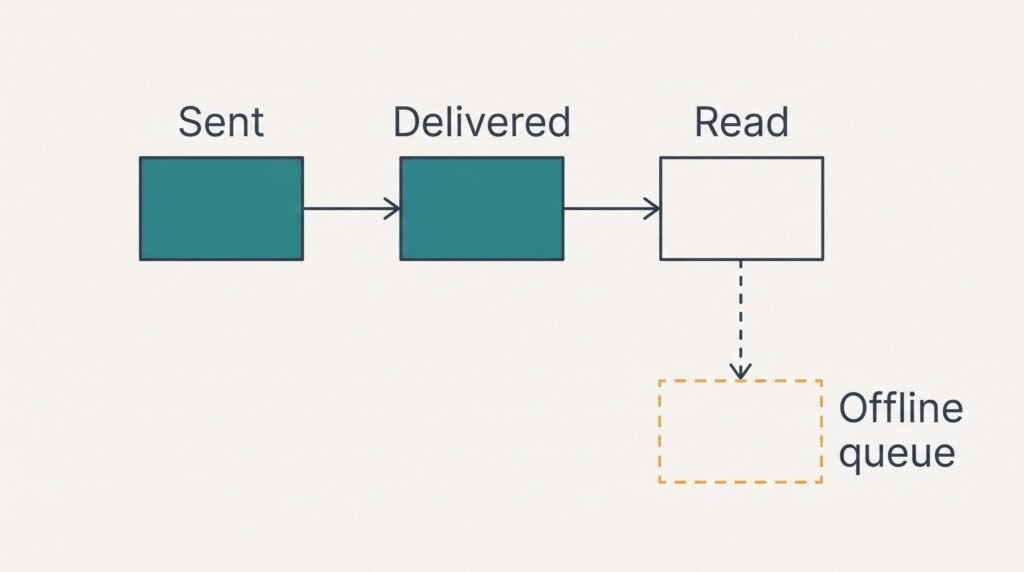
Her app tags the message with a number such as 4821. It passes the tagged message to the service. On Maya’s phone that number carries a state that moves forward one step with each note: sent, then delivered, then read. The service finds Idris’s phone and pushes a wake-up. The message lands 0.6 s later, at 19:42:00.6. His app stores it and sends a delivered note back, which takes 0.3 s. At 19:42:00.9 Maya’s screen swaps one mark for another.
Idris’s phone buzzes and lights the lock screen with the opening words of the text. He glances at them while cooking. In most apps that preview triggers no read note. Maya’s screen still says delivered. Sixteen minutes pass.
At 19:58:10 Idris opens the conversation. The app draws message 4821 in the open window and logs the display. It sends a read note, which leaves the phone in 0.2 s, and the service relays it to Maya in 0.4 s. At 19:58:10.6 her screen changes. From send to read mark she has waited 16 minutes and 10 seconds, and the receipt itself accounts for 0.6 s of that. So does a read receipt know you have opened a message here? It knows the app drew message 4821, and nothing else.
Now change one thing. Suppose Idris opens the message on a train just as the phone loses signal in a cutting for 3 minutes. The app still draws the message and logs the display at 19:58:10. The read note waits in a queue on the phone. When signal returns at 20:01:10 it leaves, and Maya’s screen changes at 20:01:10.6. Some apps stamp the mark with the arrival time and others with the time of display. Maya may see 20:01 or 19:58. Either way, nothing in the chain looked at Idris.
A note moves only when the app has completed its own step.
A Recorded Delivery Card, and Where It Breaks
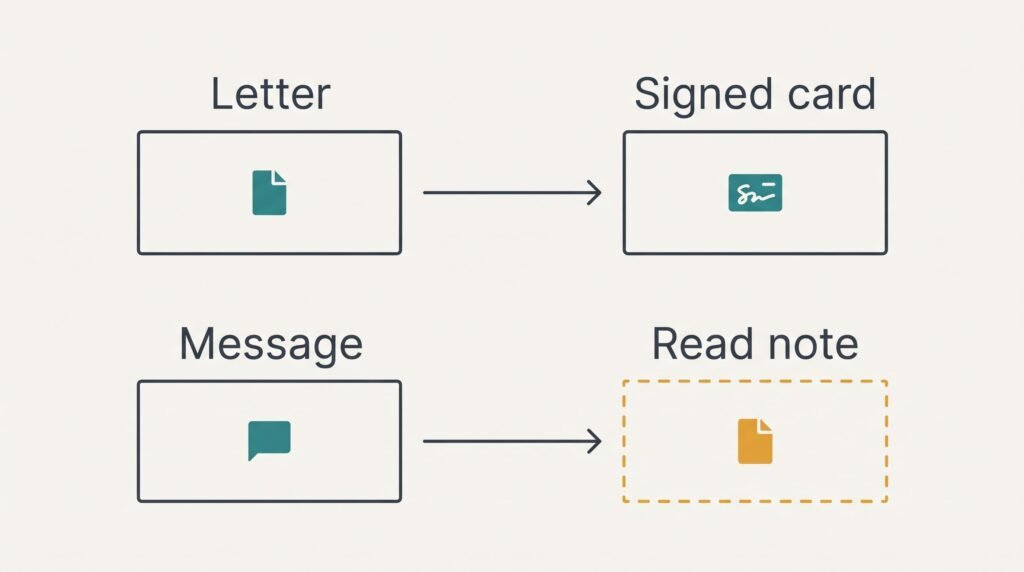
Compare the receipt with the signed card that returns after a recorded letter. The courier hands over the envelope and the recipient signs a card. That card travels back so that the sender knows the letter arrived. A delivered mark works like it, and the read mark is a second card, signed when the envelope is opened.
The comparison fails at three points. A person signs a paper card knowingly. The app signs the moment the message is drawn, and nobody asks whether you looked. A paper card forms part of the delivery itself, yet a chat app lets you stop the second card with a setting. Paper also takes days, while a note arrives in well under a second unless the phone is offline and the note sits like a card stuck in a bag.
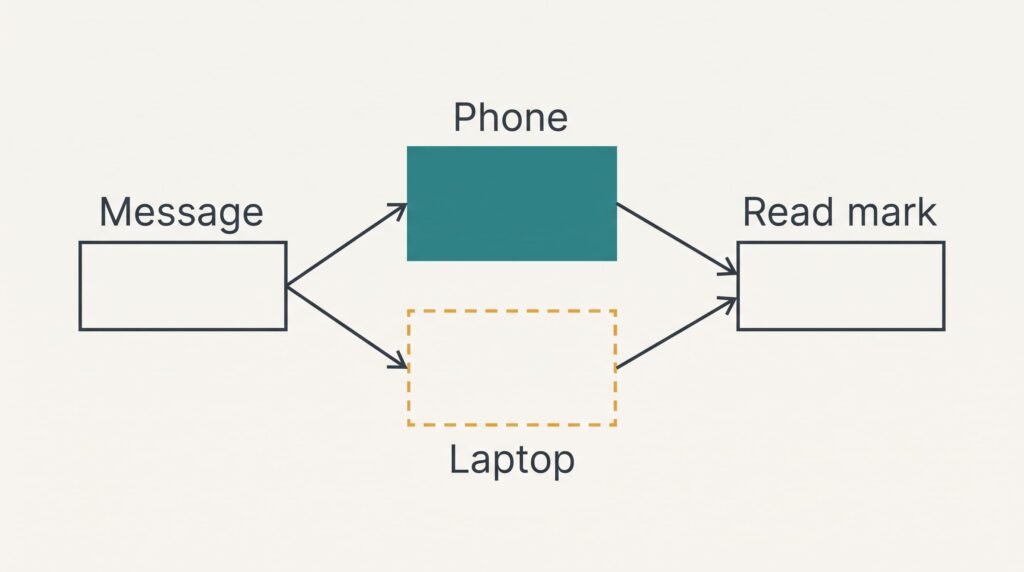
When a Read Receipt Seems to Know You Have Opened a Message
Most of the confusion comes from one fact: the app logs a display, never attention. A message can be drawn on screen while you talk to someone nearby, and the mark appears anyway.
Other limits follow from it. If the same account is open on a laptop, the laptop may draw the message and send the note while you’re away from the desk. Group chats show a mark for each person in some apps and a single mark in others. A queued note can arrive minutes after the display, as the train case showed. A glance at a preview often leaves no mark at all, which means you can know something that the sender doesn’t. In a long thread, some apps mark older messages read as soon as the conversation opens, even though you haven’t scrolled up to them. Receipts also say nothing about whether the words were understood or whether a reply is coming.
Treat the mark as a record of the screen.
Three Beliefs About Seen Marks
The first belief says a mark proves the person read the message. It formed because the word Seen sounds like an eyewitness. The app was only a window, and it saw nothing. No data in the chain can show that a person looked at the text. The label therefore promises more than the facts hold.
The second belief says switching receipts off makes you invisible. It formed because the setting is often described as hiding your own mark. In practice turning receipts off usually works in both directions. You stop seeing other people’s marks too, and other signals such as a recent-activity time may remain.
The third belief asks “does a read receipt know you have opened a message” that you only glimpsed on the lock screen. People assume yes, since the text is plainly visible. It formed because the eye and the app treat “on screen” differently. Most apps wait for the conversation to open.
A Rule for Switching Receipts On or Off
Decide by what the mark changes for the people who write to you. Keep them on where plans hinge on replies. A sister waiting to hear whether you can collect her from the station gains from the mark, because it tells her to stop waiting. Switch them off where the mark creates pressure, as in a busy work chat or a large group. A quick test uses your own habits. Say you answer eight messages in ten within an hour. The mark then adds little and can stay. If you answer fewer than five in ten, it sets an expectation you can’t meet. Remember that the switch usually works both ways.
Once the rule is set, “does a read receipt know you have opened a message” stops being a worry, because you choose what it reports. A Seen mark is a useful courtesy and a poor witness. Use it to stop someone waiting, and never as proof in an argument about whether a person chose to ignore you. A mark that arrives late is still only a note about a screen. When the sender’s mark and your own memory disagree, trust your memory.
Questions and Answers
Can a read receipt be wrong?
Yes, in both directions. A message drawn on a second device can show as read while you haven’t seen it, and a queued note can arrive minutes after you opened the message. A glance at a preview may leave no mark at all, which lets a sender believe you haven’t looked when you have.
Do I need read receipts switched on?
Only if other people use them to plan around you. If your messages are mostly quick answers to friends, the reply itself already tells the sender what the mark would. If many people chase you for answers, leaving them off removes a source of pressure, though in most apps you lose the matching view of their marks.
How is a read mark different from a delivered mark?
A delivered mark says the message reached the phone. A read mark says the app drew the message in an open conversation. Delivered can last for days if the phone sits in a drawer. Only someone opening the conversation turns it into read, which lets the two marks sit hours apart.