Ceiling spotlights leave the walls of a room dark because each spot throws a cone of light straight down, and a wall beside that cone never meets it. The room followed here is a living room in Arnhem whose floor runs 420 by 340 cm. Six spots sit in two rows on a ceiling 250 cm above it. Four quick readings point to the cause. Three faults explain it. The remedies begin at no cost and end with a modest purchase, and nothing here needs a ladder or a builder. These numbers describe that room alone; measure yours before you borrow any.
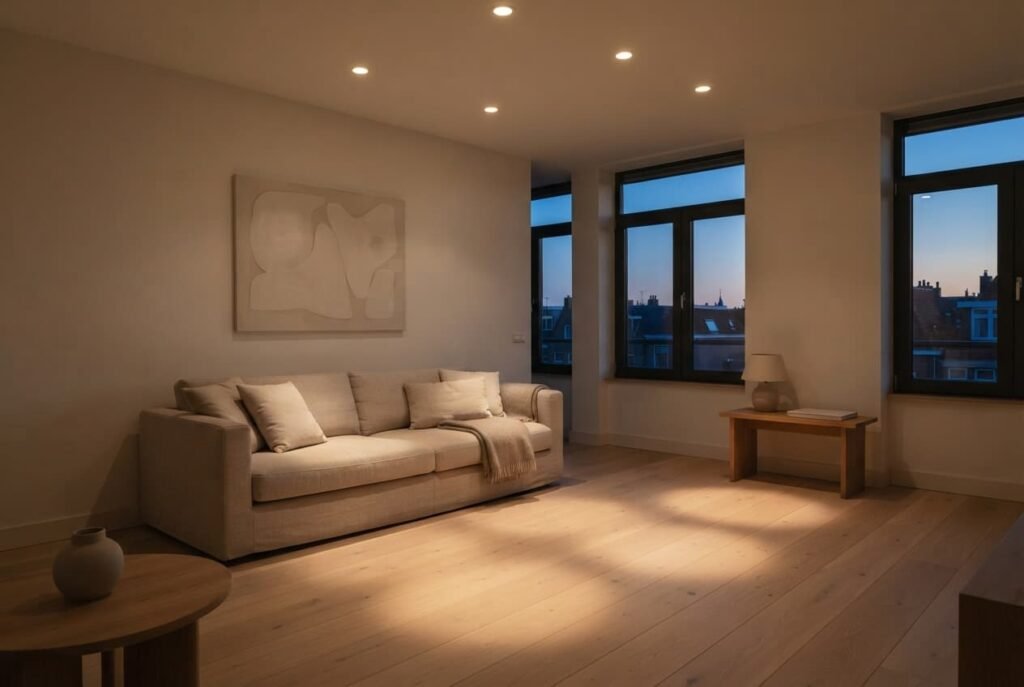
Why Ceiling Spotlights Leave the Walls Unlit
A recessed spot is a short tube with a bulb at its top, and it sends out a cone. The radius that cone covers at a given depth equals that depth multiplied by the tangent of the half-angle. Ours has a 36° beam, which gives a half-angle of 18° and a tangent of 0.325. At the floor, 250 cm below, the radius is 81 cm and the pool measures 162 cm across.
Now locate the walls. The side walls stand 110 cm from the nearest spots, beyond that 81 cm reach, which means no direct light arrives there at all. The end walls stand 70 cm away. A cone meets such a wall only once its radius has grown to 70 cm, and that takes a depth of 215 cm. The lit patch therefore starts at 35 cm height and runs down to the skirting.
Everything above the patch receives light only by bouncing, and walls tell the eye how bright a room is. A bright floor under dim walls reads as a hole in the dark. Most owners reach for more or stronger spots, yet that rarely helps, because every extra cone points straight down as well.
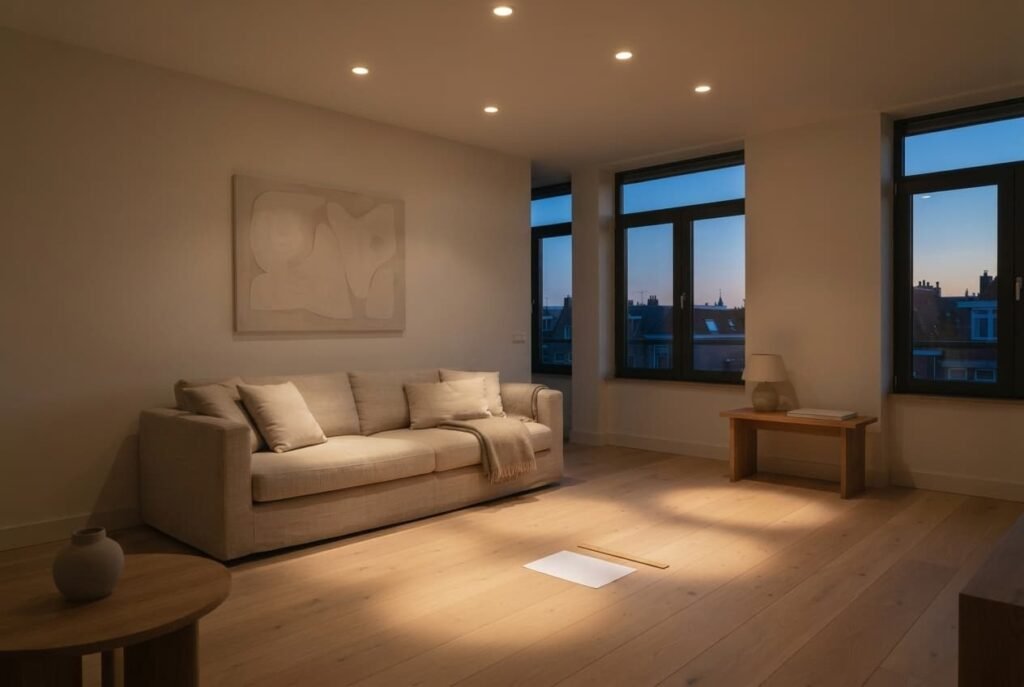
Four Readings of the Walls Under Ceiling Spotlights
Wait for dark, switch off every other light and find a single sheet of white paper and something to measure with. When ceiling spotlights leave the walls dim, these four readings show how far the damage goes.
1. Wall height: standing at the door, note where the lit patch on the end wall stops. Ours stops at 35 cm. Anything below eye level of a seated adult counts as a miss.
2. Paper pool: lay the sheet under a spot and measure the lit circle. Ours is 162 cm, which is less than twice the 110 cm to the side wall.
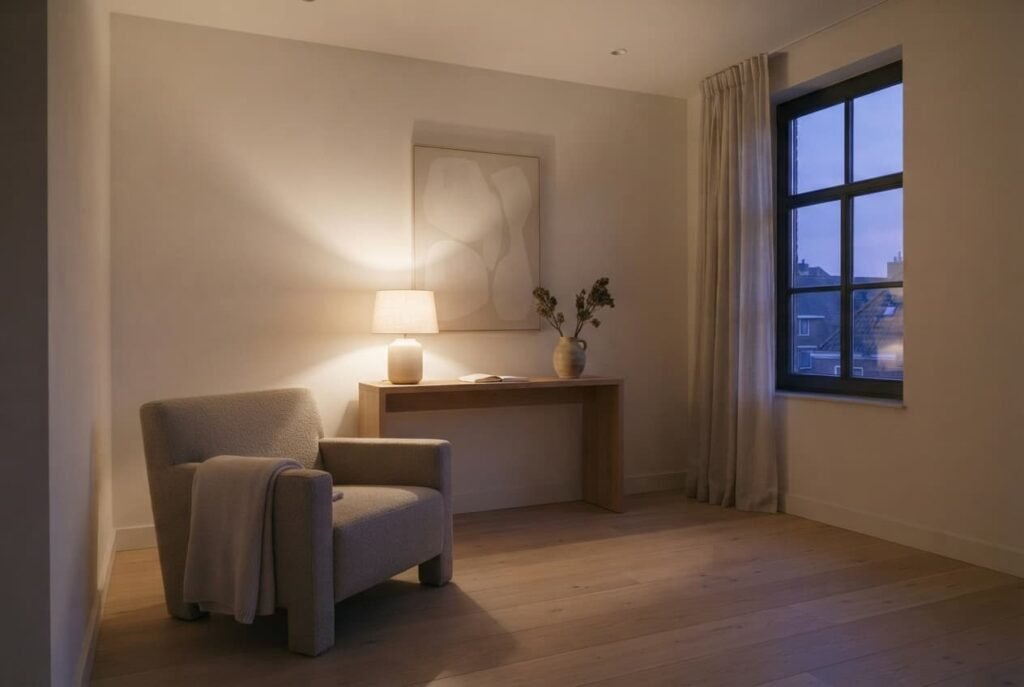
3. Corner chair: sit in the reading chair and look at your hands. A page that needs a lamp means the seat lies outside every pool.
4. Blur: from across the room, let your eyes go soft. Bright discs separated by black are the sign of a contrast fault.
All four are misses here; the three faults below each play a part.
Three Faults Behind the Dark Walls
Each fault can dim a wall alone, and ceiling spotlights leave the walls darkest when all three combine. Test them in turn and note which reading improves.
The walls fade above waist height. The cause is scale, because a narrow beam reaches the end wall only in its lowest 35 cm. Free: tilt any adjustable heads by 20° toward the nearest wall. Rearrange: carry a lamp that has a pale shade from the middle table to a console against the end wall. Purchase: swap the six bulbs for 60° beams in the same fitting. At that angle the tangent becomes 0.577. The side wall is reached at 190 cm depth, and the lit patch there climbs to 60 cm. Light also reaches the end wall up to 129 cm. Each pool’s centre dims to about one-third of its old value because the same light spreads across triple the area.
The pools look like holes in the dark. The cause is contrast. Our readings, which are rough, say 200 lux in a pool and 20 on the wall. The pool is therefore ten times brighter than its surroundings. A gap beyond five times is my own rough limit and not a standard, and past it the room reads as patchy. Free: set the spots to 60% on the dimmer (ours has one) and switch on one lamp near the wall. The pool falls to 120 lux. The wall keeps 12 and gains 30 from the lamp, which shrinks the gap below three times. Rearrange: spread a pale rug under the pool to bounce more light up onto the wall. Purchase: a floor uplighter aimed at the ceiling.
The reading corner stays in shade. Placement causes this one. The nearest spot sits 70 cm away from one wall and 110 cm from the other, which puts the corner 130 cm from it and well outside any pool. Free: borrow the hall’s floor lamp for the corner. Rearrange: slide the chair out until the seat’s centre is 60 cm from both walls. That leaves it 51 cm from the spot, inside the cone’s 67 cm radius at seat height. Purchase: a tilting spot fitted at that position, or a plug-in lamp beside the chair.
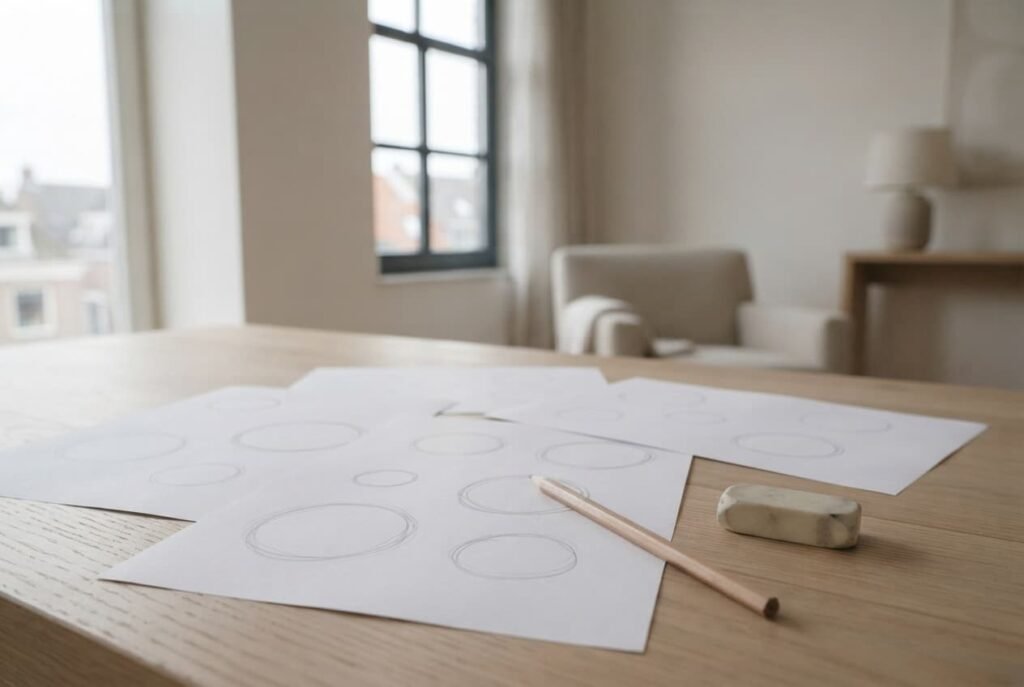
Planning Spots Before the Ceiling Is Cut
A paper plan avoids the whole problem. Draw the room to scale and cut circles at the cone’s radius for the height you care about. Then ask what each wall needs. To light a wall up to 150 cm from a spot 110 cm away, the beam needs a half-angle of about 48°, which means a bulb of roughly 95° that few fittings accept. Even a wide bulb can’t wash a wall from that distance; lamps and wall lights should share the job.
Ceiling spotlights leave the walls short of light unless the plan allows for them; pick the beam angle by the surface you want lit and not by habit.
Mark each spot’s reach in pencil on the plan, and the gaps show before anyone drills. Leave room on the plan for two lamp sockets and a dimmer, which are easy to add early and awkward later.
A Fix Not Worth Doing
Brighter bulbs make the contrast worse. Raising the lumens of a narrow beam makes the pool glare while the wall stays at 20 lux, and the ten-times gap widens. You spend more on light that lands where it was already plentiful, and the room feels no brighter than it did. A glare spot on the floor with unchanged walls is the telltale sign, and it appears within a minute of switching on.
Adding a second ring of spots has the same flaw and costs far more, because it needs new holes and wiring. Repeating a cone doesn’t change its geometry.
Tilting every head hard toward the wall also disappoints. A 25° tilt sends the beam’s axis 117 cm sideways at floor level, and the bulb’s face then turns toward anyone sitting on the far side, which brings glare.
Begin tonight with the wall-height reading and let it point to your fix. Try the free option and give it a full evening before judging. Move on to rearranging only if the wall still fades. Buy a bulb or a lamp last. Most rooms settle after the dimmer and one lamp, because the contrast fault is the one the eye notices before any other. Wider bulbs and tilting heads are meant for rooms where the walls stay dim whatever you try, and a second look with the paper sheet will show which room you have. Keep the sheet, because it answers the same question again after every change.
Questions and Answers
What is the most common cause?
A narrow beam on a spot that sits far from the wall. The cone covers a small patch of floor and reaches the wall too low, or never. The eye reads the unlit wall as the room’s edge; and that leaves the room feeling smaller and darker than a lux reading would suggest.
What is the quickest fix?
Dim the spots to about 60% and switch on a lamp near the wall. That narrows the gap between pool and wall within minutes, at no cost. A lamp moved from the middle table to a wall console adds a bright surface exactly where the eye looks for one.
Can this be fixed without cutting new holes?
Yes. Wider bulbs in the same fitting work, and so do lamps. A pale rug or a floor uplighter helps too, while the ceiling itself stays as it is. Only a changed layout needs cutting. Try these before anything else, because most rooms with this fault improve enough to stop bothering you long before any ceiling work comes up.