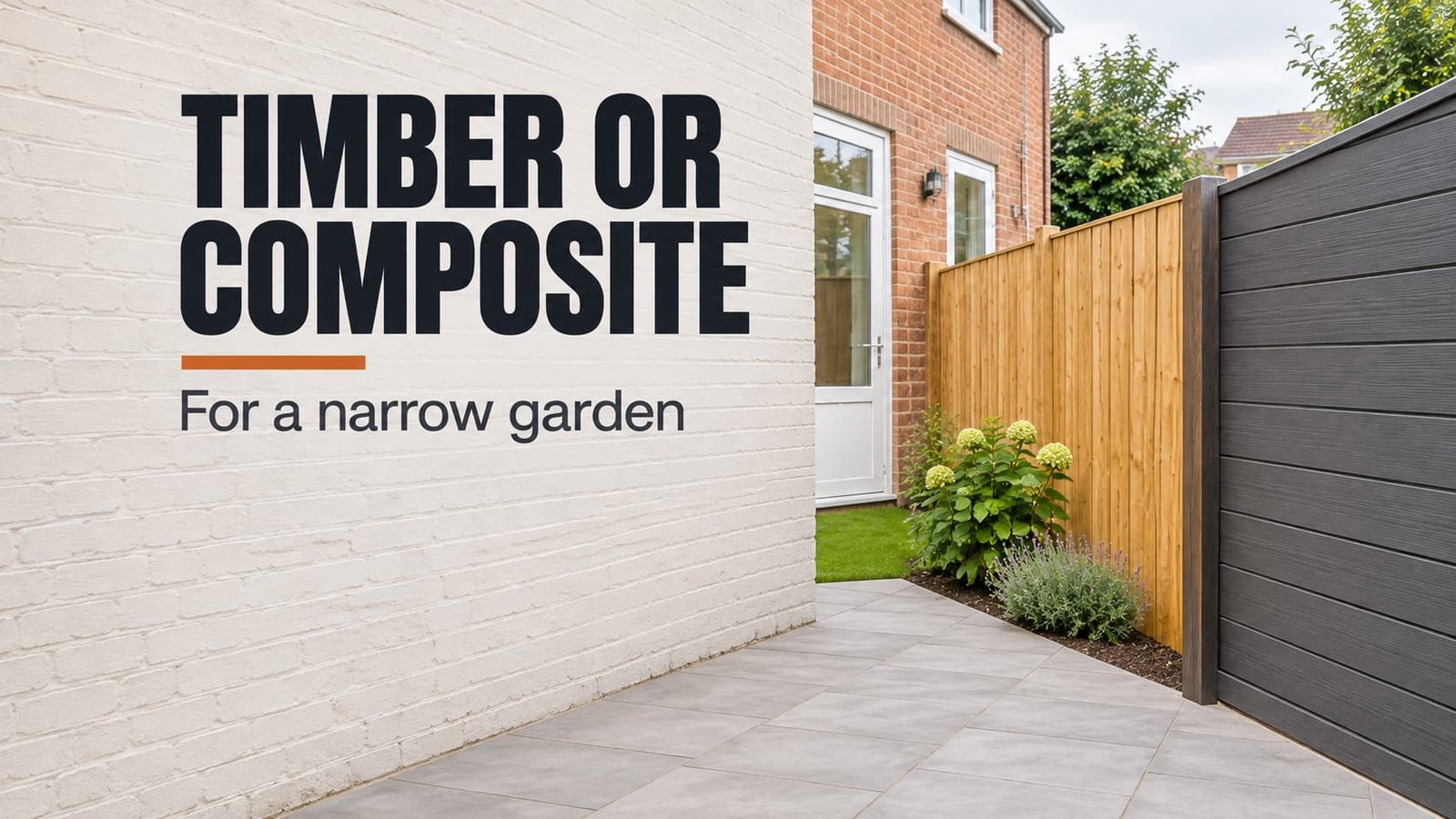
Fence panels for a narrow garden face the same wind as any others, yet they get carried through the house, stand close to every seat and shape a space only 3.6 m wide. This guide weighs timber against composite for a terrace in Utrecht. The garden is 3.6 m wide and 10.8 m long, with six panels of 180 × 180 cm lining each side and no passage beside the house. The choice turns mainly on weight and on how each material moves. Material figures are samples and don’t describe any named product. Every number belongs to this one garden. Measure your own before ordering anything.
What Moves Inside Fence Panels for a Narrow Garden
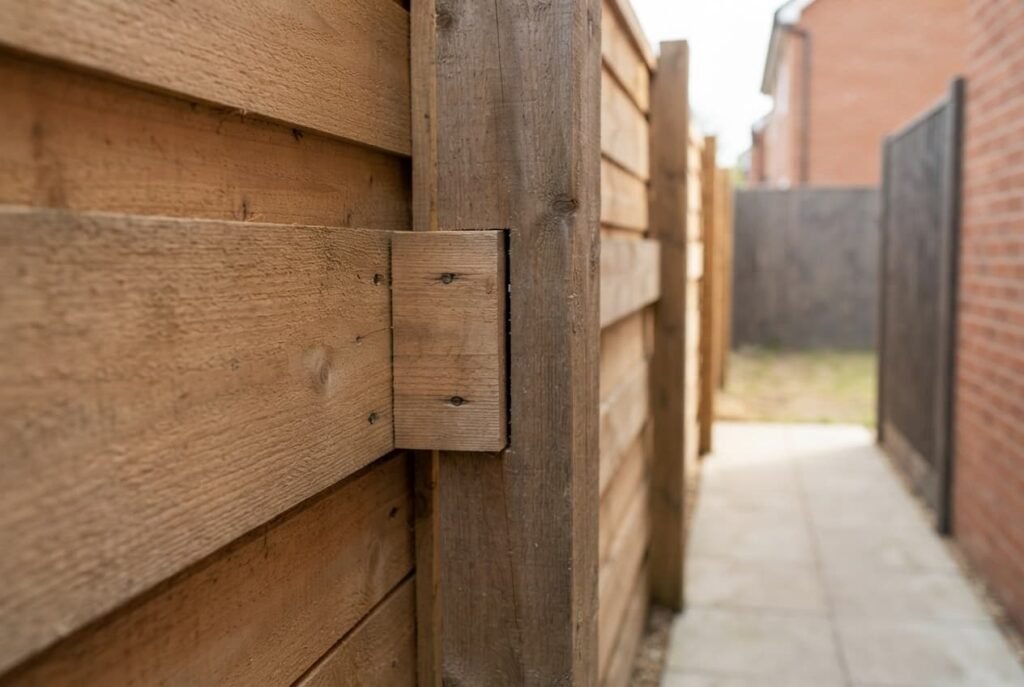
Timber and composite fail in different ways because they move for different reasons. A timber board takes up moisture in wet months and gives it back in dry ones, swelling mostly across its width. A composite board hardly notices moisture and reacts to heat instead, growing mostly along its length.
Take the sample numbers. A timber board 15 cm wide swings through six percentage points of moisture between winter and summer. At a swelling of 0.25% of width per point, that is 1.5%, or 2.25 mm per board. A panel stacks 12 boards. That means the whole panel moves about 27 mm in height across a year.
Composite figures are smaller but point in another direction. A board 180 cm long meets a heat swing of 45 °C, and a sample expansion of 0.00004 per degree gives 1,800 × 0.00004 × 45 = 3.2 mm of growth.
Both movements are manageable once the frame allows for them. Timber panels need a frame that lets boards shift a little. Composite boards need a gap of about 5 mm at each end, which absorbs the 3.2 mm with room to spare. Panels fixed rigidly in either material crack at the screws or buckle between posts, which is why the frame deserves attention too.
Timber and Composite Panels Compared Row by Row
Rows below compare fence panels for a narrow garden of the sample size. Read them in pairs. Weight and carrying belong together, because a heavier panel means more effort at the hall turn. Movement and gap belong together too, since each material needs room to shift in its own direction. Surface care and repair stand alone. Circle whichever rows would bother you in your garden. A 180 × 180 cm panel has 3.24 m² of face, and twelve of them cover 38.9 m², which is the area every coat or wash has to reach.
| Point | Timber | Composite |
|---|---|---|
| One 180 × 180 cm panel | 25 kg | 45 kg |
| Twelve panels carried through the house | 300 kg | 540 kg |
| Movement over a year | 27 mm in height | 3.2 mm along each board |
| Gap needed at board ends | none | 5 mm |
| Surface care | recoat every few years | wash when dirty |
| Repair of one damaged board | swap that board | swap that board; the colour may differ |
Weight and surface care stand furthest apart: 240 kg more to carry against a recoat every few years. Decide which of those two you’d rather live with, because the remaining rows yield to a saw or a spare board.
Where Timber Panels Earn Their Place
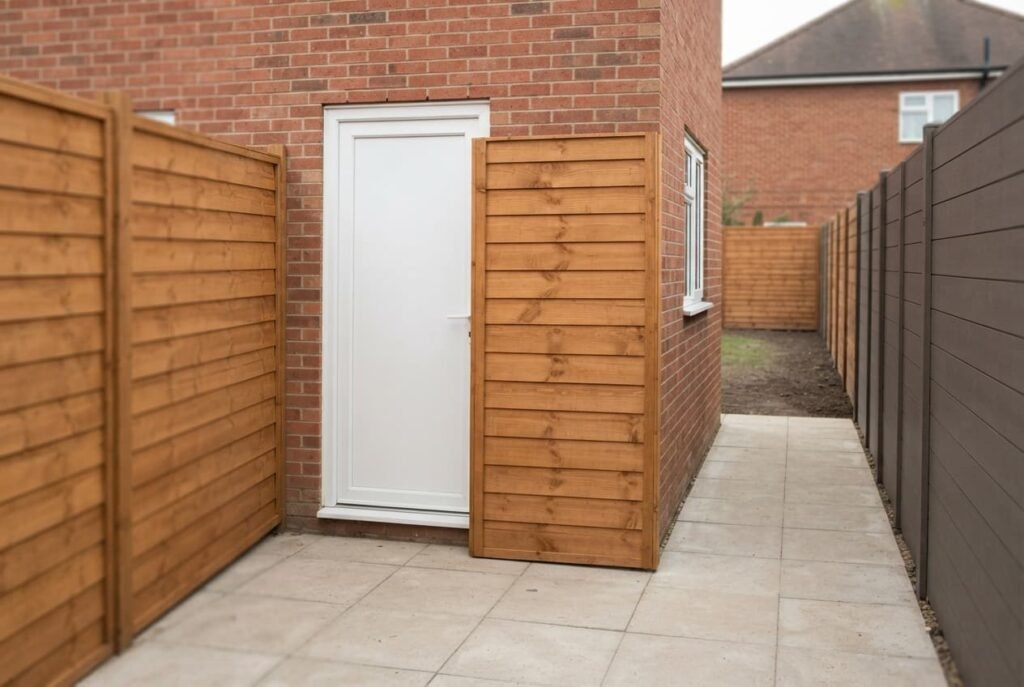
The garden has no side passage. Every panel travels through a hall 83 cm wide with one turn. A timber panel of 25 kg can be carried on edge by two adults without a trolley. Twelve of them add up to 300 kg, and two adults finish the carrying in twelve short trips.
When fence panels for a narrow garden must be carried through a hallway, weight decides most of the job. Timber also forgives bad measuring. The run along each side is exactly 10.8 m only on paper, and a fence 40 cm short needs one panel sawn down with an ordinary saw. A single split board can be swapped without touching its neighbours. Twelve boards of 15 cm make each panel 180 cm tall, and a saw trims only the last panel.
Three drawbacks come with the weight advantage. The surface needs a fresh coat every few years, and one side of 10.8 m takes an afternoon. The 27 mm movement shows up as hairline cracks in the coating. Rot gathers wherever a board touches soil. Keep the lowest board 5 cm above the ground.
Where Composite Panels Earn Their Place
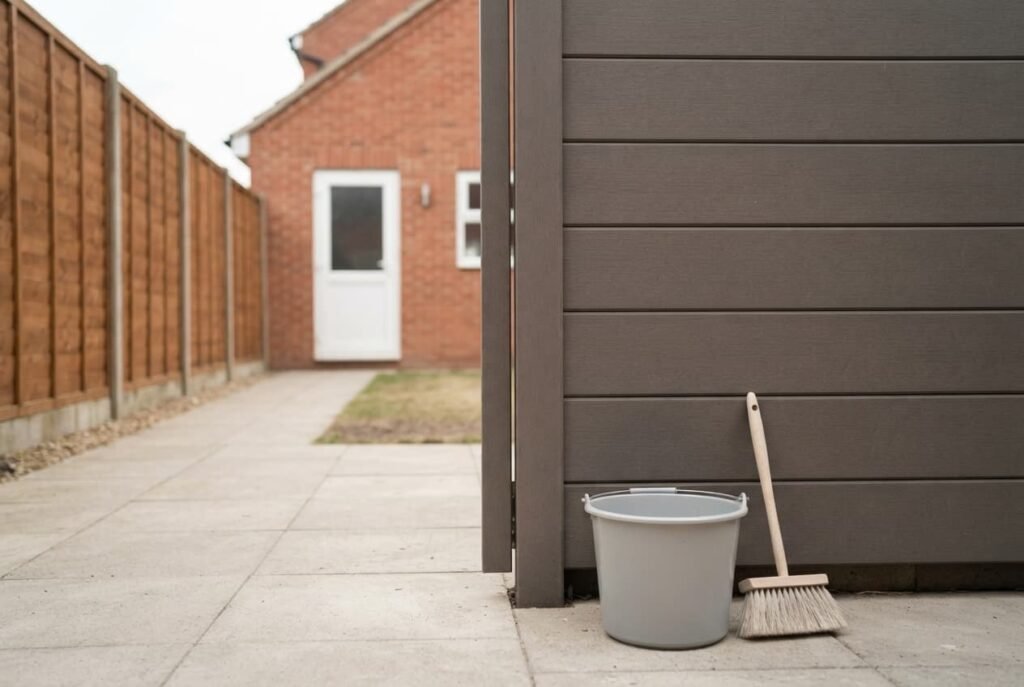
Composite suits an owner who never wants to pick up a brush again. A wash with water removes the green film from a shady side. A hose with a brush handles a 10.8 m run in about sixty minutes, and the colour stays even from board to board. Moisture hardly moves the boards. The 27 mm of swelling seen in timber simply doesn’t occur.
Carrying is where composite loses ground. Twelve panels at 45 kg make 540 kg, and each one wants two adults and a firm grip at the hall turn. Each trip risks scuffing the plaster at the turn unless the corner is padded. Plan twelve trips of one panel and rest between them.
Cutting asks for more care as well. A dense board needs a sharp blade, and a freshly sawn edge looks different from the factory face. A fence 40 cm short is therefore a bigger problem than it’d be in timber. The material also grows with heat. Leave the 5 mm gap at each end, or the boards press against the posts on a hot afternoon and bow outwards.
Keep the Fence You Have for Another Season
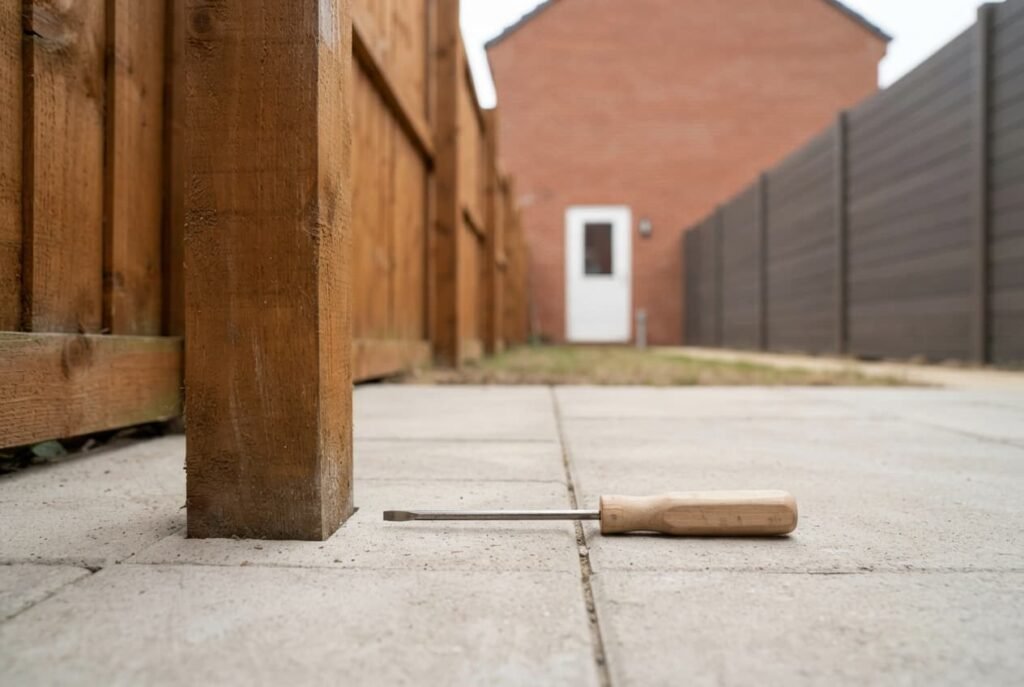
A third route replaces nothing wholesale. Press a screwdriver into every post at soil level. A sound post stops within about 5 mm, whereas a rotten one lets the tip sink 3 cm.
In the sample garden, 14 posts stand along the two sides. Say 3 of them sink and the other 11 stop at once. Then three posts and the boards touching them need replacing. The remaining 11 posts and every panel between them stay in place.
Repair costs a morning and avoids hauling twelve panels through the hall. Replace only what fails the screwdriver test, and recoat the rest when the surface turns dry and grey. Replacing every one of the fence panels for a narrow garden isn’t always needed, because a fence’s weak points usually sit at post bases. Posts at the corners and beside the gate take the most strain. Test those twice.
The route also gives you a full season to watch where the sun falls and the wind pushes.
Which Fence Panels in a Narrow Garden Suit You
Two branches settle the question, and each carries a single accepted drawback.
If the panels must come through the house, choose timber. Twelve panels weigh 300 kg against 540 kg, and each one fits through an 83 cm hall on edge. Accept the recoat every few years and the 27 mm of seasonal movement, and leave room in the frame for it. Keep one spare board for the first repair.
If you never want to pick up a brush, choose composite. Washing replaces recoating, and the colour stays even. Accept 240 kg of extra carrying and the 5 mm gap at each board end, and plan the carrying days before the delivery arrives. Rest between the twelve trips.
Before ordering, take a card strip 180 cm by 5 cm and walk it through your hall to the garden. If it turns the corner without touching the wall, either material will make the journey. A panel’s weight matters less than its length on a narrow turn. Measure that length at the tightest point and order only after the card has passed. Note the result beside the panel size on your order list.
Questions and Answers
How long do the panels last?
Both materials serve for many seasons if the posts stay firm. Timber fails first at points that touch soil. Keep boards 5 cm above the ground. Composite resists moisture and fades slowly in strong sun. The posts usually give way before either type of board does.
What upkeep does each one need?
Timber wants a fresh coat every few years, and one 10.8 m side takes an afternoon. Composite wants a wash with water when a film builds up. Neither needs sanding on a normal schedule, but a scratched composite face can’t be sanded out the way timber can.
Which suits a garden that gets full sun?
Composite takes sun well but grows with heat. Leave 5 mm gaps. Timber copes with sun. It dries quickly. Its surface greys and splits faster in strong light. In a south-facing garden, either works if the frame allows for movement. Dark colours run hotter in sun and move more.