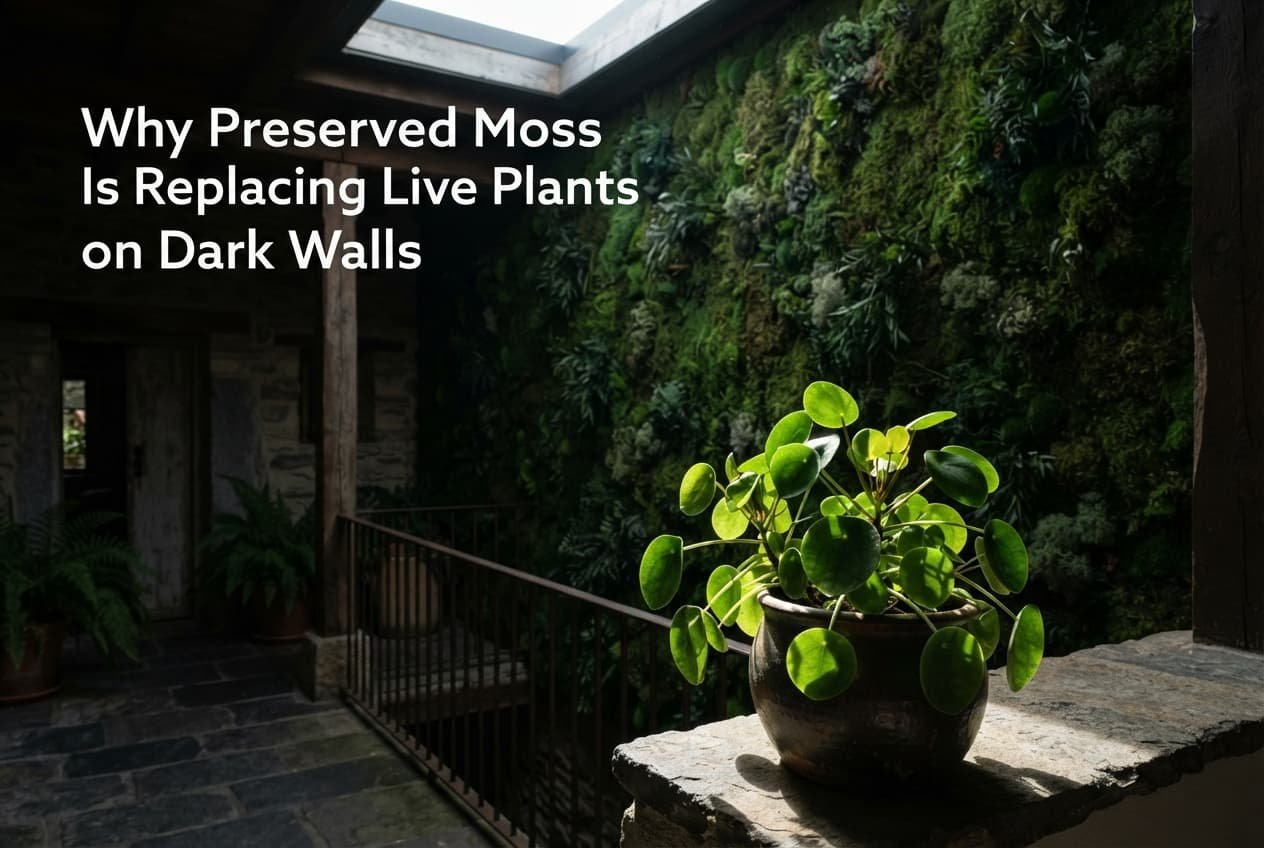
Every indoor courtyard has one wall that eats plants. It is the wall that never sees direct light, where the fern sulked, the ivy stretched thin and the replacement fern did exactly the same. Designers have increasingly stopped fighting that wall and started covering it with preserved moss: real moss, treated so that it stays soft and green without light, soil or water. It is less a shortcut than an honest answer to one specific problem.
What actually changed
For years the advice for a dark wall was to choose tougher plants. The shift is toward accepting that some surfaces cannot support living things and filling them with a material that does not need to. Preserved moss is real moss that has been harvested and treated with a preserving solution, commonly glycerine-based, so that it keeps its texture and colour without growing. It is sold as ready-mounted panels, as tiles, and as loose tufts to glue onto a backing.
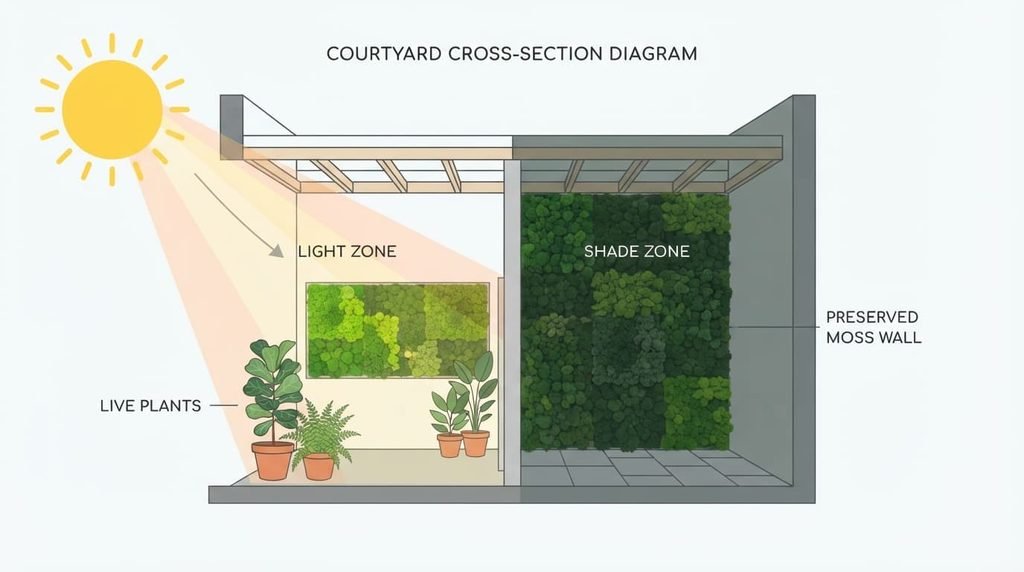
What changes is the division of labour. Live plants go where there is light, and preserved moss goes where there is not.
Why it keeps coming back
The mechanism is the dark wall itself. Interior courtyards and light wells have walls that sit in shade for most of the day, and too little light is one of the most common reasons indoor plants decline. A problem that repeats produces a repeated demand for something that works in exactly that spot. Preserved moss removes the things that defeat plants on such a wall, which are too little light, uneven watering and stale air, simply by not needing any of them.
There is a visual reason as well. A bare wall behind a lively planting looks unfinished, and the live plants in the lit spots read as an island. Moss gives the wall the colour and texture of greenery, so the whole courtyard looks like one planted space.
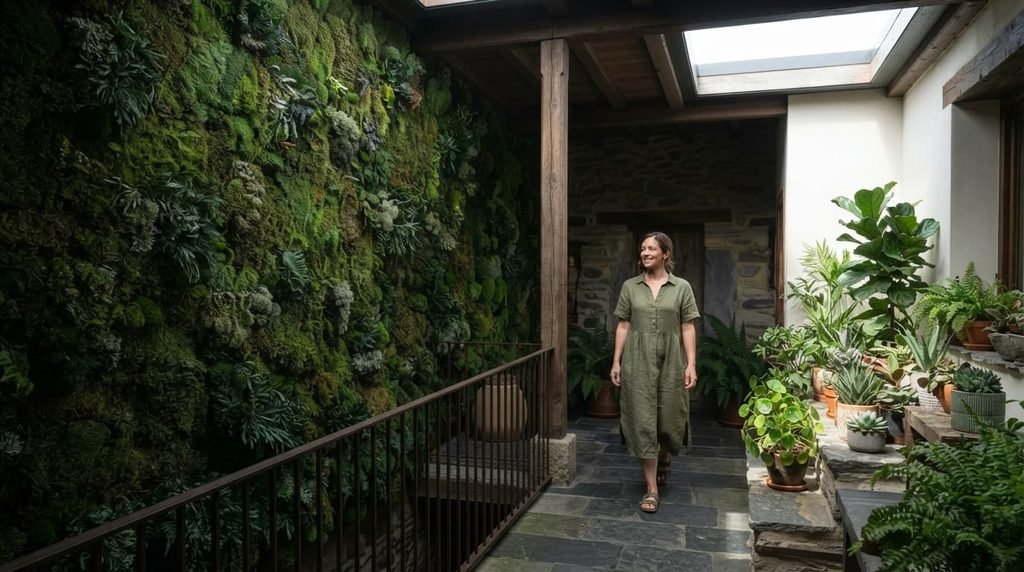
What this changes in a courtyard
Three things shift in practice.
The wall becomes a feature instead of a problem. There is no watering schedule for that area and no replacement plants every few months.
Maintenance becomes protection. Instead of caring for the moss, you keep moisture, strong sun and heat away from it. Dust it with a soft brush or a gentle puff of air, and never water or spray it.
It is a surface, not a garden. Preserved moss does not grow, flower or change through the year, and it does not make a space feel alive the way a growing plant does. The best arrangements pair moss on the dark wall with real plants in the light.
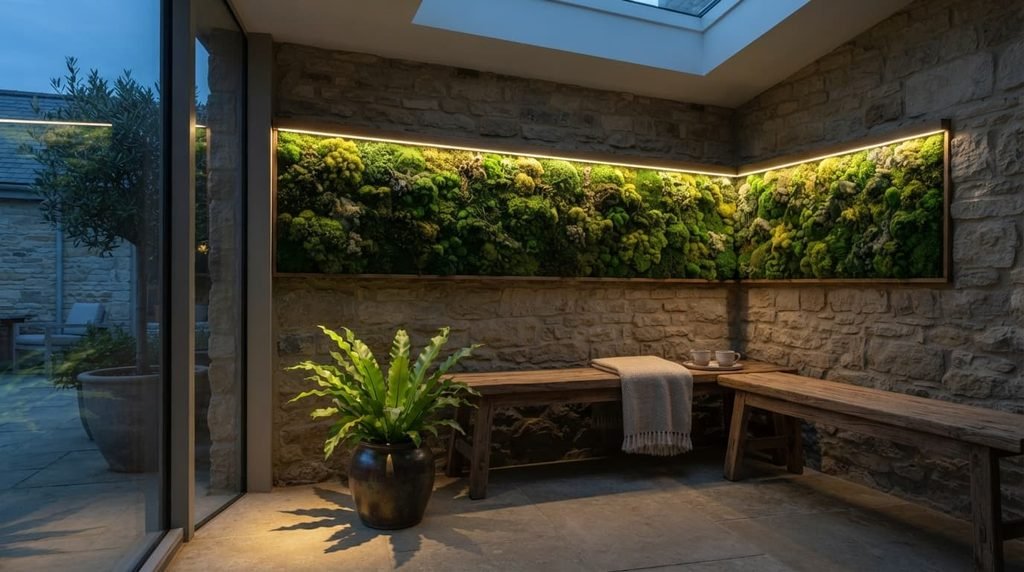
What it looks like in practice
A single large panel, or a grid of tiles with a clean edge, on the darkest wall is the simplest version. A band of moss behind a bench works well, and so does a recessed niche filled with tufts. Keep it a few hand-widths above the floor so that splashes from watering other plants cannot reach it. Mix two or three shades, such as olive, forest and pale green, because a single flat green looks like painted board.
Mount it on a flat, dry, stable wall using the fixings the maker recommends. Large panels are heavy, so check what kind of wall you have, and if you do not know what runs inside it, consult a licensed professional before drilling. Then place a living plant directly in front of the moss, in whatever lit spot you have, so that the eye reads the whole arrangement as a garden. Light the wall deliberately, even though the moss itself needs none. A low-heat LED strip or a small spotlight aimed across the surface brings out its texture, and it stops the dark wall from reading as a hole. Avoid hot halogen bulbs and fittings that sit close to the moss, because it is dried plant material and heat dries and dulls it.
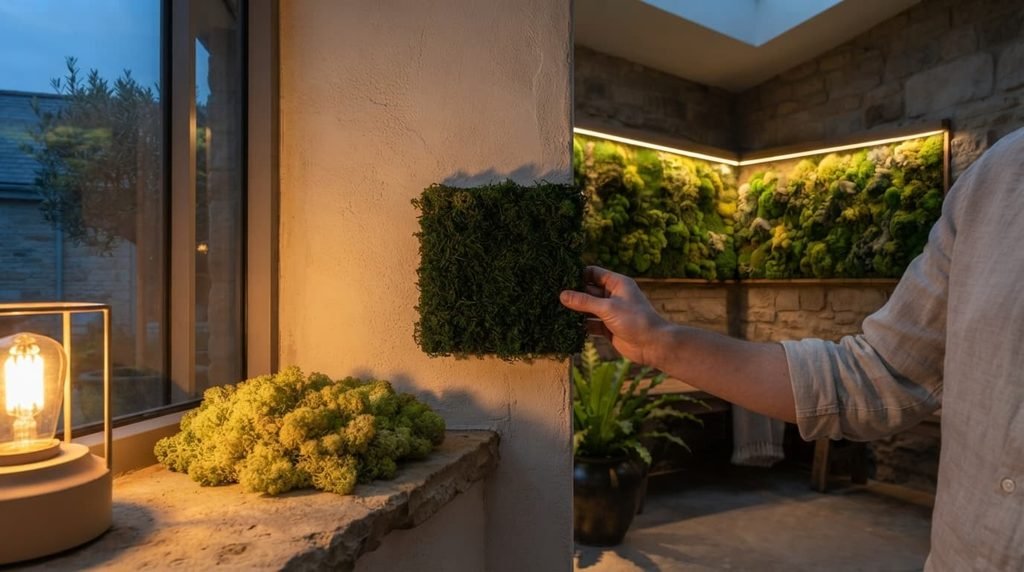
How to choose a panel
Buy a sample before you commit to a wall. Hold it against the wall at different times of day, because artificial light shifts colour: warm bulbs can make a green moss read yellow, and cool bulbs can make it look grey. Ask what the product is made of. Preserved moss is a natural material, while some cheaper panels use dyed foam or synthetic fibre that looks similar in a photograph and ages differently. Look at the edges and the backing too, since a neat finish matters more on a large wall than the shade of green.
Where this trend genuinely holds up
It holds up in the one situation it was designed for: a wall too dark for living plants and dry enough for moss. It also suits households that travel, rented homes where nothing can be planted in the ground, and courtyards where installing irrigation for a living wall is not practical. Its running cost is close to nothing, although it usually costs more upfront than a few pots of live plants.
Where the verdict should stay negative
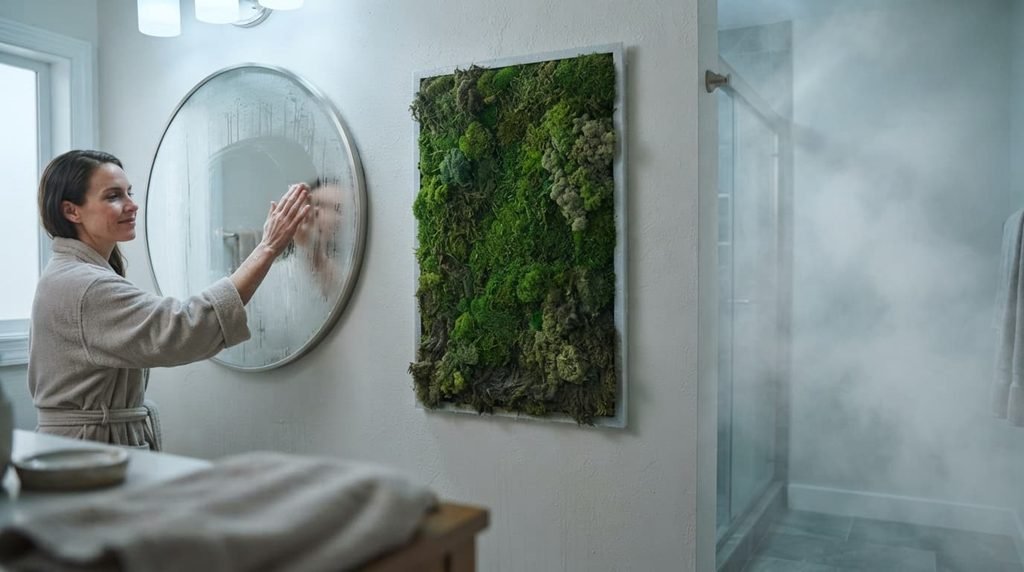
Preserved moss isn’t worth it in a damp, steamy or sunny spot, or if what you want is a living garden.
Preserved moss absorbs moisture from humid air, which can dull its colour or let mould form, and strong direct sun fades it. In a courtyard with open glazing that gets full sun, or near a shower or kitchen steam, it will age quickly. It is also dried plant material, so keep it away from candles, heaters and fire features. And if the point of your courtyard is the feeling of growing things, a wall of preserved moss will look good and feel like a backdrop. Adopting it because it is popular, in a space that wants life, trades a living courtyard for a static one.
What people get wrong when adopting it
The most common mistake is watering it. Moss likes water when it is alive, but preserved moss is no longer alive, and water damages the treatment and the colour.
The second is covering the entire courtyard. Where there is light, live plants do things moss never will, so leave them room.
The third is ignoring the fixings. A heavy panel on an unsuitable wall, or drilling blind into a wall that hides wiring or pipes, creates problems that no amount of green can hide.
Questions readers keep asking
Does preserved moss need any light?
It needs no light to stay looking as it does, though strong direct sun fades it. Ordinary indoor light is fine.
How long does it last?
In a dry, shaded, stable indoor spot it can keep its look for a long time, but colour softens gradually. Makers’ claims about years vary, so treat any specific figure cautiously.
Is it the same as artificial moss?
No. Preserved moss is a natural material that has been treated, while artificial moss is man-made. They differ in feel and in how they age, so ask what a panel is made of before you buy.
Does it clean the air like living plants?
It does not grow, so it does nothing a living plant does. Choose it for how it looks and for what it saves you in care, not for any effect on the air.