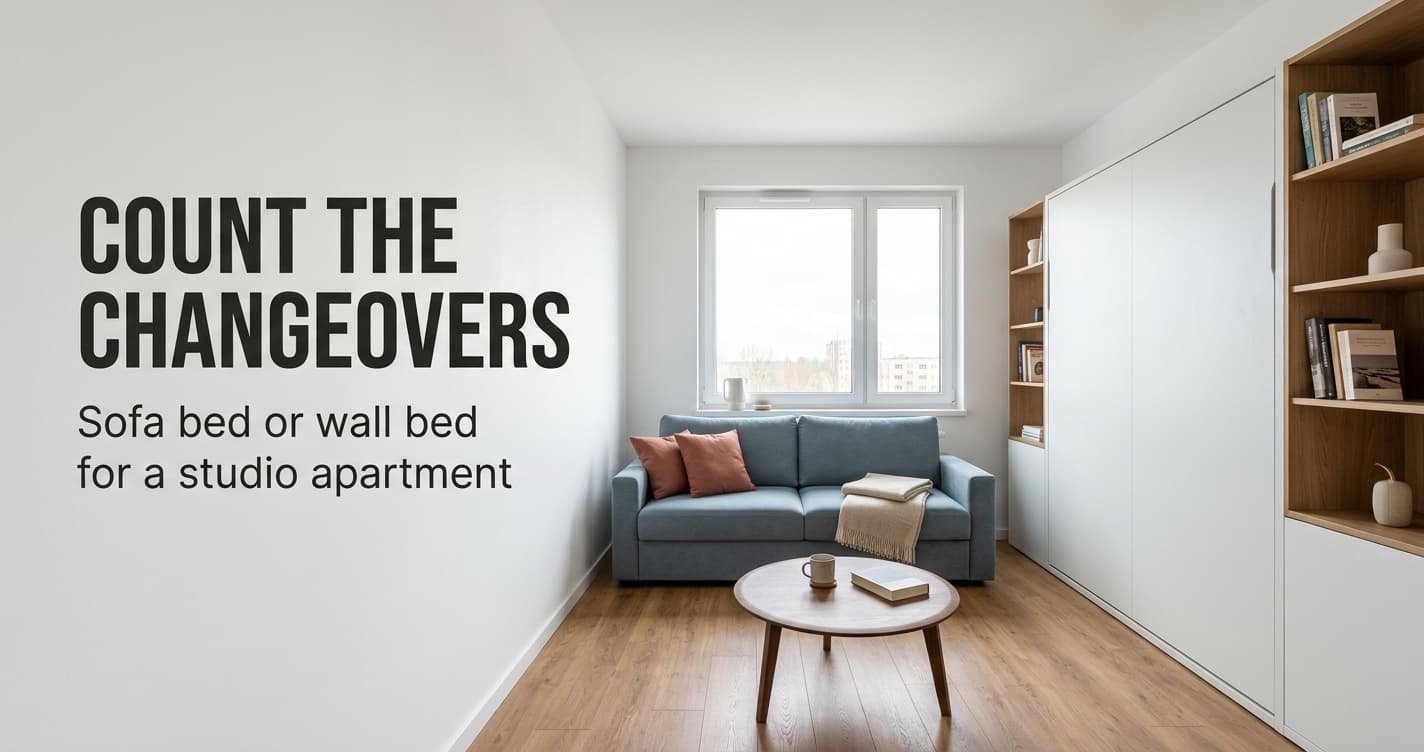
Choosing a sofa bed or wall bed by floor area gets the question backwards, because the two take almost the same floor by day. The deciding property is the cost of each changeover. A sofa bed makes you rebuild the bed every night, while a wall bed lets the bedding stay on. Sleep in the studio most nights and take the wall bed. Let guests do most of the sleeping and take the sofa bed.
This guide assumes a Dutch studio of 340 by 540 cm (18.4 m²) under a 250 cm ceiling. The figures are typical dimensions rather than a particular model. If you rent, read your lease before you drill into a wall.
The property that decides a sofa bed or wall bed
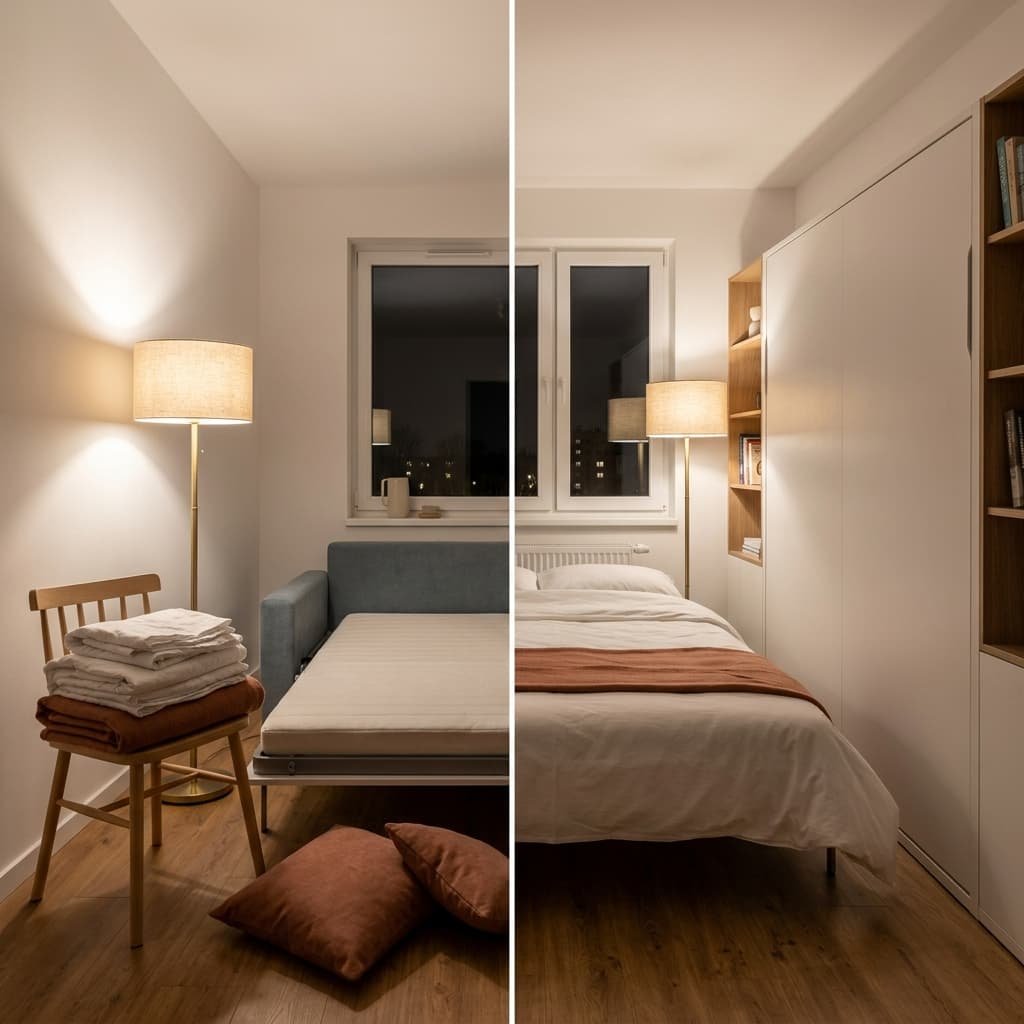
Count what happens at night. A sofa bed opens in four actions. You clear the cushions and pull out the frame. Then you unfold the mattress and make up the bed. Closing it takes four more. You strip the bed and fold the mattress. Then you stow the bedding and push the frame home. That’s eight actions a day.
A wall bed takes two, because the bedding stays strapped to the mattress. You release and lower the bed in the evening. In the morning you lift and latch it. Over a year that’s 2,920 actions against 730. The counts are a tally of a typical routine, so treat them as a model. No single night looks dramatic, and the multiplication is what decides.
The deciding property is the cost of a changeover, because a bed that’s hard to convert stays in whichever state you left it. The cost falls at the worst moments, when you’re tired in the evening and rushed in the morning. A sofa bed left open takes the seat and the walkway with it, and the studio becomes a bed with nothing to sit on. A wall bed left down does the same. Cheap changeovers keep both states available.
Sofa bed and wall bed, side by side
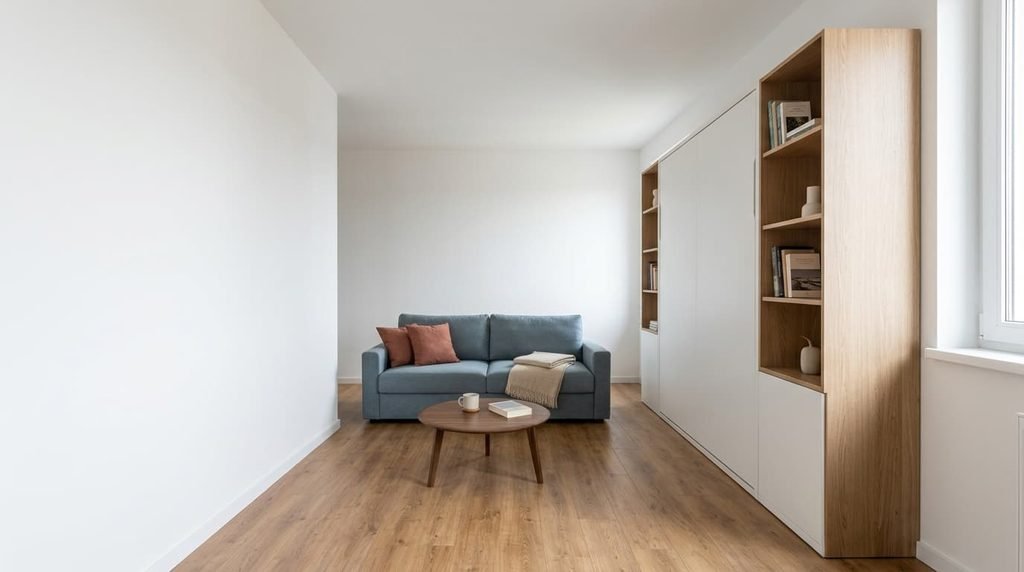
These rows are typical dimensions or counts you can check when you weigh a sofa bed or wall bed, and no brand enters them.
| Property | Sofa bed | Wall bed |
|---|---|---|
| Floor taken by day | 200 × 95 cm = 1.9 m², and it is also the seat | Cabinet 160 × 40 cm = 0.64 m², plus a sofa of 170 × 85 cm = 1.45 m², so 2.09 m² |
| Floor needed at night | About 200 × 210 cm = 4.2 m² with the frame pulled out | About 160 × 205 cm = 3.28 m² |
| Actions per changeover | About 8 a day | 2 a day |
| Bedding while folded | Stored elsewhere | Stays strapped to the mattress |
| Mattress | Thin, typically 10 to 15 cm, and folded | Standard, full length, resting flat |
| Wall | Nothing fixed | Anchored, and the wall carries the load |
| Moving house | Carried out like a sofa | Unscrewed and refitted |
The first row surprises people most: the wall bed with its own sofa takes 0.19 m² more by day, which is 10%, because a cabinet 40 cm deep claims so little floor. Floor area separates the two far less than the changeover row does, so measure the cabinet together with the sofa before floor decides.
Where a sofa bed wins
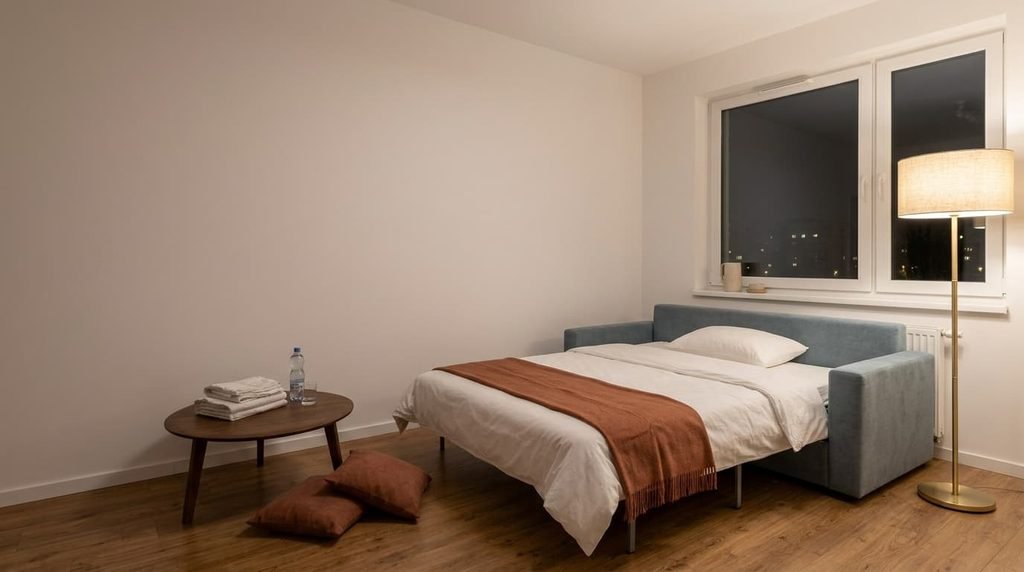
A sofa bed wins when the bed is the guest and the sofa is the resident. Ten nights a month at eight actions is 80 actions, which most people accept. It also wins in a rental. Nothing is fixed to a wall, and the bed leaves with you like any sofa, so a short lease costs you nothing extra.
One plain reason is repair: a worn mattress or a tired mechanism is replaced as a part, with no screwdriver near the wall. A sofa bed also suits a studio whose only free wall carries the window, since it needs no cabinet of 215 cm behind it.
The costs are plain. At night the open frame takes 4.2 m² of the 18.4 m² floor, which is 23%, so the coffee table moves every time. The mattress folds, which is why it is thin. Fold lines and a cross-bar can be felt through it.
A mattress wears fastest at its folds.
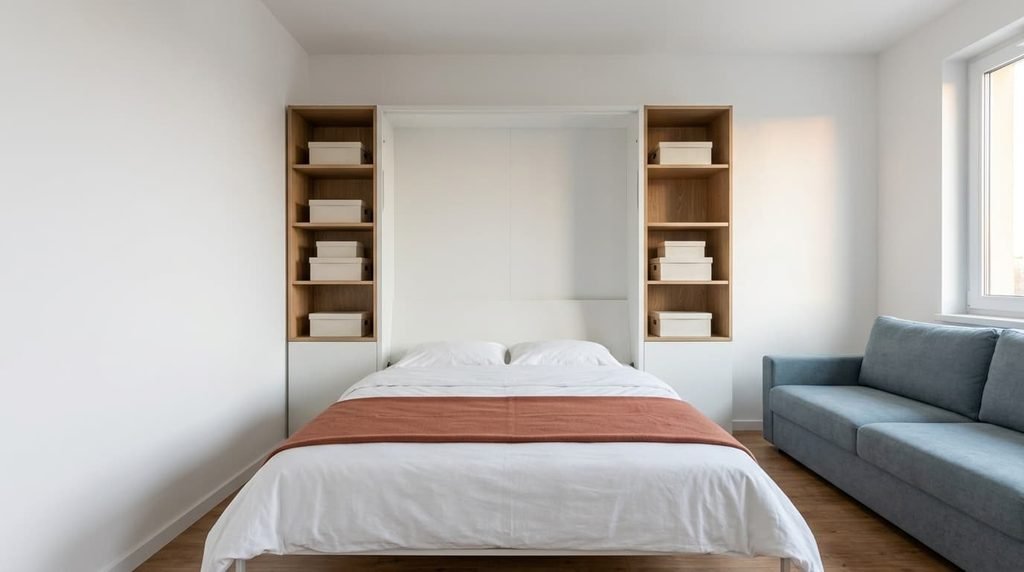
Where a wall bed wins
A wall bed wins when you sleep in the studio most nights. Two actions on 30 nights is 60 actions a month, against 240 for the sofa bed. The bedding stays made. A standard mattress lies flat all day, so it never folds.
One plain reason is floor at night: open, the bed needs 3.28 m², about 0.9 m² less than the sofa bed’s 4.2, and the sofa stays outside that zone. Shelves 40 cm deep can flank the cabinet and add storage on either side. A mattress that never folds also outlasts one that does, since folds are where mattresses wear first.
The costs mirror that. The bed wants a clear wall of at least 160 cm and a ceiling above its 215 cm cabinet. It is fixed to the wall, and the wall type decides the fixings. Brick and concrete take them differently from plasterboard, and I can’t judge yours from here. You also need a separate sofa of about 1.45 m².
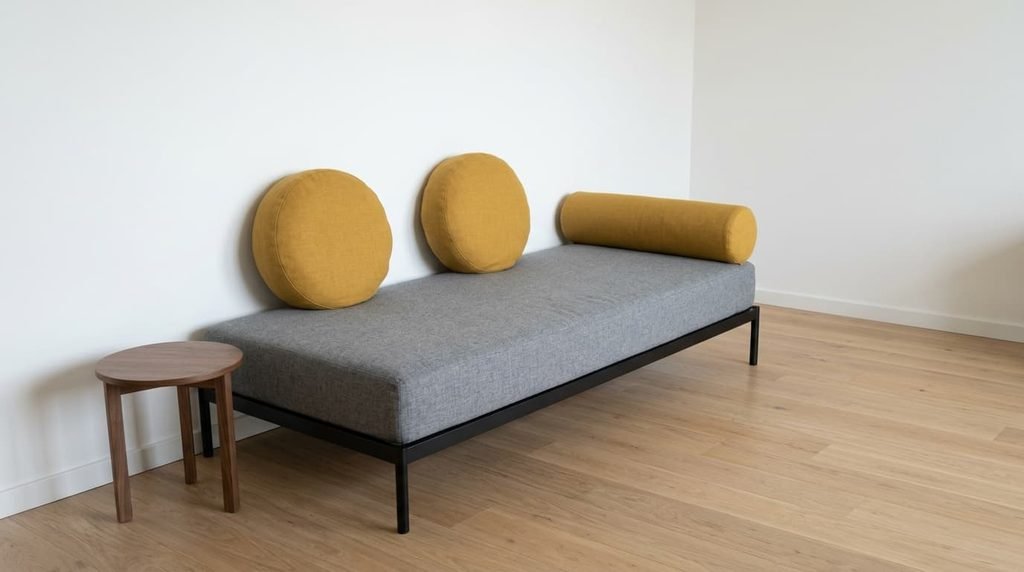
When neither a sofa bed nor a wall bed is right
If one person sleeps in the studio and rarely hosts, the better third option is a daybed. It’s a fixed single bed of 90 × 200 cm, which is 1.8 m², dressed with bolsters by day. The bedding stays on, so a changeover is zero actions. Bolsters 25 cm thick leave a seat 65 cm deep.
The best conversion is the one you never perform, and I’d take zero actions over a clever mechanism for a single sleeper. By day a daybed takes 1.8 m², against 2.09 m² for the wall bed with its sofa. The frame has no moving parts to wear, and nothing touches the wall.
A daybed sleeps one, so a second sleeper rules it out. Hosting needs a folding mattress stored elsewhere. If your current bed already works and the seat is the missing piece, keep the bed. Add a sofa of 170 × 85 cm.
How to decide in thirty seconds
If you sleep in the studio on ten or more nights a month, take the wall bed. Clear a wall 160 cm wide and 215 cm high, and keep 205 cm of floor free in front of it at night. Choose a sofa of about 170 × 85 cm for the day, and place it outside that zone.
If guests do most of the sleeping or you can’t drill into your walls, take the sofa bed. Choose a coffee table light enough to lift, and keep the bedding in a box within reach. Ten nights a month is the line I use, but it moves with how much eight daily actions bother you.
A sofa bed or wall bed comes down to the changeover: eight actions a night against two. Floor area barely separates them, at 1.9 m² against 2.09 m² by day. Count how many nights a month you really sleep in your own studio before you look at either. Ten or more nights point to the wall bed, and fewer point to the sofa bed.
Questions readers keep asking
Which lasts longer: a sofa bed or a wall bed?
Wear follows the number of cycles. A daily sleeper folds a sofa bed’s mattress 365 times a year, while a wall bed’s mattress stays flat and only its hinges and lifting parts work. Ask the maker for the tested cycle count of the mechanism, and compare it with your nights a year.
What maintenance does a wall bed need?
Little. Check the wall fixings twice a year and watch how the bed moves. If it lifts heavier or lowers slower than before, the lifting parts are wearing and need replacing. Wipe the frame and vacuum behind the cabinet. Let the mattress air while the bed is down.
Is a sofa bed or wall bed better for two people in a studio?
For two people sleeping nightly, a wall bed suits better. It takes a standard 140 × 200 cm mattress that never folds, and the bedding stays on. The sofa bed’s thinner folded mattress and eight daily actions suit two people only as an occasional guest bed.