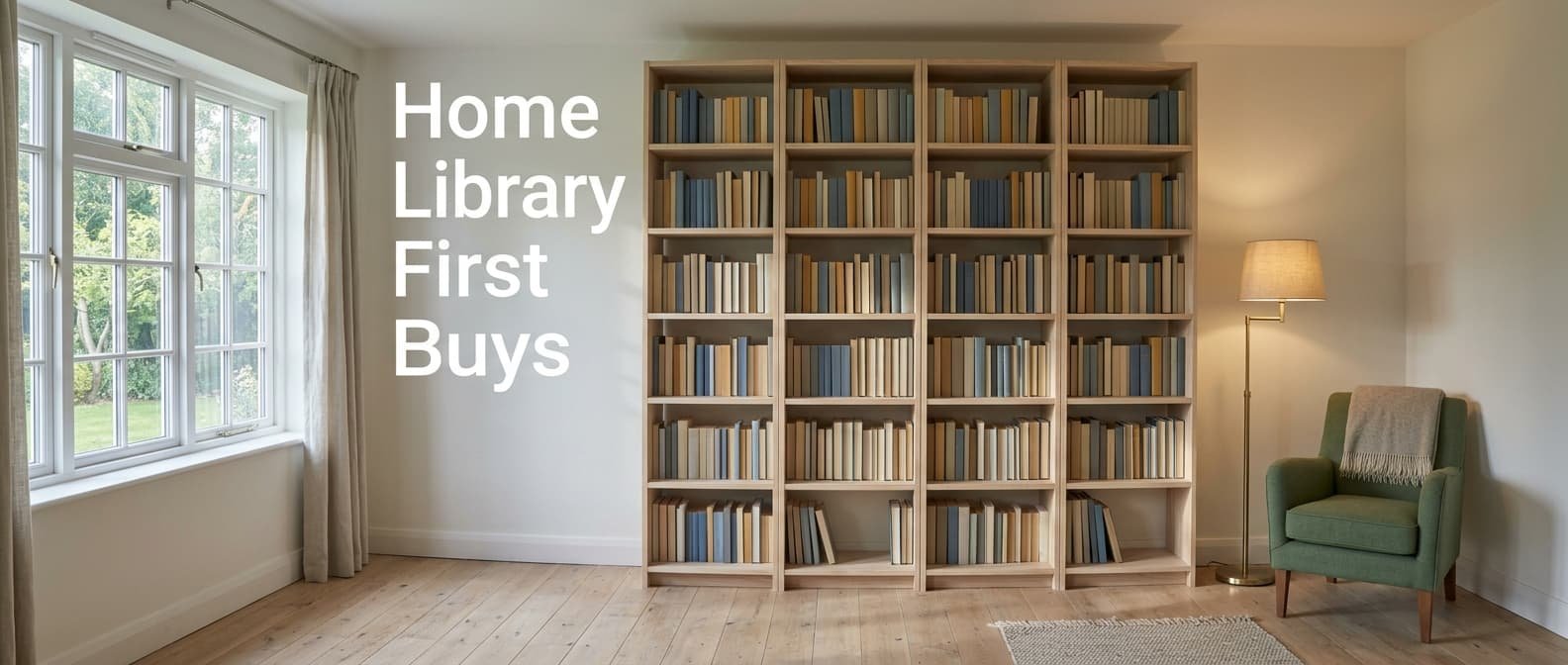
Most guides send you to the armchair first, and that’s the wrong first purchase. Turning a spare room into a home library starts with the shelving. A reading lamp and a blind come next, then the chair, with a side table last. The chair can wait because it moves, while the shelves stay put once 200 kg of books sit on them.
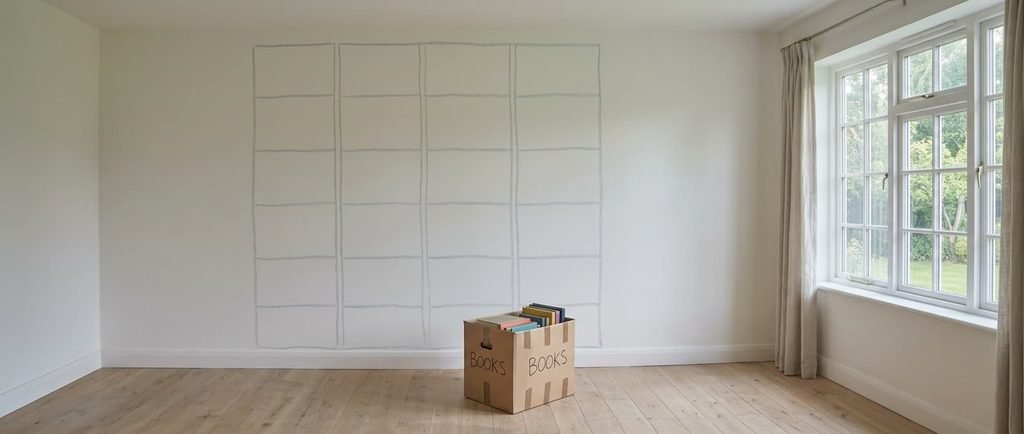
This is a Dutch spare room measuring 280 by 330 cm. The ceiling is 250 cm high and one window sits on the short wall. It holds about 400 books. No prices appear below, since they date fast. Construction is the yardstick for every piece.
Turning a spare room into a home library: the rule that decides where money goes
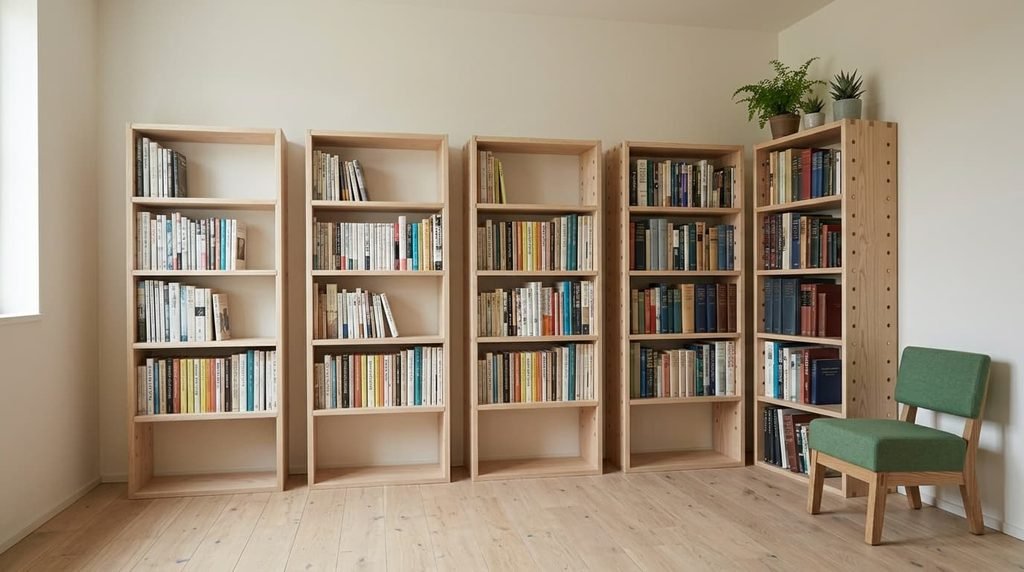
Money follows geometry. Spend first on the piece that fixes the most of the room and is hardest to move once it’s loaded. Shelving is that piece. Your 400 books, at an average spine of 2.7 cm, run to 10.8 m. Filled to 80% of each shelf, which leaves room to grow, they need 13.5 m of shelf. On a 330 cm wall, four columns of 60 cm with six shelves each give 14.4 m. The wall decides the room before any other purchase does. Every other piece has to find a place around it.
Weight supplies the rest of the rule. 400 books weigh about 200 kg, at roughly 0.5 kg each. A chair weighs 12 kg and moves with one hand. Shifting the shelves means emptying them first, a job about 17 times heavier. A mistake in a heavy fixed piece costs a weekend. In a light loose piece it costs a minute. Fixed pieces also set the sightlines. Put the shelving on the wall at right angles to the window. Daylight then rakes along the spines instead of striking them head on, and the books fade more slowly.
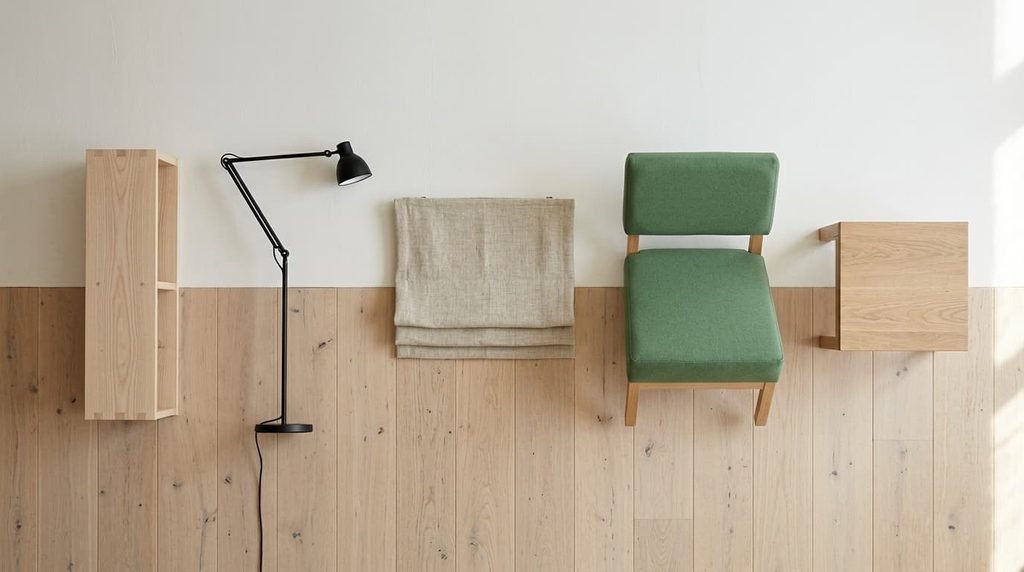
The rule predicts the list below, which puts heavy fixed pieces first and light loose ones last.
Turn the spare room into your home library: the list in buying order
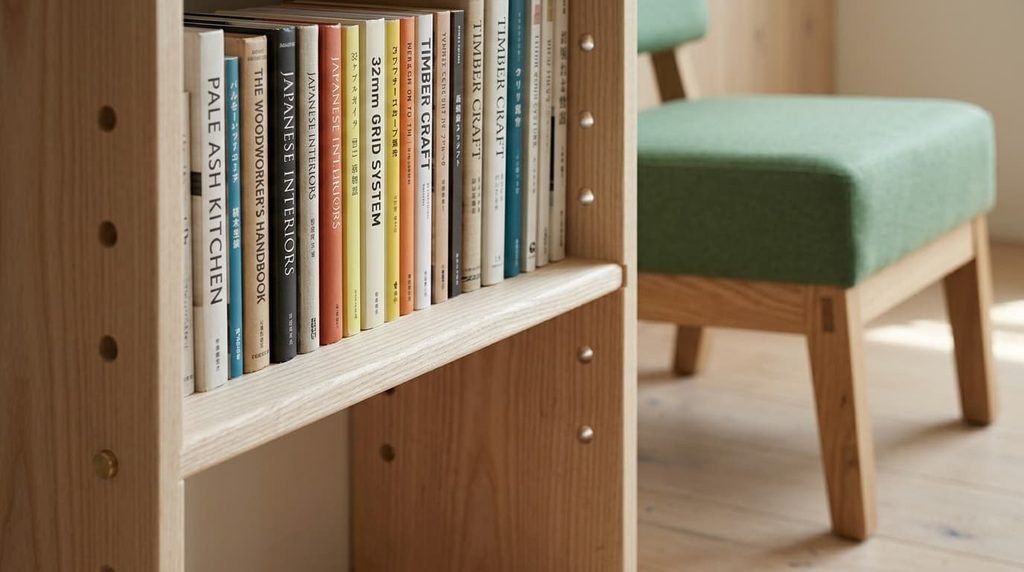
1. Shelving made of 25 mm boards, with no span over 60 cm between uprights, adjustable on a 32 mm pin grid. It tops out at 190 cm. Position one is the shelving, since it fixes the wall and everything else takes its place from it. Tier: BUY ONCE, as 200 kg rests on the boards and fixings every hour of the year. The construction fault to look for is an 18 mm board over an 80 cm span. Under a load spread along the board, sag grows with the fourth power of the span. It shrinks in proportion to thickness cubed. That board sags 8.5 times as much as a 25 mm board over 60 cm.
2. A floor lamp with a weighted base and a two-pivot arm. The arm reaches 70 to 90 cm, and the bulb is a dimmable 2700 K. Second place follows, as the finished shelves show which corner needs light and a lamp needs a socket within 2 m of its base. Tier: MID, since the pivots take daily wear. The fault is a single spring arm that drifts down within weeks.
3. A woven blind 130 cm wide for a 120 cm window, hung above the frame. It comes third because sun fades spines first, and the shelf columns nearest the window take the low winter beam. Tier: MID, since the weave decides how long it hangs straight. The fault is a blind narrower than the recess. It leaves two gaps that throw stripes of sun along the nearest column.
4. An armchair with a seat 44 cm high and 52 cm deep, its frame joined with glued dowels. It’s fourth because it moves, and a month in the finished room shows where you sit. Tier: MID. The fault is a stapled frame, or a seat deeper than 58 cm that leaves the back cushion out of reach.
5. A side table of 40 by 40 cm, 55 cm high so it meets the chair arm. Last in line, it takes any spare spot. Tier: BUY CHEAP, as nothing in it is hidden. The fault is unbraced legs that let the top rock by more than 3 mm.
Where to spend, and the one purchase to cut back
Spend on the board thickness and the wall fixings. The lamp’s pivots earn a share as well. Each carries load or wear every day and can’t be inspected once it’s installed. A bowed board or a drifting arm shows nothing in a shop. In turning a spare room into a home library, the shelving holds 200 kg for 8,760 hours a year. That’s 1,752,000 kg-hours. An armchair holds 80 kg for about 390 hours, at 1.5 hours a night over 5 nights a week for 52 weeks. That’s 31,200 kg-hours. The shelving carries 56 times the load-hours.
The armchair is the purchase to talk yourself out of. Guides usually rank it as the headline expense. Its job is set by your body, though. The room has to be finished before you know where to sit. A frame with glued joints and a firm seat does the whole job. Extra upholstery depth adds comfort you can’t test in a shop.
Buy the side table cheap and the rest at mid tier, since a table hides nothing and the lamp and blind can be swapped later.
What this order assumes, and when it breaks
Turning a spare room into a home library at this scale assumes about 400 books and a wall you can drill. The material of your wall is the unknown here. Masonry takes a plug almost anywhere. A stud partition holds fixings only at the studs, usually 60 cm apart, closer in some builds. Tap the wall and mark the studs before you settle the column width. A 60 cm module lands on a stud at every upright only when they’re 60 cm apart.
A collection of 1,000 books needs 27 m of spine and 33.8 m of shelf at 80% fill. That’s ten columns of 60 cm, more than one 330 cm wall can take, so the plan moves to a second wall. If you rent and can’t drill, buy freestanding units made of 25 mm boards. Make them 60 cm wide and 30 cm deep, and stand the heaviest at the foot of the wall. Everything after the shelving stays in the same order.
What to skip entirely
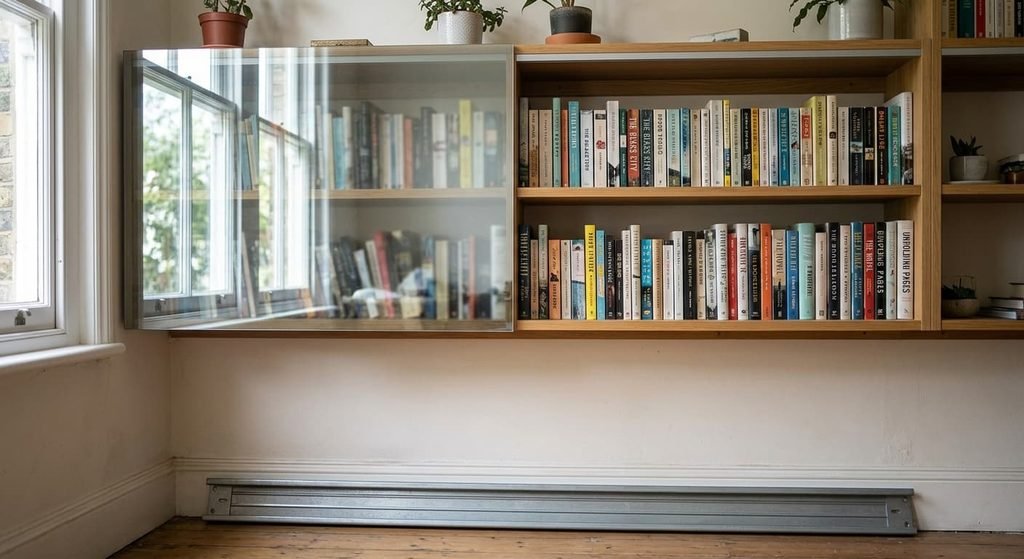
Books bought by the metre to fill the shelves tops the skip list. They’re chosen for their covers, and they take a place that your own paperbacks would use. A rolling ladder on a rail comes next. With the top shelf at 190 cm, every book sits within reach from the floor. The rail then costs wall space and nothing else. Glass doors on every column also earn nothing. They reflect the window and hide the spines you want to scan. A desk belongs to a different job, so it waits until you’ve written there for four weeks. Picture ledges also fall short, since a 10 cm ledge takes one row of paperbacks and gives you almost no run.
To turn a spare room into a home library, put shelving first. The armchair belongs in fourth place. The rule sends money to the piece that fixes the most of the room and is hardest to move once loaded. I’d defend that order against the armchair-first habit. A wrong chair is a minute’s work to swap, while a wrong shelf means emptying 200 kg. Spend four weeks in the finished room first, then buy the last two pieces.
Questions readers keep asking
How many shelves does a home library need?
Count the spines first. Each book averages 2.7 cm, so 400 books run to 10.8 m, and filling shelves to 80% means 13.5 m of shelf. Six shelves per 60 cm column give 3.6 m each, so you need four columns. Add a column for every 100 books you expect to gain.
Which piece comes first in a home library?
Buy the shelving. It fixes the wall, and everything else takes its position from it. Choose 25 mm boards with no span over 60 cm, because that combination sags one-eighth as much as an 18 mm board over 80 cm.
How can you check a bookshelf for sag before buying?
Check the board thickness and the gap between uprights. For an evenly spread load, sag grows with the fourth power of the span, so an 80 cm span sags 3.2 times as much as a 60 cm one in the same board. Press the middle of a loaded shelf with your palm and watch for movement.