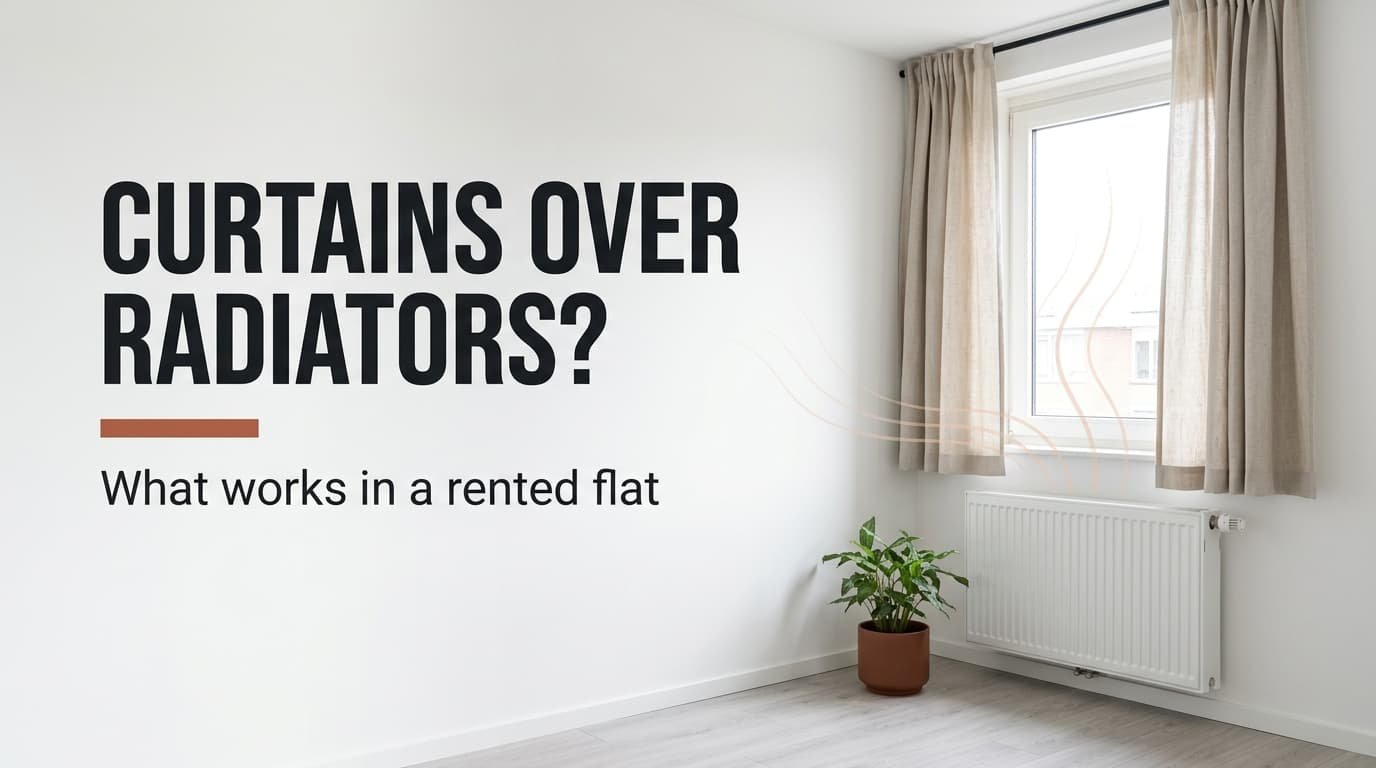
Floor-length curtains look best, but that rule stops holding once a radiator sits under the window. Curtain length and radiators compete for the same 85 cm of wall. The quickest relief is to tie the curtains back while the heating runs. The fabric isn’t the culprit. A thermostatic valve, the dial that shuts the radiator once the air near it is warm, reads the wrong air. The four fixes run from free to one plumber’s visit.
Our test flat is Dutch, with a 140 cm window, a sill at 85 cm and a 120 cm panel radiator. The temperatures are round examples, so measure your own before you spend anything.
Curtain length and radiators: why the hem decides the heat
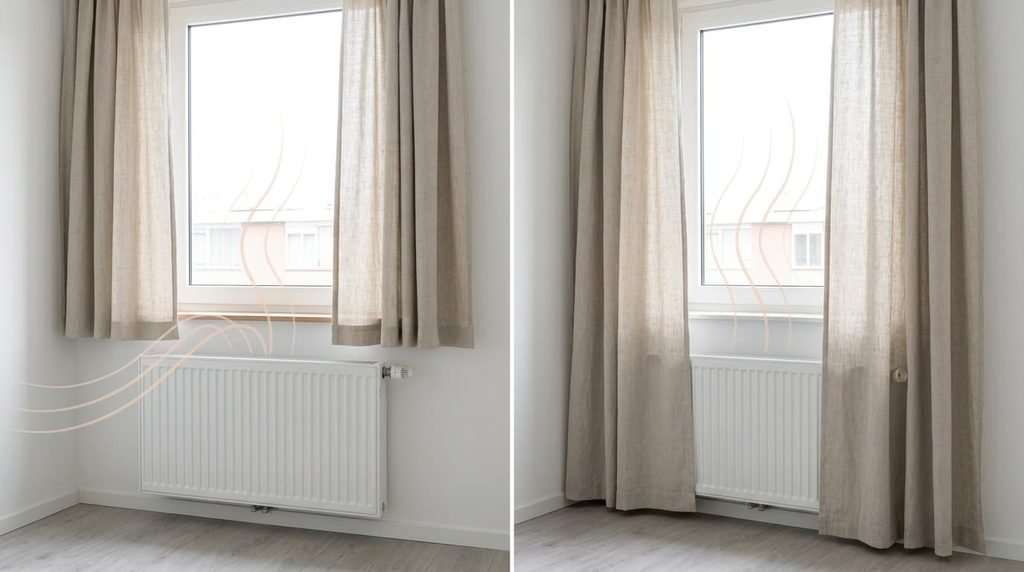
A panel radiator sends about three quarters of its heat upward as moving warm air and the rest outward as radiation, so what hangs in front of it matters most. Under a sill-length curtain, the 10 cm sill catches that warm air and bounces it forward into the room. Under a floor-length curtain, the fabric shuts that route. Inside it, the warm air climbs in a pocket between the curtain and the glass. There it meets cold glass and gives up its heat to the window instead of the room.
Nobody warns you about the detail at the radiator’s end. A thermostatic radiator valve, or TRV, is the dial-topped head that shuts the flow once the air around it reaches your number. On a common scale, 3 means about 20 °C. Inside the pocket that head reads 4 °C above the room, so the curtain fools the valve about the room’s temperature. The valve shuts at 20 °C on its own thermometer. The room stalls near 16 °C while the radiator looks perfectly healthy. Closing curtains at night still cuts loss through the glass. That’s why the answer is never simply to leave them open.
Radiators and curtain length: a 45-minute check
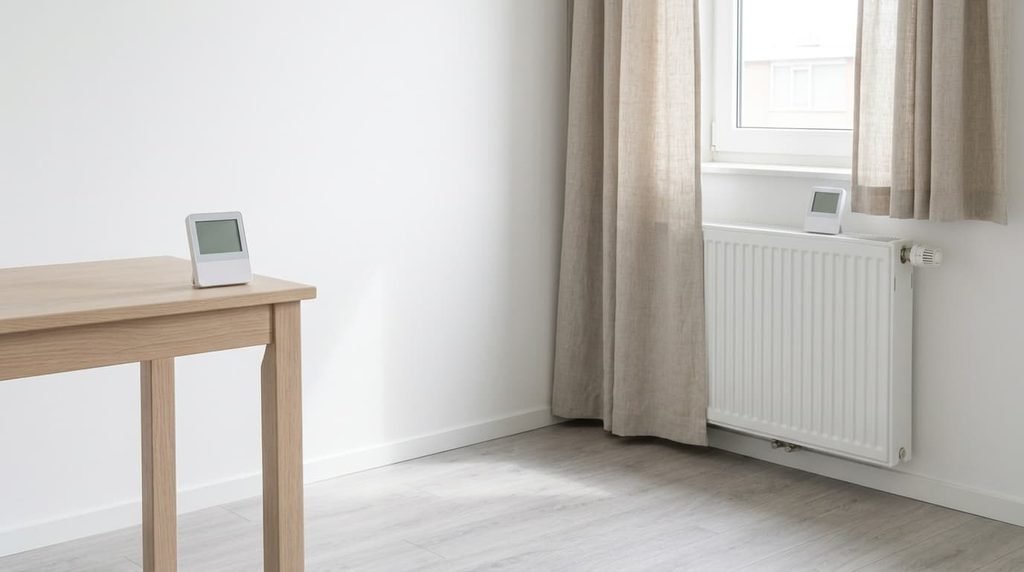
Three problems feel identical from the sofa, and only one belongs to the curtain. You need two cheap thermometers, and the dial must sit on 3 with the curtains closed.
Place one thermometer behind the curtain, level with the valve head, which usually sits about 45 cm above the floor. Put the other in the middle of the room, 2 m from the window and 120 cm up. Do it on a cold evening, since a mild day shrinks every gap and hides the pocket. Keep both thermometers out of direct sun. Read both after 45 minutes of heating. A gap of 3 °C or more is the pocket, and it’s what this article fixes.
If the gap is under 1 °C while the radiator is hot all over, the radiator is too small for the room. No curtain can cure that. Cold at the top with the dial on 5 means a stuck valve pin, which is a job for the landlord.
Write both numbers down before you buy anything.
Four fixes, from free to a plumber’s visit
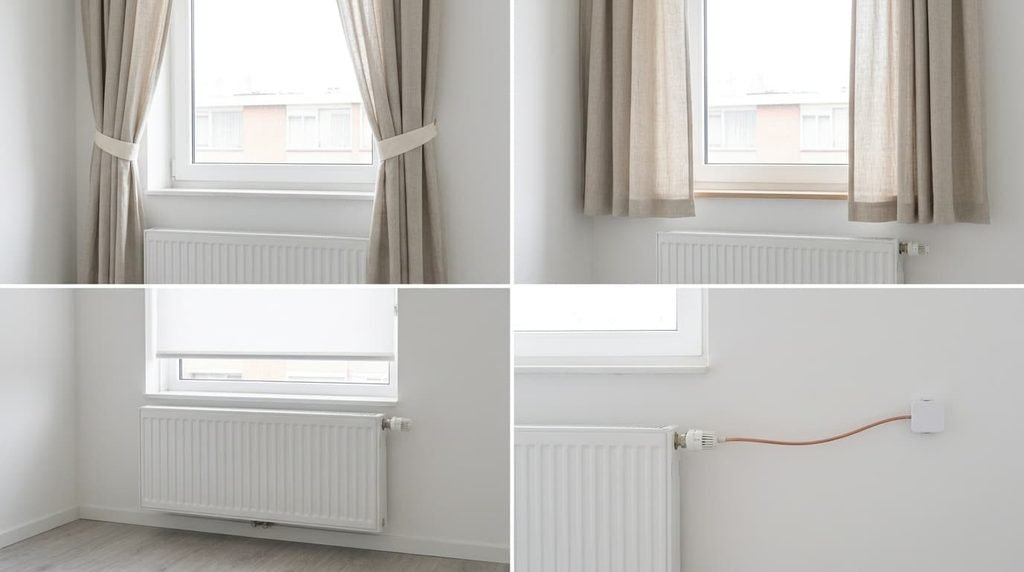
Curtain length and radiators ask for four different kinds of change. Try them in this order and measure the room after each one. The baseline is the room stalling at 16 °C.
Tie the curtains back while the heating runs, which opens the route. The pocket stops forming and the head reads the room again. The offset drops from 4 °C to about 1 °C, and the room climbs from 16 °C to 19 °C. It costs nothing if you use the curtains’ own tie-backs. Screwing hooks into a rented wall needs the landlord’s okay. The catch comes at night, when closing them brings the pocket back and the room slides toward 16 °C.
Shorten the hem to the sill, so the hem stops 1 cm above it. That leaves nothing in front of the valve. The sill does the deflecting, pushing the warm air out into the room. The offset falls to about 1 °C, so the room reaches 19 °C all day. It costs a few hours with a needle or one new pair. The pair is the safer choice if your curtains are lined. Cotton shrinks 2 to 3% after its first washes. A 144 cm drop creeps up by about 3.5 cm, so the hem ends 4 to 5 cm above the sill.
Swap the curtains for a blind inside the reveal, the recess between the window frame and the wall. A blind there takes the fabric out of the warm air’s path. The offset is close to 0 °C, and the room reaches 20 °C. It costs more than a hem, and it won’t look as soft in the room. Light also leaks past a 1 cm gap at each edge, which bothers some sleepers more than others.
Ask the landlord to fit a remote-sensing valve head, where a sensor on a thin tube clips to an open wall 2 m away. It reads the room instead of the pocket. The offset is exactly 0 °C whatever the curtain does, so even a floor-length pair can stay. It needs a plumber and the landlord’s consent, which is reasonable since the valve is their equipment. Expect to wait a week or two for the visit.
What your flat won’t let you change
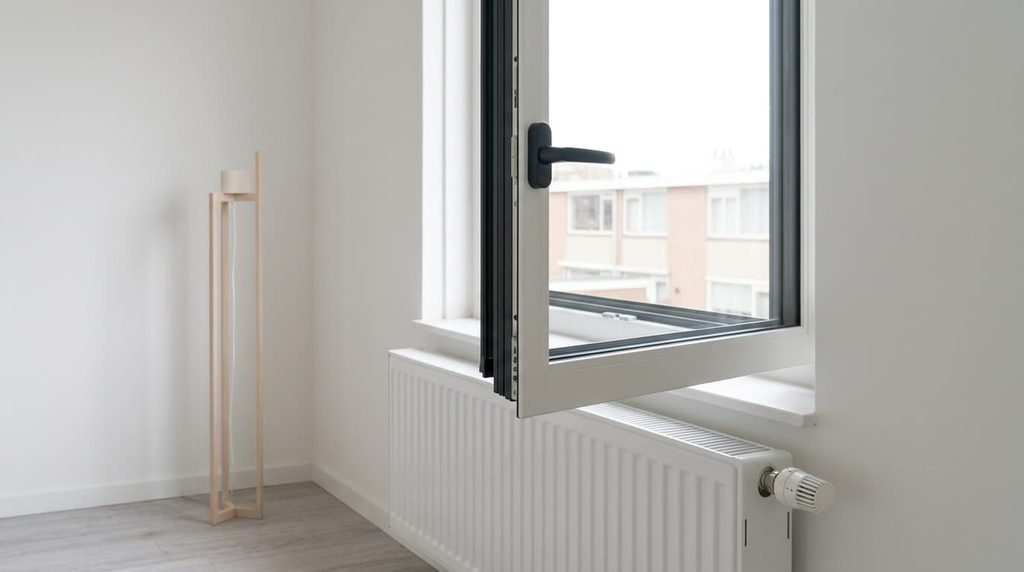
With curtain length and radiators, you can change what hangs, not what’s there. The radiator stays under the window. The sill stays 10 cm deep, and the valve head stays at the radiator’s end. A 120 cm panel gives the output it gives. A room that stays cold with no gap between the thermometers needs a bigger radiator, not a different hem. The 1.4 m window stays 1.4 m wide too, so curtains still need about 15 cm of overlap on each side.
Dutch tilt-and-turn windows swing inward by 90°. A blind in the reveal has to clear the sash and a handle that protrudes about 8 cm. Whether your pocket reads 3 °C or 6 °C depends on your sill depth and how tightly the curtain hugs the wall. I can’t see either from here.
The foil panel that doesn’t help
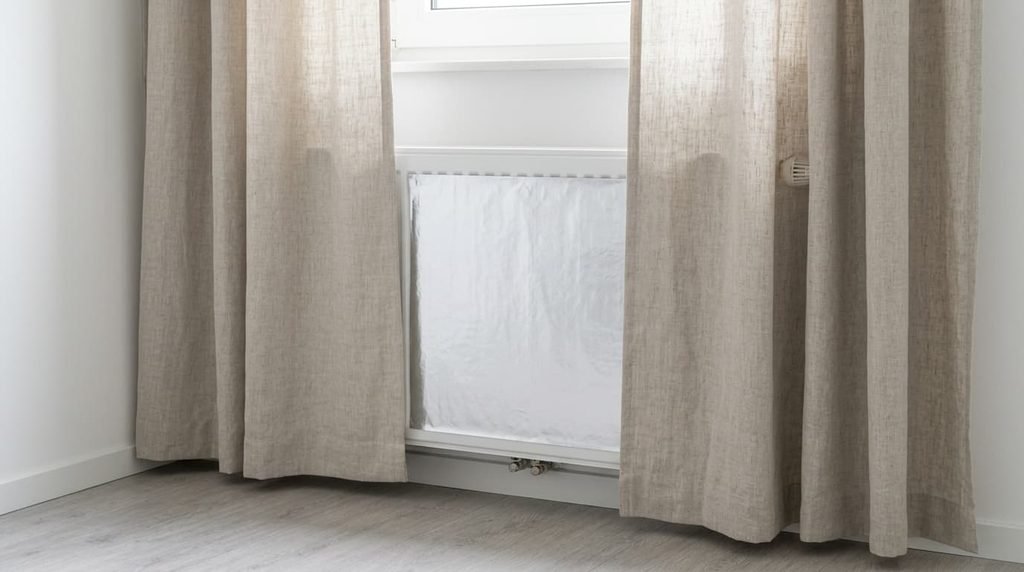
Reflective foil behind the radiator is sold as a heat-saver, and it’s easy to believe because it’s cheap. It acts on the radiant quarter, the heat leaving the back of the panel towards the wall. It does nothing about the rising air or the reading at the valve. The offset stays at 4 °C and the room stays near 16 °C. On an internal wall it returns heat that wasn’t being lost. On bare external brick it recovers only a small slice of that quarter. Even a perfect reflector would leave the offset untouched, because the offset comes from the curtain. Real fixes change what the valve reads or where the air goes. The idea persists because a warm wall behind the radiator feels like proof, even though the room hasn’t improved.
A foil panel changes none of that.
Curtain length and radiators come down to one measured gap. A gap of 3 °C or more calls for tied-back curtains or a hem at the sill. Below 1.5 °C, leave the curtains alone and inspect the radiator. Read both numbers again after each change, and stop when the room matches the dial. Most rented flats need only the first two steps, and the rest are there for stubborn cases.
Questions readers keep asking
Can I keep floor-length curtains over a radiator?
Yes, if you fit a remote-sensing valve head or tie the curtains back whenever the heating runs. In the example, the remote sensor brought the room to 20 °C whatever the curtain did. Without either change, a closed floor-length curtain leaves the room near 16 °C.
Does a curtain over a radiator waste heating?
It can. Turning the dial to 4 lifts the room to 20 °C, but the pocket then sits at 24 °C. With 5 °C outside, the glass behind it loses 19 ÷ 15, or 27%, more heat than before. You pay for warmth that escapes through the window.
Which curtain works best with a radiator under the window?
A lined, sill-length curtain with the hem 1 cm above the sill suits most rented flats. The lining cuts loss through the glass at night, and the radiator’s warm air still reaches the room. If you want floor-length, add the remote sensor.