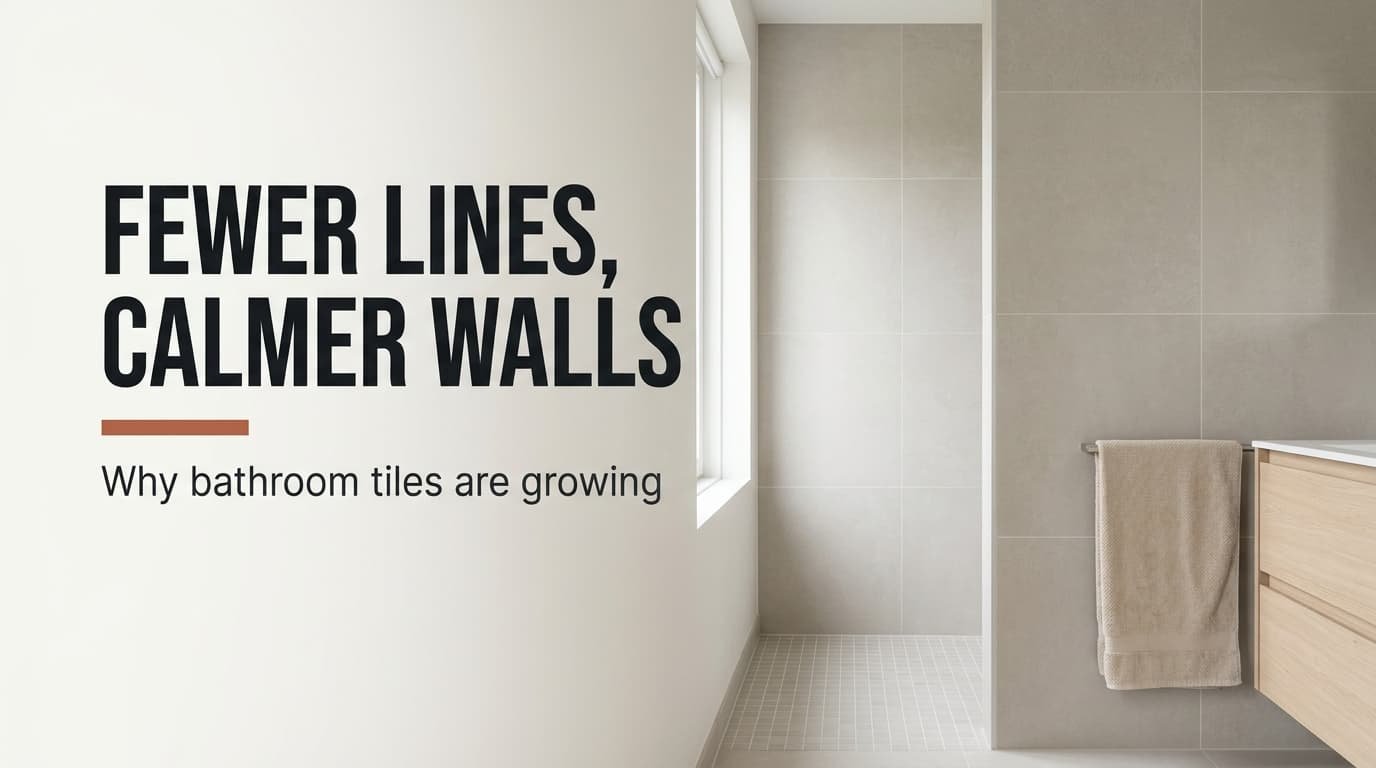
A grout line is the cheapest part of a bathroom and the first part to go grey. Large-format tiles are replacing small mosaic tiles in Dutch bathrooms mostly because they delete those lines. On the walls I’d call the swap worth making. The floor is another story. In a typical bathroom the length of joint falls from 888 m to 55.5 m.
The sums assume a bathroom of 200 by 250 cm, tiled to 210 cm on the walls. The mosaic is 5 cm square and the large tile is 60 by 120 cm. Your own room will move the totals but not the pattern.
Where small mosaic tiles came from
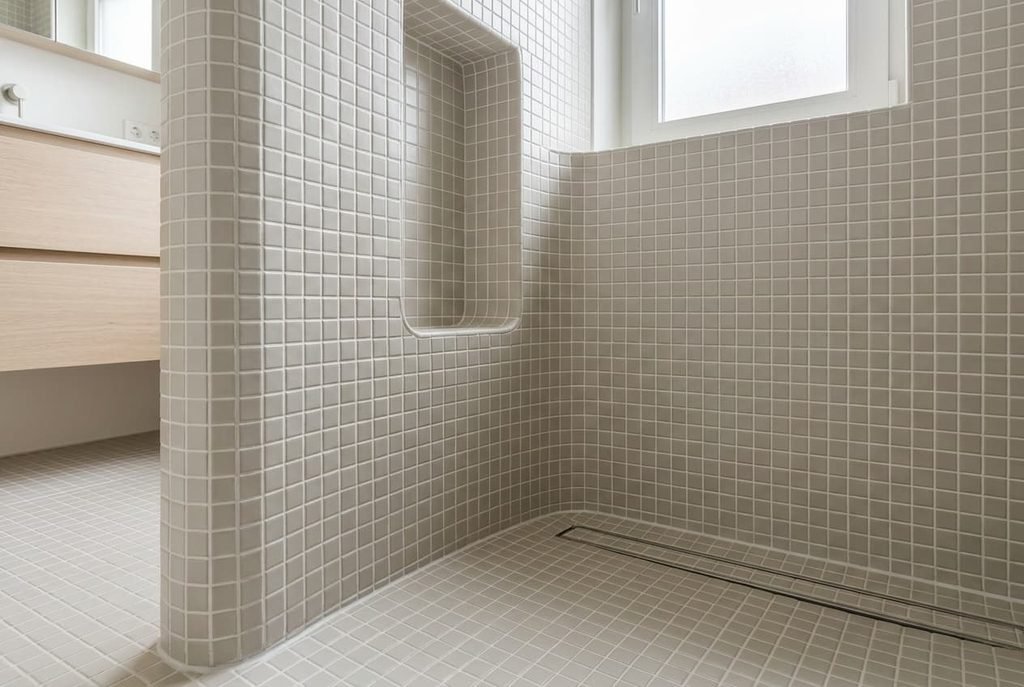
Small tiles solved real problems. A piece of 5 cm follows the fall to a drain and wraps a curved niche. It also hides a plaster wall that is not quite flat. It weighs a few grams, so any wall carries it. One person with a trowel can lay it.
Large tiles were hard to use for the same reasons. Early big porcelain was thick and heavy, and its size varied. The joint between two tiles had to absorb the difference. Fitters needed straight walls and the right mortar. The saw cuts that suited small pieces were awkward on a slab.
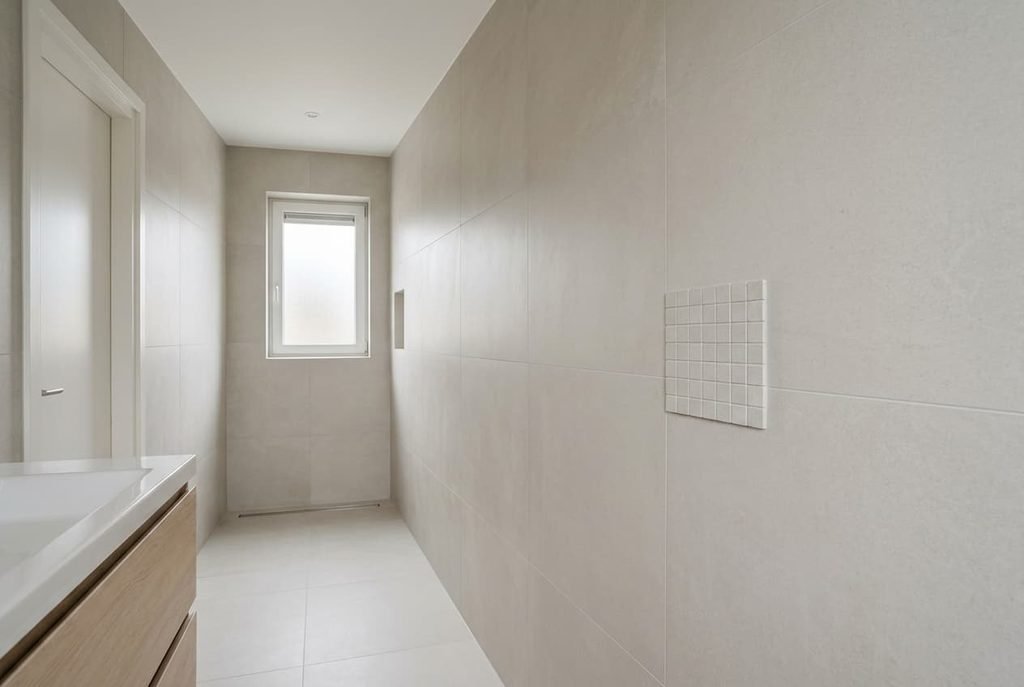
Two things changed. Porcelain became thinner and truer to size, so a 60 by 120 cm tile now sits flat with a joint of 2 mm. Levelling clips and thin-bed mortar made it easier to lay a slab without lippage. That’s the small step where two tile edges meet at different heights. The mosaic stayed because it forgave a poor wall, and the new method won’t.
What follows is a change in how a bathroom looks, and it is easy to count.
What actually changed now large-format tiles are replacing small mosaic tiles
The tiled area in our bathroom is 22.2 m². The walls take 17.2 m² once the 80 cm door is subtracted, and the floor takes 5.0 m². A joint runs along every tile edge. Each tile shares an edge with a neighbour, so the length of joint per square metre is 1 ÷ width plus 1 ÷ length.
For a 5 cm mosaic that is 20 + 20 = 40 m of joint per m², or 888 m across the room. For a 60 by 120 cm tile it is 1.67 + 0.83 = 2.5 m per m², or 55.5 m. The measurable change is 888 m of grout line falling to 55.5 m, a drop of 94 percent.
The joints also shrink in width. A 3 mm joint on a 5 cm mosaic leaves 11.6 percent of the surface as grout. A 2 mm joint on a large tile leaves 0.5 percent. In this room that is 2.6 m² of grout against 0.1 m².
Piece count changes just as sharply. Mosaic arrives in sheets of 30 by 30 cm, so 22.2 m² needs about 247 sheets. One large tile covers 0.72 m². That means 31 whole tiles, or about 36 once we allow 15 percent for cuts. Fewer joints mean fewer places for the room to look busy and for a damp cloth to snag. The plan matters too. With 31 tiles you can place every joint on paper. A joint that lands behind the door bothers you less than one across the middle of a wall.
Who large-format tiles suit, and who they don’t
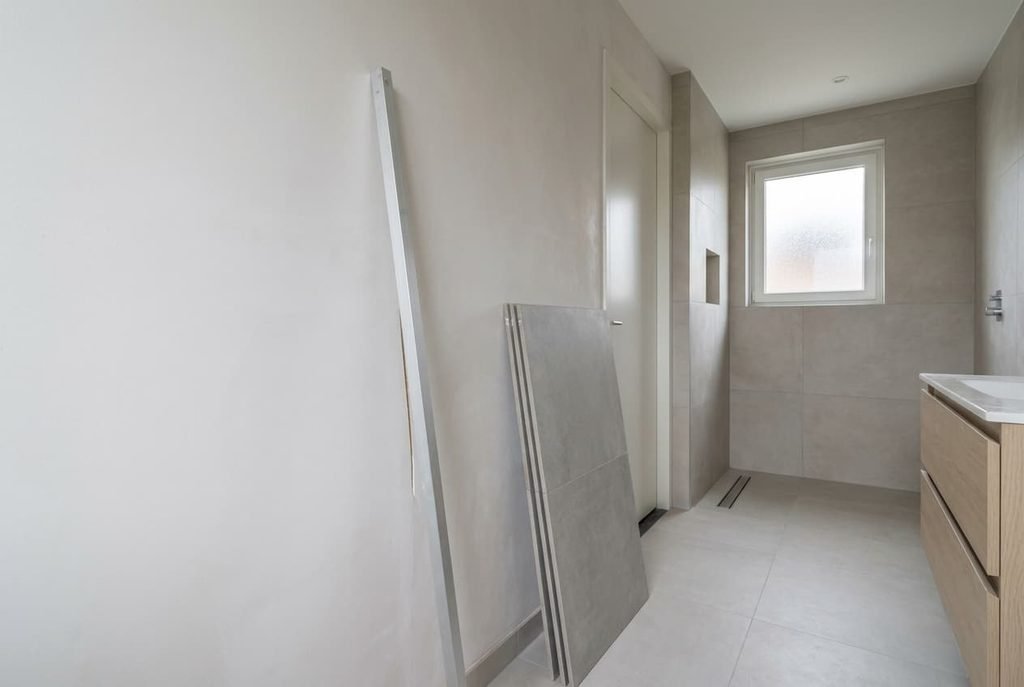
They suit a wall that is flat. Large-format tiles are replacing small mosaic tiles first on walls that are flat. Press a 2 m batten against yours. If the largest gap stays under 3 mm, a large tile will lie true. A wall that fails can be levelled first, but that’s a day of work before any tile goes up.
They suit people who clean. A room with 55.5 m of joint takes a wipe and a rinse. The grout between mosaic pieces collects soap film that takes a brush. They also suit small rooms, where a line-free wall makes the 200 cm width look unbroken.
They suit poorly where the surface moves or curves. A tile is stiff, so a curved niche needs cuts the mosaic would never need. An arched alcove does too. Weight matters as well. A 10 mm porcelain tile weighs about 24 kg per m², so a 60 by 120 cm piece is 17.3 kg against 2.2 kg for a sheet of mosaic, and two people have to carry it.
They suit a shower floor least. A floor that falls 2 percent to a central drain makes a V shape. Centre a 120 cm tile on the drain and its middle sits 12 mm lower than its ends. Flat porcelain won’t follow that curve. You’d need to cut it into four pieces, which brings the joints back.
Are large-format tiles replacing small mosaic ones, and is it worth adopting
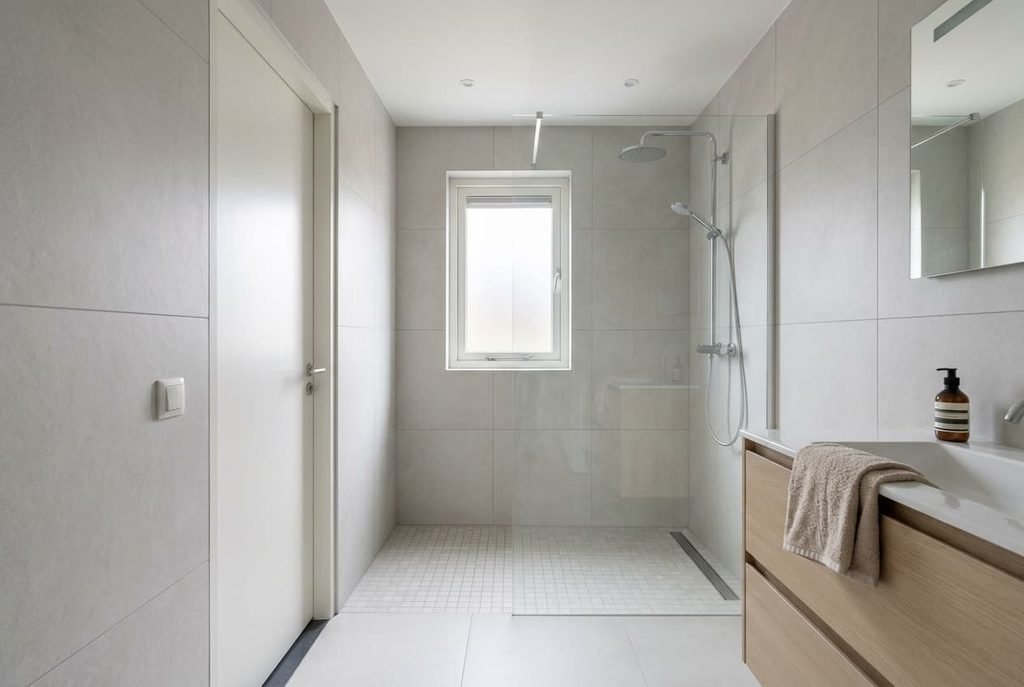
Count what you would undo. The walls total 17.2 m² and the floor 5.0 m². Put the large tile on the walls and keep the mosaic where the floor falls to the drain. The walls are flat, and the floor isn’t.
That split puts 77 percent of the area into the format that removes the most joint. The walls are the part the eye reads at standing height. The floor can keep its small pieces, since they follow the fall. Whether large-format tiles are replacing small mosaic tiles in your own bathroom is mostly a question of the shower.
Keeping an existing mosaic is sensible when it is sound. Removing 22.2 m² of tile and the bed beneath it is the most disruptive job in the room. A good clean on old grout recovers much of the look. Replace it when you are stripping the room anyway.
The version that will date fastest
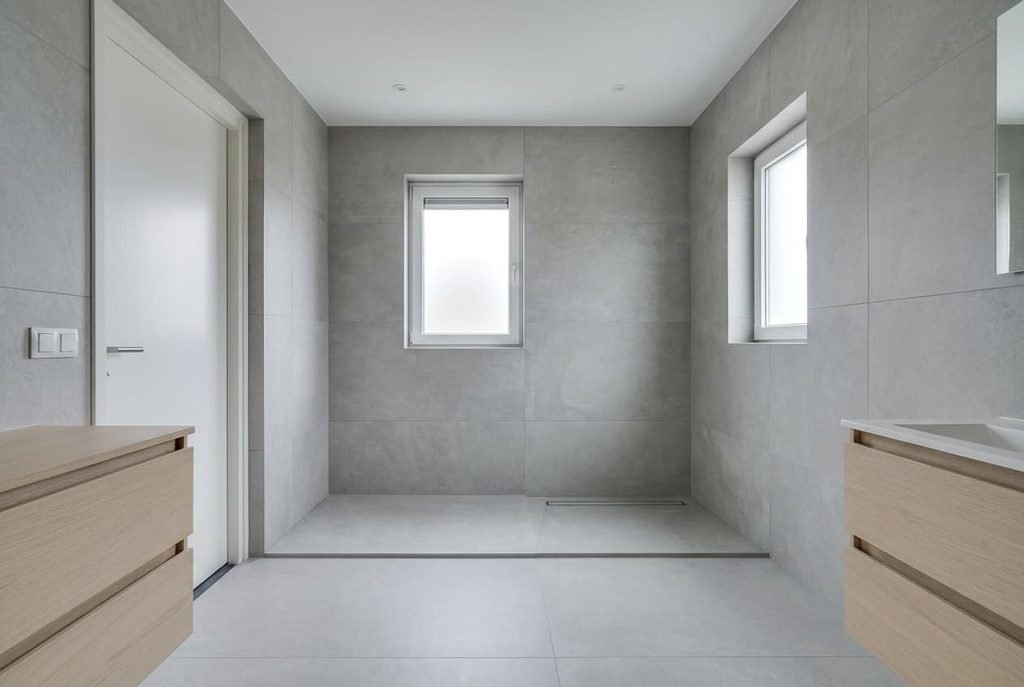
The extreme version is slab-sized tiles on every surface, shower floor included, with hairline joints. Look for the signs. The joints measure 1 mm or less. The same tile runs across walls and floor. A drain is cut in from the edge of a slab.
Such a room depends on perfect substrate. A joint of 1 mm leaves no room for the small movement that buildings make. A single crack then runs across a whole tile. Replacing a broken 120 cm slab means breaking out its neighbours.
The room also reads as one hard surface, with nothing soft to catch the sound of a voice.
A bowed wall can’t hide behind a slab either. The shadow of every ripple falls across a big flat face.
The moderate route puts the large tile on the walls and gives the floor its own smaller format. It leaves the joint at 2 mm. That keeps the calm and forgives a little movement.
How to try it without committing
Lay a straight 2 m edge flat on each wall and measure the biggest gap. That single figure decides whether a large tile will work. A gap under 3 mm is ready for tiling, and one over 5 mm needs levelling first.
Then ask a supplier for one sample tile measuring 60 by 120 cm and lean it against the wall for a week. Check how the light crosses it in the morning and at night. The sample doubles as your colour check. A tile that shows every ripple in the plaster is telling you something. You’ll want to hear it before the adhesive is open.
Large-format tiles are replacing small mosaic tiles because they remove joints. Walls are where the saving starts. Test the wall first. Leave the shower floor in small pieces unless your fitter plans a single sloped plane. Keep a spare tile in the loft, because a match is hard to find years later. That keeps the experiment cheap and reversible.
Questions readers keep asking
Should I replace sound mosaic tiles with large ones?
Not just for fashion. Sound mosaic still works, and a deep clean of the grout restores most of the look. Replace it when you are already stripping the bathroom, because the demolition is the costly part. Then choose a large tile for the walls and a smaller format for the floor.
Do large-format tiles suit a small bathroom?
Often yes. With 2.5 m of joint per m² instead of 40, the walls read as one calm surface. That makes a room of 200 by 250 cm look wider. The wall must be flat first. If the check with a 2 m straightedge fails, level it before you order.
How long will the large-tile look last?
The moderate version, with a 2 mm joint and a smaller floor format, ages well because it is quiet. The extreme version with hairline joints and slab floors needs a perfect wall in every year you live there. Ask what you would have to break out to leave.