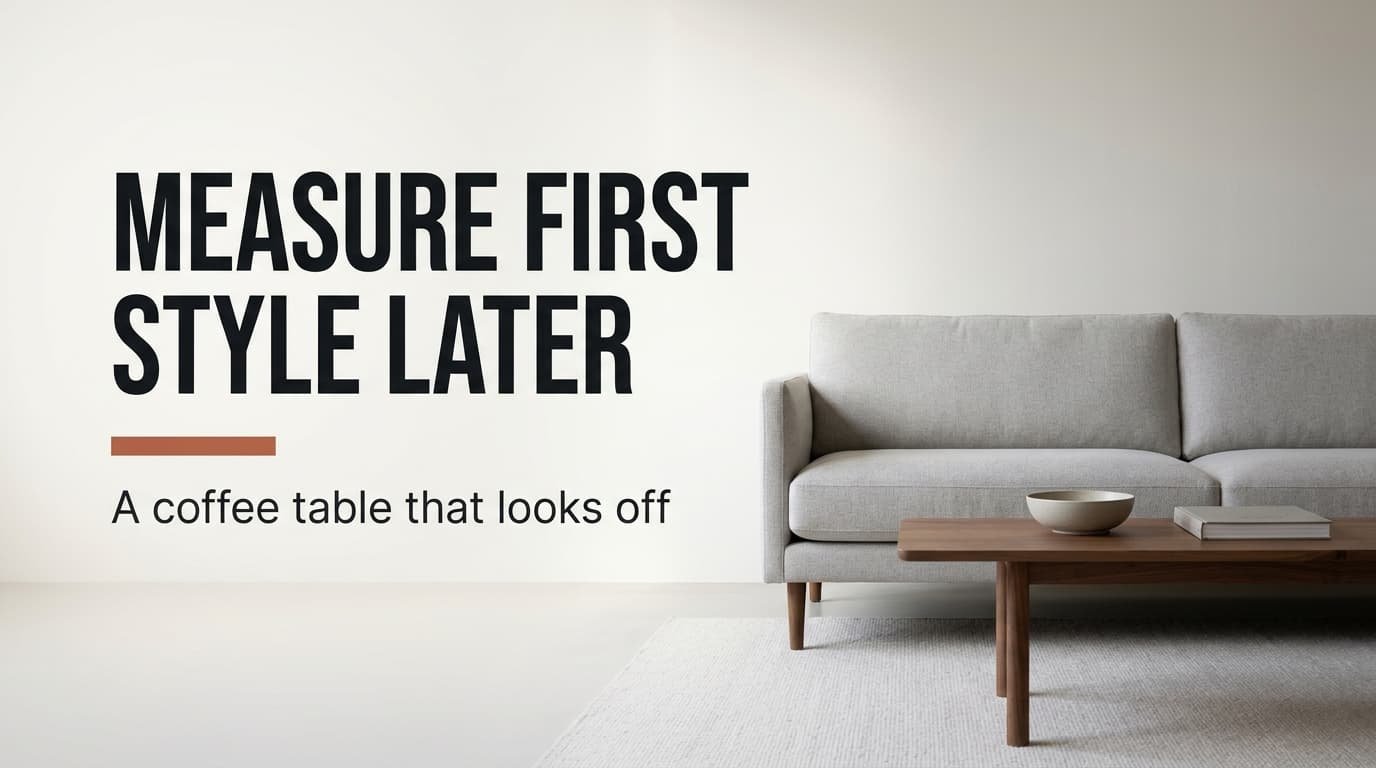
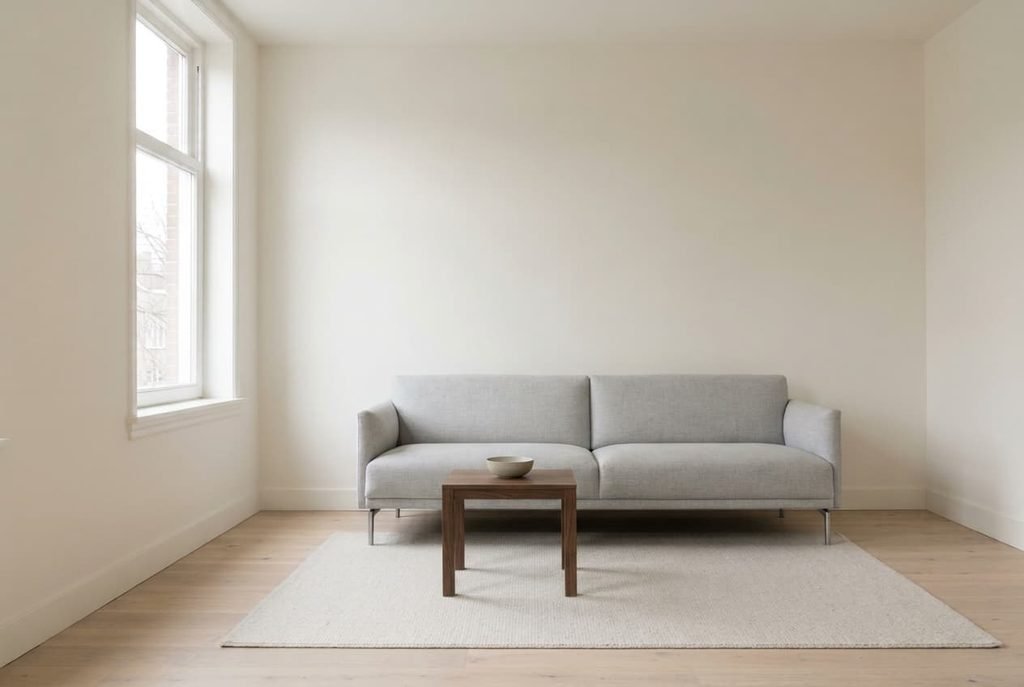
Nothing collides. The lane is clear. Yet the sofa and its table look like strangers. A coffee table can look wrong while every tape measurement passes, because the eye compares it with the sofa and ignores the floor. Three faults account for nearly all of it, and each takes minutes to confirm. We use a living area of 380 by 460 cm in a Dutch apartment, where the sofa is 220 cm long and its seat stands 42 cm high. A table of 70 by 70 cm rises 52 cm from the floor. Treat the thresholds as my own rules of thumb, and check them on your room before you act.
What makes a coffee table look wrong beside a sofa that fits it
The eye doesn’t read a table in centimetres. It sees the table as the sofa’s partner and judges the pair on three relations. One is the table’s length against the sofa’s. Another is the height of its top against the seat, and the last is the distance from sofa front to table edge. When one relation falls outside the range the eye expects, the pair reads as unrelated, however tidy the layout. That is what makes a coffee table look wrong in a room with plenty of space, and it is why moving the table a little often helps more than replacing it.
These are the ranges we use. A table works at 50% to 66% of the sofa’s length. Its top sits level with the seat or up to 4 cm lower. The gap between sofa front and table edge runs from 35 to 45 cm. Our table fails all three: it reaches 32% of the length, its top sits 10 cm too high and the gap is just 15 cm.
The usual misdiagnosis is blaming the table’s style or colour, which sends people shopping. Buy the same size with the same height and you repeat the fault in a new finish.
A checklist to run from the sofa
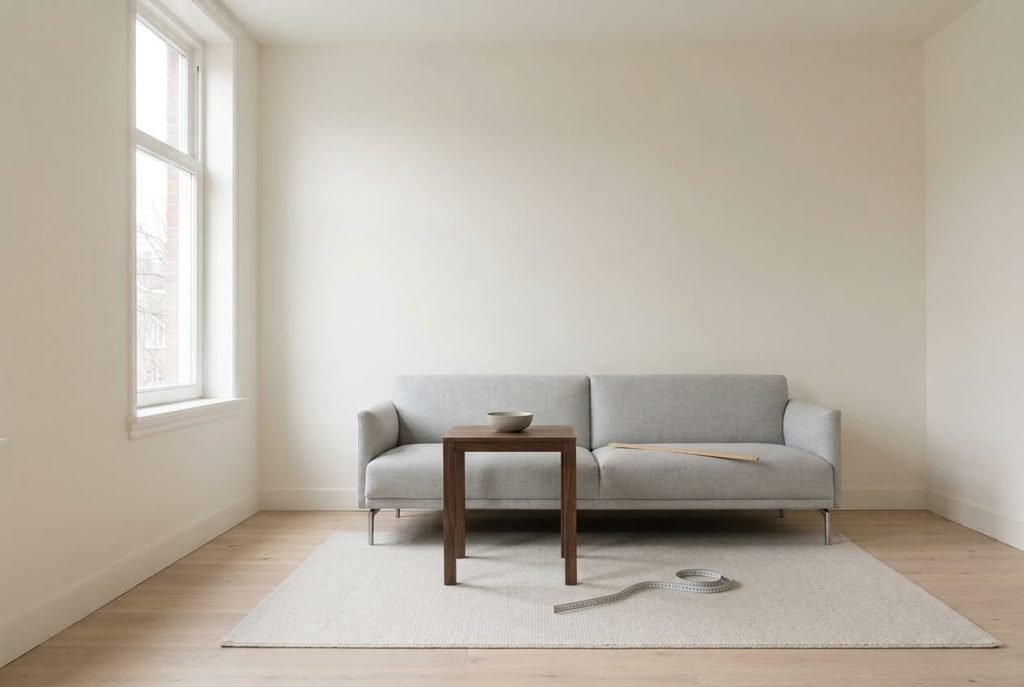
Sit where you sit every evening and answer five questions. None needs a purchase.
1. Measure the sofa front, then the table’s long side. Divide the second figure by the first. Below 50% or above 66% is flagged.
2. Lay a ruler flat on the seat cushion and sight along it at the tabletop. A top more than 4 cm above that line is flagged.
3. Measure from sofa front to table edge. Under 35 cm, shins brush the table each time you stand, and over 45 cm a mug sits beyond your reach.
4. Point your phone camera at the table from your seat with its black-and-white filter switched on. A dark patch on a lighter rug flags contrast.
5. Study the top itself. A bare surface with one object pushed into a corner is flagged, since the eye finds no place to settle.
Our room trips the first four checks. Four flags rarely mean four separate causes, because two checks often trace back to one fault.
A wrong coffee table: the three faults to look for
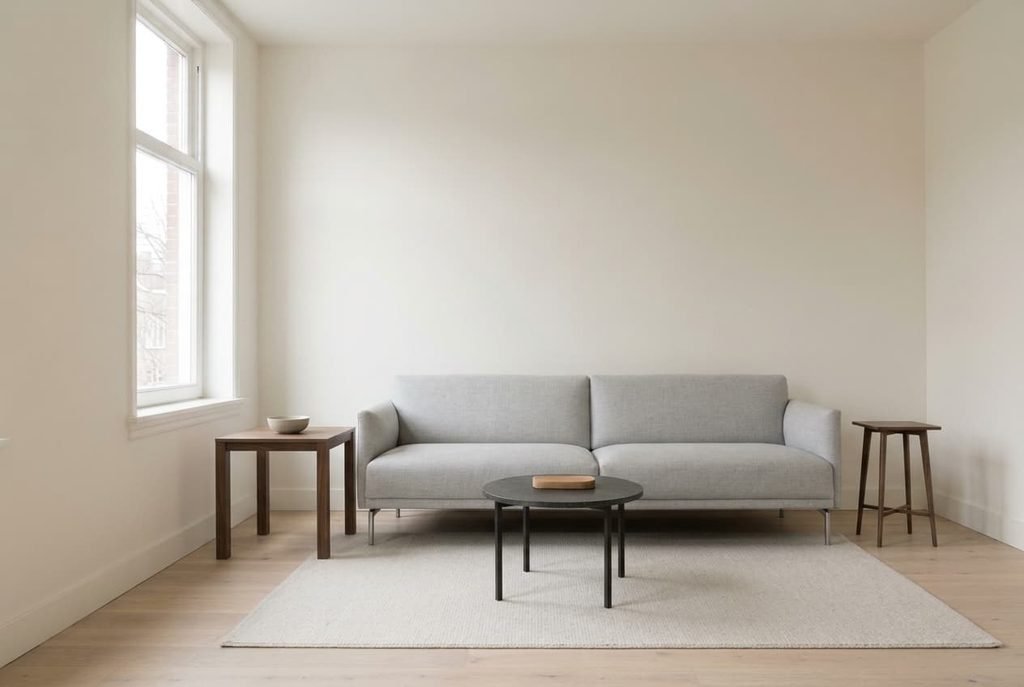
“The table feels jammed against the sofa, or adrift from it.” Placement is the culprit here. A 15 cm gap drops the table into the knee zone, and the eye reads the pair as cramped despite the free floor. Draw it outward until 40 cm separates sofa and table, a shift of 25 cm in our room. Mark the new position with tape and keep it there for seven evenings. Nothing is spent. Reach is the limit, since beyond 45 cm the table stops serving the seat. Check that a stretched arm still lands a mug on it.
“The surface looks like a dark hole in the rug.” Contrast is behind this one. A dark walnut top of 70 by 70 cm on a pale rug forms the sharpest tone step in the room, and it pulls the eye in. Break it up with things you already own. Gather a book and a bowl, plus a candle, so they cover about 30% of the top, and pick pieces in the rug’s mid tones. The price is effort alone. Daily life is the limit, because a mug will land on the group sooner or later. Keep it flat and low. Set to one side of the top, the group usually looks more relaxed than one squarely in the centre.
“The table reads as a footstool beside the sofa.” Scale decides this. A 70 cm table against a 220 cm sofa covers a quarter of the sofa’s footprint of 220 by 90 cm, and a height of 52 cm lifts the top 10 cm above the seat. Both pull it out of the pair. A replacement of 130 by 60 cm and 40 cm high gives 59% of the length and a top 2 cm under the seat. Only the purchase needs money. The lane limits it, since 130 cm leaves 45 cm of sofa beyond either table end, just enough to step past. Test the size with the cardboard mock-up first, then buy once, because the fault that makes a coffee table look wrong returns in any finish.
Work through them in sequence, as the first two cost nothing and often clear two flags together. Recheck after each step, before you spend.
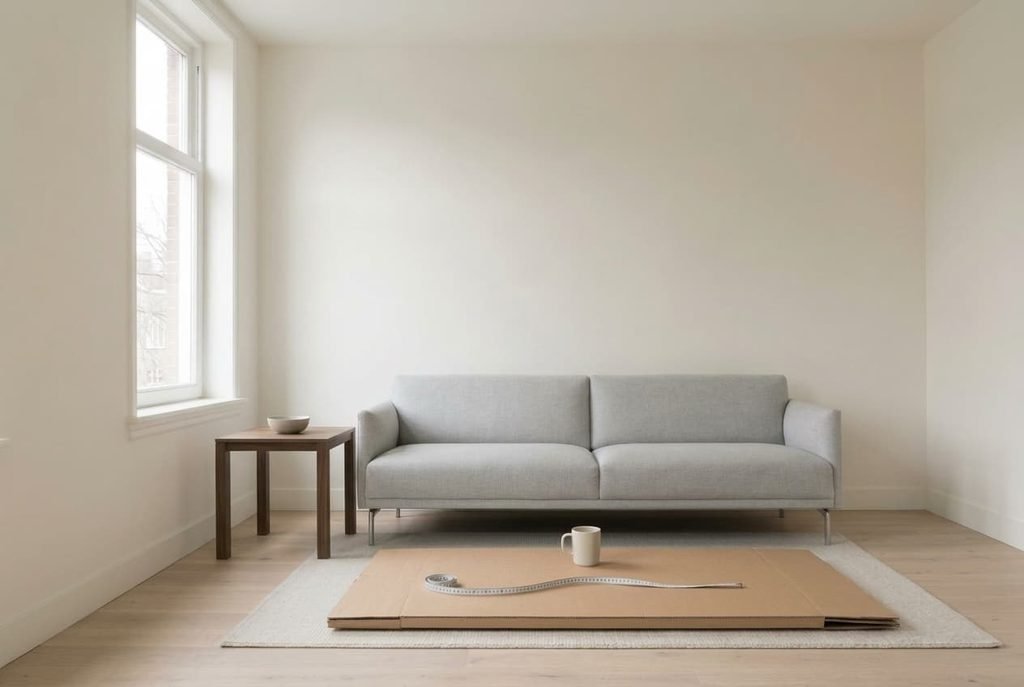
Checks before the next purchase
Before buying another low table, cut a cardboard mock-up to the target size and lay it on the rug for a day. For our room the target is 130 by 60 cm, with the seat’s 42 cm as the height to match. Walk past it, set a mug on it, then sit down. If the shape bothers you at that scale, a purchase would have bothered you more.
Height is the figure most buyers skip.
Take a tape when you shop and measure the real top. Listings round heights, and they skip the thickness of feet pads. Ask for the height without pads, since a pad of 2 cm shifts the seat-to-top relation more than any change of finish.
A nesting pair passes these tests easily. Pulled apart, the two reach 130 cm, and pushed together they shrink to one block when guests leave.
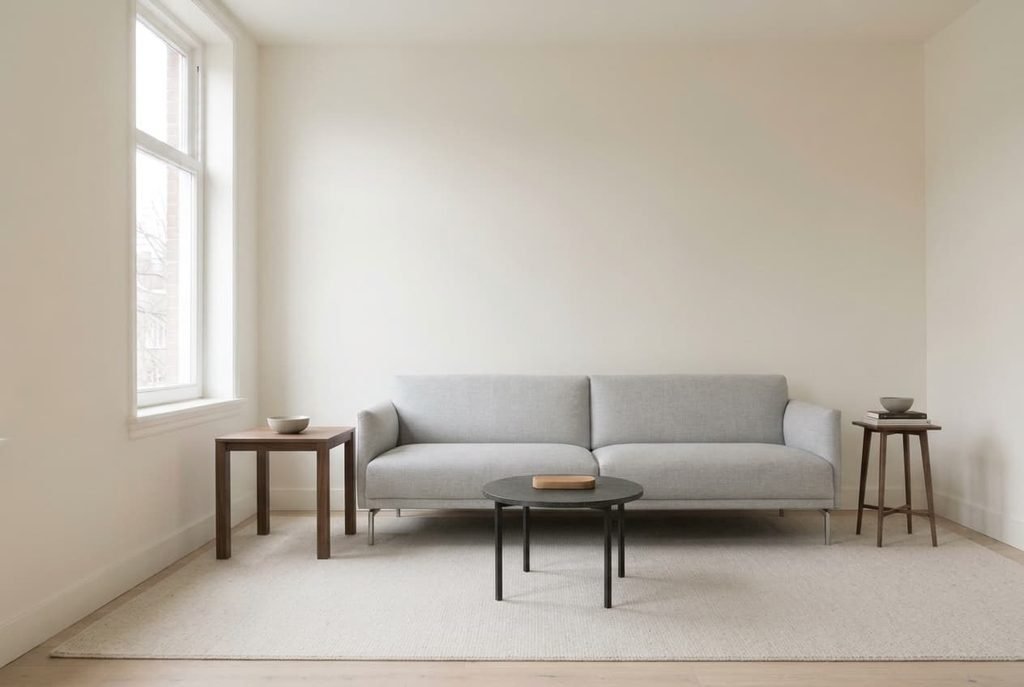
The fix that isn’t worth doing
Laying a larger rug to rescue the table feels like a bigger gesture, so people try it first. A rug of 240 by 340 cm replaces one of 160 by 230 at a much higher price, yet the table still stands 10 cm above the seat. The backdrop changes while the three relations carry on unchanged. It can even make matters worse, because a dark top on a bigger pale rug is a larger hole.
Adding a second small table beside the first breaks down in much the same way. Two pieces of 70 cm total 140 cm, yet each keeps the 52 cm height and the 15 cm gap, and the pair adds a fresh problem in the space between them.
You’d be paying twice to repeat one fault.
Spend on the relations instead. Measure first and move the table second. Decide only then whether a new one is needed at all, since a single centimetre figure is usually what makes a coffee table look wrong, and that figure costs less to change than the furniture. Check the gap tonight. Cut the cardboard tomorrow and walk past it for a few days. By the time you open a shop page, you’ll know the length and height you want, along with the distance. The search then becomes a short one. Store those three figures in your phone’s notes beside the sofa measurement, so the next purchase starts from facts and not from a photograph.
Questions readers keep asking
What is the most common reason a coffee table looks wrong?
Scale. Most tables are bought for the space they fill and not for their relation to the sofa. A table under half the sofa’s length reads as an afterthought, whatever its style. Measure the sofa first, then compare the table’s long side with it.
Is there a quick fix I can try today?
Yes: set the gap to 40 cm. Moving the table out of the knee zone costs nothing and needs only a minute, and it often removes the cramped feeling at once. Mark the spot with tape, and judge it across a few evenings instead of a single look.
Can this be fixed without buying anything?
Often it can. Placement and the objects on top are both free to change, and they cover two of the three faults. Only a wrong scale usually calls for a new piece, and a cardboard mock-up makes that purchase short and confident.