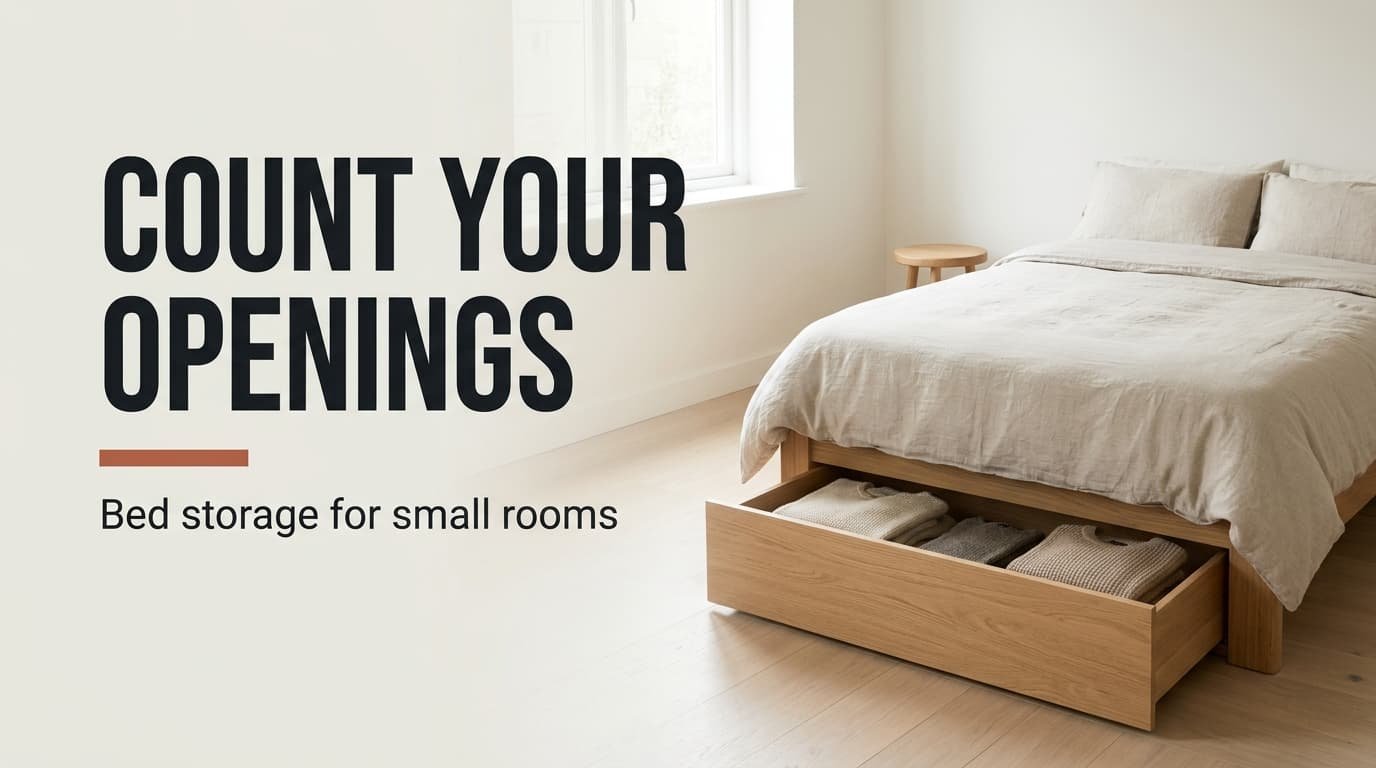
Bed drawers or a lifting storage bed: for a small bedroom the answer turns on how often you open the store. Both options hide storage under the mattress. The question is what each asks of you in time and in clear floor. Drawers hold 280 L and open in about 10 seconds. A lifting base holds 710 L and takes about 40 seconds to reach. We model a Dutch bedroom measuring 300 × 380 cm, holding a double bed, 160 × 200 cm, whose head touches a short wall. Treat each figure as an example and measure your own floor first. The clear space at the foot end decides which option opens at all.
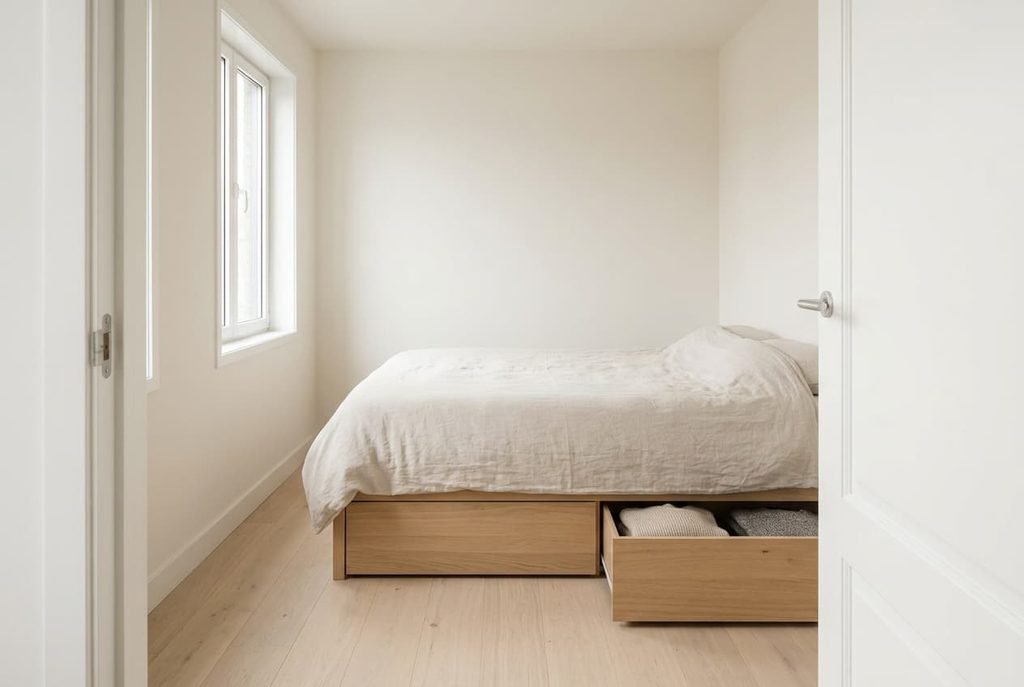
How bed drawers or a lifting storage bed compare in a small bedroom
Both options turn the dead space under the mattress into storage, and the difference lies in how you reach it. Drawers give you a small store that opens in seconds, whereas a lifting base gives you a large store behind a heavy lid. Neither wins on every count, and that’s why the sums matter.
Start with the room. The head end is fixed on the short wall, which leaves 180 cm of floor at the foot. Two drawers at the foot, each 100 × 70 × 20 cm inside, hold 140 L apiece, so 280 L together. The lifting base is hinged at the head and hides a void of 190 × 150 × 25 cm, about 710 L. That’s 2.5 times the volume.
Volume alone favours the lifting base. Access reverses the result. A drawer slides out 100 cm and shows everything inside it. The lifting base opens like a chest, and your arm reaches only about 70 cm into a 190 cm void. That puts 37% of the length within comfortable reach, so the far end becomes a place for things you touch twice a year.
Reach is the property that decides the result.
The two options side by side
Six properties settle the choice, and each one holds whatever the finish or the maker. Rows come from the room above, taking a 25 kg mattress and 250 cm of ceiling height. The 30-second gap in opening time comes from clearing pillows and the duvet, which a drawer skips. The last row matters on a hard Dutch floor. A raised base shows the whole floor to the vacuum, whereas drawers leave only their own sides. A drawer needs its own length of floor plus 50 cm for you to stand, which makes 150 cm. The lifting base needs only 60 cm at the foot. Its raised frame stands 200 cm tall plus the 25 cm box, about 225 cm in all.
| Property | Bed drawers | Lifting base |
|---|---|---|
| Storage volume | about 280 L | about 710 L |
| Floor needed to open | 150 cm at the foot | 60 cm at the foot |
| Height needed to open | none | about 225 cm clear |
| Reach into the store | everything, once the drawer is out | 37% within an arm’s length |
| Time to open | about 10 seconds | about 40 seconds |
| Floor beneath the bed | sealed by the drawers | open to the vacuum when raised |
Volume favours the lifting base. The drawers win on speed and reach, and clearance goes their way too. That makes bed drawers or a lifting storage bed a closer contest than the volume row suggests.
How bed drawers behave day to day
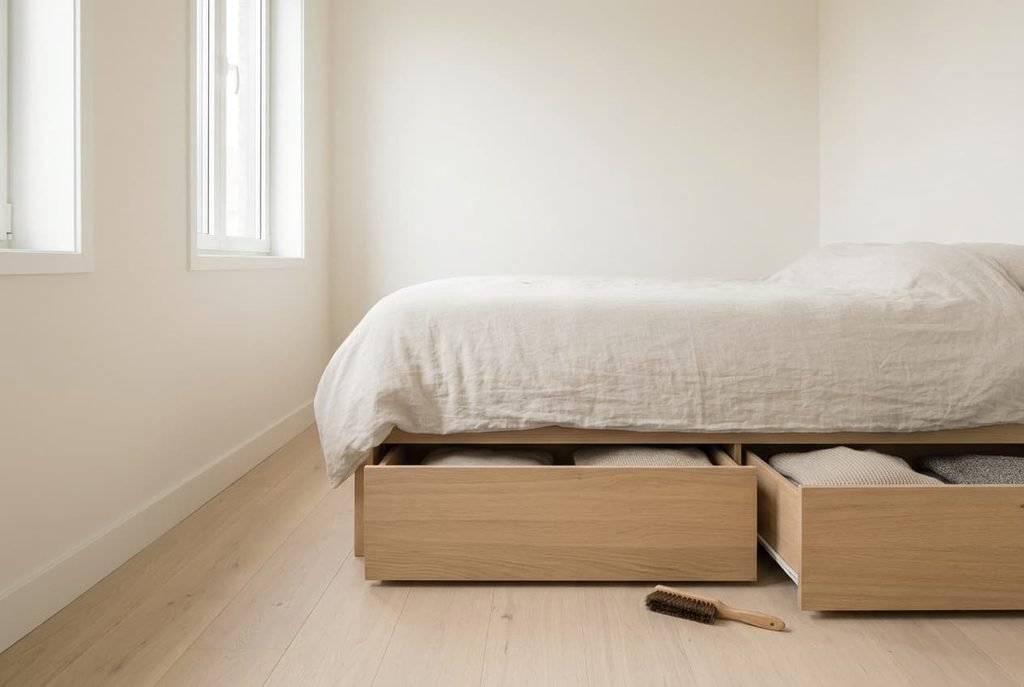
A drawer 100 cm long slides out onto 100 cm of floor and leaves 50 cm for you to stand. The foot end therefore needs 150 cm. Here that leaves 30 cm to spare. A bench or chest at the foot wouldn’t leave room.
Rollers glide on a hard floor and drag on a thick rug. A drawer of winter jumpers weighs around 15 kg, and the base panel carries all of it. A panel of 6 mm bows under that load, so ask for 12 mm or add a centre rail.
Dust gathers at the sides, where the drawer doesn’t reach. A hand brush clears it in a minute. The drawers lift out for cleaning, and the runners are the first parts to wear. They can be replaced one at a time.
Because each drawer shows all its contents at once, the store stays tidy without effort. Socks and T-shirts work well, and so does gym kit, since you see everything the moment the drawer opens.
How the lifting base of a storage bed behaves day to day
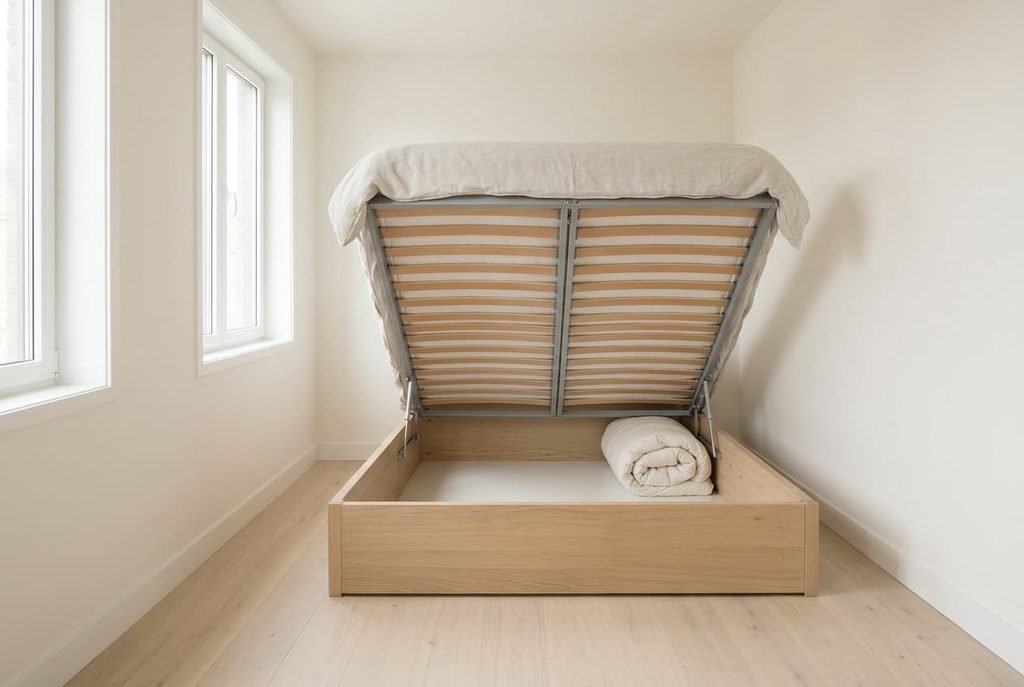
Gas struts raise the base, hinged at the head, so the lift feels light even with a 25 kg mattress on top. Pillows and the duvet slide off, though. The routine takes about 40 seconds: you clear the bedding and raise the base. Then you reach in and close the lid. The bed gets made again afterwards.
Raised upright, the frame reaches about 225 cm. A 250 cm ceiling clears that, but a pendant light hanging down to 215 cm over the foot wouldn’t. Check the swing before you buy.
The far end is the awkward part. An arm covers 70 cm of a 190 cm void, so 120 cm lie out of easy reach. Put duvets and luggage at the back along with spare linen. Keep them in covers, because a closed void holds still air. Compare the struts’ rated load with the mattress too, since a heavy foam mattress needs stronger ones.
Struts lose pressure after many years. They’re standard parts, and replacing a pair takes about 20 minutes with two people.
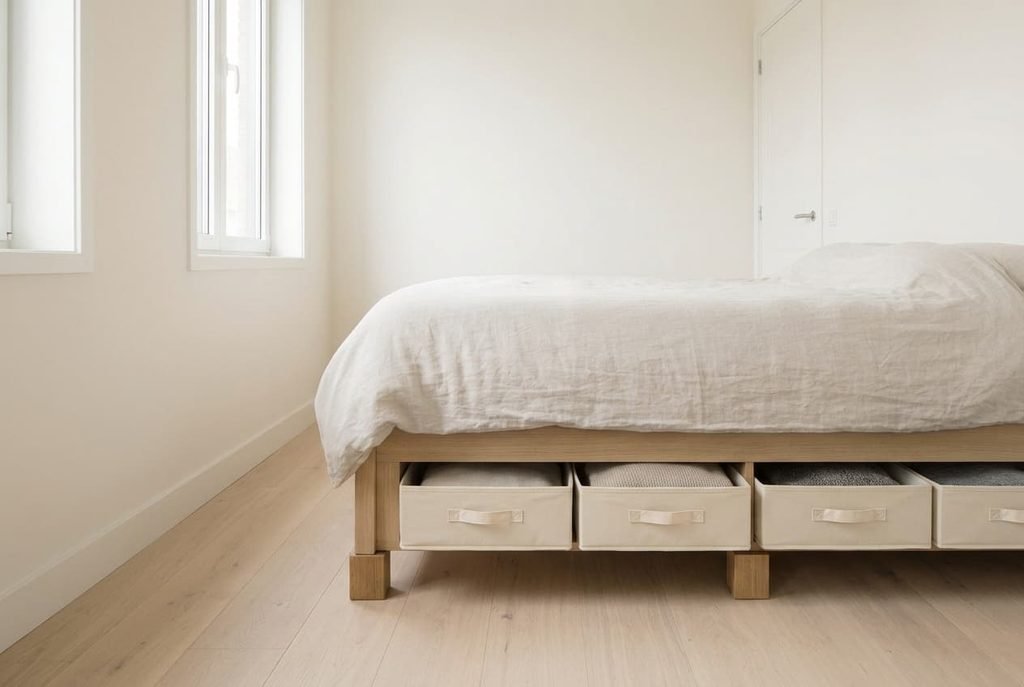
The third option: raise the bed you already own
Neither bed is the only route. Your existing bed, with 20 cm of clearance, can stand on risers 10 cm tall. The gap becomes 30 cm, and six boxes of 60 × 40 × 24 cm hold 57.6 L each, or 346 L together. That beats the two drawers by 24% and reaches about half the volume of a lifting base.
Each box slides out 60 cm from the side, which fits the 70 cm left beside the bed. Choose risers rated above the weight of the bed with its mattress and two adults, and check that every leg sits fully inside its cup.
The plan costs no new bed and the least floor. Its limit is height: the mattress rises by 10 cm, so a bed that stood 45 cm high now sits at 55 cm. A tall person finds that comfortable, whereas a short one may find it a climb. Try a stack of books under each leg first. Treat this as the trial before you buy bed drawers or a lifting storage bed.
How to pick: count your openings for a month
Choose the drawers when you open the store more than once a week, because daily use costs 10 seconds, or 61 minutes over a year. The same daily routine on a lifting base costs 40 seconds, or 243 minutes, which is four hours of lifting and re-making.
Choose the lifting base when you open it less than once a month, since twice a year costs only 80 seconds in total. The slow access barely matters, and the 710 L void swallows duvets and luggage along with other bulky things you need only in season.
Risers and boxes serve the middle ground, a household that opens the store about once a week.
To pick between bed drawers or a lifting storage bed, tally your openings for one month and read off the branch. The tally takes less effort than another hour of measuring, and it removes the guessing. Jot each opening on a scrap of paper and count the scraps on the last evening. Clearance comes first, since a lifting base needs 225 cm above the foot and the drawers need 150 cm of floor.
Questions readers keep asking
Do drawers or a lifting base last longer?
Both last many years with ordinary loads. Drawer runners and rollers wear first, and they can be replaced one at a time. A lifting base fails at its gas struts. They lose pressure slowly and are standard parts that are cheap to replace. Neither is a reason to choose one over the other.
How do I keep dust out of the store?
Drawers collect dust at their sides, so brush them once a month. A closed lifting void stays cleaner but holds still air, so keep bedding in cotton covers or vented boxes. Skip sealed plastic bags for textiles, because trapped damp can leave a musty smell in a cold Dutch bedroom.
Which suits a rented flat?
The drawers, in most cases. They need no hole in the wall and no lift clearance, and they move with the bed when you leave. A lifting base is a heavy bed that needs a strong stairwell and a clear ceiling height, which a rented flat doesn’t always offer.