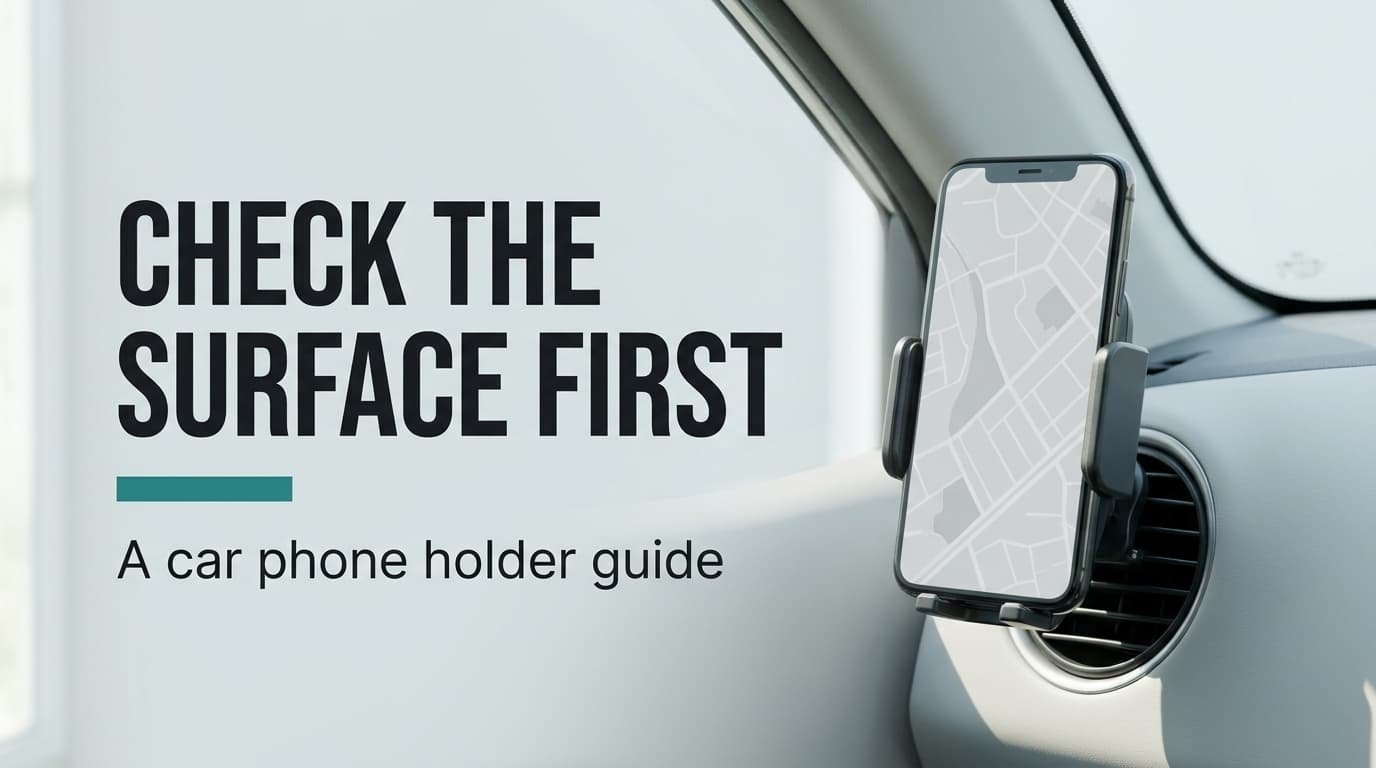
A car phone holder for daily commutes looks like a five-minute purchase, until the first bumpy road sends the phone into the footwell. A small car offers three places to mount one, and each place fails in its own way. This page ranks four checks by how often they cause regret and points out the headline claims that merit less of your trust. The article closes with a quick test that you can run before ordering. Our example is a ten-year-old hatchback driven 35 minutes each way. The phone and case weigh 220 g together.
What Matters Most in a Car Phone Holder for Daily Commutes
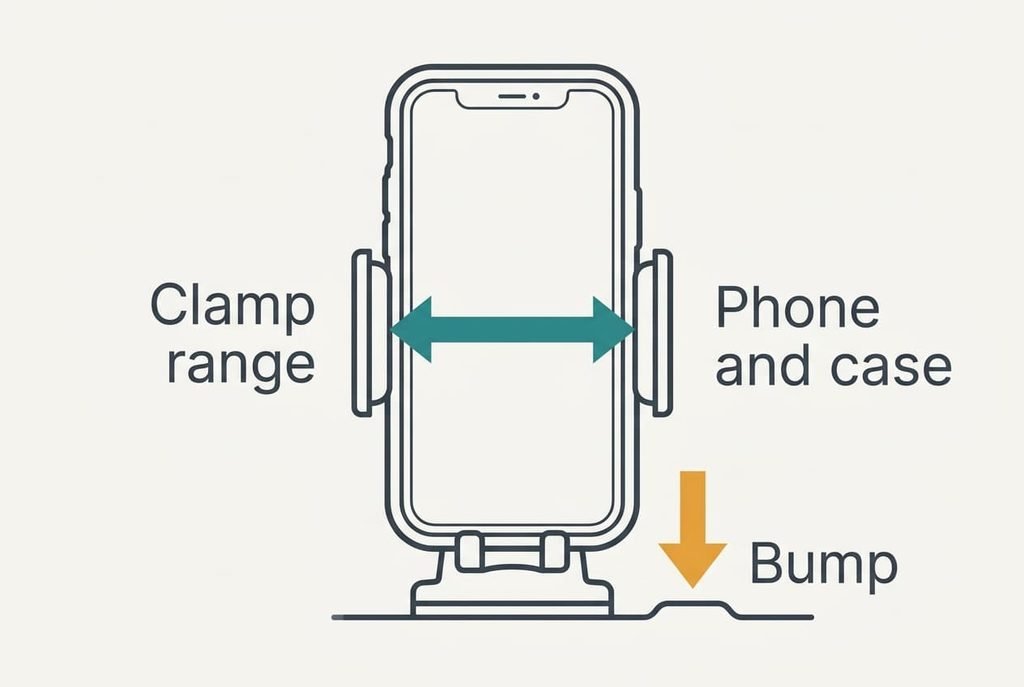
The question that matters most is how well the mounting spot carries the phone and case through every bump, because a holder that lets go costs you a hand and a glance each time.
Count the daily exposure. Twelve journeys a week, each with a few potholes, give the mount roughly sixty chances to fail. A hold that fails once in a hundred bumps drops the phone about every second week. Re-seating costs ten seconds, and the habit of watching it is the real price. Heat and cold change how pads and adhesives behave too, so a spot that holds in April may slip in July.
The phone sets a second limit. Take a phone of 78 mm across, wearing a case with 3 mm of padding at each edge. It needs a clamp opening to 84 mm at least, and the side buttons must stay free. A mount that can’t take that width sends you shopping again within a month.
The car sets the third limit. Its vents and its dashboard come in different shapes and textures, so a holder that suits a friend’s car may fail in yours.
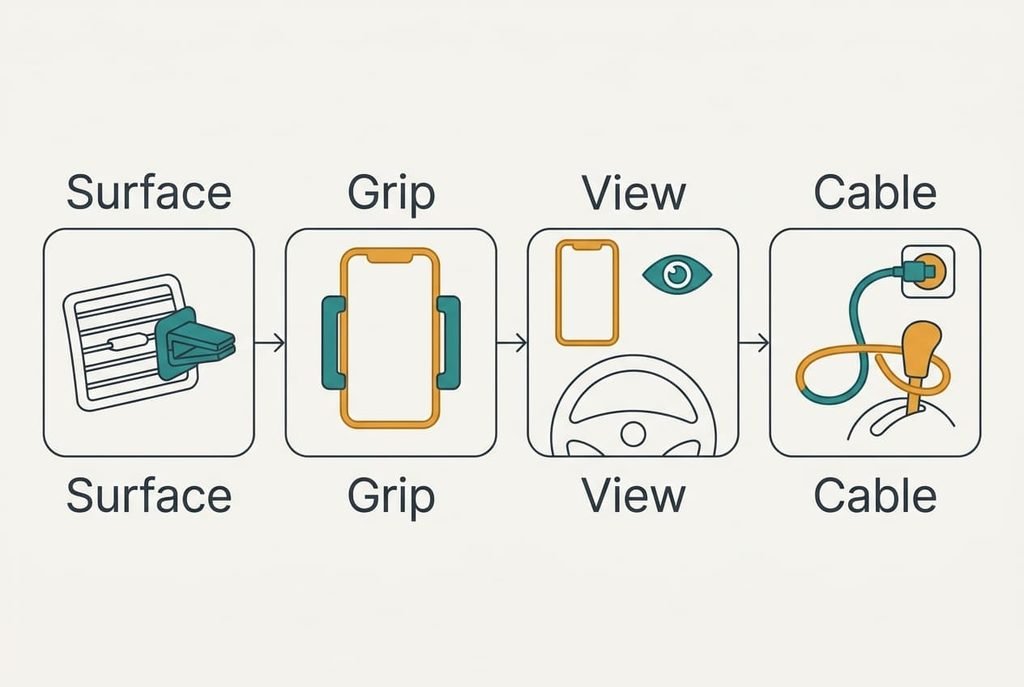
Four Daily Checks for a Car Phone Holder, in Order of Priority
1. The mounting surface. Vent slats and a dashboard each need a different kind of grip, and a windscreen needs a third. It decides whether the holder keeps its place from one week to the next. Press a finger on your own car to judge it, and compare the slat thickness with the clip’s stated opening. Slats that flex under a firm push won’t carry 220 g, and a grained dashboard gives suction nothing to seal against. A mistake here shows up on the first warm afternoon, when the holder drops.
2. Grip and release. The jaws or the magnet plate must hold the cased phone firmly and let go with one hand. Compare the stated clamp range with your phone and case, and read how the release works. A holder that needs both hands is one you’ll fumble at every red light. A poor grip lets the phone shift on a rough road, and the screen tilts away from you.
3. Position and view. Sit in the driver’s seat with your usual posture, then hold the phone at the spot you have in mind. Repeat it with the seat belt on, to see whether your arm still reaches. Look for a place below the line of the road ahead, clear of the mirror. Make sure the gear lever clears it too. Distance from your eyes sets the length of each glance. A bad position adds a head turn to every instruction, and you’ll notice it within a week.
4. The charging port and cable. Hardly anyone checks this one. The holder’s lower jaw may cover the charging port, or the cable may have to loop across the gear lever. Find where your phone’s port sits and where the socket is, then pin a length of thread along the route and measure that. A miss means a cable that unplugs at every gear change, or a phone that can’t charge while mounted.
Which Holder Claims Are Oversold for Daily Commutes?
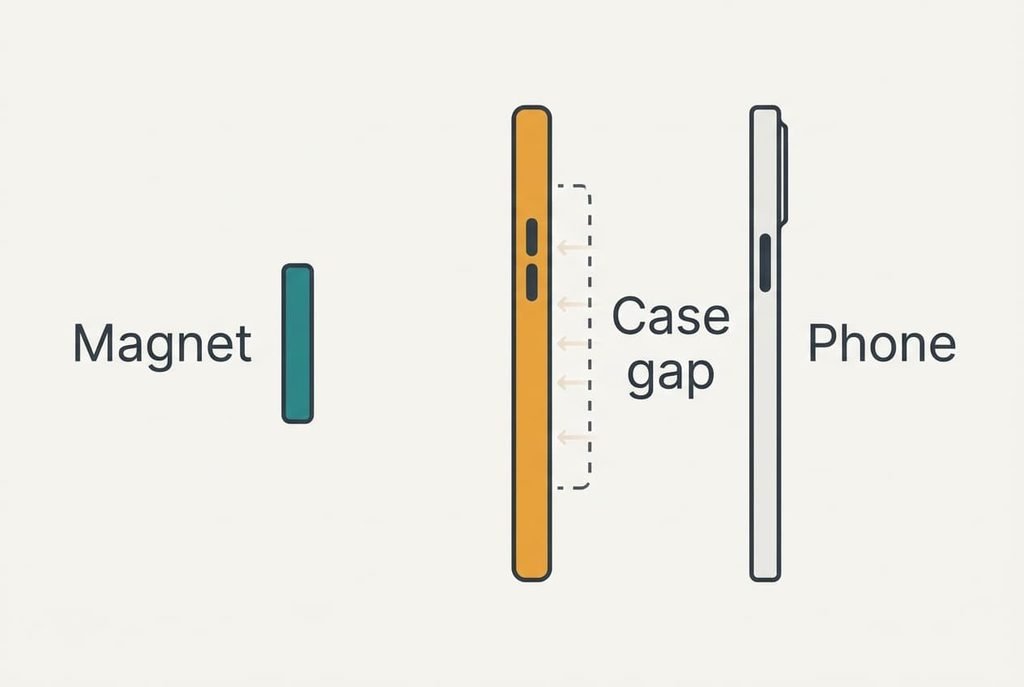
Some claims on a car phone holder for daily commutes get more room on the packaging than they deserve, and you’ll meet them in every listing. A big magnet strength figure is promoted because it’s an easy number to print, yet it tells you little about how far your case holds the phone from the magnet. A thick case adds a gap, and pull falls quickly with distance.
Full rotation looks clever and suits a person who swaps between portrait and landscape on every journey. A commuter sets the angle once, so the joint is just another place to work loose. A built-in wireless charger is a similar extra. It adds bulk and heat to the dashboard, and the cable route from the fourth check still needs solving.
A very long arm is the last oversold feature. It brings the phone closer to your eyes, but in a hatchback the extra reach shakes more over every bump.
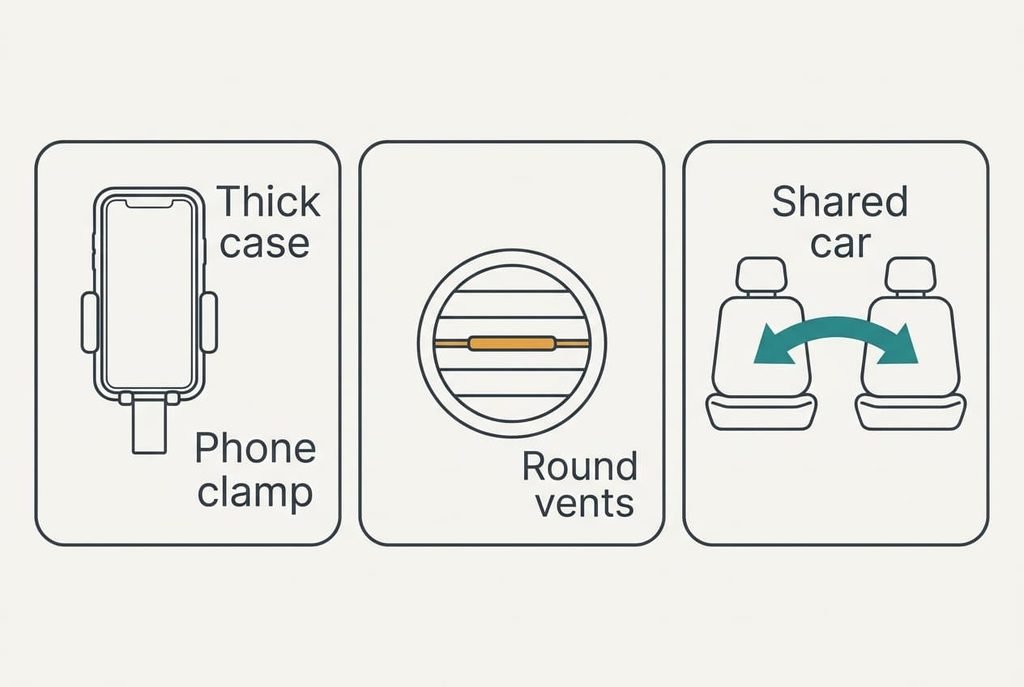
How the Order Changes From One Driver to Another
A driver with a thick protective case should move grip and release to the top. The case adds width and a gap that many clamps and magnets were never tested against. Measure the case, not the phone.
The owner of an older car with round or fragile vents should put the mounting surface first. A base that sits in a cup holder may suit that car better than any clip.
A driver who shares the car with a partner needs a holder that adjusts without tools, since a fixed position suits only one of them.
The charging check climbs when journeys are long. On 35 minutes each way, a phone running navigation loses a lot of battery.
When to Walk Away From the Idea
A holder is the wrong answer when the car has no grippy dashboard spot and no sturdy vent, because a mount forced onto a curved or crumbly surface lets the phone drop again and again. A holder pressed against a rattling panel adds a buzz to every drive as well.
In that car, use a base that sits in a cup holder. Another route is to run directions through the speakers and keep the phone in a pocket. Spoken directions ask nothing of the dashboard, and you only need to set the route before the engine starts.
A car phone holder for daily commutes also earns less in a very short journey. Under ten minutes each way, the phone can ride in a door pocket. A minute spent seating it takes a tenth of the journey, and the money goes further on a better charging cable.
A Two-Minute Check Before You Order
Sit behind the wheel with the cased phone, and measure the width with a ruler. Press the surface you picked with a finger, and note whether it flexes or feels grained. Write down the case width and the cable length from socket to phone, then note the height of the chosen spot.
Then hold the phone at that spot for a full minute. If your arm tires, the spot is too far away. If the phone hides the mirror, the spot sits too high. Check that the cable reaches the charging port without crossing the gear lever. Compare your notes with each product’s listed clamp range.
A holder that misses either of those numbers goes back to the shop. A car phone holder for daily commutes has to match your case and your surface before it is worth buying. Order after that check, and hold on to the receipt until the first month ends, since the first week may prove otherwise.
Questions Readers Keep Asking
How much should I spend on a holder?
Spend in proportion to how often the phone rides on it. A daily commute deserves a sturdier clamp and a better joint than a trip twice a year. Compare grip and surface fit before looking at extras, and treat the cheapest option as the one you’ll most likely replace.
Which type lasts longest in a car?
Vent clips tend to wear at the clip, and suction mounts lose their seal after repeated heat and cold. A base in a cup holder ages slowest, since it has no seal and no clip. Check the jaw hinge and the pad after a month, and replace worn parts before they fail.
What spec should I check first?
The clamp range against your phone and case. It’s the one figure that rules a holder out at once, since a mount that can’t open wide enough never holds your phone. Measure the case and note the width. Discard any holder that can’t fit it.