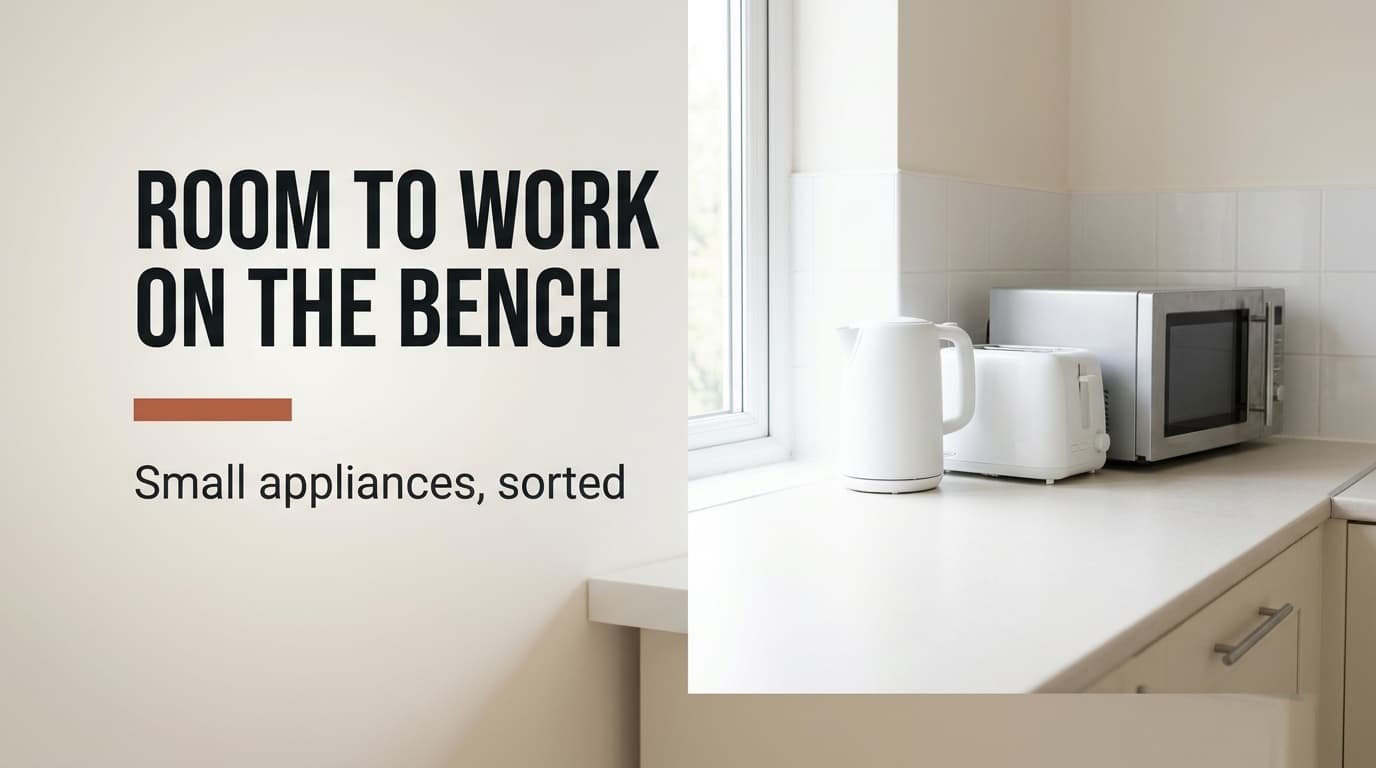
A kitchen worktop that disappears under small appliances loses its use long before its area runs out. The free space exists on paper, yet it comes in strips too narrow to chop on. Our example is a Rotterdam kitchen with a run of 150 by 60 cm between sink and hob. Three short checks name the cause, then four fixes run from the free to the professional. Each attacks a different mechanism. All the numbers describe this one kitchen, so bring a tape measure to yours. You won’t be asked to give up an appliance you love.
How a Kitchen Worktop That Disappears Loses Its Space
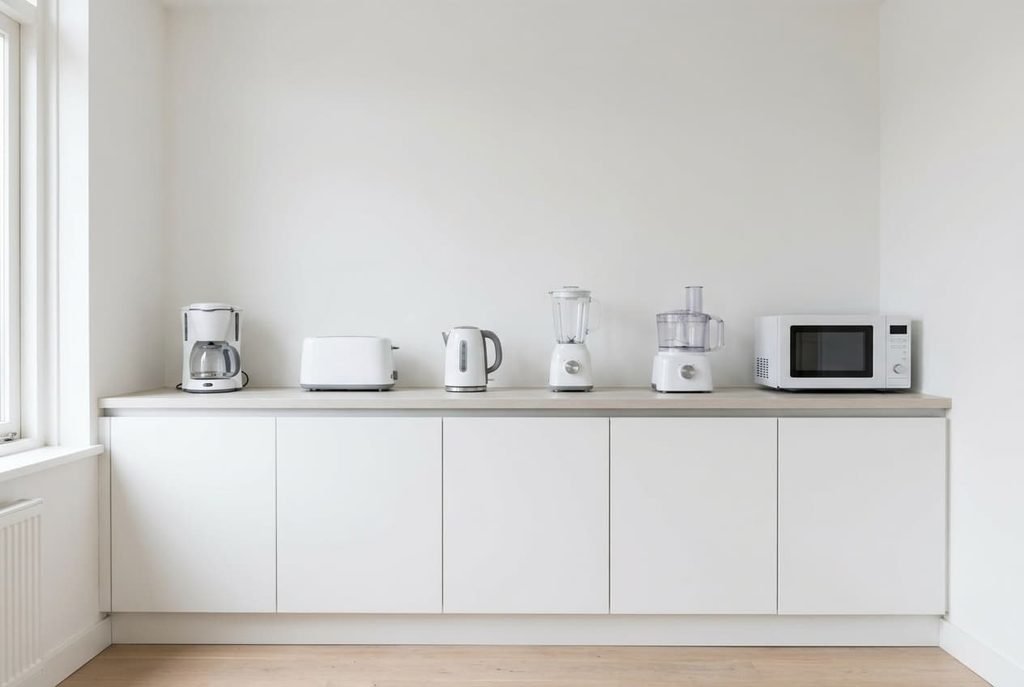
Our run measures 150 × 60 = 9,000 cm². Six appliances stand on it, from a kettle just 20 cm square to a microwave of 45 by 35 cm. Together they cover 4,790 cm², or just over half of the worktop. That leaves 4,210 cm² of bare surface, a figure that sounds generous.
The surface is broken up, though. Appliances sit where the sockets are, and the gaps between them measure 28 cm at best. The widest unbroken piece is 28 × 60 = 1,680 cm². A chopping board 40 cm by 30 cm needs elbow room of 10 cm on each side, so a real task wants one clear piece of 60 × 40 = 2,400 cm². Ours reaches 70% of that.
What fails is the largest unbroken rectangle and not the total free area, because a board needs one piece of clear worktop, and so do your hands. Six small gaps add up to a lot of space and no usable bench.
Each appliance also claims a margin. A kettle breathes steam upwards and wants 30 cm of open air above it. A toaster wants a few centimetres from the wall. Those margins turn a neat footprint into a larger dead zone.
Clear pieces are what a worktop is for.
Confirming Why the Kitchen Worktop Disappears
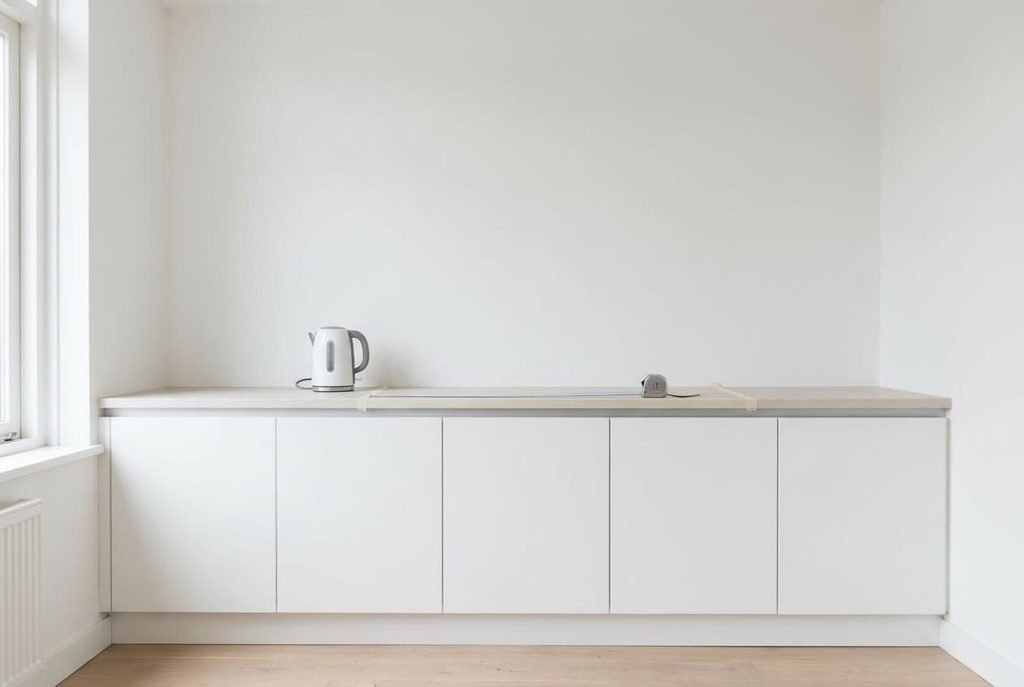
Three short checks show which version you’re facing. Each check takes roughly five minutes and calls for just a tape and paper.
First, trace each appliance’s base on the paper and add the areas. If the total passes half of your worktop, footprint is the cause. A total under a third points away from it, so move on to the second check. Ours came to 53%.
Second, measure the widest clear strip between obstacles in both directions. If the largest rectangle is smaller than 60 × 40 cm, the fault is fragmentation, even when total space looks fine. A rectangle that passes means the trouble is placement and the quantity is fine. Ours measured 28 × 60.
Third, check the cupboards for a spare space of 40 × 40 × 40 cm. If one exists, a relocation fix can work. If every shelf is full, move straight to the later fixes. Ours had none, apart from the shelf under the sink, and the bin already lives there.
Four Fixes When Small Appliances Take the Worktop
Move the weekly appliances into a cupboard: this one removes footprint, and it costs only effort. Take the bread bin of 40 by 25 cm and the blender, 20 cm square, off the surface. That frees 1,400 cm², leaving a total of 3,390, or 38%. The clear strip then measures 40 × 60 = 2,400 cm², which just passes. The limit is the cupboard. It needs a spare 40 cm cube, and a blender that lives behind a door gets used less.
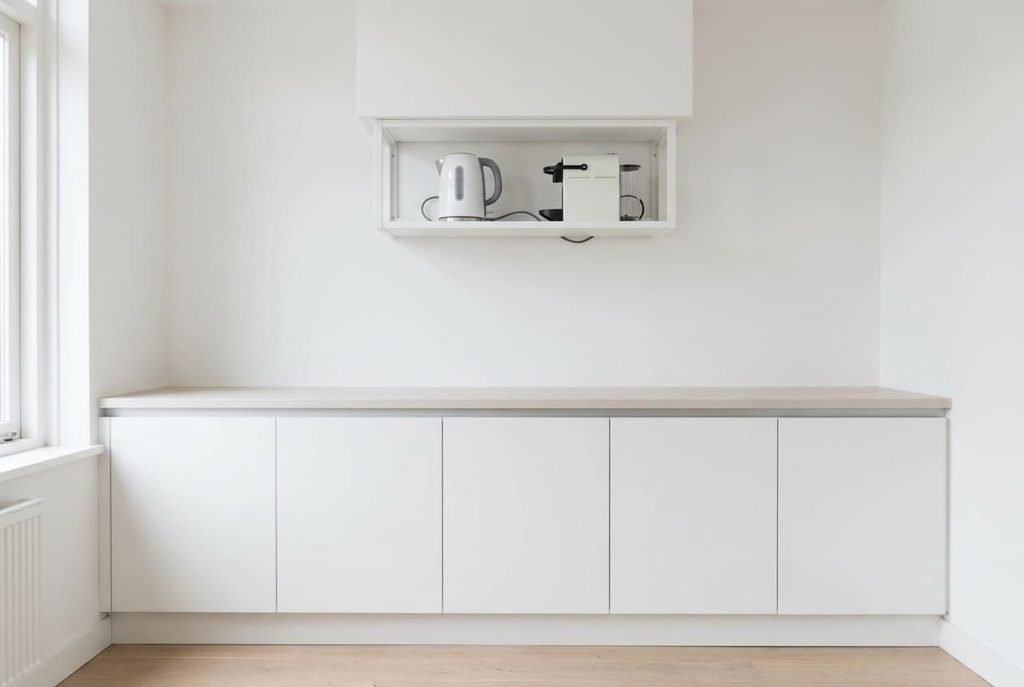
Lift the kettle and coffee machine onto a wall shelf: here the footprint moves off the surface instead of vanishing. A clip-on shelf of 60 by 20 cm fixes under a wall cupboard, which sits 55 cm above the worktop. The kettle (400 cm²) and the coffee machine (875 cm²) leave the bench, bringing the total to 3,515 and the clear strip to 44 × 60. Fit the shelf with a clamp, then test it with a full kettle before relying on it. It’s a small purchase. Headroom is the limit: the space under the shelf is 35 cm, enough for a board, though a tall jug won’t fit. The kitchen worktop that disappears gets its middle back this way, and the cooking zone stays open.
Replace two appliances with one combination oven: this goes after the number of things rather than their place. A microwave with a grill of 45 by 35 cm does the work of the microwave and the toaster. It saves the toaster’s 540 cm² and nothing else, so the strip grows only to 32 × 60 and still fails alone. The purchase is larger. Combine it with the first fix to clear the test, and only buy it if both old machines are wearing out. A working pair that’s replaced early costs more than the space is worth.
Build an appliance cupboard with a socket inside: a joiner fits a housing with a lift-up door over the microwave and its power point, so the machine lives in a space made for it. That removes 1,575 cm² from the surface and the clear strip reaches 48 × 60. The limit is the work itself. The work fills a day, and a rented kitchen needs the landlord’s consent. Do this one last, after the cheaper fixes have shown you what is left.
What Your Own Kitchen Run Allows
A kitchen worktop that disappears has fixed causes and flexible ones. Treat them separately.
The sockets are fixed. Ours has two double sockets, both at the left end of the run, so every appliance crowds there. A joiner can add a socket, but a tenant should ask the landlord first. The wall cupboards are fixed too, with their bottoms at 55 cm. That height caps any shelf under them at 20 cm if the kettle is to keep 30 cm of air above it. The sink and hob sit 150 cm apart and won’t move either.
What can change is where the appliances stand. Moving the kettle two sockets to the right costs nothing and widens the gap on the left from 28 cm to 44. Mind the cable’s length, because a lead stretched across the bench is a new obstacle.
Work with the sockets you have, not the sockets you wish for.
The Fix That Doesn’t Work
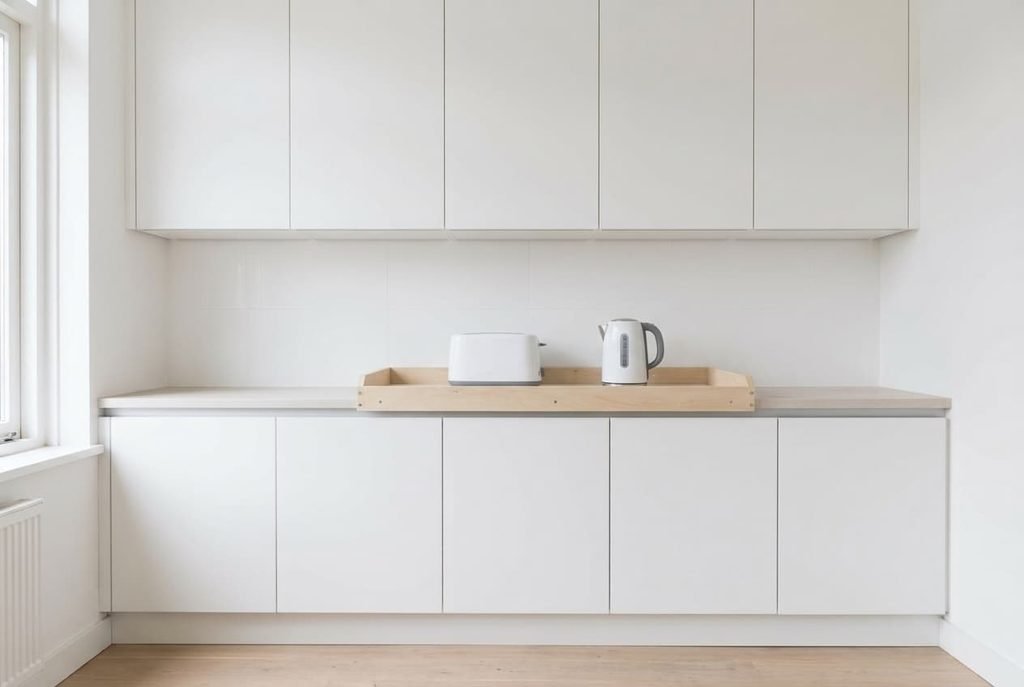
A worktop organiser tray for the appliances tempts nearly everyone first, yet it backfires. A tray of 50 by 30 cm holds the toaster and the kettle, whose footprints add up to 940 cm². The tray itself covers 1,500 cm², so it adds 560 cm² of dead border and merges nothing. The pieces of bench stay as small as before.
A rolling trolley beside the worktop goes wrong another way. It moves the clutter to the floor, where a trolley 40 cm wide cuts a 110 cm aisle to 70 cm. A cook holding a pan needs about 90 cm to pass, so the kitchen gets harder to cross while the bench stays broken. Both fixes look tidy for a week, yet neither touches the mechanism behind the broken strips, which is why the bench looks organised and still can’t be used.
A kitchen worktop that disappears needs fewer footprints or fewer fragments. Neither a tray nor a trolley provides either. Spend on the first or second fix instead, and test the result by tape. Measure the clear rectangle again after each step, because the strip tells you faster than a feeling does. Stop when it reaches 60 × 40 cm, and check again in a month so the habit holds.
Questions Readers Keep Asking
Can I fix this without a bigger kitchen?
Yes, in most small kitchens. The problem is a broken surface rather than a lack of area. Our run had 4,210 cm² of free space and could not use it. Joining the pieces, or moving two appliances away, gave a clear rectangle of 2,400 cm² without adding a centimetre.
How much should I spend?
Start with nothing. Moving the weekly appliances into a cupboard passed the test on its own. A wall shelf costs little, a combination oven costs more, and a joiner’s cupboard costs the most. Spend only as far as you need to reach a clear rectangle of 60 × 40 cm.
Could the sockets be the real cause?
Often, yes. Appliances gather where the power is, and they leave gaps too small to use. If everything stands within 60 cm of one socket, ask whether another point can be added. Moving our kettle along to the last socket widened the strip to 44 cm, which helped more than any tidy-up.