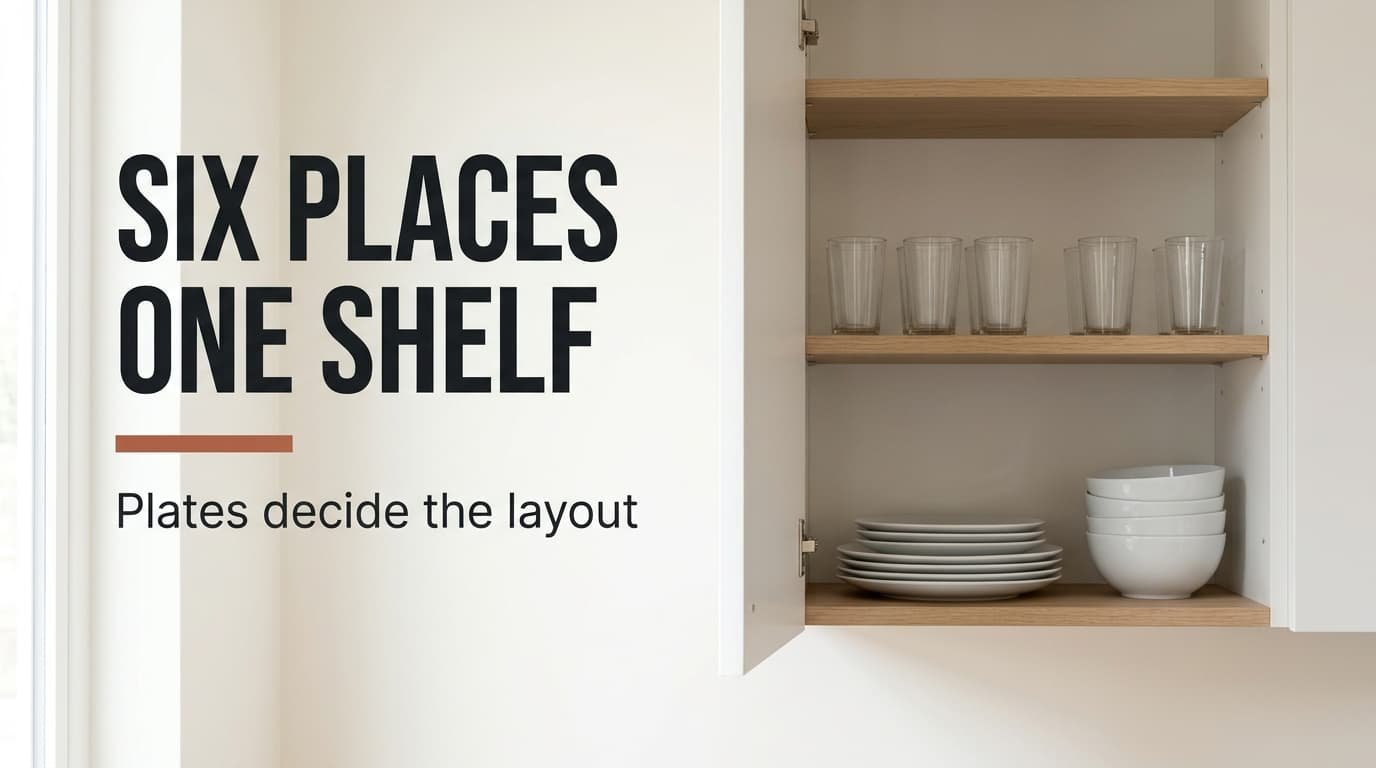
Turn a dinner plate over and the foot ring tells you most of what a shelf needs to know. Its width fixes the layout, and its rim decides how long the plate survives. This page covers tableware for six guests in a Utrecht flat whose only spare cupboard is 33 cm deep and 60 cm wide. Five purchases make a full table, bought in the order a wrong choice would hurt most. Each comes with a size and a spending tier, plus the build flaw to check. Prices stay out of it. Shops and shelves differ too much for a figure to travel.
Why Plate Width Decides Tableware for Six Guests
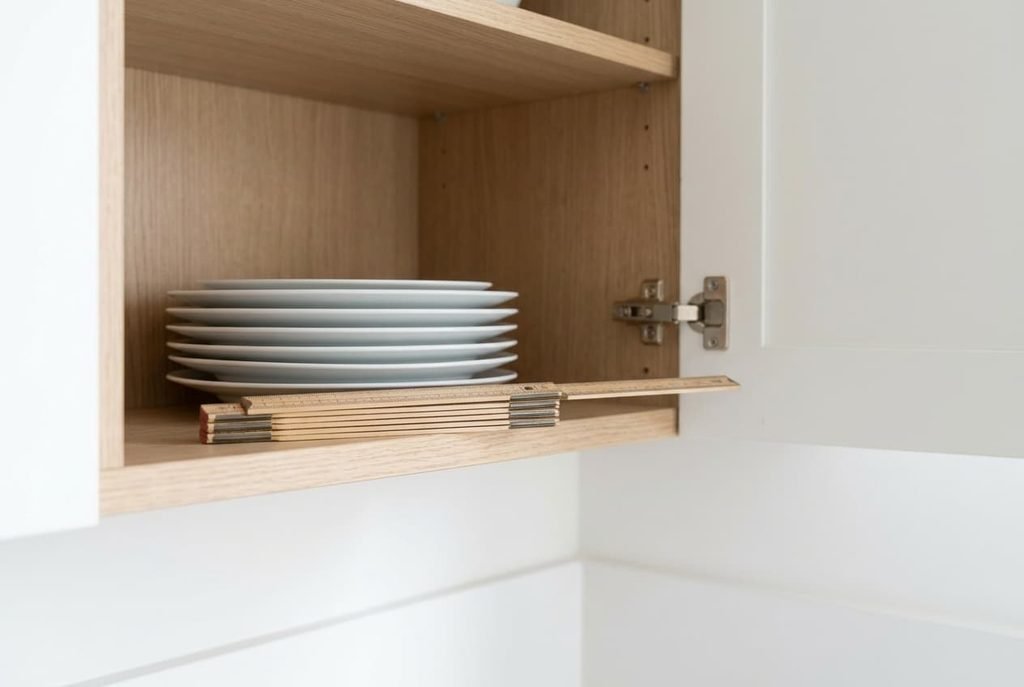
Our cupboard has two shelves. Each is 33 cm deep and 60 cm wide. The gap to the shelf above is 28 cm, and every shelf offers 1,980 cm² of floor. Tableware for six guests adds up to 37 pieces: 18 of cutlery for a drawer and 19 for the shelves.
Stacks grow more slowly than you’d expect, because every plate nests into the one below. Our sample plate adds only 1.1 cm per extra plate, so six of them rise to 8.0 cm instead of 15.0 cm. Height therefore never limits anything here. Width does, since a plate 26 cm across takes 43% of the 60 cm shelf by itself. The plate decides how wide the whole shelf is, because all other pieces must squeeze into the 34 cm that remains.
Every size and weight in this article is a sample, so use your own cupboard’s numbers instead.
Measure the shelf width and the clear height above it. Each check needs one minute and a tape, and both save you from returning a box of plates that stands 2 cm too tall. A box labelled for six people may still hold pieces that don’t fit, so compare the printed diameter with your shelf before anything else.
Five Purchases for the Cupboard, Dearest Mistake First
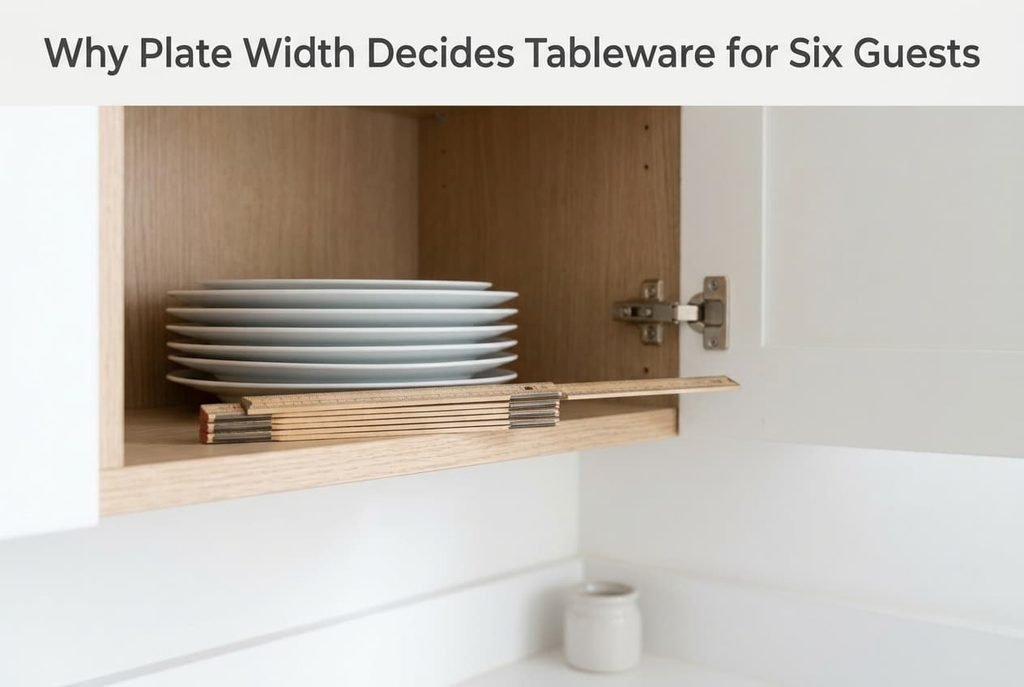
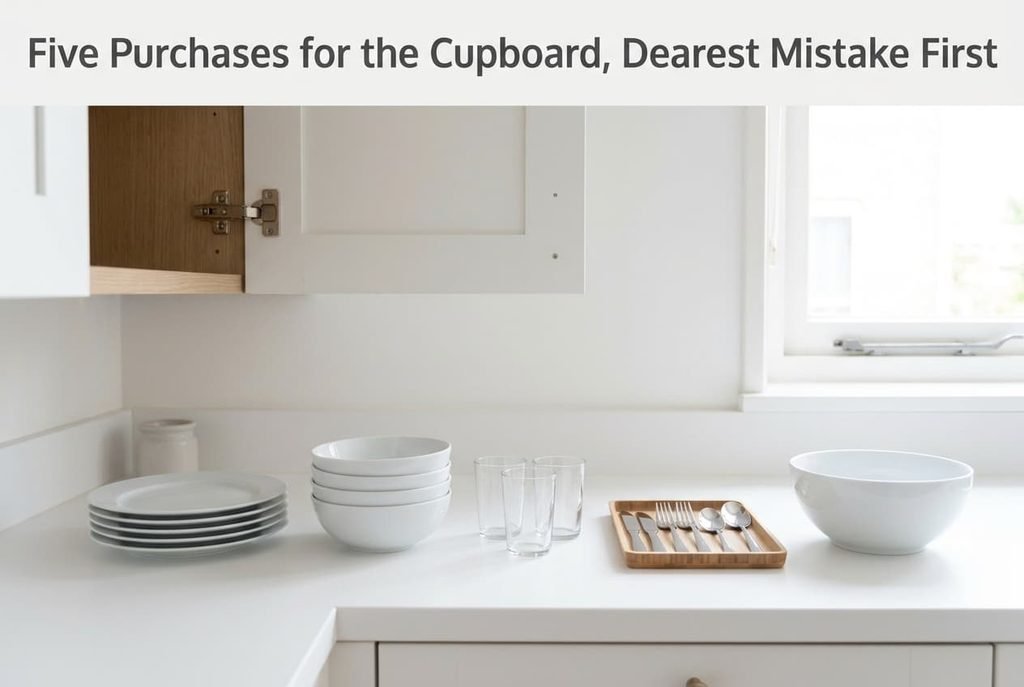
1. Six dinner plates, each 26 cm across, come first. They stand 2.5 cm tall, and the stack of six rises 2.5 + 5 × 1.1 = 8.0 cm. Tier: BUY ONCE. A body fired until it stops absorbing water keeps its glaze sound for years. Reject a rim under 3 mm thick, which chips first. Tap the rim with a fingernail. A clear ring means a sound body, and a dull note suggests a hairline crack.
2. Six pasta bowls come second. Each is 21 cm across and 5.5 cm tall. One wide bowl handles soup and dessert alike, and the bowls nest to 5.5 + 5 × 1.5 = 13.0 cm. Beside the plates they fill 26 + 21 = 47 cm of the shelf’s 60. Tier: MID. An evenly fused inner glaze matters most here, since spoons scrape it at every meal. Reject a foot ring with a low spot. Press one edge of the bowl on a flat counter, and any rocking gives it away.
3. Cutlery ranks third because it lives in a drawer and never competes for shelf width. The set has 18 pieces, three per guest. The tray must be at least 24 cm long, since the table knife measures 22 cm. Tier: MID. One-piece steel handles stay rigid for years. Avoid a knife handle welded from two hollow halves, whose seam splits. It also traps water. Run a thumbnail along the handle and feel for a ridge.
4. Six straight-sided tumblers follow, each 7.5 cm across and 10 cm tall. Two rows of three cover 22.5 × 15 cm. They rank fourth because a broken glass is easy to replace. Tier: BUY CHEAP. Pressed glass with a thick base takes knocks well. Avoid a rim with a ridge you can feel, because that joining seam is where pressed glass chips. Run a fingertip once around the lip.
5. One shared serving bowl comes last. It measures 28 cm across and 9 cm tall, and a saucepan can serve for a few evenings. Tier: BUY CHEAP. A wall of about 8 mm holds heat and resists chips at the rim. Reject a glaze covered in fine cracks, which collects stains. Tilt the bowl under a lamp and check the inner surface.
Why the Pasta Bowl Is the Item to Scale Down
A boxed set usually adds side plates and soup bowls to the dinner plates. Side plates of 19 cm and soup bowls of 16 cm would give 26 + 19 + 16 = 61 cm of width on the shelf. The shelf offers 60 cm, so that full set misses by 1 cm. It also adds six pieces, since that set has 18 against the 12 we bought.
One pasta bowl replaces both extra shapes, and the width used drops from 61 cm to 47 cm. That leaves 13 cm free, so a jug 11 cm wide or a stack of coasters fits beside them. Bread rests on the plate’s rim, and dessert goes into the bowl that held the soup.
Buying one shape also lets you spend less on this item. Plates carry the knife work of every meal, so they earn the BUY ONCE tier. A bowl meets only spoons, which is why MID is enough. Choosing tableware for six guests this way puts the saving where a failure would show first.
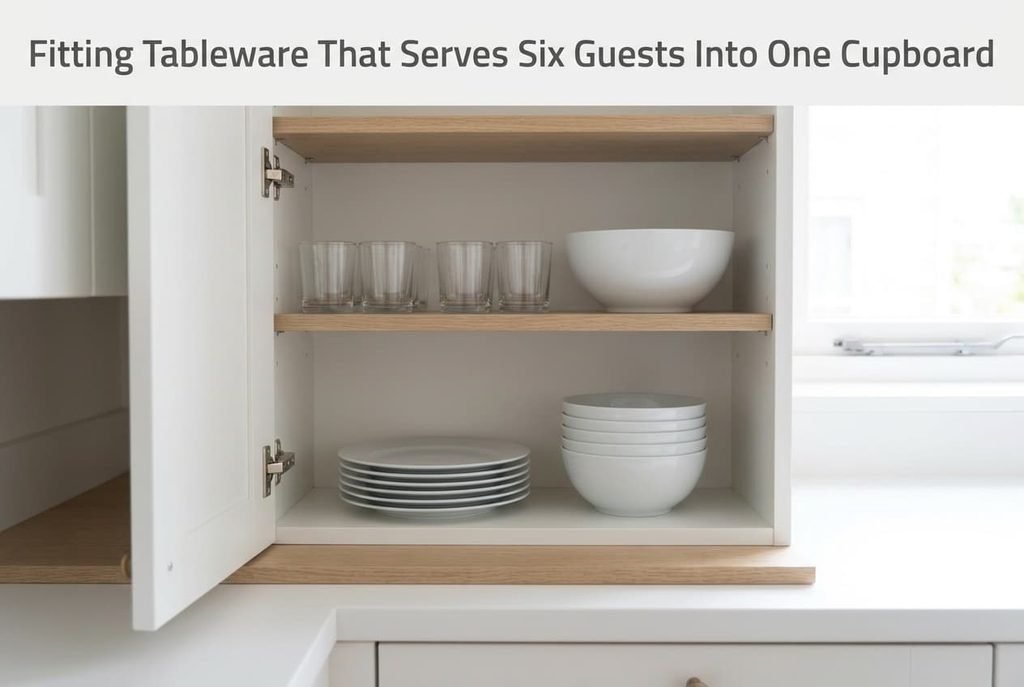
Fitting Tableware That Serves Six Guests Into One Cupboard
The lower shelf takes the heavy pieces. Plates and bowls stand side by side and use 47 of the 60 cm, leaving 13 cm. Their stacks rise 8.0 and 13.0 cm, far below the 28 cm available. A felt disc between plates stops scratches, and five discs of 2 mm add 1.0 cm.
The upper shelf holds the light pieces. The tumblers use 22.5 cm and the serving bowl 28 cm, which makes 50.5 cm and leaves 9.5 cm. Keep the tumblers near the front, because they’re the pieces you touch most.
In our sample the plates weigh 0.5 kg each, the bowls 0.45 kg, the tumblers 0.25 kg and the serving bowl 0.9 kg. The lower shelf then carries 3.0 + 2.7 = 5.7 kg and the upper shelf 1.5 + 0.9 = 2.4 kg. That’s 8.1 kg altogether. If your shelf is a thin board, check its span before you load it.
Wash the heavy pieces first and put them away first, so the lower shelf is ready before the upper one.
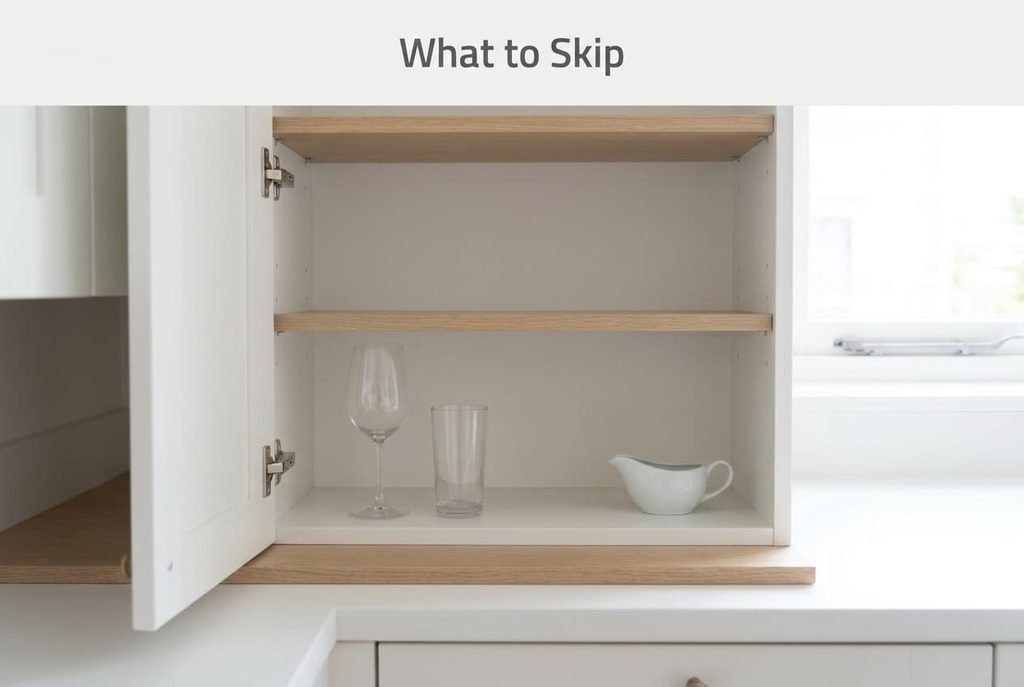
What to Skip
Skip stemmed wine glasses, because a glass 20 cm tall can’t nest or stack, and the stem gives way before the bowl does. Straight tumblers do the same job on a shelf with room to spare.
Skip a gravy boat or any dish with a single purpose. A boat of 14 × 11 cm needs 154 cm² of shelf, and the spare 9.5 cm of width can’t take it in either direction.
Skip a second set kept for best occasions. Twelve plates would use 52 cm of width in two stacks, so the bowls would have no space left.
Skip a fourth piece of cutlery per guest. A dessert fork lifts the drawer from 18 to 24 pieces, and the spoon already does that job.
Start with the plates and bowls. Add the cutlery drawer next, then the glasses once the shelf works. The serving bowl can wait until a dinner needs it. A cupboard of 60 cm can hold tableware for six guests without crowding, as long as you keep to the order above. The 19 shelf pieces and 18 drawer pieces add up to 37, and the two shelves still have 13 cm and 9.5 cm to spare.
Questions Readers Keep Asking
How many pieces do six guests need?
Thirty-seven pieces cover six guests. Eighteen are cutlery for the drawer, and 19 go on the shelves. The shelves hold six plates and six bowls on the lower level. Six tumblers and a shared bowl stand above. Buy two spare tumblers, because glasses are the pieces that break first.
What should I buy first if I can’t buy it all at once?
Buy the six plates. They fix the shelf layout, and every other purchase is sized to the space they leave. Add the bowls next. Until the rest arrive, borrow what you lack from friends or use what you already own. Nothing is lost by waiting a month.
How can I judge a plate in the shop?
Check three things. Tap the rim and listen for a clear ring. Measure the rim, which should be at least 3 mm thick. Then set the plate on a flat counter and press an edge, because rocking means the foot ring is uneven. A plate that passes all three will last.