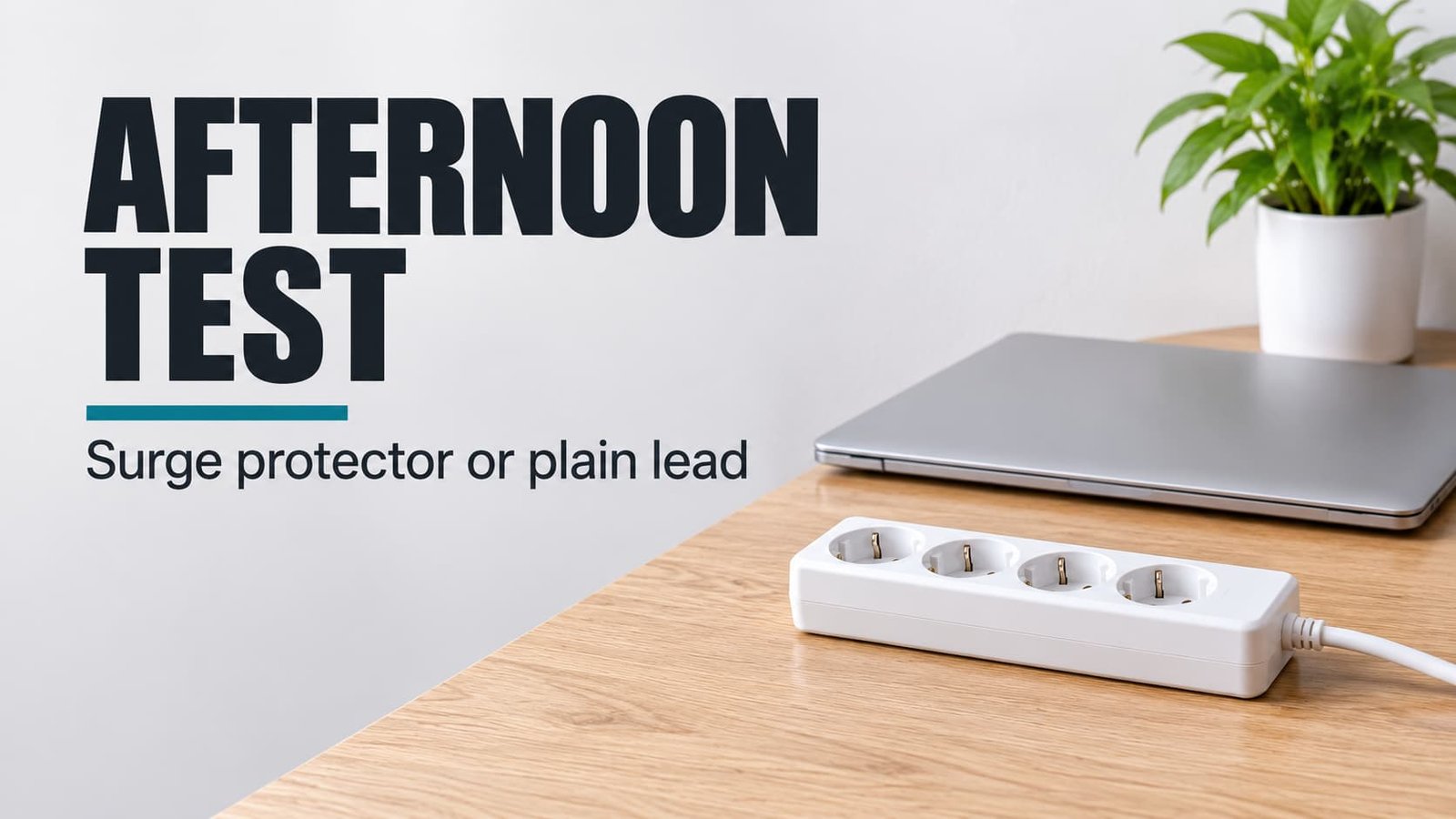
Spend on protection only for what you can’t replace in an afternoon, and spend nothing on the rest. Choosing a surge protector or a plain extension lead for a home office comes down to that single test. A protected lead is worth having when something on it holds the only copy of your work. A plain lead is enough when everything plugged in can be bought again this week. Our worked desk sits in the UK on 230 V and carries six devices that draw 145 W together. Every figure is an example, so measure your own. Both leads cost little to buy, so the real cost sits in what a spike can do to kit you can’t get back.
What Decides Between a Surge Protector or a Plain Extension Lead
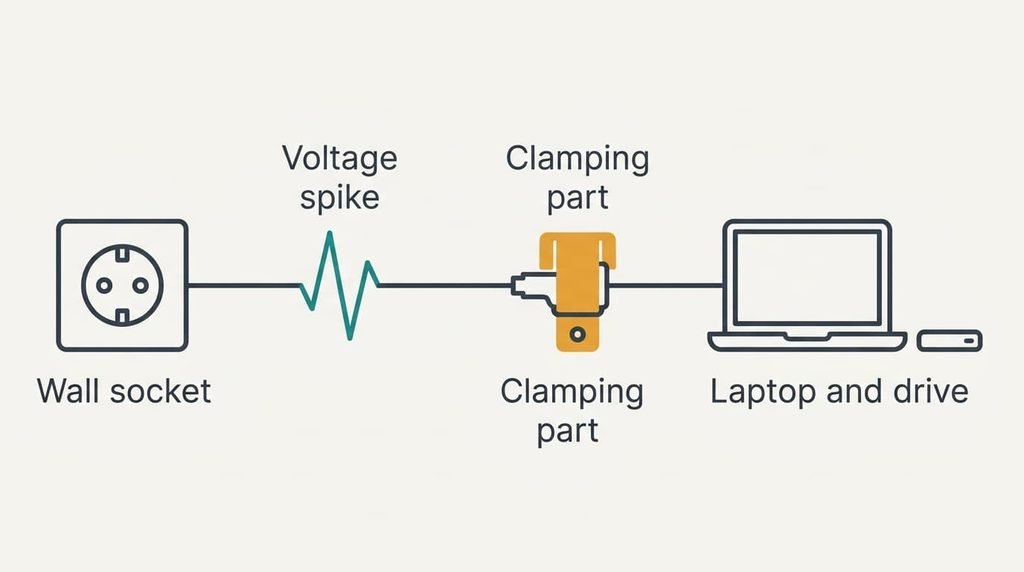
A surge is a brief jump in voltage well above the usual 230 V. It arrives down the mains cable from lightning nearby or from big motors switching elsewhere on the circuit. A plain extension lead has no defence against it. The fuse in its plug reacts to too much current, which is a different fault, so it stays silent while a spike passes through.
A surge protector adds a part that clamps the voltage and soaks up the excess as heat. That part is used up as it works, which matters later. Each device also carries its own power supply, and many absorb small spikes unaided. The lead acts as a second line of defence.
That leaves one question, and what on the lead you couldn’t replace in an afternoon answers it. Call it the afternoon test. Our desk holds a laptop charging at 65 W and a monitor at 30 W. It also holds a router at 12 W, a phone charger at 20 W, a lamp at 8 W and an external drive at 10 W. The total is 145 W, or 0.63 A at 230 V, a tiny fraction of what a lead can carry.
Two of the six fail the test. A shop can’t supply your laptop’s settings in an afternoon. Nor can it restore the drive, which may hold the only copy of your files.
Seven Checks Side by Side
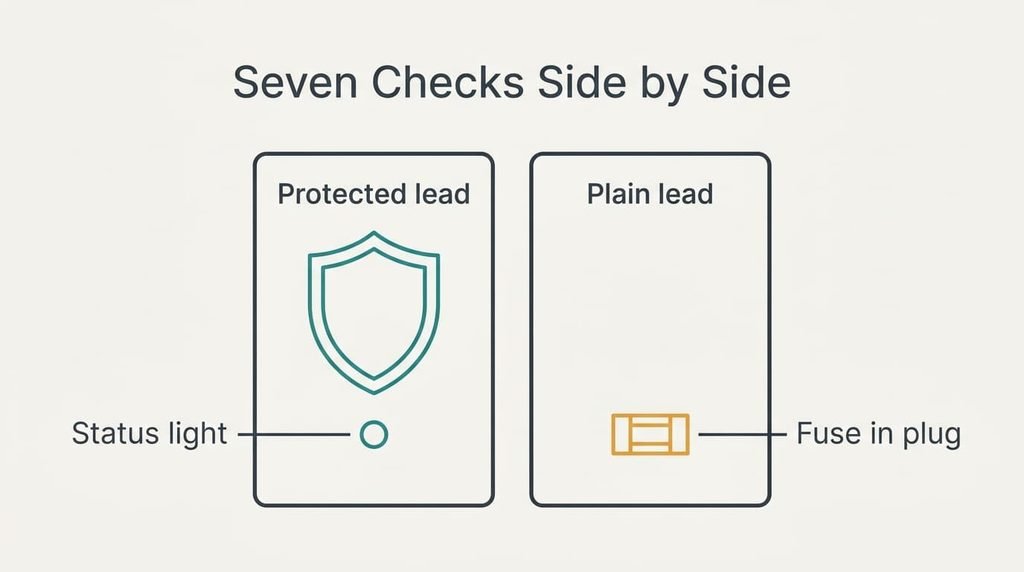
Seven checks cover what separates the two leads in daily use. They leave out colour and cable length, which settle nothing here.
| Check | Surge protector | Plain extension lead |
|---|---|---|
| Stops a voltage spike | Clamps it, up to its energy rating | No defence at all |
| Stops an overload | Fuse in the plug, same as the plain lead | Fuse in the plug |
| Wears out with use | Yes, one absorbed spike at a time | Only through physical damage |
| Shows whether it still works | Only if it has a status light | Nothing to show |
| Covers a phone line or ethernet | Only with extra ports built in | No |
| Keeps the desk running in a power cut | No | No |
| Maximum total load | 13 A on the plug fuse, about 2,990 W | 13 A on the plug fuse, about 2,990 W |
The row that surprises most buyers is the third. A protector can spend its protection quietly and still deliver power, so it looks identical to a working one while behaving like a plain lead. Without a status light you’d have no way to know, which is why the fourth row carries so much weight. A lead can read protected on its box and behave as a plain one.
When Protection Is Worth Having
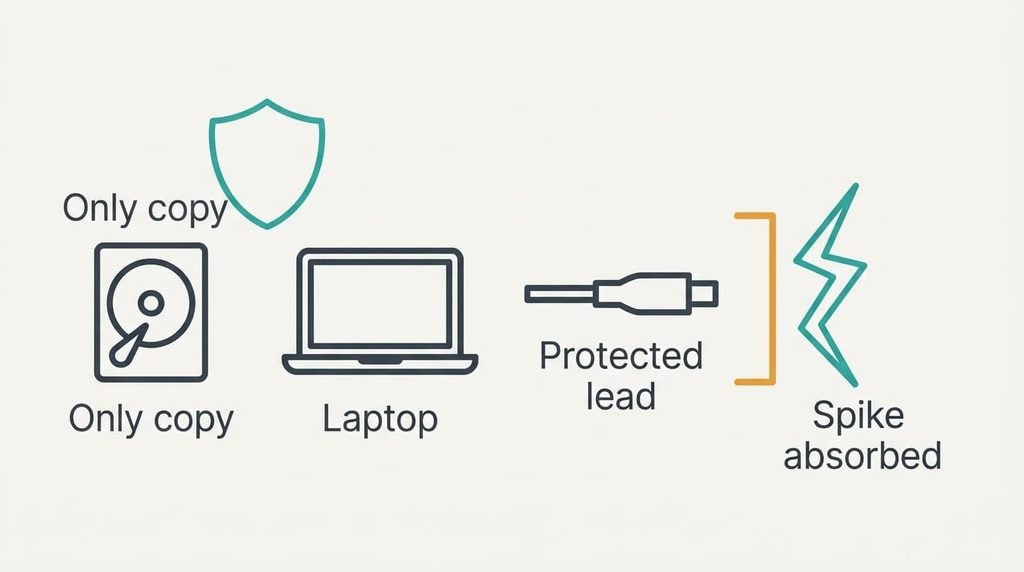
A surge protector or a plain extension lead earns the choice by what sits on it. The protected lead wins when a failure would cost more than a shop trip. Our drive is the clearest case. If it is the only home of a year’s invoices, a spike that kills it outweighs the whole lead.
Think of the part inside as a budget in joules. Assume a rating of 600 J and an average absorbed event of 50 J. That gives 12 events before the budget runs out. Real wear isn’t this tidy, so treat the figure as a rough guide.
Location matters too. A ground-floor flat with a kitchen on the same circuit sees more switching from fridges and washers than a quiet top-floor room. A router with a phone line or an ethernet run from outdoors adds another path for a spike. Only a lead with extra ports covers it.
Protection is no substitute for a backup, because it lowers the odds of losing the drive while a second copy removes the loss itself.
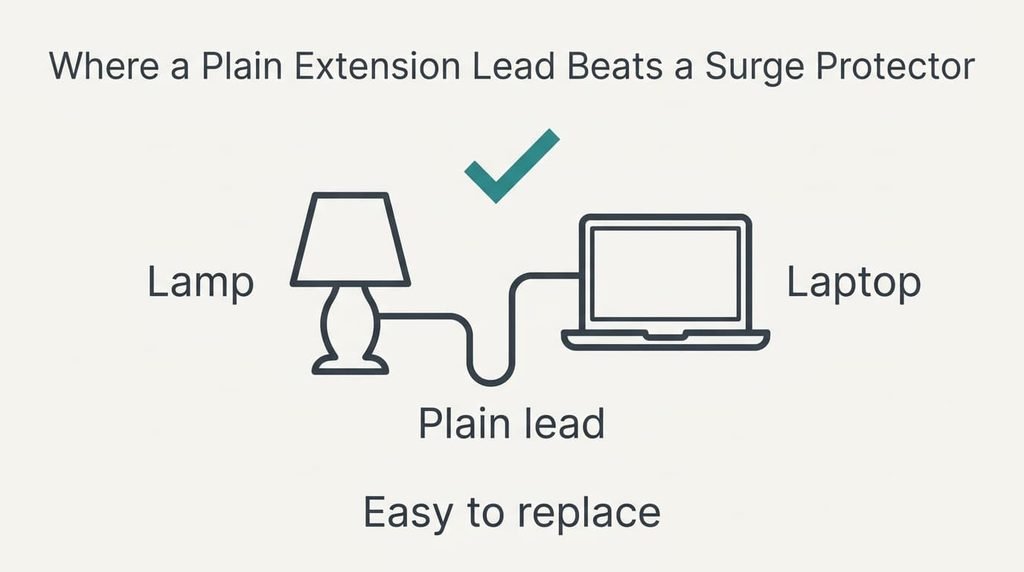
Where a Plain Extension Lead Beats a Surge Protector
Wherever nothing fails the afternoon test, a plain lead wins. A desk with only a laptop and a lamp holds replaceable kit. The laptop’s charger already absorbs some of the knocks, so the extra part adds little.
A plain lead also can’t mislead you. It never claims a protection it has lost, and it has no part inside that ages. A protected lead with a dead indicator invites false comfort from a label that may no longer be true. A lead with nothing to check is one less thing to forget.
Simplicity helps with length and fit as well. Plain leads come in more lengths and socket counts, so the lead can be chosen to suit the desk and not the reverse. A short run along the skirting is easier to inspect than a bulky strip hidden behind a pile of cables.
If your desk fits this description, spend that effort on a backup drive and a spare charger. Those two cover the failures that actually hurt.
When Neither Lead Is the Right Answer
Some loads should never go on a surge protector or a plain extension lead. A fan heater of 2,000 W draws 8.7 A. That takes up 67% of the 13 A the lead can carry before the desk uses a single watt. Plug high-power appliances straight into the wall socket, and keep the lead for quiet electronics.
A lead plugged into another lead is a second case. Chaining multiplies the load on the first one and hides how many sockets the supply is feeding. Two protectors in a chain don’t add up to better protection either, and they muddle the status lights.
Coiling matters as well. A lead wound up under load can warm along its length. Run it out straight and keep it off rugs, where heat has nowhere to go.
If you need more sockets than one lead gives, ask an electrician to add a wall socket. That’s the clean answer when a desk outgrows its supply.
Which Branch Fits Your Desk
Count the devices that fail the afternoon test before you choose a surge protector or a plain extension lead.
If one or more devices fail the test, choose the surge protector, because the loss you are guarding against is bigger than the lead. Look for a working status light and an energy rating in joules on the box. Our desk has two such devices, so it takes this branch.
If every device passes, choose the plain extension lead, because nothing on it matters beyond what a backup and a spare charger already cover.
Your desk may sit between the two. Move the single precious drive onto its own protected lead, and let the other devices share a plain one.
Whichever lead you pick, the real protection comes from habits around it. Back up whatever you’d miss. Glance at the light if there is one, and run every cable straight and uncoiled. A lead is a small part of a working desk, yet the afternoon test turns a vague worry into a count you can act on in five minutes, and that count settles the purchase for good.
Questions Readers Keep Asking
How much effort does a protected lead need over time?
Very little. Glance at the status light each morning and replace the lead if it is off or flashing. Replace it after any serious electrical event too. The part inside may have spent its budget while the lead looked unharmed.
How can I tell a surge protector has stopped protecting?
Only a status light tells you, and some leads have none. A lead without one gives no sign at all, so treat its protection as expiring after a major storm or a known spike. A lead with a dead light still passes power while offering nothing extra.
Does a laptop-only desk need one?
Rarely. A laptop’s own charger absorbs many small spikes, while little else on the desk would be missed. Add a protector if the same lead also feeds a drive that keeps the sole copy of your files, or if storms hit your area often.