Every August the door starts to catch at the top corner, and you shoulder it shut. Two small problems usually add up here: the wood has swelled a little and the door has dropped a little. A wooden door that sticks in summer rarely has just one of them, because either alone would pass unnoticed. This guide tells you which you have and fixes it over a weekend, starting with the free options. Our example is an 83 cm interior door in a Dutch flat. All figures are round assumptions. Paper and a screwdriver are the main tools, and a small tin of sealing paint is the only purchase you may need.
Why a Wooden Door That Sticks Only Binds in Summer
Wood takes up water vapour from the air and swells, mostly across the grain. August air holds more vapour than March air, so the door is simply following the weather. Along the length of the door the change is small. Across its 830 mm width we’ll assume 0.4 percent in a humid month, which is 3.3 mm in total or 1.66 mm at each edge.
The frame leaves a gap of 3 mm at each side. Swelling uses 1.66 mm of it, and the paint on the edge takes another 0.3 mm. That leaves 1.04 mm, so the door still swings.
Now add the drop. Hinge screws loosen over the years, and the free corner sinks by about 1 mm. Put the two together and the door binds once swelling and sag have used up the gap that the paint leaves, since 1.04 − 1.00 leaves 0.04 mm. Its top latch corner lies farthest from the hinges, so a small sag shows there first.
Because the door follows the air over weeks, the change is slow. In winter the swelling goes and the gap opens to 1.7 mm, which is why the door seems fine until the next summer.
Three Checks to Find Which Version You Have
On a sticking day, slide a sheet of paper about 0.1 mm thick around the closed door, and mark every point where it grips with a pencil on the frame. A grip along the whole latch edge points to swelling, while a grip at the top latch corner alone points to sag.
Then open the door wide and lift the handle end with two fingers. Play of 1 mm or more means a hinge has loosened. Watch the top hinge screws as you lift, because a screw that moves in its hole confirms it.
The last check is the paint. Shiny or worn patches on the edge mark the rub, and they should agree with your pencil marks, which are worth keeping for later. A wooden door that sticks all year at one corner has sag only. One that grips along the edge in summer alone has swelling only.
Most doors that bind in August have both causes, so expect to use two of the fixes below.
Four Fixes From Free to Professional
Bring the room’s humidity down. This attacks the swelling directly. Open a window in the cool of the morning or run an extractor, so the air carries less vapour. If swelling falls from 0.4 to 0.2 percent, each edge grows 0.83 mm instead of 1.66, and the corner gains 0.83 mm of clearance. It costs nothing but time, and you’ll notice the door easing within a few days. Keep the bathroom door shut during showers so the steam stays in that room. It falls short on a bathroom door, because the steamy room beside it keeps topping the wood up.
Fit longer hinge screws. This stops the sag. The short screws bite into the thin lining of the frame, which wears loose over the years. Change one screw at a time in the top hinge for a longer one that passes through the frame into the wall behind. That pulls the hinge tight, so the 1 mm drop disappears and the corner regains it. It needs one small purchase and ten minutes. It won’t help where the wall behind is soft plaster, and then only a joiner can set the frame right.
Seal the bare edges. This slows the uptake of vapour. Lift the door off its pins and coat the hinge edge. Do the latch edge next, then both ends, leaving a day between coats. Bare wood takes up vapour faster than a painted face, so a sealed edge helps a wooden door that sticks to swell less. If swelling falls from 0.4 to 0.3 percent, each edge gains 0.42 mm. A small tin and an hour of work cover it. It slows the swelling rather than reversing it, so a door already tight needs one of the other fixes first.
Have a joiner ease the edge. This removes wood at the point of rub. A joiner takes off what the rub mark shows, normally under 1 mm. If the frame has moved, they reset the stop strip too. Show them your pencil marks and tell them which fixes you’ve tried. Ask them to leave the stop strip alone unless the frame has moved. It’s the dearest option because it needs a visit, and it’s permanent, so the winter gap grows by the amount removed.
What the Frame and the Wall Fix in Place
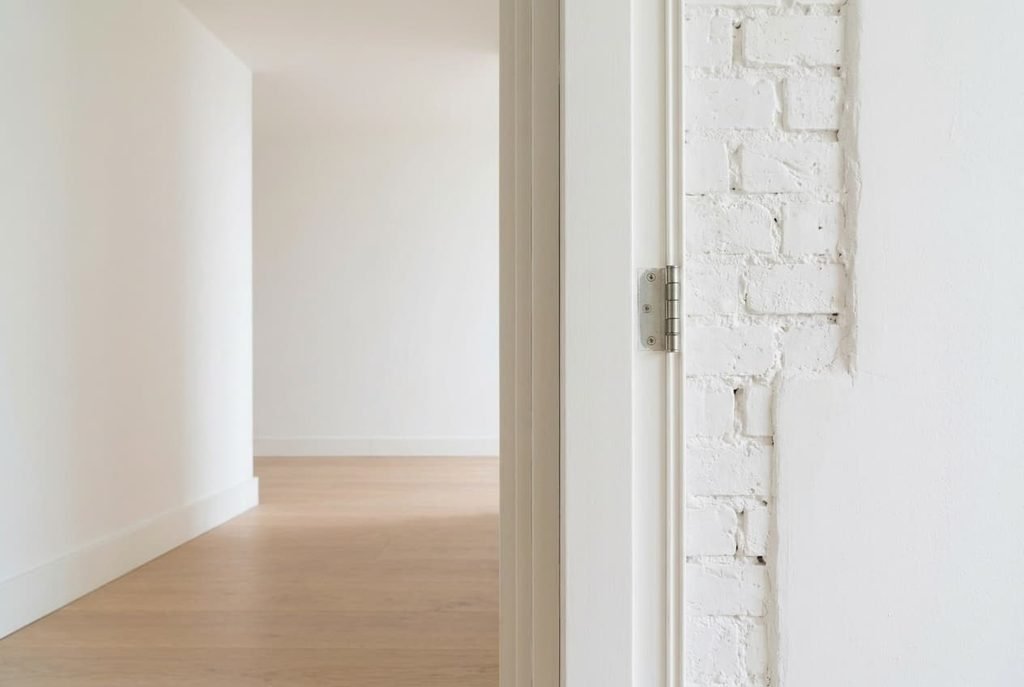
A Dutch flat usually has its door frame built into a brick wall, and the stop strip is part of it. Neither moves. That fixes the 3 mm gap at each side and the positions of the hinges, so every useful fix lives in the door and not in the wall.
Keep the fixable causes apart from the fixed ones. A loose hinge can be mended in ten minutes. A frame that has shifted a few millimetres in an old wall is for a joiner.
The room matters too. A bathroom door lives beside steam daily, and nothing short of changing the room removes it. A hallway door sees steadier air. Humidity and sealing work better there.
The practical order puts the hinge first, then sealing, then humidity. Rerun the paper test afterwards to confirm that a wooden door that sticks no longer grips anywhere.
Why Planing a Door That Sticks Backfires in Winter
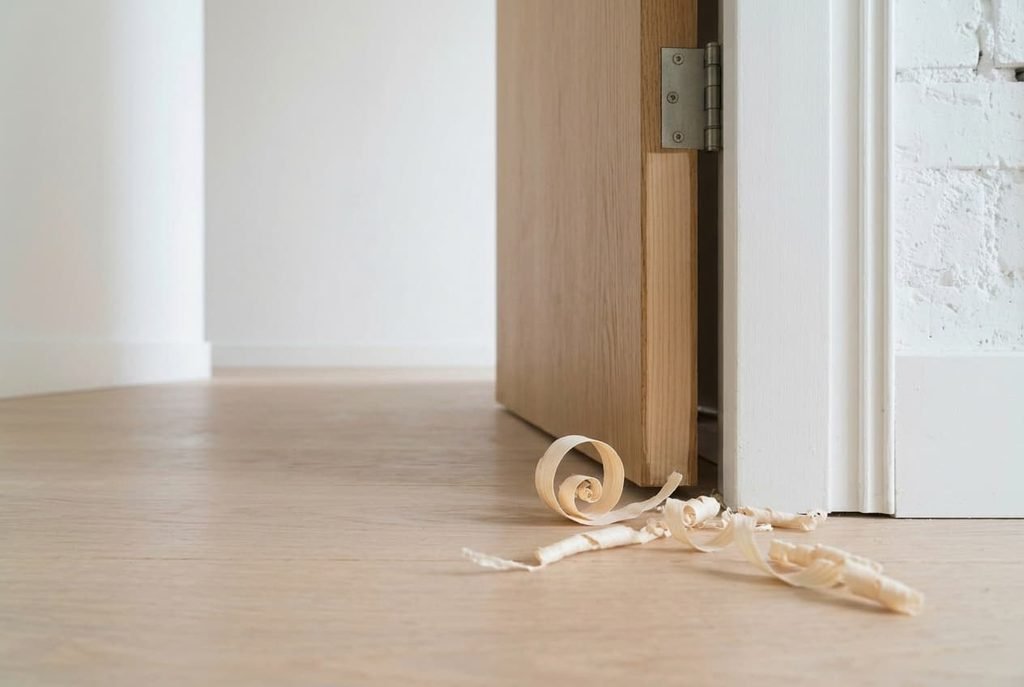
Planing the latch edge until the door swings freely in August feels like the quickest answer. In our example it takes 1 mm off the edge. The door then swings in summer. In winter the gap grows from 1.7 mm to 2.7 mm, and the edge can’t be put back. Fix the sag later as well, and the winter gap reaches 3.7 mm.
Sanding the paint away has the same flaw on a smaller scale. A wider gap lets sound and a draught through from the hall for six months to buy a few weeks of ease.
Candle wax on the rub mark fails too.
It cuts friction, yet clearance is measured in tenths of a millimetre, and wax can’t buy that back. The door will bind again by the end of the month.
A door that sticks every summer is telling you which hours to watch. Fix the sag first and rerun the paper test in July. If a gap remains at the top corner, add sealing next. Keep the humidity routine going through August. Leave the plane to a joiner, and only after the other fixes have been tried, because that cut is the one you can’t undo.
Questions Readers Keep Asking
Can a sticking door be fixed for good?
Usually yes. Sag is mended once with a longer screw, and sealed edges swell less for years. The wood itself never stops responding to the air, so a small seasonal change remains. If the frame has moved, a joiner has to reset it.
Which fixes cost nothing?
Lowering the humidity, and tightening what is already there. Airing the room costs only time, and a loose screw often needs just a turn. Sealing paint and longer screws are small purchases. A joiner is the only visit you might pay for.
Could fresh paint make it stick?
Yes. In our sums six layers of paint took 0.3 mm of the 3 mm gap, so each coat costs about 0.05 mm. A door painted just before summer is a common cause, so keep the edge coats thin and let each one dry fully.