Phones agree on the exact time because each one asks a time server for the time and corrects its own clock by the difference, after allowing for the delay of the reply. Left alone, a phone would wander by roughly two seconds a day. That small habit keeps millions of devices within a sliver of a second of each other. The page follows one request through a Bristol flat, from the phone’s wrong guess to its corrected clock. You’ll see what the method cannot promise, which wrong ideas surround it, and when to change the setting yourself. All numbers are assumed examples.

How Phones Agree on the Exact Time: The Short Answer
A phone asks a server what the time is and shifts its own clock by the measured difference, after halving the delay of the round trip. That is the whole method. It also omits how the delay is measured, and why the correction is never perfect.
Start with the phone’s own clock. A quartz crystal inside vibrates 32,768 times each second, and a counter turns every 32,768 vibrations into one second. Crystals run slightly fast or slow, and temperature shifts the rate. Assume an error of 20 parts per million, which is 20 millionths of a second gained or lost every second.
Over a day that adds up to 0.00002 × 86,400 = 1.73 seconds. After 30 days the phone would be 52 seconds out. Servers don’t have that problem, because they take their time from atomic clocks or satellite receivers. The phone borrows their accuracy rather than keeping its own.
The phone doesn’t depend on one source alone. Many mobile networks announce the time when a phone attaches, so a handset with no Wi-Fi still gets a first correction. The internet exchange traced below is the more precise route, hence the detail it gets.
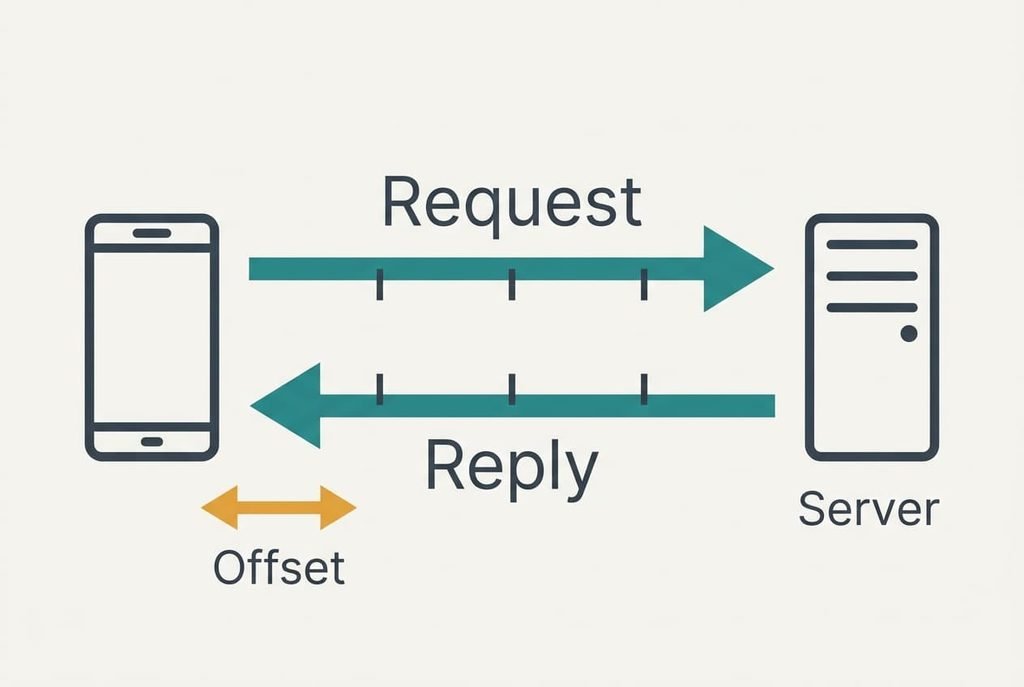
One Request Traced: How Phones Agree on Time to the Second
Suppose the phone last corrected itself about 17 hours ago, which leaves it running 1.2 seconds fast. It will ask a server for the time over Wi-Fi, in a message of about 48 bytes.
Measure everything on the server’s timeline, in seconds. At 100.000 the phone writes its own reading into the message and sends it. Because its clock is fast, that reading, called T1, is 101.200. The message travels for 20 ms and reaches the server at 100.020, which the server logs as T2. A millisecond later, at 100.021, the server sends the reply and logs that moment as T3.
The reply takes another 20 ms and lands at true time 100.041. The phone reads its fast clock and writes T4 as 101.241. Now it holds four numbers and two sums. The round-trip delay is (T4 − T1) − (T3 − T2) = 0.041 − 0.001 = 0.040 s. The offset is ((T2 − T1) + (T3 − T4)) ÷ 2 = (−1.180 + −1.220) ÷ 2 = −1.200 s.
Here is why the offset sum works. The outward journey makes the server’s stamp look later than it should, and the return journey makes it look earlier. If both take the same time, the two effects cancel exactly. The offset says the phone is 1.200 s ahead, so it winds its clock back by that amount.
Now make the journeys unequal. Let the outward trip take 30 ms and the return 10 ms. The offset becomes ((100.030 − 101.200) + (100.031 − 101.241)) ÷ 2 = −1.190 s. The phone corrects by 1.190 and stays 10 ms out, which is half the 20 ms gap between the two legs. It can’t see the imbalance, because it measures only the total. A small error can be nudged away gradually, while a large one is usually corrected in one step.
Time software often repeats the exchange several times and trusts the reply that came back quickest.
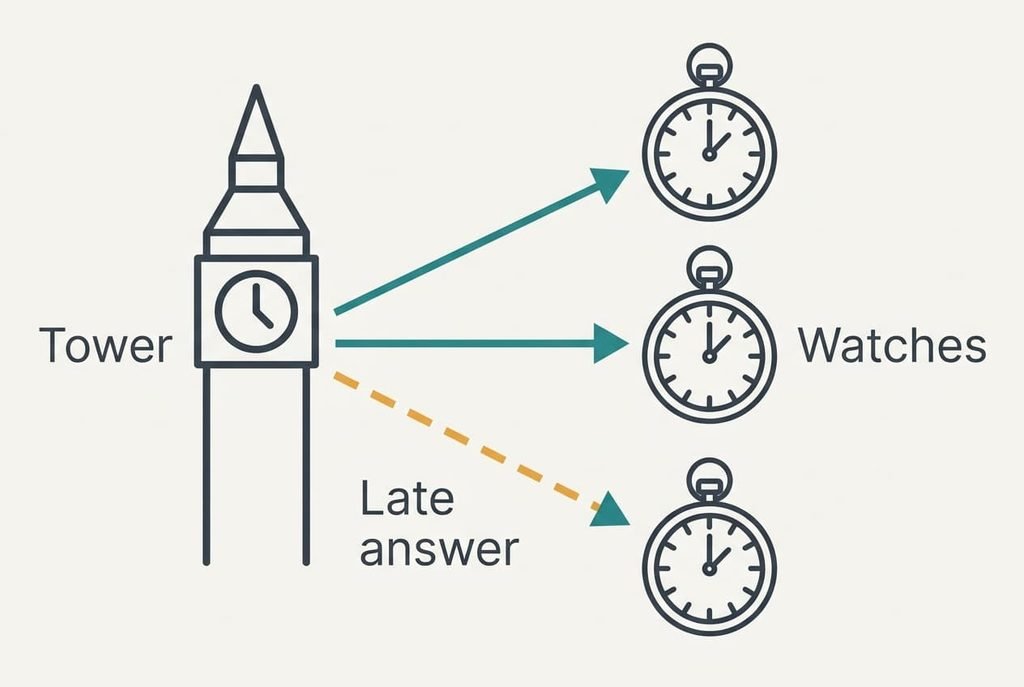
A Village Clock and Where the Comparison Fails
Picture a village with one clock on a tower. Everyone carries a pocket watch that wanders a little each day, so people glance at the tower now and then and adjust their watches. That’s how phones agree on the exact time too. Many private clocks follow one reference through regular glances.
The picture fails twice. A glance at a tower costs nothing, whereas a phone’s look takes 40 ms and the answer is already old when it lands. That lateness is why the phone measures the delay and subtracts half of it. And a village has one tower, while phones consult different servers that themselves follow atomic clocks, so no single clock sits at the centre.
What the Agreement Cannot Promise
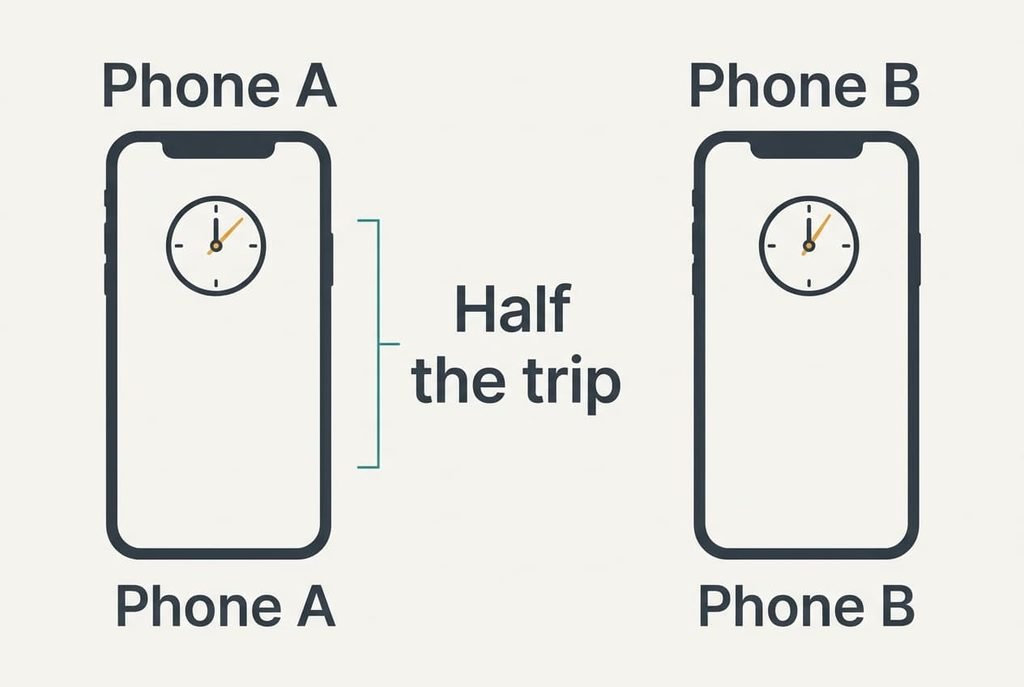
Matching to the second isn’t matching to the millisecond. The error ceiling is half the round trip. A clean 40 ms exchange allows up to 20 ms of error, and a busy mobile connection with a 300 ms round trip allows up to 150 ms. Most people read “synchronised” as “identical”, but the error can be as large as half the round trip, and the phone cannot see it.
Two phones can therefore show the same second yet differ by a tenth of a second. Photograph a stopwatch with both and the readings may not match. For a shared countdown or a score clock that gap is visible. For a kettle timer it’s irrelevant, and that distinction is the practical limit of the whole method.
The method also needs a network.
Cut the connection and the crystal’s drift resumes at 1.73 s a day. After 120 days offline a phone would be about 207 seconds, or 3.5 minutes, away from true time. Phones agree on the exact time while online only by borrowing it.
Three Beliefs That Don’t Match the Facts
“Phones read the time from GPS.” The belief forms since the location icon and satellite maps are so familiar, and a satellite signal does carry an accurate clock. Most phones get the time from the internet or the mobile network, and a satellite receiver is used only when it happens to be running.
“Quartz is accurate, so my clock stays right.” This forms because a wristwatch looks fine for weeks. Yet 1.73 s a day is invisible on a watch face. It becomes a full minute within about five weeks, and it goes unnoticed until a train is missed.
“Changing the time zone changes the time.” The display jumps, so it feels as if the moment itself moved. Only the label changes, and the underlying instant, counted from the same reference, stays put. A flight to another country alters what the screen shows but not what the clock knows.
A Rule for When to Touch the Setting
Leave automatic time switched on, and turn it off only for a short test that you reverse within a day. If two phones differ by more than two seconds, one of them has the setting off or has been offline for over a day, since 1.73 s a day accumulates fast. That gap is the quickest field test of whether anything is wrong.
A manual clock is a clock that has stopped being corrected. Check it against a trusted source once a week and expect to wind it back by about 12 seconds each time, since seven days at 1.73 s is 12.1 s.
Switching automatic time back on repairs everything within minutes of the next connection. The reason the setting matters is that phones agree on the exact time only while it stays on. Beyond that, no setting changes the physics. The crystal drifts and a server corrects it, while the network adds a small delay between them, and your only job is to leave the correction running. Check the offset once after a long trip, then forget about it.
Questions Readers Keep Asking
How accurate is the time on a phone?
Usually within a few tens of milliseconds of true time when it has synced recently. The ceiling is half the round trip to the server, so a slow connection widens the possible error. Offline, the crystal drifts about 1.7 seconds a day in this example.
Do I need to set the time myself?
No, and doing so makes it less accurate. A manual clock stops being corrected and drifts at the crystal’s rate. Leave automatic time on, and check the time zone instead, because that is the part that can be wrong after travel.
Is a phone more accurate than a wristwatch?
Usually, yes, because it keeps correcting itself. A watch with the same sort of crystal drifts at the same rate and has nothing to correct it. Being a minute out after several weeks is typical; only a radio-controlled watch breaks that pattern.

