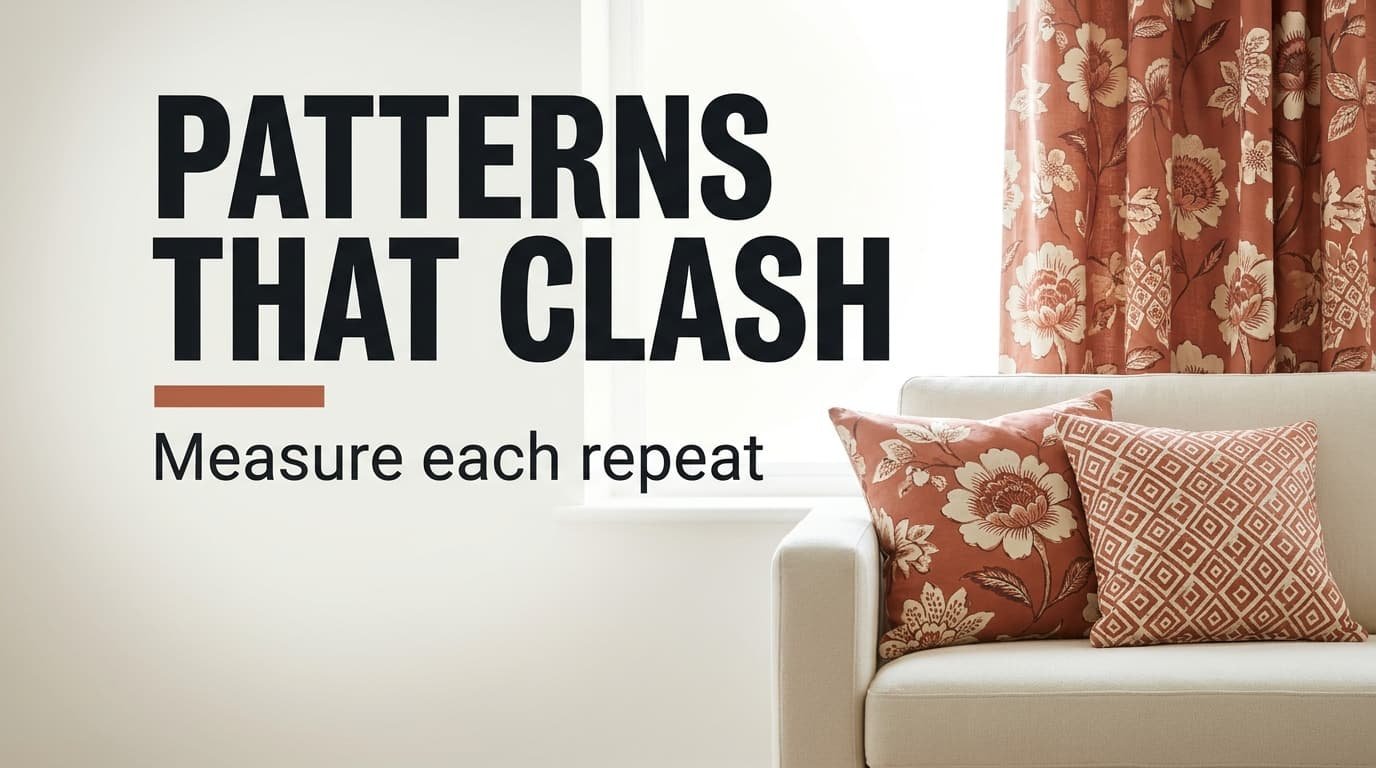
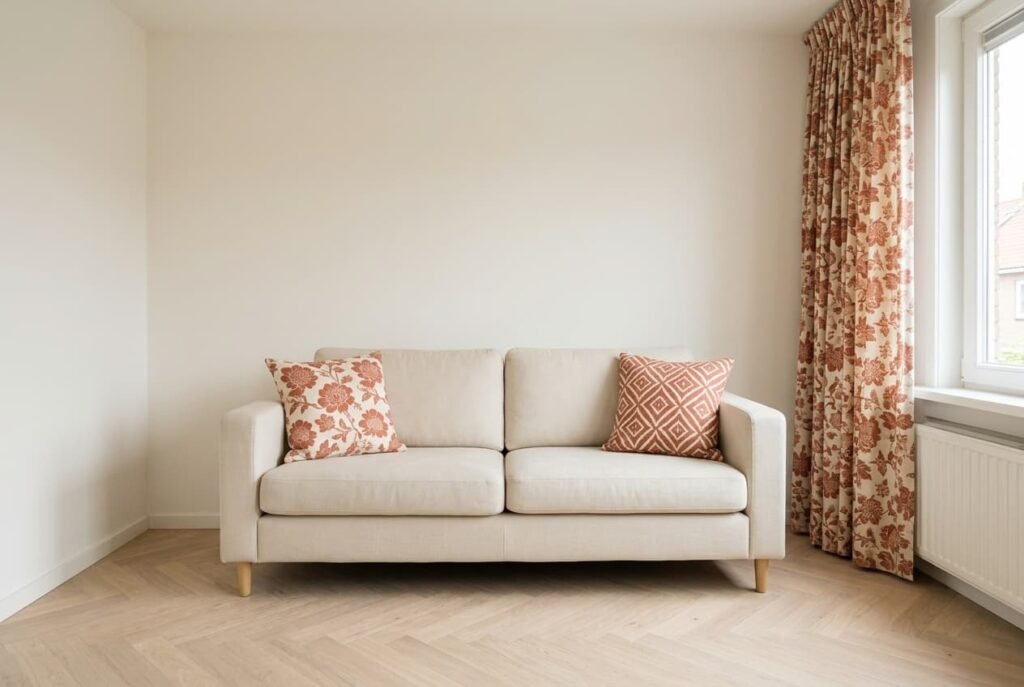
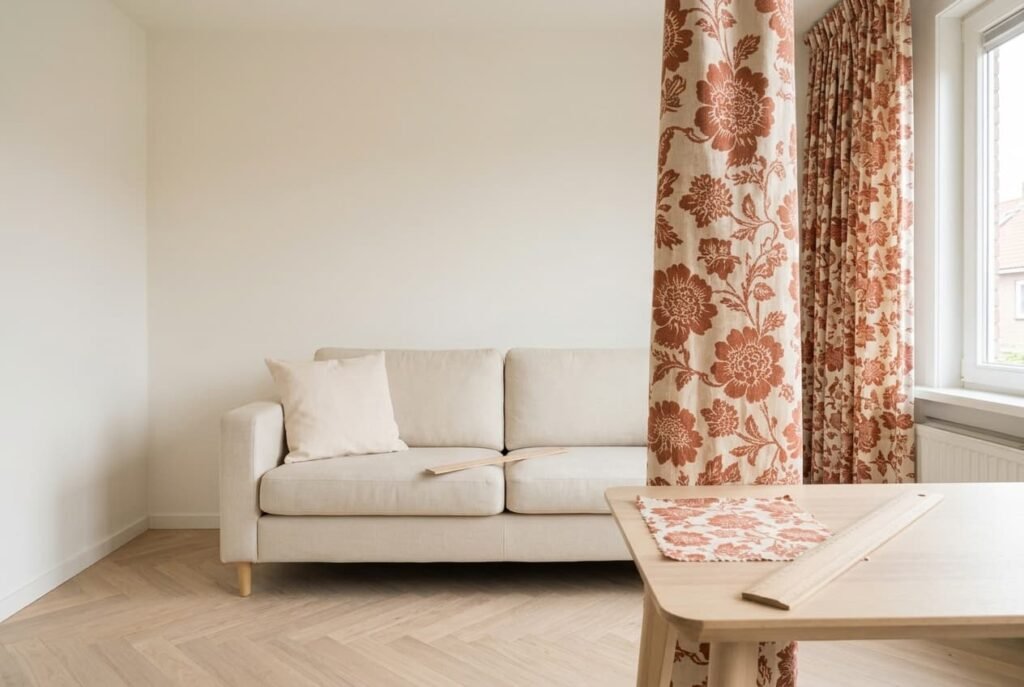
Both patterns use terracotta and cream, yet the sitting area feels busy. The colours aren’t at fault. Patterned curtains and cushions clash when their repeats are nearly the same size, because the eye can’t separate them and reads a single noisy surface. Three faults account for almost every case. Our setting is a Haarlem flat. The sofa faces a window 3.2 m away, the curtains span 240 cm and each cushion is 45 cm square. These figures are assumed samples, and your tape has the last word. Nothing here needs a renovation. A new sofa or a different palette isn’t required either.
Why Patterned Curtains and Cushions Clash Even in the Same Colours
The eye sorts patterns by the size of one repeat, meaning the distance before a motif returns. A large repeat reads as a bold shape and a small one reads as texture. When two repeats are close in size, nothing separates them. The brain then treats both as one messy pattern. A shared palette makes this worse, since it strips away the single cue that might have set the two apart. With no difference in hue, only the scale of each repeat and its strength remain, and ours match.
Put numbers on it. Our curtain has a floral repeat of 24 cm. From the sofa at 3.2 m that fills a visual angle of 4.3°. The cushion has a geometric repeat of 22 cm, which fills 3.9°. The sizes differ by only 9%, a ratio of 1.1 to 1. Assume the eye needs no less than 2 to 1 before it separates two patterns. Ours falls far short, however well the colours agree.
A palette works as a family and scale works as a hierarchy. Colours can match closely while the hierarchy is missing. Buying cushions in another colour treats the wrong variable, because the clash comes from repeat size and the shades were never the cause.
A Checklist From Your Seat at Dusk
Take your normal seat, with the lights on as they usually are. Everything below needs just a pencil and a tape.
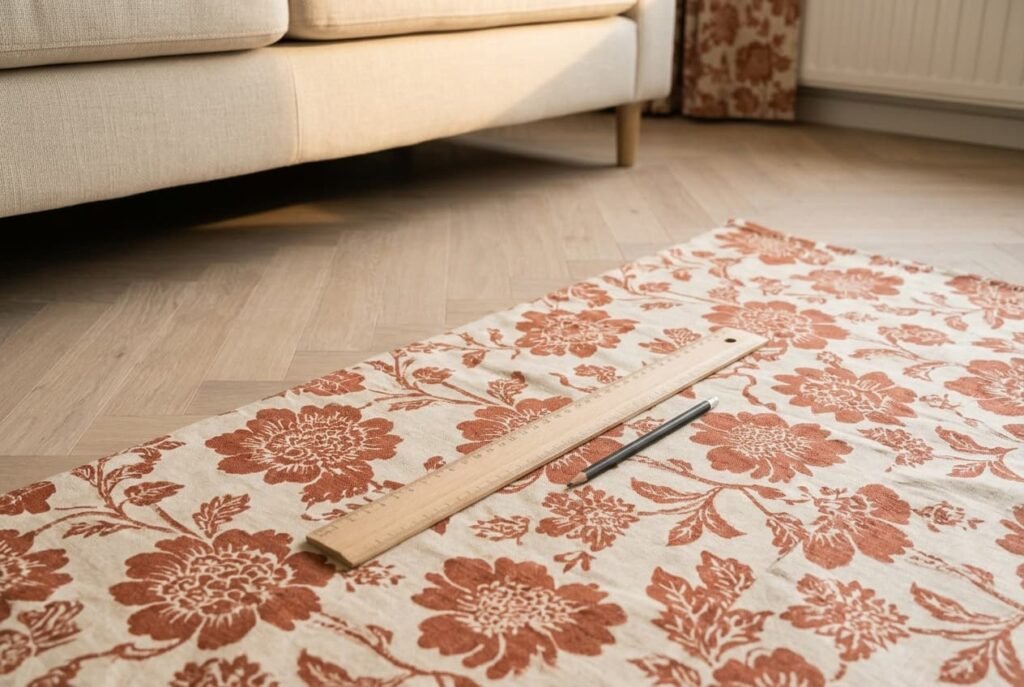
1. Measure one full repeat on each patterned item, from a motif to the next identical motif. Divide the larger by the smaller. A ratio under 2 means the patterns rival each other.
2. Squint for five seconds. If the curtains and cushions merge into one blur of equal strength, their contrast is too close.
3. Compare the darkest motif on each. Two dark motifs on pale grounds hit equally hard, and neither gives way.
4. Count the patterned things in view from the seat, from the window across to the sofa. More than three leaves the eye with nowhere to rest.
5. Check how high each pattern sits. A cushion level with the curtain hem fights it at eye level, whatever the repeat sizes are.
Our room fails every check except the last one. Repeat size and item count are the trouble here, not height.
Three Faults Behind Curtains and Cushions That Clash
The room has nowhere to rest. Placement causes this. Four patterned items stand in view. The curtains and a rug sit at the window end. The cushions and a throw sit on the sofa. Each one asks for attention and none yields it. Stow the throw for a week. That leaves three, and you can look again from the seat. The change is free. Its limit is the rug, which can’t move. It still competes with the curtains for the eye.
Both patterns hit equally hard. Contrast causes this. Take a motif reflecting 20% of the light on a ground reflecting 70%. The difference over the sum is 50 over 90, a contrast of 0.56 for both items. Swap the cushion covers for a softer pair from another room, such as tone on tone with motifs at 55% on the same 70% ground. Their contrast falls to 15 over 125, or 0.12, roughly one fifth of the curtain’s. To see it, photograph the sofa from your seat and switch the photo to greyscale. Two patterns of equal strength look equally dark there. The swap costs nothing. Another room loses its covers. Covers made for one sofa may not suit a different one.
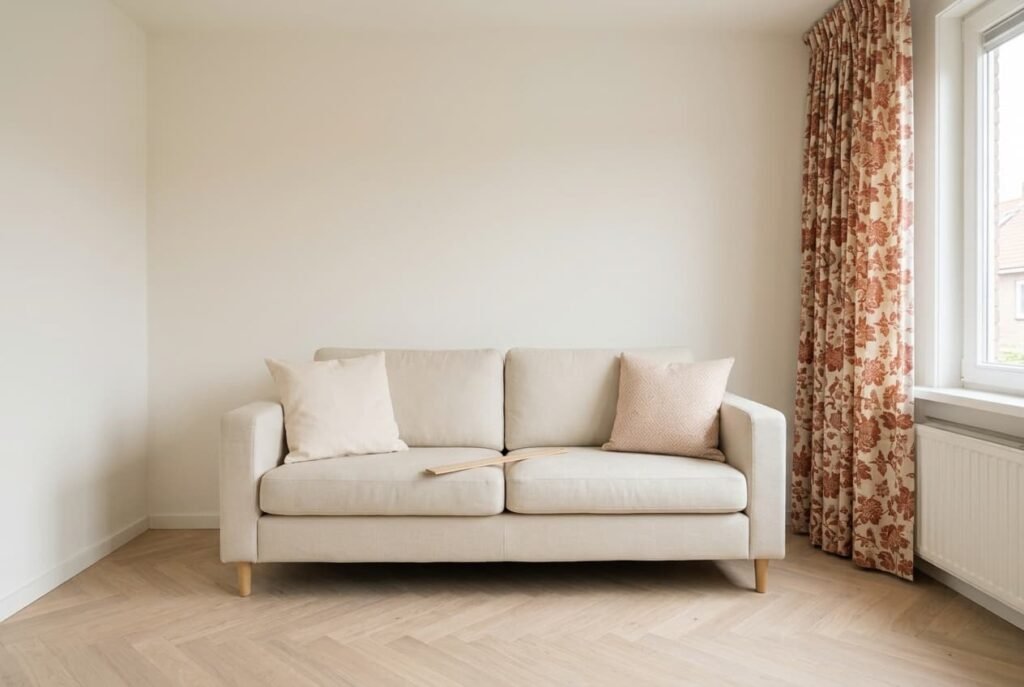
The two repeats are nearly equal. The cause here is scale, the one at work in our room. With a curtain repeat of 24 cm, the cushion needs a repeat of 12 cm or less to reach 2 to 1. A repeat of 10 cm gives a ratio near 2.4 and an angle of 1.8°, which reads as texture beside the bold curtain. Test before you buy by wrapping a cushion in a plain pillowcase for an evening. If the room settles, order covers with the smaller repeat. This is the sole step that costs money. Check the repeat on the actual cover, not the product photo: a 10 cm repeat on a 45 cm cover shows 4.5 repeats across. The limit is the sofa, since cushions that fine can look fussy against a plain seat. Patterned curtains and cushions can share a palette, but their repeats have to differ.
Take the three in sequence, and look at the view again once each change is made.
Checks Before the Next Patterned Purchase
Measure the repeat before you buy. Ask for a sample or a close photograph taken next to a ruler, then work out the ratio against what already hangs in the room. Anything under 2 to 1 against your patterned curtains and cushions goes back on the shelf.
Bring a swatch home and hold it up against the curtain from the sofa. Distance changes everything, because a motif that looks bold across a shop table can shrink to texture across a room. Leave the swatch pinned for a day before you commit.
Choose one pattern to lead in each view. The lead takes the large repeat and the strongest contrast, and the others support it with smaller repeats and softer tones. A room with one voice reads calm, while a room with three equal voices reads loud.
The Fix That Isn’t Worth Doing
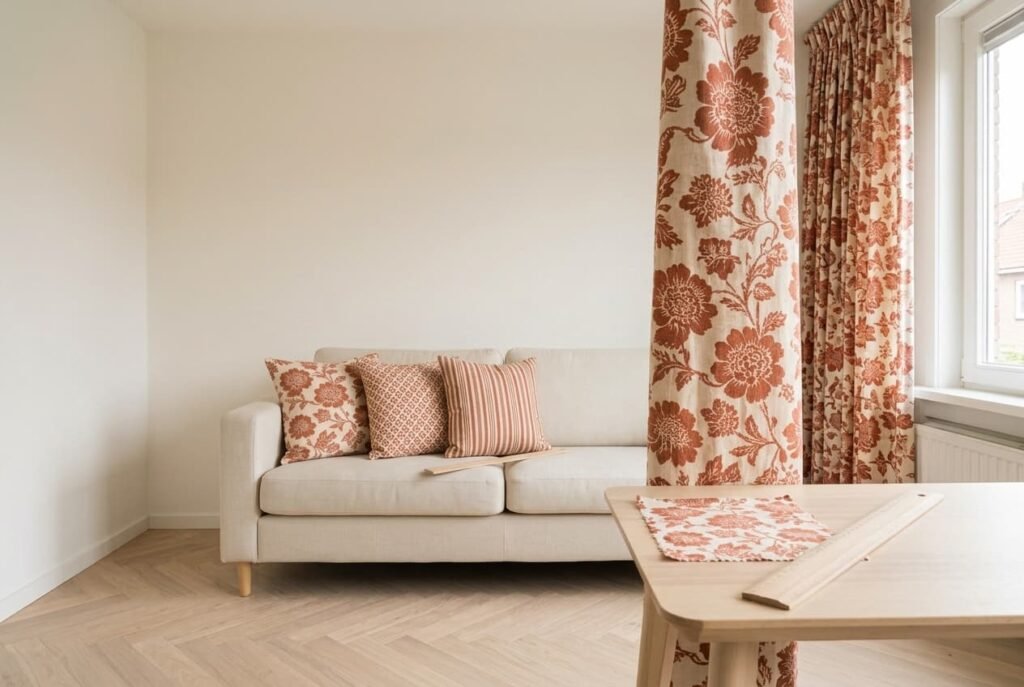
Adding a striped cushion to bridge the two feels like a clever compromise for patterned curtains and cushions that clash. Take a stripe with a repeat of 15 cm. Against the curtain at 24 cm the ratio is 1.6 to 1, and against the floral cushion at 22 cm it’s 1.5 to 1. Both fall under 2 to 1. The new piece joins the fight and turns it into a three-way tie. Square cushions also hide the stripes behind each other, which makes the line look like a jumble. Draping a throw over the cushions to cover the clash only swaps a visible fight for a muddle. More cushions in the same palette repeat the error at greater expense, because a new item only helps when its repeat is half the size of its neighbour’s or double it.
Another bridge is no cure.
Two repeats sitting too close together cause the whole clash. That ratio is cheaper to correct than any palette. Measure both repeats, divide the larger by the smaller and stow the throw tonight. Swap in softer covers tomorrow if the room still shouts. Order small-repeat covers only after the pillowcase test has passed. Write the target ratio on a card so that your next buy begins with your measurements and not with a catalogue photograph. Look again after a season, because lower winter light changes how contrast reads, and a pairing that passed in autumn may need another glance. The receipt can stay in the drawer.
Questions Readers Keep Asking
What is the most common cause of patterns that fight?
Repeats of nearly the same size. Colours get the blame, yet a shared palette is easy to arrange. Measure one repeat on each item and divide the larger by the smaller. A result under about 2 points to a clash, whatever the shades look like.
Is there a quick fix I can try tonight?
Yes. Stow the throw and take the cushions off the sofa. Settle in your normal spot and look at the curtains alone for a minute. Then put one cushion back wrapped in a plain pillowcase. If the room calms, the patterns were too numerous or too similar.
Can this be fixed without renovation?
Entirely. Every step uses items you already own or a pair of new covers. No painting or building is involved, and the curtains stay. Begin with the free change and the swap. Buy only if the plain-pillowcase test confirms that a smaller repeat will settle the room.