A door handle that works loose is nearly always a clamp that has lost its grip, and the lever is the reason. Every push on a 12 cm handle multiplies the force 30 times at the small square spindle inside, which rocks the clamp until it slackens. Take an interior door in a rented Eindhoven flat, 4 cm thick, opened roughly 40 times daily by three people. All forces and sizes below are assumptions. Measure your own door before trusting them. Four repairs run in rising order of effort. After them comes a shortcut that looks sensible and fails.
Why a Door Handle That Works Loose Keeps Coming Back
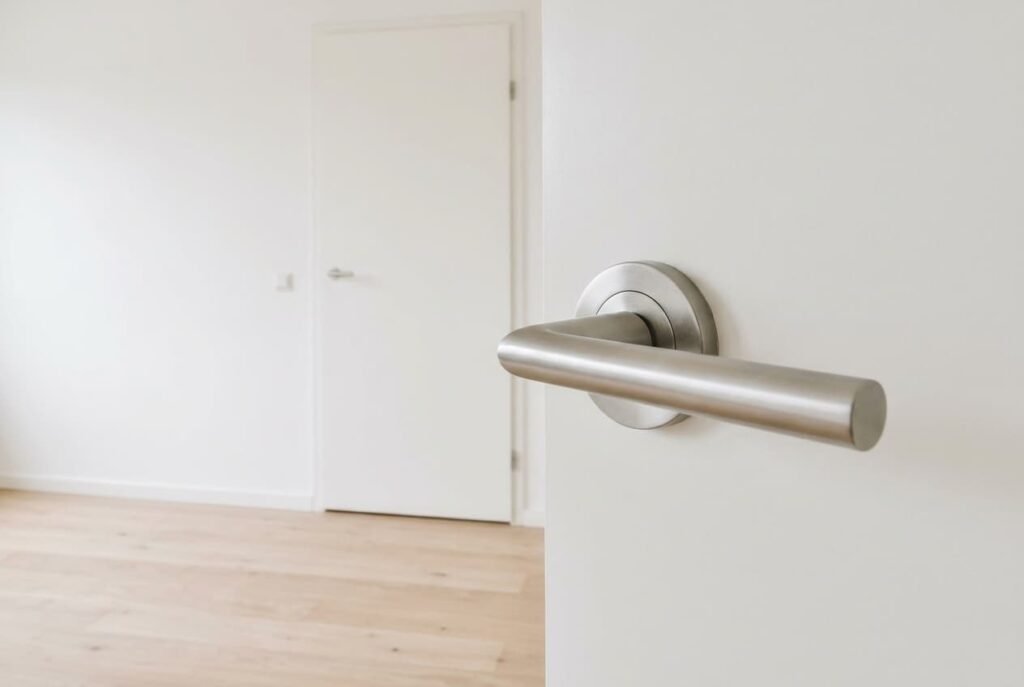
A lever handle sits on a square steel spindle that runs through the door and turns the latch on the far side. A small grub screw presses on the spindle and holds the handle on. Two further screws or bolts hold the plate, called the rose, against the door.
Assume a push of 25 N on a lever 12 cm long. That gives a torque of 25 × 0.12 = 3.0 N·m. The spindle is 8 mm square, which puts its edge 4 mm from the centre. The force at that edge is 3.0 ÷ 0.004 = 750 N, which is 30 times the push from your hand.
A tight clamp carries that load without moving. Slackened by only 0.2 mm, it lets the handle rock on the spindle with every press, and each rock hammers the grub screw’s seat a little flatter. The looseness feeds itself, and the gap widens with use. At 40 uses a day the handle rocks about 14,600 times a year once the gap has opened.
The handle itself is rarely the part that has failed.
Which Door Handle Works Loose: Where the Play Hides
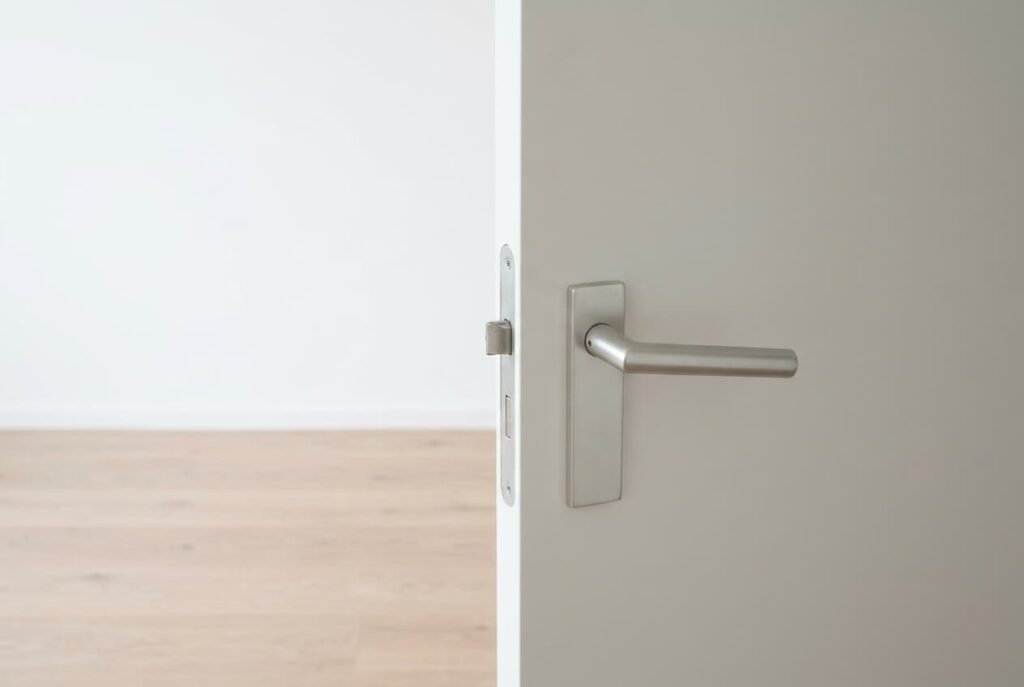
Three faults make a door handle that works loose feel the same. One is play between the handle and its spindle, which gives a clunk as you let go. A second shows as a plate that shifts against the door, with a hairline shadow round the rose. Finally, a weakened spring leaves the handle drooping once released.
Test them one at a time. Hold the handle level and wiggle it up and down. Movement that stops at the rose points to the grub screw. Next grip the rose itself and twist it, and any shift against the door means the plate screws or bolts. Finally let go of the handle from a level position. It should rise back unaided. A handle that sinks has a weak spring.
Press the latch tongue with a fingertip with the door open. It should slide in and spring out freely. A tongue that sticks makes you push harder, which loosens everything faster.
Draw a pencil line across the rose and onto the door before you start. If the line breaks later, the plate has moved.
Four Fixes for a Loose Handle, From Free to a Locksmith’s Visit
Begin with the first and stop when one repair keeps the handle firm across seven days of normal use. The four target different parts. Early success spares you the rest, and a door handle that works loose rarely needs all four.
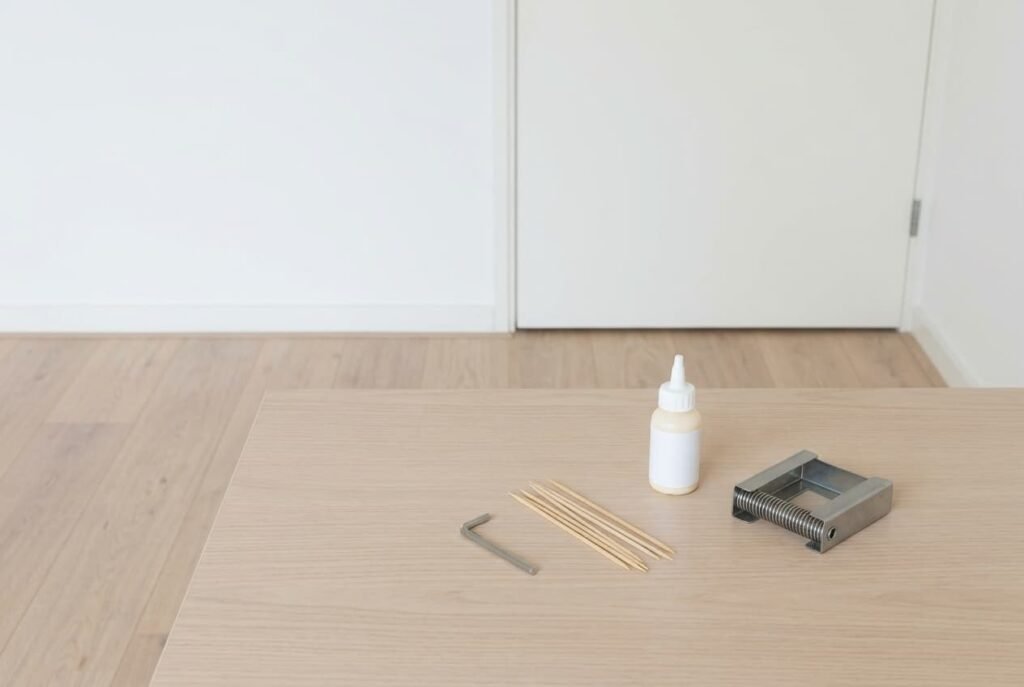
Reseat the grub screw. This restores the clamp from the second section. Push the handle fully onto the spindle until no daylight shows between its collar and the rose, then turn the grub screw down with the small hex key until it stops, plus a quarter turn. Assume a 2.5 mm key and check yours. No money is needed, only five minutes. The limit is a screw whose tip has been rounded by earlier slack, because a rounded tip can’t bite and the handle works loose again within weeks.
Pack the screw holes in the door. Plate screws wobble when the holes in the wood have widened. Dip two wooden cocktail sticks in wood glue and tap them into the hole. Snap them off flush. Leave the glue overnight before refitting the screw. The wood gives the thread something to cut into again. It costs a few sticks and glue you may already own. On a hollow-core door the skin is too thin to hold a thread, and only the solid lock block will take it.
Replace the spring or the whole set. A worn spring is what makes a handle droop. Assume the lever weighs 0.12 kg with its centre 8 cm from the spindle, giving 0.12 × 9.81 × 0.08 = 0.094 N·m of sag. A worn spring returning 0.07 N·m loses that contest, while a new one at 0.25 N·m wins with a margin of 2.7 times. A spare set is inexpensive. Match the distance between the screw centres to your door. A tenant should get the landlord’s agreement before swapping anything. Keep the old set so it can go back on when the tenancy ends.
Have a locksmith refit the spindle. A spindle cut for a 3.8 cm door is too short for a 4.4 cm one. The handle engages 3 mm less. The grub screw then presses on a smaller bearing, and the 750 N lands on less steel. A visit takes about half an hour, and the landlord should arrange it. One limit remains. If the latch cut-out in the door edge has been made oversize, a joiner must mend it first.
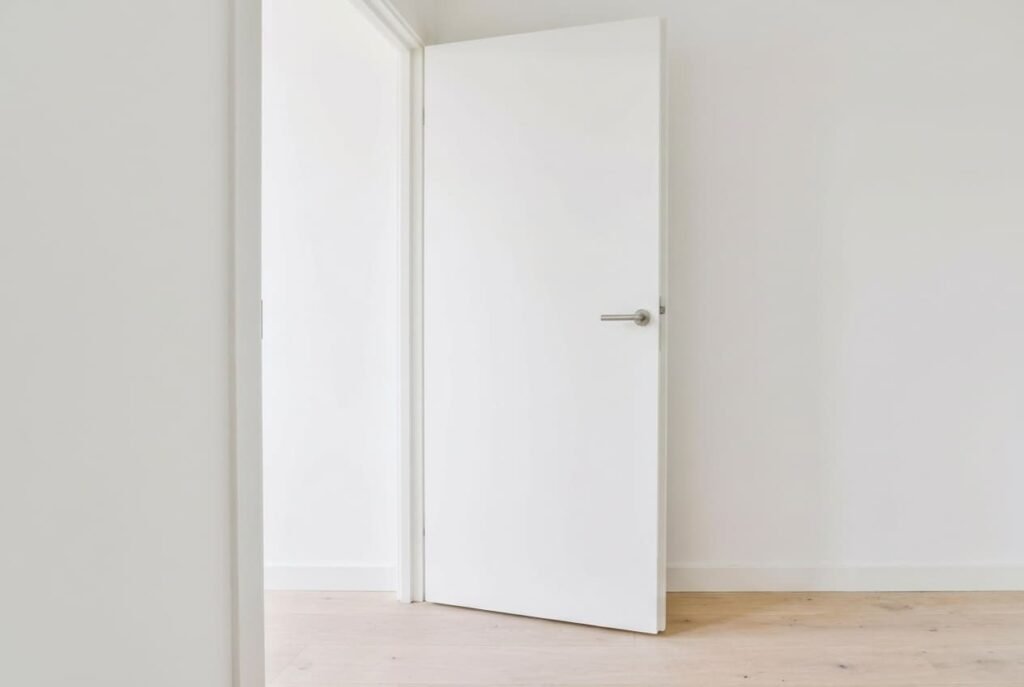
What the Door and the Landlord Fix in Place
This door is hollow-core and 4 cm thick, hinged on the right, with the handle centre 105 cm above the floor. Its faces are thin skins of board around a light cardboard honeycomb. Solid wood exists only in the lock block, a strip about 5 cm wide round the latch, and the plate screws must reach it to hold. The honeycomb gives a thread nothing to grip. A longer screw only drills deeper into empty board.
The building owns the door and the handle set. Tightening a grub screw and packing a screw hole can both be undone. You’re free to try them. Swapping the set or cutting into the door edge isn’t a tenant’s decision. Photograph the handle and the rose before you touch them, and tell the landlord what you changed.
The lock block, not the skin, is what holds the screws.
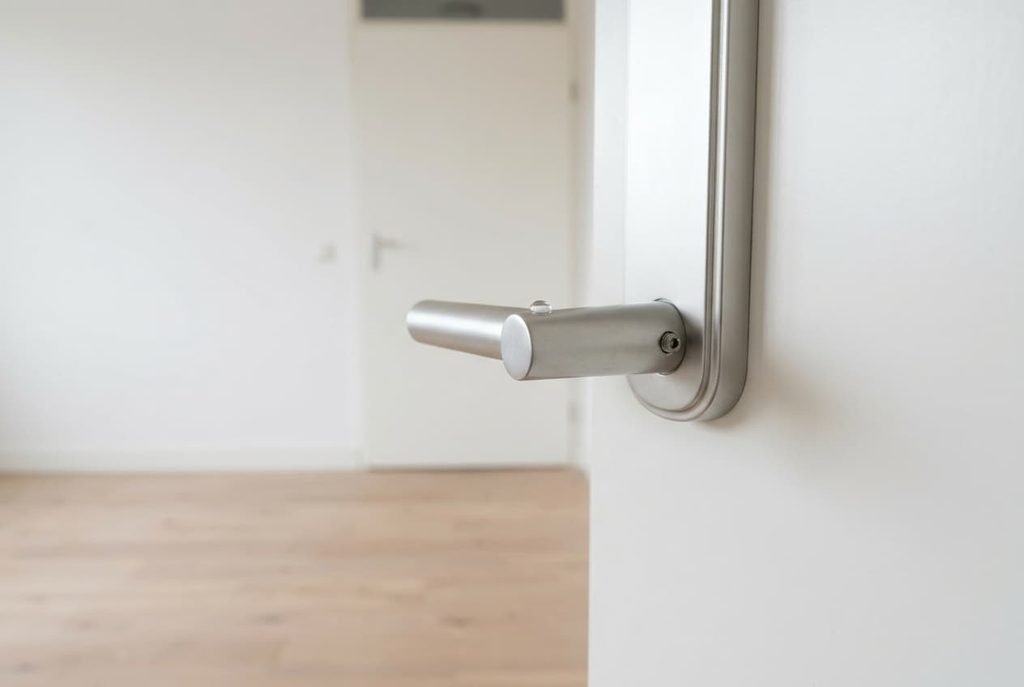
A Quick Fix That Backfires Within Weeks
Gluing the grub screw in place feels like a permanent answer to a door handle that works loose. A drop of superglue on the thread locks the screw, and the handle feels solid that evening. Superglue is brittle. Under a 750 N edge load the film cracks within a few weeks. The handle loosens again. The screw stays bonded and refuses to turn. Drilling is the only way off. Glue that runs down onto the spindle can also freeze the latch.
Glue hides the real cause as well. If the screw had backed off because its tip was rounded, the glue seals that fault in place, and every later repair starts with a drill. A fresh grub screw is inexpensive and takes two minutes to fit. Keep a spare in the drawer with the hex key, since the old one may have lost its edge.
Tighten the screw properly and test it after a week by wiggling the handle. If it stays firm, leave everything else alone. If the play returns, work down to the plate and then the spring in that order. Mark the date on a note inside the cupboard door. Check the pencil line each month. A handle that holds through a full season needs no further work.
Questions Readers Keep Asking
Can a loose door handle be fixed at all?
Yes. Almost every case responds to a hex key or a screwdriver, because each of the three parts can be reached. A door whose latch cut-out has been made oversize is the rare exception, and only a joiner can mend that. Wiggle the handle to begin with, since the result shows which part to treat.
What does it cost to fix?
Reseating the grub screw and packing the holes cost almost nothing. A new spring or set is an inexpensive part, and a locksmith’s visit is the single big expense. Stop once any fix keeps the handle firm for a week. The 750 N load shows why a half-measure fails so quickly.
What is the most common specific cause?
A grub screw that has backed off its seat. Each press hammers it a fraction looser, and once the gap opens the rocking speeds up. Check it before anything else. Look at the plate screws only when the handle stays firm on its spindle but the rose still shifts against the door.