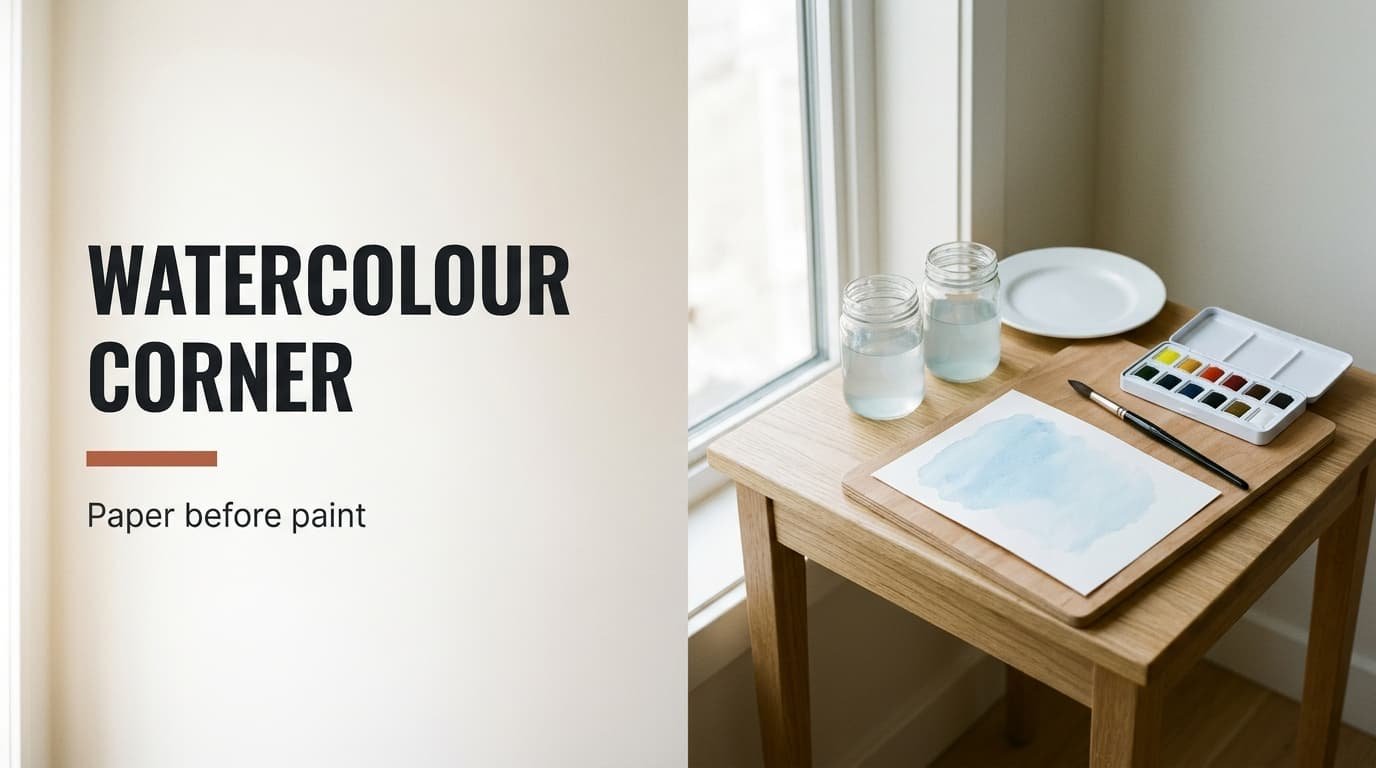
Most beginners lose their first month to the wrong paper. A watercolour corner for beginners runs on five purchases, and the paper outranks the other four. The plan below follows an Amsterdam flat where a table one metre long and half a metre deep stands beside a window. One adult paints there on three evenings a week. Every number comes from that table. Your own readings will differ, and no brand is named anywhere. Buy in the order given, then pause as soon as a wet sheet dries flat and a wash goes on smoothly.
What Decides a Watercolour Corner for Beginners in a Small Flat
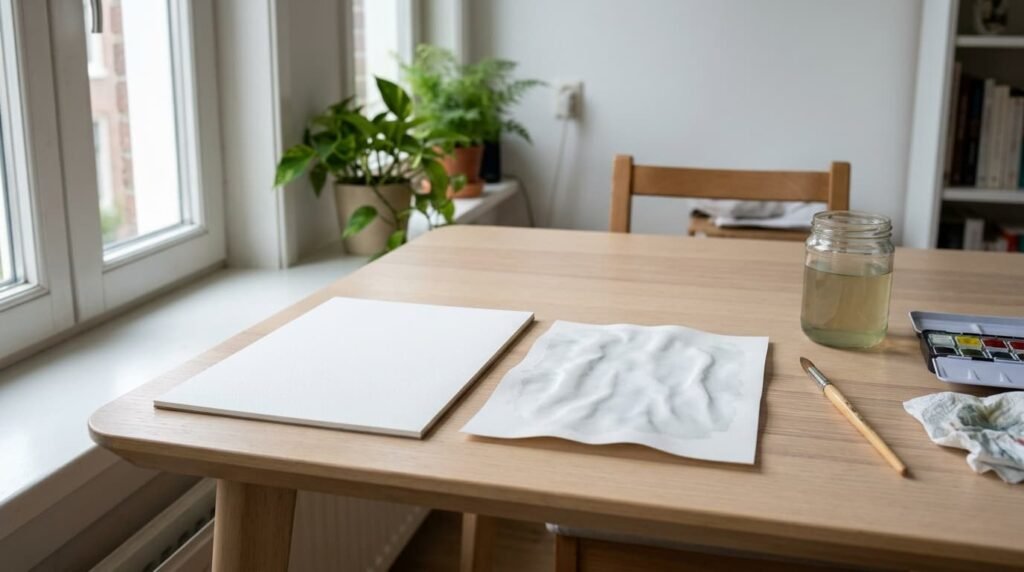
Water decides the first rule. An A4 sheet measures 21 × 29.7 cm, which is 624 cm². At 300 g per square metre it weighs about 18.7 g, while a 150 g sheet weighs 9.4 g. A light wash of around 5 ml adds 5 g of water, equal to 27% of the heavy sheet’s weight and 53% of the thin one’s. The thin sheet ripples under that load, but the heavy one doesn’t. Paper that ripples pools the wash into puddles that dry in rings.
Space sets the next rule. The tabletop gives 5,000 cm². A board measuring 30 by 40 cm takes 1,200 cm². A palette 15 cm by 30 cm takes 450 cm², and two jars 10 cm across take about 160 cm² between them. That adds up to 1,810 cm², or 36% of the table, and the rest stays free for your elbows.
The flat adds a boundary of its own. Since the table is also where you eat, the corner must pack away in three minutes and fit one shallow box with a base of 1,200 cm². A wipe-clean mat under the board protects the rented surface.
Decide on the paper before anything else.
Five Purchases for a Beginner’s Watercolour Corner, Costliest Mistake First
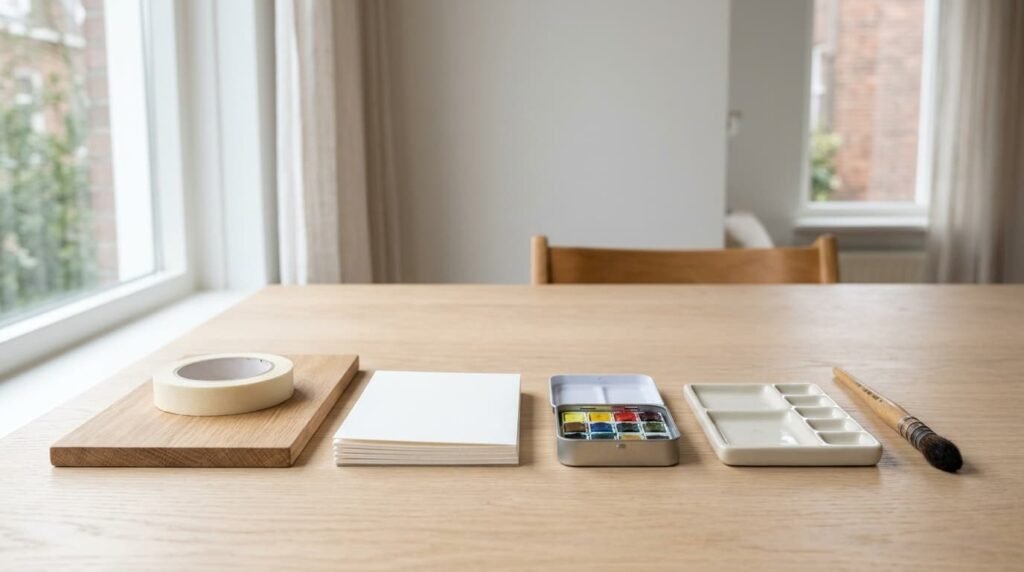
1. Twenty sheets of 300 g cold-pressed paper in A4 lead the list, since every other purchase lands on them. Tier: MID. One sheet a session gives you twenty sessions, which is about seven weeks at three evenings a week. Paper with cotton in it holds the water on top for a moment and then sinks it evenly. Cheap wood-pulp paper sheds fibres under a wet brush and drinks the paint at once. Touch a wet stroke to a corner in the shop: it should shine for a few seconds. A stroke that vanishes or beads into blobs fails.
2. A round brush, size 8, with a fine pointed tip comes second. Tier: BUY ONCE. Its belly lays a broad wash and its tip draws a thin line. One brush covers the early work. Wet it and flick it once. The hairs must spring back into a single point. A loose metal sleeve and hairs that splay or shed into the wash are the faults to look for.
3. Third come six half pans, each primary colour in a warm and a cool version. Tier: MID. Six colours make 6 × 5 ÷ 2 = 15 two-colour mixes on top of the six alone, which is plenty to learn on. Twelve pans only give a beginner more ways to make mud. Look for pans filled level with the rim. A pan that has sunk or cracked in its tin was filled badly.
4. For mixing, a palette 15 cm by 30 cm with a lid. Tier: BUY CHEAP. Enamelled metal or glazed ceramic wipes clean, whereas plastic holds colour in its scratches and beads the water. Wells that are too shallow let a wash run over the edge.
5. Last come a board in plywood or hardboard, sized 30 cm by 40 cm, and low-tack masking tape 2.5 cm wide. Tier: BUY CHEAP. Tape on all four edges holds the sheet flat while it dries and leaves a clean white border. A board 9 mm thick stays flat, while a thin one bows. Strong tape tears the paper surface on removal. Stick a strip to your sleeve and peel it: a good tape comes away without pulling a single thread.
Why the Palette Is the Item to Scale Down
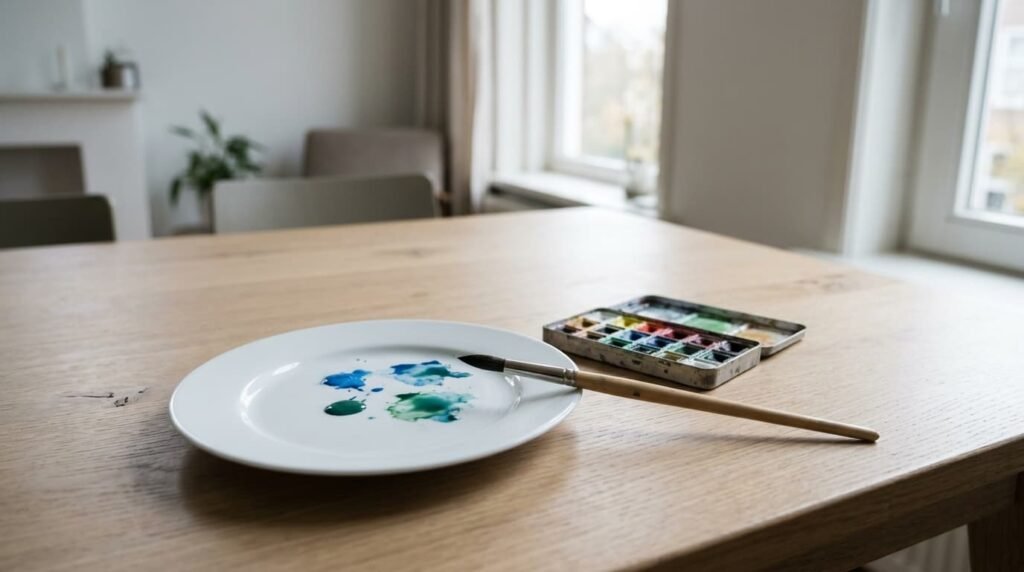
In a watercolour corner for beginners, the palette can go without hurting your progress. A white dinner plate does the palette’s job and costs nothing, because you own one already. Across 20 cm, a plate gives π × 10² = 314 cm² of flat mixing space. Around 120 cm² of wells is what a tray 15 cm by 30 cm might offer, and the wells fill with dried paint that you never use.
The plate wins on cleaning as well. Glazed ceramic takes no stain, and a wet cloth clears it in seconds. Most sets of pans also come in a tin whose lid is a mixing surface. You may hold two surfaces before you spend anything.
Its drawback: no lid. A mixed wash dries on the plate between evenings, which hardly matters because beginners mix fresh each time. The plate also uses 314 cm² of table against the tray’s 450 cm², which frees 136 cm².
Revisit the tray after a month, if mixed colours keep drying before you use them. Meanwhile, spend your attention on the paper.
Habits That Keep the Corner Working
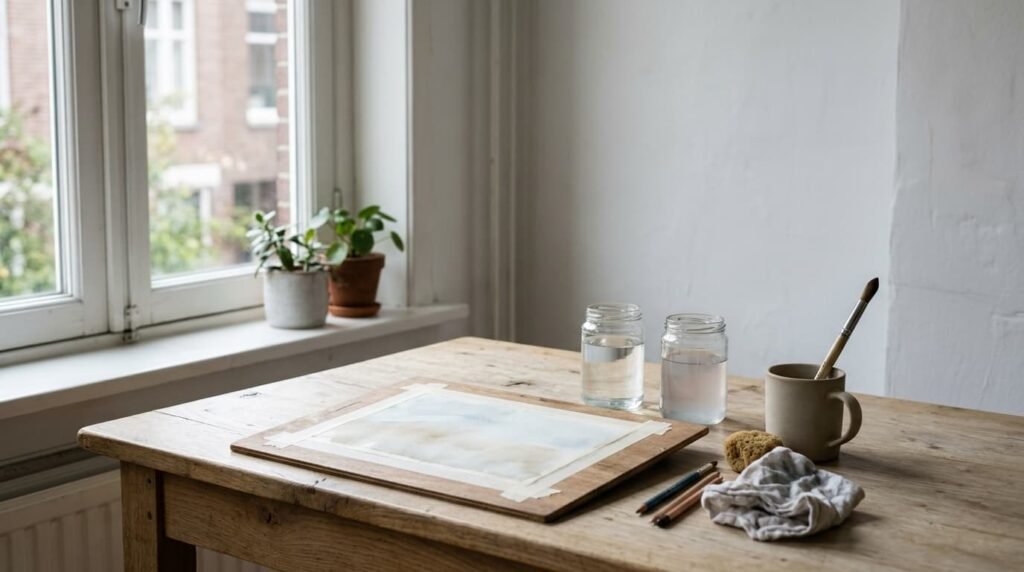
Because the table serves breakfast too, the routine around a watercolour corner for beginners needs care. Fill two jars of 300 ml. Use one for rinsing and the other for clean water, and change the rinse jar when it turns the colour of weak tea.
Leave each taped sheet flat for roughly 30 minutes before you move the board.
Peel the tape slowly, at a shallow angle, only once the paper is fully dry. A rushed peel lifts a strip of the surface. Rest the brush bristles up in a spare mug, never on its tip in the jar, or the point bends for good. Close the pans when you finish and wipe the plate.
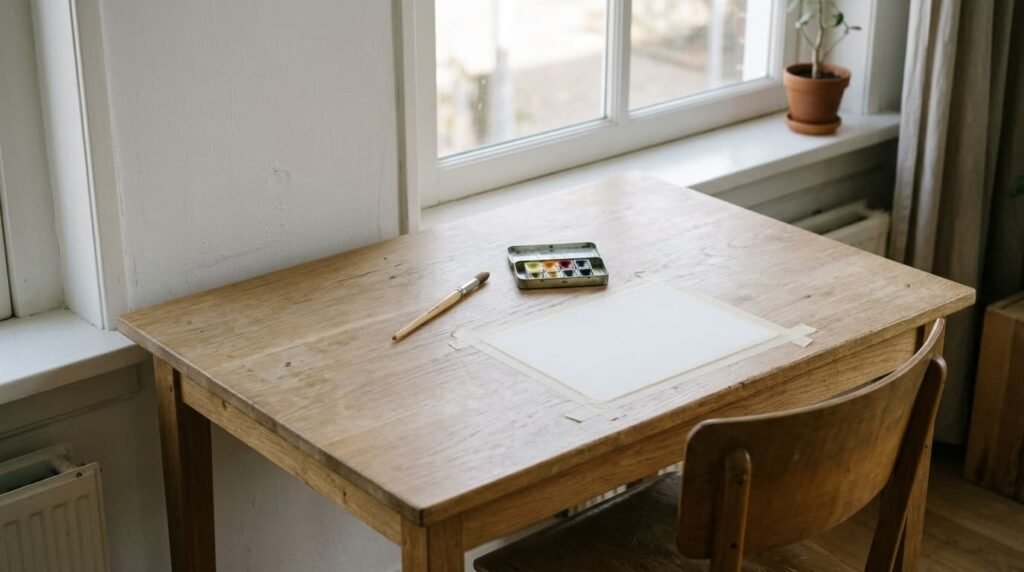
Sit so the window is on the side away from your painting hand. A right-handed painter takes light from the left, and the hand then casts no shadow on the wet paper. Pack everything into the shallow box and the three minutes pass easily. The rest of the evening is yours again.
What to Skip
Skip sets of 24 pans, because every extra colour adds a new way to muddy a wash, and you’ll keep using the same six. An easel tilts the paper and sends washes running downhill. A flat table works better, and a stretching frame is unnecessary once tape holds the sheet. Masking fluid and spray bottles solve problems you don’t have yet. A sketchbook with thin pages ripples like the 150 g sheet. A brush set of twelve leaves eleven brushes idle while one good brush does the work. Coloured pencils and fine pens belong to another hobby and would crowd the table. Finally, skip buying everything at once, since a watercolour corner for beginners shows its gaps after a fortnight of use.
Once a wet sheet dries flat and a wash goes on evenly, the buying is done. Judge it on the picture you paint most often, because that result reflects your real evenings. Most beginners find that paper and brush matter most, and everything else can wait. You’ll see the difference in a week. The corner earns its place by making a short session easy to start. If effort is left over, spend it on one good sheet.
Questions Readers Keep Asking
How many brushes do I need to begin?
One round brush in size 8 is enough for several months. It paints washes and fine lines. Add a larger flat brush only when you want to cover a whole sheet quickly. Extra brushes add clutter on a small table and teach you nothing about the paper.
In what order should I buy the pieces?
Rank them by the waste a wrong choice causes. Wrong paper spoils every session and leads. The brush follows, then the paints. The board and tape come next, and the palette last, if ever. A white plate from your cupboard replaces it, and most beginners never buy one.
How do I judge watercolour paper in the shop?
Check the weight printed on the pack: 300 g keeps flat. Look for cotton in the description. Touch a wet stroke to a corner and watch it sink evenly. Run a finger across the surface, and if it feels fuzzy or sheds fibres, put it back.