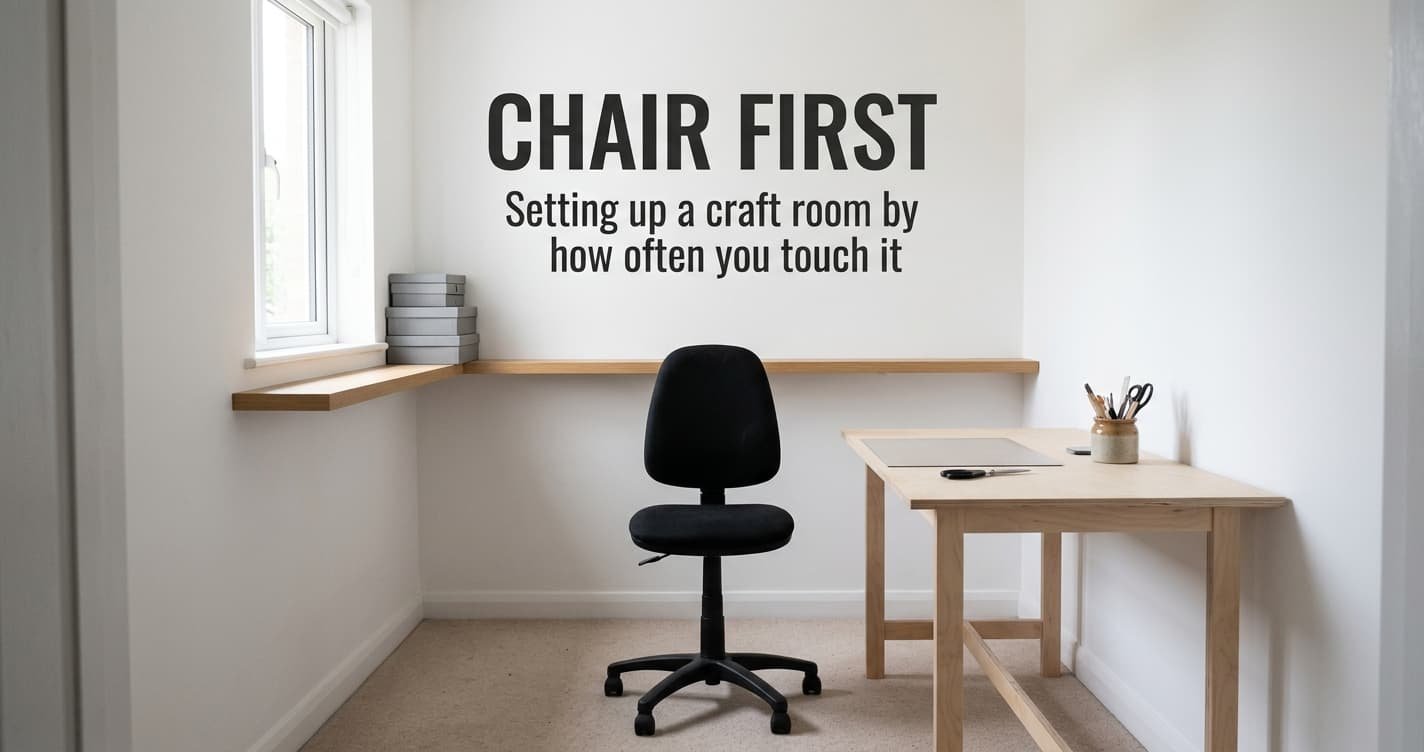
Craft rooms are usually furnished backwards. Shelves go in first and the chair arrives last. Setting up a craft room in the right order starts with the chair and the table. Heavy pots come next, then a shelf, then lidded boxes. The order follows how often your body and your hands touch each piece, and it saves you from buying the wrong thing first.
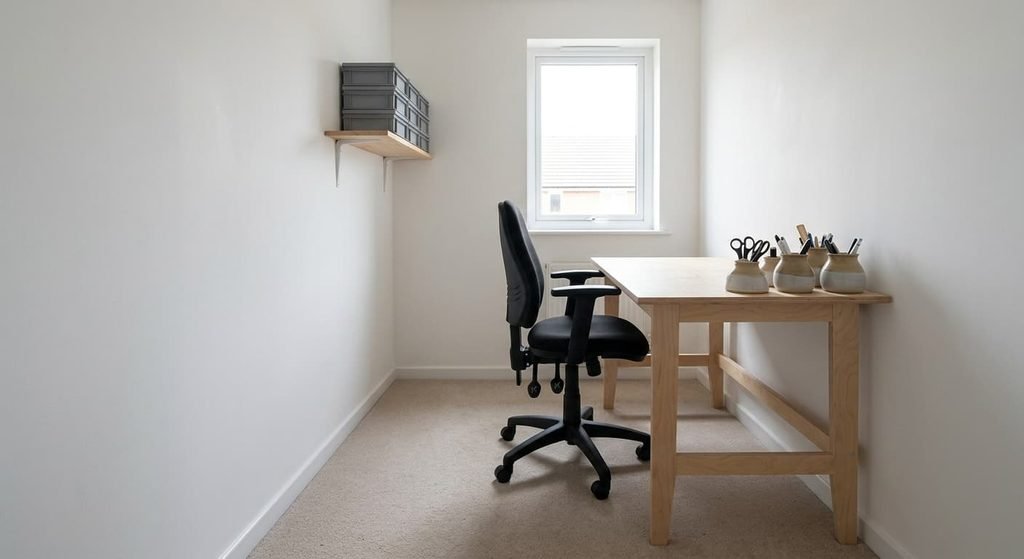
The room here is a spare one measuring 290 by 360 cm, in the Netherlands. Prices are left out since they date fast, so every piece is ranked by construction instead. The figures assume two-hour sessions, three a week.
The rule behind setting up a craft room
Count contact before you count cost. At 2 hours a session and 3 sessions a week, a 50-week year gives you 150 sessions and 300 hours. Your body touches the chair and the table in every one of them. In a session you might fetch 40 small items, which makes 6,000 touches a year. A box you open 3 times a session sees 450. A box of seasonal stock might see 4.
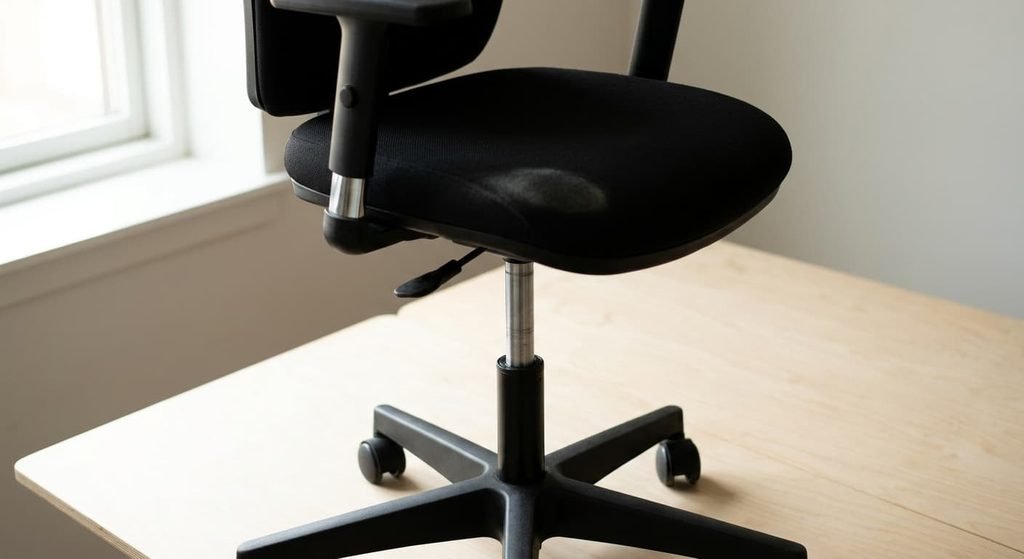
Contact tells you where wear lands. A second fact tells you where failure hides. Parts you can’t see fail first and can’t be repaired cheaply. The hidden parts are the gas-lift cylinder inside a chair and the joint under a table top. A pot has nothing hidden. A shelf board hides only its fixing, and a table hides its joints.
Spend most where contact is long and the part that fails is out of sight. A chair outranks a shelf by that rule, and a shelf outranks a pot. A pot sees 6,000 touches against 4 for a seasonal box, a ratio of 1,500 to one, yet it still earns the least money because nothing in it can fail unseen.
Everything in the list below obeys that sentence.
The list, in buying order
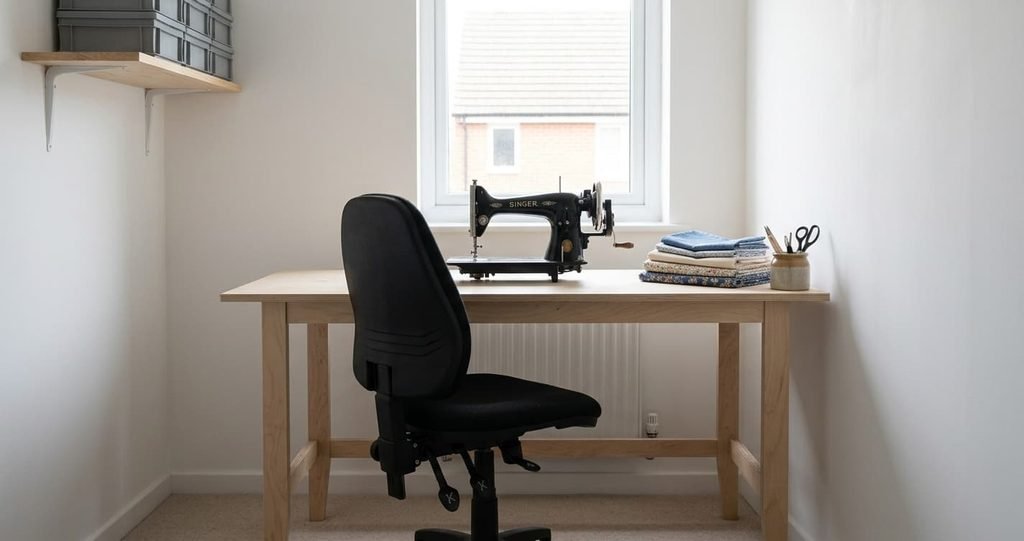
1. A chair whose seat adjusts across about 42 to 55 cm, with a gas-lift cylinder and a five-star base. It goes first because it takes 300 hours of contact a year and suits any craft. It also sets the height of the table you buy second. At a 75 cm table, a seat near 48 cm puts the surface 27 cm above your lap. Tier: BUY ONCE. The cylinder and its seal are hidden, and they decide how long the chair lasts. A bad version sinks under your weight, so you spend each session creeping downwards.
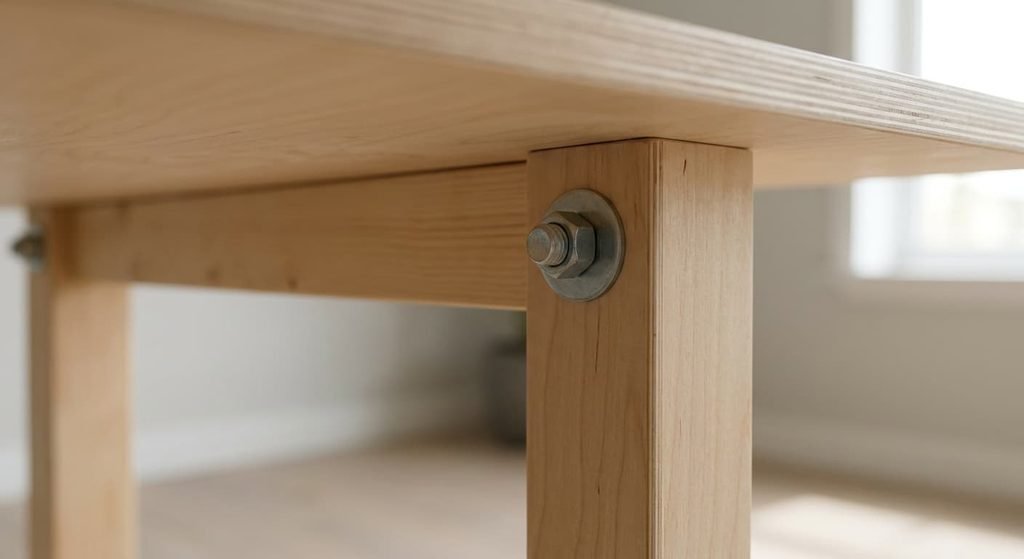
2. A table top of 18 mm birch plywood, 120 by 75 cm, on two legs joined by a rail. It comes second because the chair has fixed the height, and your largest project fixes the length. A 60 cm mat plus 30 cm each side makes 120. Tier: MID, since the top is plain while the joints between rail and leg carry the load. A bad version is longer than 120 cm on end legs only. Sag grows with the cube of the span, so a 160 cm top sags 2.4 times as much.
3. Four ceramic pots, each with a base as wide as the pot is tall, for the 20 tools you touch most. They come third because those 6,000 touches belong within arm’s reach. Tier: BUY CHEAP, since nothing in a pot is hidden. A bad version is light plastic on a narrow base that tips.
4. A shelf board of 18 mm, spanning no more than 80 cm between supports, for the boxes you open weekly. It sits fourth because 450 fetches a year need a place off the table. Tier: BUY ONCE. Whether a loaded board stays up depends on the fixing. A bad version is 12 mm thick over a 100 cm span. Stiffness rises with the cube of thickness, and sag with the cube of span, so that board sags about 6.6 times as much.
5. Lidded boxes of one size, with lids that clip shut. They come last because four fetches a year can wait until the rest is working. Tier: BUY CHEAP. A box hides no moving part. A bad version has lids that bow. A mixed set wastes shelf height.
Where to spend when setting up your craft room, and where not to
When setting up a craft room, spend on the cylinder in the chair and on the rail joints in the table. The fixing that holds the shelf to the wall gets money too. Each carries load every session and can’t be inspected. A rail bolted through the leg tends to stay square, while one screwed into end grain loosens sooner. A cylinder that holds a seat firm through five minutes of sitting is one to keep.
Everything else can be cheap, because a pot is a pot and a lidded box is a lidded box.
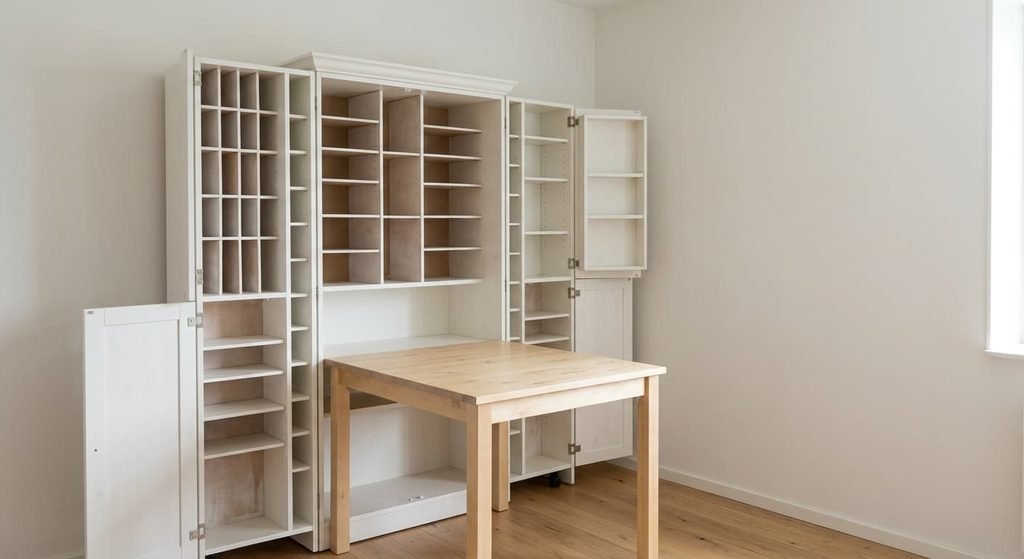
A cabinet of many drawers is the piece to argue down. Most people picture it as the big purchase of a craft room, yet its drawers hold the stock you touch four times a year. That’s 4 touches against the 6,000 of the pots. Lidded boxes on a high shelf do the same job for far less. Fixed compartments also lock your stash into the sizes of the day you bought them. Drawer runners are the hidden part, and they only repay their price if you open the drawers often, which the count says you won’t.
What this order assumes, and when it breaks
The order assumes hand crafts and one person, at about 150 sessions a year. How many sessions you’ll keep up is the one variable this guide can’t know. Below one session a week, the chair falls to MID, because about 100 hours a year of contact no longer repays a hidden cylinder. Treat that threshold as arithmetic from this guide, not as a measured result. Count your sessions for a month before you decide which side of it you’re on.
A sewing machine reorders the list. It vibrates. That moves the table’s mass and leg bracing to first place, with the chair second. A top that walks across the floor costs more than a chair that sinks. If you paint or glue, seal the birch with a wipe-clean finish before the first session, because bare ply soaks up spills. If children share the room, buy the table first. Choose legs with a height range, since the right table height changes as they grow.
What to skip entirely
An all-in-one craft cabinet with fixed compartments heads the list. It sizes every slot to a stash you don’t own yet. A cabinet of 90 by 45 cm also takes about 0.4 m² of a 10.4 m² floor, close to 4%, and that’s floor a table needs. A label printer comes next. Masking tape and a pen do the same job, and the label ages with the box, so a printed one is simply a pricier version of a thing you’d replace anyway. Write the date on the tape and you’ll also see which boxes you haven’t opened. A second work surface should wait until the first one is covered on seven sessions in ten. Until then, a second surface collects clutter and costs floor you’ll want later.
Setting up a craft room starts with the chair. The rule is to spend most where contact is long and the failing part is hidden, which sends the money to the cylinder and the rail joints, plus the shelf fixing. I’d stand by the chair-first order over the shelves-first habit. A shelf that is wrong can be moved, while a chair that sinks ruins every session across all 300 hours of the year.
Questions readers keep asking
What should I buy first for a craft room?
Buy the chair. Setting up a craft room begins with the piece your body touches for every hour you craft, and it sets the height of the table you buy next. Choose a seat that adjusts across about 42 to 55 cm and holds its height under your weight for five minutes.
How many pieces do you need to start a craft room?
Five cover most hand crafts. Start with a chair and a table. Add a set of four pots, then a shelf board, then one size of lidded box. Anything beyond that can wait until you’ve used the room for a month and counted what you actually reach for.
How do you tell whether a craft table is sturdy enough?
Lean on the middle with both forearms. If the top flexes visibly or the table walks, the span is too long or the joints are loose. Sag grows with the cube of the span, so a top over 120 cm needs a rail or a middle leg.