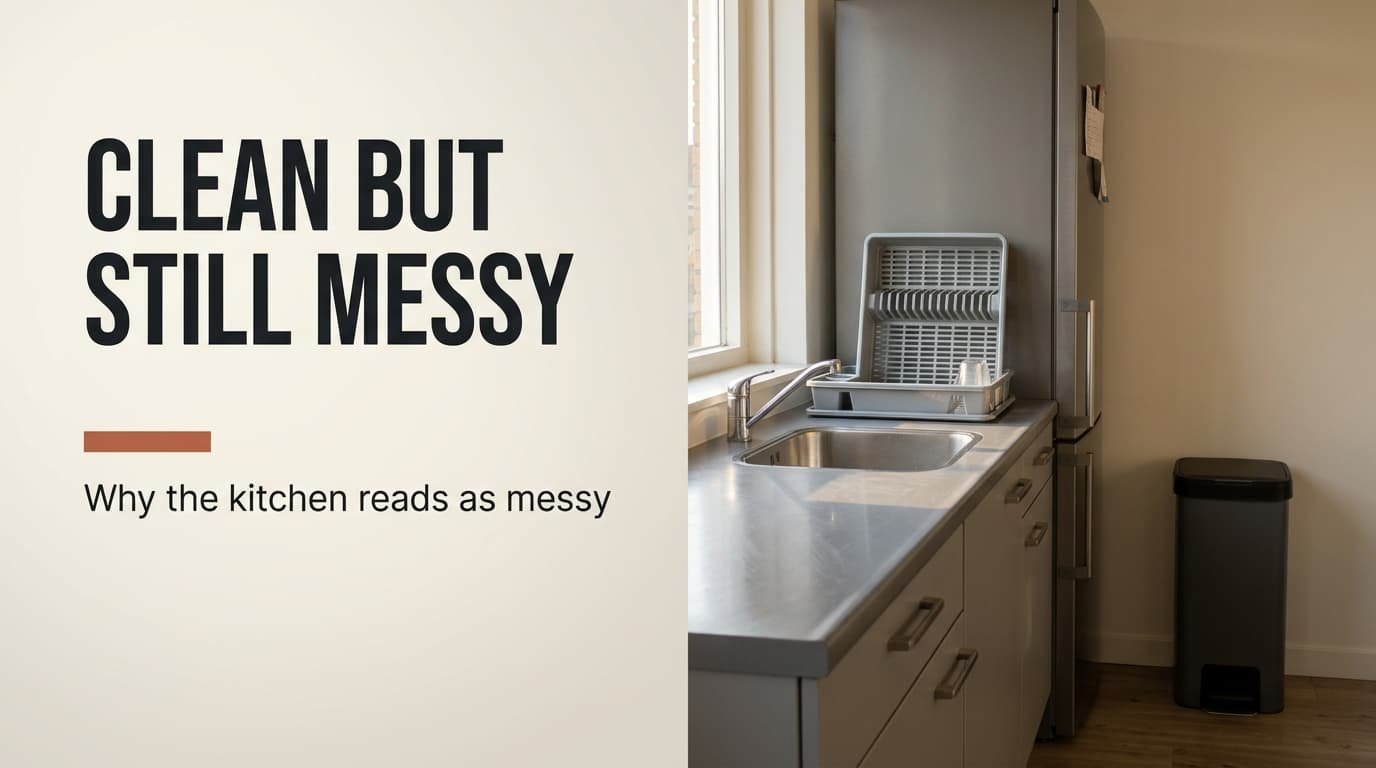
A kitchen can look messy even after we clean it, because the eye reads smears of light on the worktop and the first object in the doorway. The biggest dark shape in the room adds to the effect. That’s a contrast and placement problem, and taste doesn’t enter into it. Three small faults cause most of it.
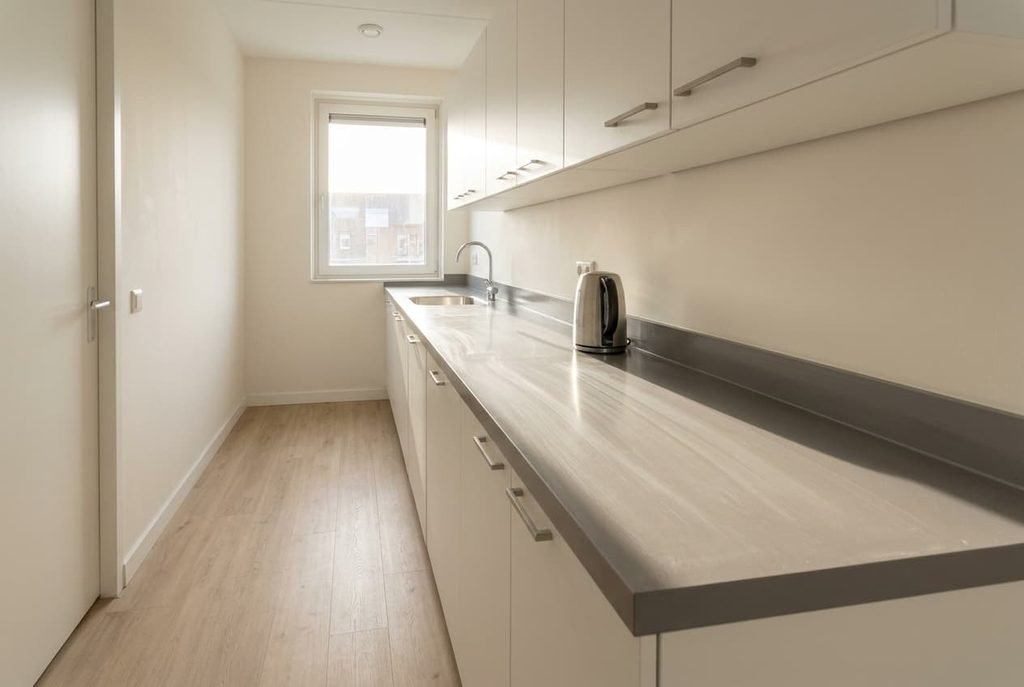
Our model is a Dutch kitchen measuring 300 cm across and 420 cm deep, with 250 cm of height. The worktop is 90 cm high, and a 120 by 120 cm window sits above the sink. The numbers are rounded from a simplified model, so measure your own room before trusting them.
What makes a kitchen look messy even after we clean it
Cleaning more is the usual answer, yet the eye is reading reflections and sight lines, and dirt barely enters into it. Take reflections first. A glossy surface throws back roughly 4% of light arriving from directly above. The share climbs as the light skims the surface: 17% at 70° from the vertical, 25% at 75° and 39% at 80°.
The window’s centre is 70 cm higher than the worktop and 250 cm off to the side, so its light arrives at about 74°. That’s roughly 24% mirrored, six times the straight-down figure. Any film left by a cloth scatters that mirror image unevenly, and the eye sees it as a streak.
Sight lines work the same way. From the doorway, the central 20° of your view takes in a strip 1.6 m wide at 4.5 m, and everything inside that strip is read first. A bin that stands 60 cm tall against a 90 cm worktop adds a third effect, scale.
You can predict all three in a kitchen you haven’t built yet. Gloss plus a window within 3 m gives streaks, and any object parked midway along the far wall gets read before the rest. A large dark shape without a cupboard around it finishes the set.
Why a kitchen can look messy even after you clean it: which fault is yours
Run three checks before you change anything. At the time of day when the sun sits lowest, photograph the worktop from the doorway, then take a second photo at noon. If streaks show in the first photo and vanish in the second, the fault is reflection. If they show in both, the film is thick enough to need the wipe-and-dry method below.
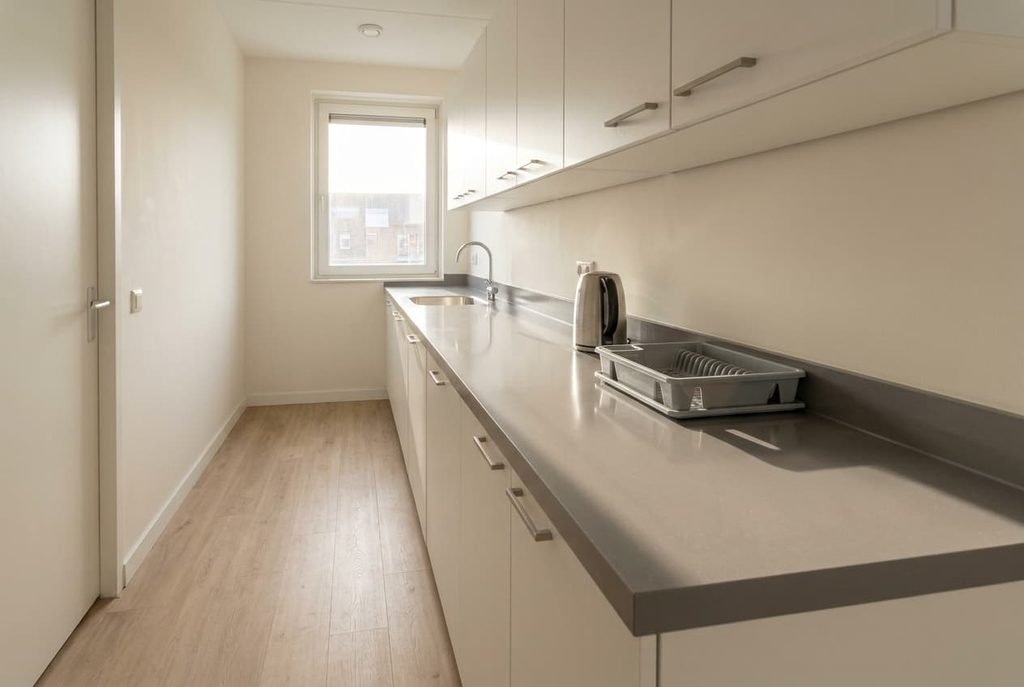
Then stand at the door. Squint until details blur. Whatever object still stands out is the thing the eye reads first. If it’s something you’d normally put away, like a drying rack, you’re looking at placement. A built-in object such as a hood points to a fault outside this list.
Lastly, cover the bin with your hand. If the room settles at once, scale is the cause. Hold the hand there for five seconds, because a room that settles slowly points to a wider mix of causes. Most kitchens show one fault strongly and the others weakly.
Fix the strongest first.
The faults, diagnosed
“It looks smeared the moment the sun hits it” comes from contrast. A glossy surface under skimming light mirrors about 24% of it, and a film of detergent breaks that mirror into streaks. Start with a clean damp cloth, then dry the worktop using a dry microfibre cloth in one direction, so the film dries in a single pattern. Use less detergent than you think you need, because every extra drop leaves more film. It costs nothing, and you’ll see the change within a day. It can’t change the gloss itself, so a very glossy top will still show fingerprints. Skip the dry polish and the room will still look messy even after we clean it.
“What I notice from the door is the drying rack” comes from placement. With a 300 cm wall, the central 1.6 m runs from 70 to 230 cm, and a sink centred under the window puts the rack at 150 cm. Slide the rack 110 cm past the sink along the worktop, and it leaves the strip altogether. That’s a rearrangement, and it costs a few minutes with a tape measure. Check again at dusk from the entrance, when the lit window draws the eye hardest. The limit is the counter space, since the rack needs a spot near the sink. Ask everyone in the house to use the new spot for a week, because habits follow the rack.
“The bin is the biggest thing in the room” comes from scale. A bin measuring 60 cm high by 35 cm wide stands at two thirds of the worktop’s height, and its dark body is the largest unfixed object in view. A pull-out bin that lives inside the base unit hides it, and that’s the one fix here that needs a purchase. If you can’t buy one yet, tuck the bin beside the fridge’s far edge, where it falls outside the central strip. It needs a base unit with 40 cm of clear width, and a 40 cm pull-out wants about 45 cm of space inside, so measure the cupboard before ordering.
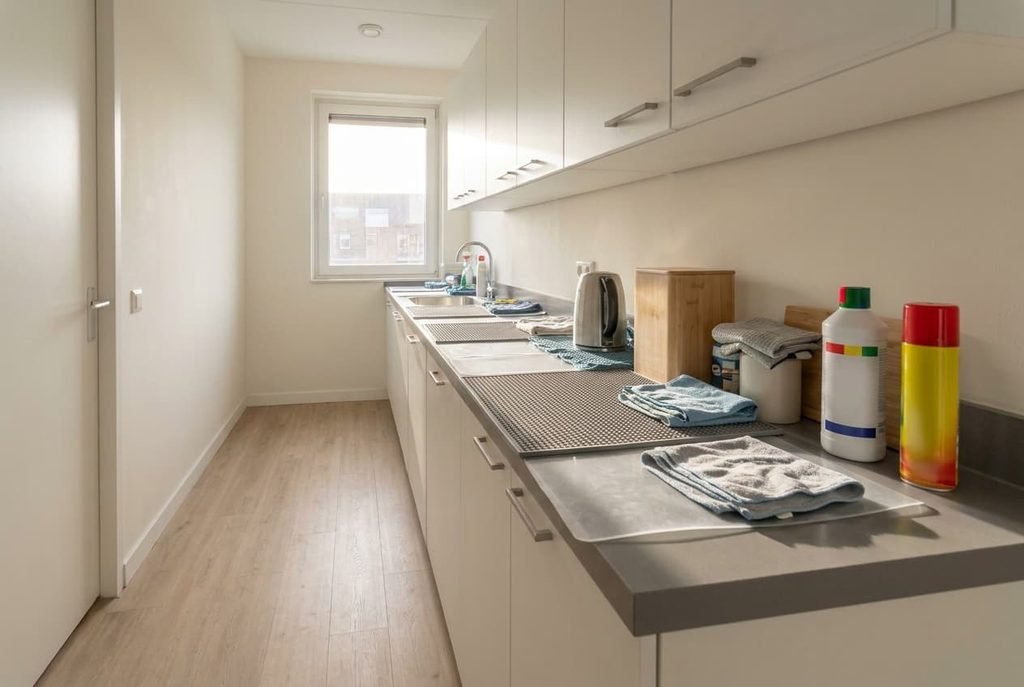
What to check before you add anything else
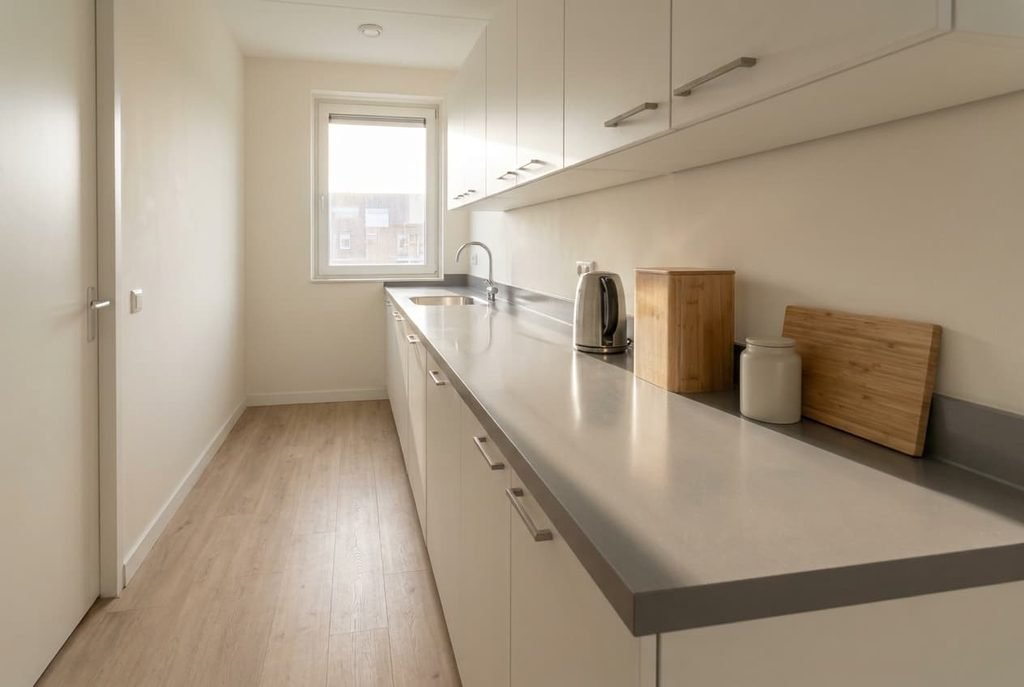
Before any new object goes on the worktop, ask three questions. Does it have a gloss finish that will mirror the window? Will it stand inside the central 1.6 m strip? Is it taller than two thirds of the worktop height?
Say you add a steel kettle to the sink run. Its polished body bounces the window’s light at that same 74° angle and draws a bright line across the strip, so it needs a spot at the side. A tall bread bin of 35 cm fails the second question and passes the third, which means it belongs on the last stretch of the run. One sheen per surface keeps the streak problem down, and a mix of matt and satin items quietens the whole worktop. With those checks done, the kitchen won’t start to look messy even after we clean it.
The fix that isn’t worth doing
Cleaning more often with a stronger product is the remedy most households try first. It makes the film thicker, because stronger products leave more residue, and a thicker film breaks the mirror more visibly. It also dulls a gloss finish over a few months. The trade leaves a bigger fault than the one you began with.
Three wipes a week with less detergent beat daily scrubbing.
Covering the worktop with mats trades the fault for another. Each mat is a new object in the strip, and its edge adds a line. A tablecloth effect on the counter also hides the surface you’re trying to show. Scented polish spray makes the same trade, since it adds a film of its own on top of the one you removed, and the streaks return within a day.
A clean kitchen that still looks messy has a reading problem. The eye finds skimming reflections, the first object at the door and the largest dark shape. One check catches all three fastest: stand at the door when the sun is lowest and look at the strip. Move the rack, dry the surface in one direction and tuck the bin away. In a kitchen that can look messy even after we clean it, the sequence of fixes matters little. Start with the fault you saw strongest, then repeat the doorway check monthly, plus after any new purchase. Pencil the date beside the light switch so the check turns into a habit.
Questions readers keep asking
Why does my worktop look streaky after I wipe it?
Gloss surfaces mirror skimming light, and a thin film from detergent breaks that mirror into lines. Use a damp cloth, then dry in one direction with microfibre. Use less detergent than you think, since extra product only leaves more film behind.
What is the quickest way to make a kitchen look tidier?
Clear the central strip of vision at the door, which is about 1.6 m wide on a 300 cm wall. Move the drying rack and the bin out of it. That’s free and quick, and it often does more than an hour of scrubbing.
Can I fix this without buying anything?
Mostly, yes. The streak and the rack both respond to technique and rearranging. Only the bin might need buying, as a pull-out unit. A simple move to the edge of the strip can replace that too, if the budget is tight this month.