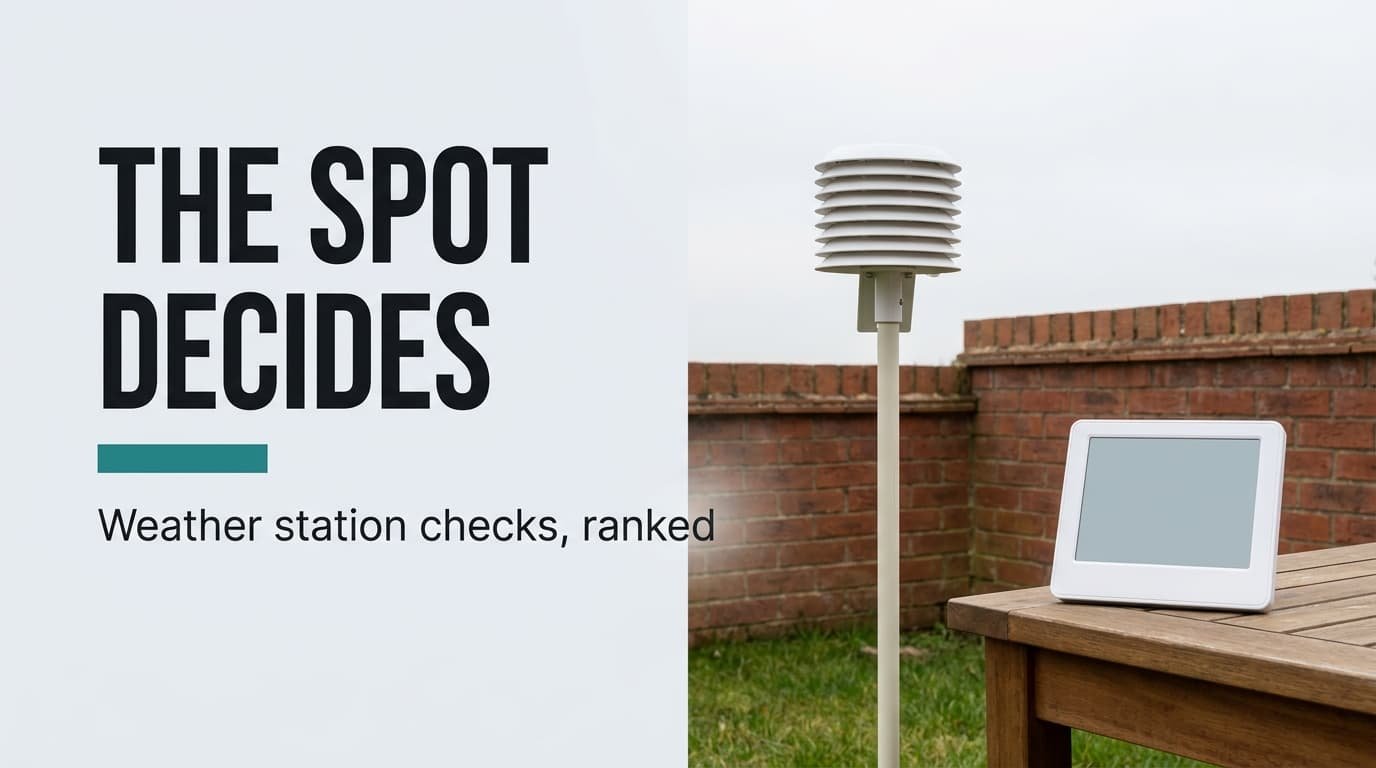
Buying a home weather station starts with a question about your garden rather than the box: where can the outdoor sensor sit so it reads the air and not your wall? Everything else on the spec sheet comes second. Our example is Dan, who rents a terraced house in Sheffield with a garden of 6 by 4 m. His back wall faces south, and the only open lawn lies 4 m from the kitchen window. Four checks follow in order of weight, then the box claims that mislead. Every figure is invented for Dan’s garden, so measure your own.
What Matters Most When Buying a Home Weather Station
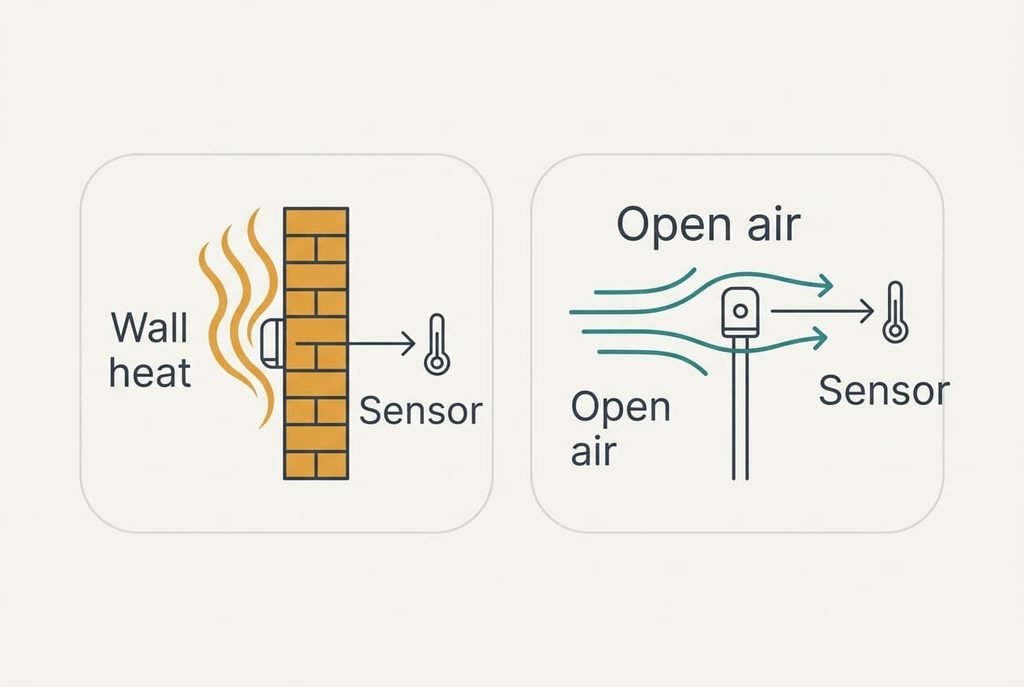
A thermometer reports the temperature of whatever touches it, and in a garden that is rarely the air. Dan’s brick wall soaks up the afternoon sun and hands the heat back all evening. A sensor fixed 20 cm from that wall would read about 4 °C above the true shade temperature at 15:00, and it would stay warm long after sunset. The position of the outdoor sensor decides how far you can trust any weather station, because no circuit can correct for a wall that is heating it.
Wind and rain behave the same way. A 1.8 m fence steals most of the breeze from anything placed behind it, and a branch overhead catches raindrops before a gauge can. Textbook advice puts the sensor about 1.5 m above the grass. It wants open air around it and a clear gap to fences and trees. Few small gardens have such a spot, so walk yours before you shop and stand where the sensor could go. Ask what the sun or the brick would do to it there.
That one fact outranks every figure printed on the box.
Four Checks When Buying a Weather Station for the Home
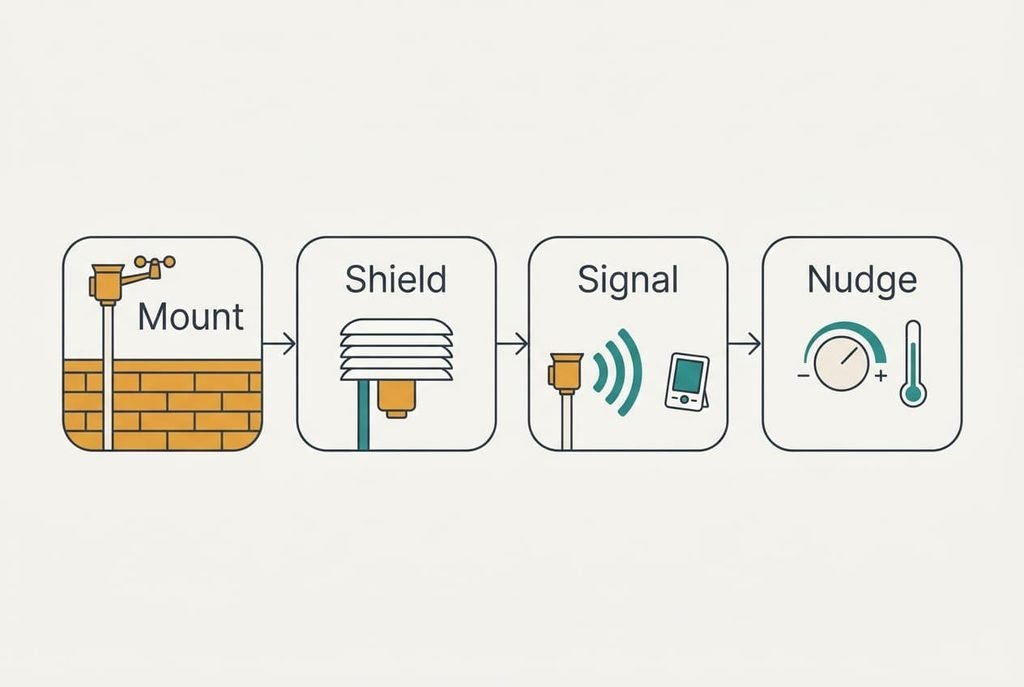
1. How the outdoor sensor mounts. Some units clip flat to a surface, while others sit on a pole or bracket that holds the sensor 30 cm or more clear of it. For Dan, that gap is the difference between reading the air and reading his brick. Look at the listing photographs and see whether the sensor hangs in open space with room behind it. A model that only fits flat against something will pick up the south wall’s heat every afternoon.
2. Whether the sensor has a radiation shield. This is a cover of stacked white plates that lets air flow through and keeps direct sunlight off the sensor inside. It changes what you see on a bright day, when an unshielded sensor can read several degrees high. Check the product photo for slits between the plates and look for daylight through them. A solid plastic dome is the wrong shape, since it traps heat like a small greenhouse.
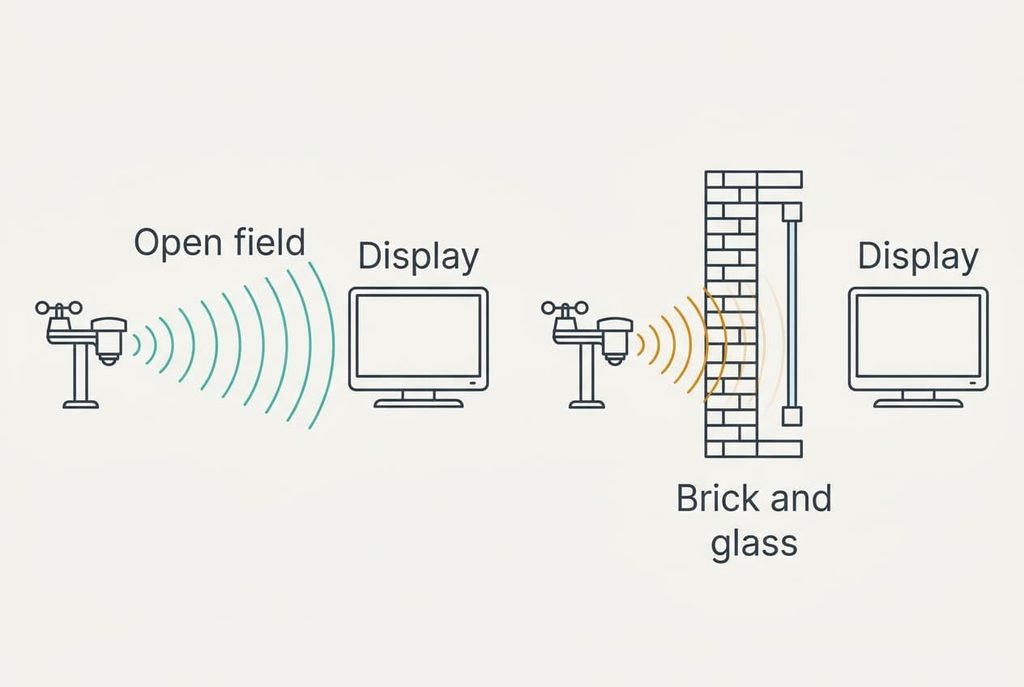
3. How the signal reaches the display. The outdoor sensor sends readings by radio to a unit you keep indoors. Dan’s display would sit in the kitchen. A brick wall and a double-glazed window stand between it and the garden. Tally the walls between sensor and display on your own route, and treat any stated range as a figure for open ground. If readings drop out whenever the back door shuts, the display lives in the wrong room. Moving it a metre can be enough. Run the test again and check the placement first.
4. Whether you can nudge a reading. Most buyers skip this one. A setting that adds or subtracts a small correction lets you match the sensor to a trusted thermometer once and then forget about it. The listing may call it an offset or a calibration. Dan could set his in about ten minutes with a thermometer in the shade. Without that setting, a 2 °C error from a poor spot stays on the screen until you replace the station.
Claims on the Box That Sound Better Than They Work
The line printed largest is often the accuracy figure quoted to a tenth of a degree, and it earns less trust than it asks for. That number describes the electronics tested in a laboratory. Dan’s errors come from his wall, and they’re measured in whole degrees. Makers promote the tenth of a degree because it prints well and is awkward to argue with on a shelf.
A quoted range of 100 m or more gets the same treatment. It comes from a test across an empty field with no obstacles. Dan’s signal has to cross brick and glass before it reaches the kitchen. A long list of extra readings is the third lure, and each extra sensor behind it needs its own battery and its own spot in the garden.
Test the range where you live. Put the display in the room you’ll actually use and carry the sensor outside for an hour. If the numbers keep arriving, the claim has done its job for you.
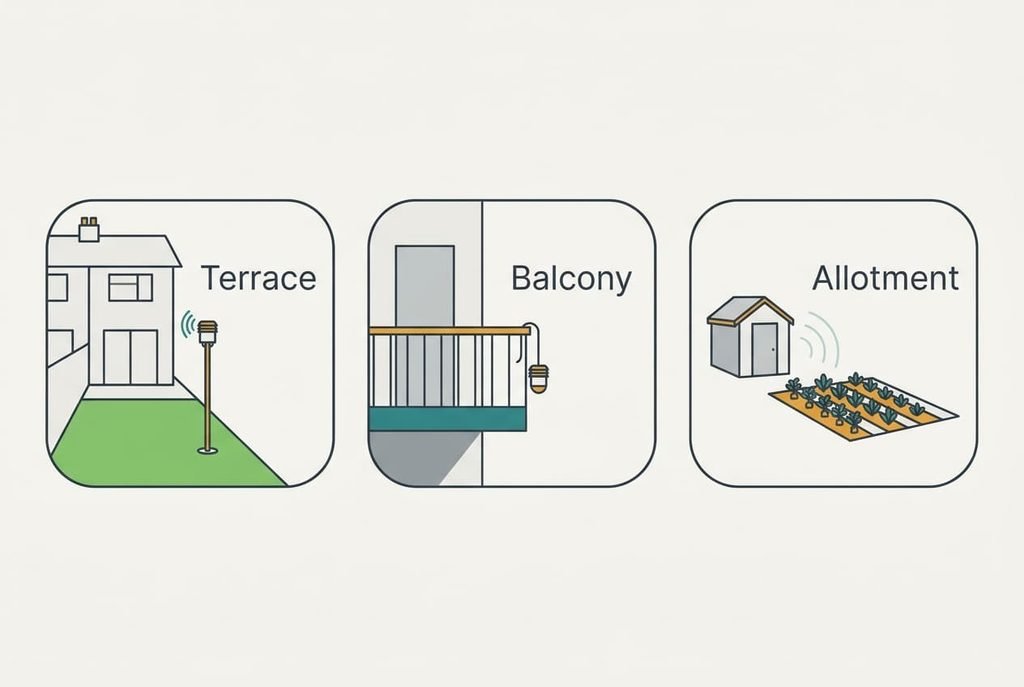
Three Gardens and What Each One Asks For
Dan has the open lawn but a hot wall, so the first two checks rise. A pole and a shield come first. The nudge setting is a useful safety net if his chosen spot proves imperfect.
Aisha lives in a first-floor flat with a balcony and no garden. A pole won’t fit, and the glass doors behind her throw back the afternoon sun. She can hang a sensor from the outer rail, 40 cm out, on the shaded side. The shield matters most to her, and the nudge setting follows. If you’re buying a home weather station for a balcony, find the side that stays in shade longest.
Marcus has an allotment 40 m from his shed, so the signal check comes first. He should put the display near the shed window and test it there.
When a Station Isn’t Worth Taking Home
Pass on a unit whose outdoor sensor can only stand flat against a wall. No later fix helps a reading that starts in the wrong place. If the listing is silent about how the sensor mounts, ask the seller about it and move on if there’s no answer. A tenant who’s buying a home weather station for a rented garden should be stricter still, since a bracket can’t be drilled into a landlord’s wall.
A model with no way to adjust a reading deserves the same suspicion when your best spot is imperfect. So does a large bundle with a rain gauge plus a wind cup that you have nowhere to put. Each extra part adds one more job: levelling it and keeping it powered. Parts you can’t reach tend to fail unnoticed.
Skip any station whose display can’t sit in a room you’ll walk through daily. A reading on a screen in a spare room nobody visits won’t change what you wear.
A Check to Run Before You Trust a Reading
Set the outdoor sensor on its chosen mount with the shield fitted. Place a second thermometer beside it in the shade. Read both after ten minutes and again at midday, then once more at dusk. Write each gap on a sticky label and keep the labels near the display for a week, so a pattern has time to show. A steady gap of one degree is easy to correct with a nudge, whereas a gap that swells in the afternoon points to heat from the wall.
If the gap grows with the sun, move the sensor another 30 cm out and try again.
Use this check each spring. Leaves return and fences get repainted. Wipe dust from the shield plates at the same time. A station that matches a trusted thermometer in the shade is ready to trust, and that’s the quiet test that decides the value of buying a home weather station.
Questions Readers Keep Asking
How accurate does the temperature reading need to be?
Less than the box suggests. A reading within a degree or two of a trusted thermometer is useful for planting and for deciding whether to cover plants, and that’s well within reach if the sensor sits in shade. Placement errors in a small garden usually dwarf any difference between two laboratory figures, so check the spot first.
Is it worth paying more for extra sensors?
Only if you have a place for each one and a plan to look at the numbers. Extra sensors raise the number of batteries to change. They add cleaning jobs and more faults to chase, so a simple unit well placed beats a crowded one badly placed. Add rainfall or wind later if you notice yourself wanting them.
How long should the outdoor unit last?
Longer than you’d think if it stays shaded and dry, though the plastic covers weather over the years. The battery and the seals go first, with the shield plates close behind, and each can usually be replaced separately. Ask whether spare parts are sold, and choose a model whose battery door opens without tools.