A bed that squeaks every time you turn over almost always has a joint that has lost its grip. Two parts rub past each other over a tiny distance, and each rub sounds a note. Where the noise starts decides which cure fits, and a short test on the bare frame tells you. Picture a flat-pack double bed measuring 1.4 m by 2 m in a rented Rotterdam bedroom, used by two adults of 80 kg and 70 kg. All forces and distances are working assumptions, and your own measurements will differ. Four remedies follow in order of effort, plus one tempting shortcut that backfires.
Why a Bed That Squeaks Every Time Is Really a Loose Joint
A squeak is stick and slip. Two surfaces catch and release hundreds of times a second, which lands in the pitch your ear picks up easily. A bolted joint stops the sequence by clamping its parts so firmly that friction pins them in place.
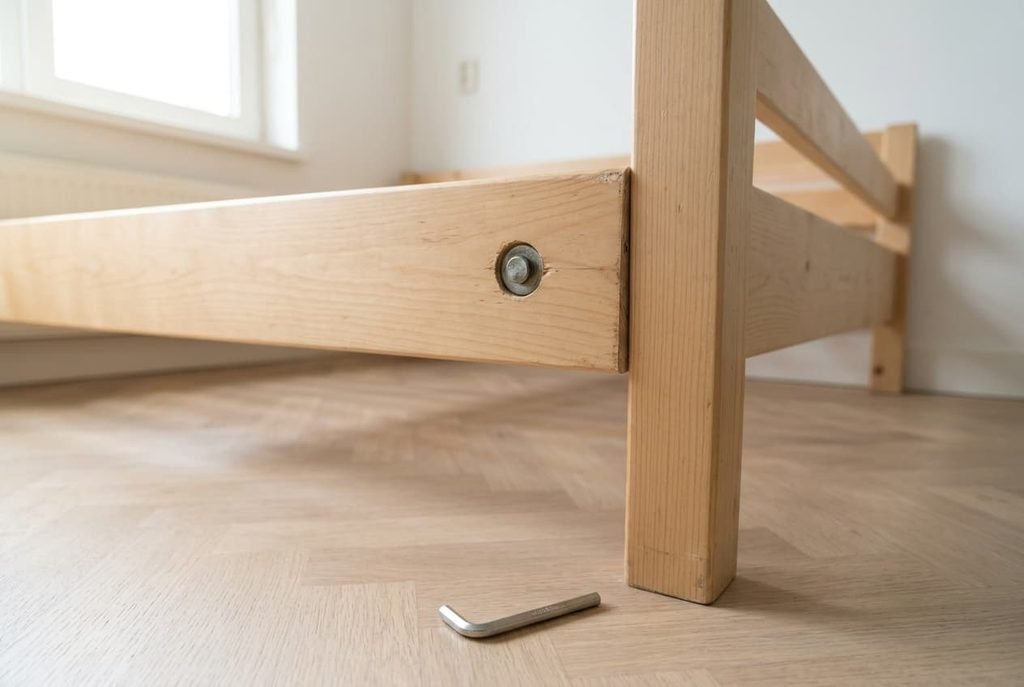
Put numbers on that. Turning over shoves the frame sideways with perhaps a quarter of one adult’s weight. At 80 kg the sum is 0.25 × 80 × 9.81, close to 200 N. The four corner joints split that at about 50 N each. Every corner holds two bolts, and wood against wood has a friction coefficient of roughly 0.4. The joint stays put while 0.4 × 2 × P reaches 50 N, so each bolt must keep a clamp of about 63 N.
Fresh bolts clamp at around 300 N. Then the wood fibres beneath each head compress and relax. A year of nightly loading and seasonal swelling can drop the clamp to 30 N, which resists only 24 N per joint, and the corner begins to shift with every roll. Nothing has snapped. The frame has simply let go of itself, and that explains why the squeak arrives gradually.
A Bed That Squeaks Each Time: Finding Your Pattern
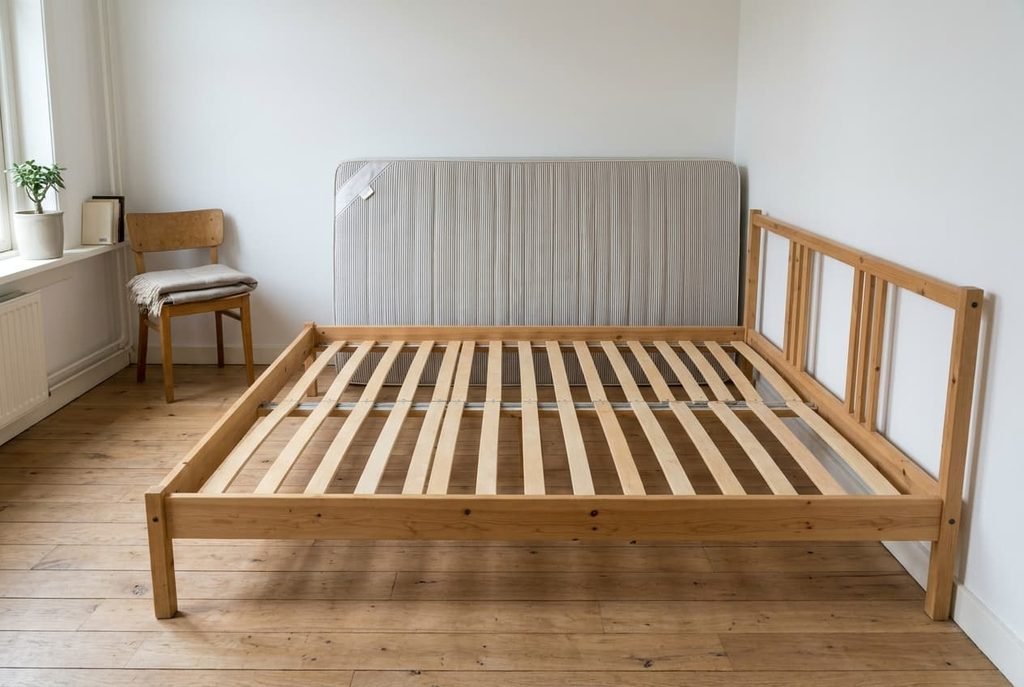
Three different sources produce the same complaint. Corner joints are the usual culprit, with the noise rising from one end of the frame. Slats come next. They give a click or creak under the mattress that shifts as you move along the bed. The mattress rubbing on its base is the last candidate.
Run the check in sequence. Stand the mattress upright against a wall. Press the bare frame sideways at each corner using the heel of your hand, and watch the joint, since 1 mm of movement together with a squeak settles the verdict on corners. Press each slat end down with a thumb next. A slat that clicks or slides more than 2 mm in its cap marks the slats as the cause. When the bare frame stays quiet through both checks, put the mattress back. Then roll across it, and any noise you hear now comes from the mattress. Put a strip of painter’s tape beside every noisy point as you find it, because a squeak that moves around is easy to forget by the time you reach the toolbox.
Most beds show a loose corner plus a slightly noisy slat.
Four Remedies, Ranked by Cost
Begin with the cheapest and quit once a bed that squeaks every time you turn over goes quiet. The remedies address separate causes, which means a silent night after the first makes the others unnecessary.
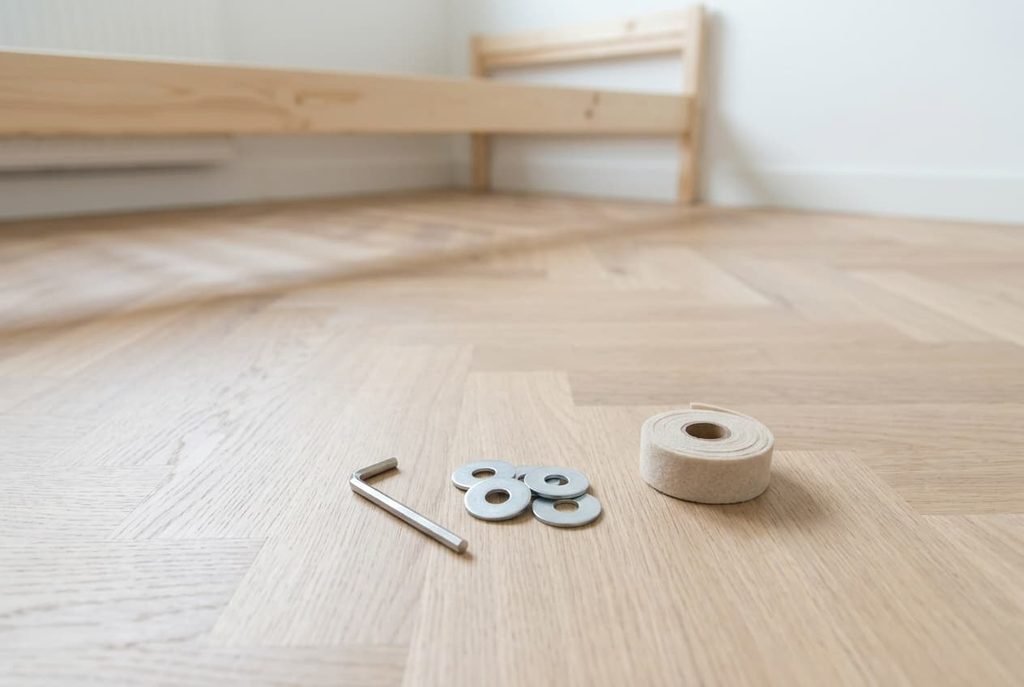
Re-tighten every bolt in turn. Take the hex key from the flat-pack bag and give each bolt a quarter turn, hopping between opposite corners so the frame draws up evenly. Stop when each one feels firm. That moves the clamp back towards its original 300 N. The job needs no purchase and about ten minutes. Wood relaxes again over the months, so repeat the round each autumn when the heating comes on, and treat a bolt that spins without biting as a hole problem for the fourth remedy.
Fit wide washers under the bolt heads. A head 13 mm across around a 9 mm hole presses on 69 mm² of wood, while a 24 mm washer presses on 389 mm², about 5.6 times the area. At 300 N the pressure falls from 4.3 MPa to 0.77 MPa, and wood that stays uncrushed keeps its clamp longer. A few washers from a hardware shop cost very little. They can’t rescue a hole that has already worn oversize, and a washer must sit flat in its recess to work.
Line the slat ends with felt tape. The frame has 14 slats, which puts 28 ends in plastic caps, and each end slides perhaps 1 mm along its length as you roll. A strip of felt 2 mm thick separates wood from plastic so that nothing rubs. This cures the slat click, and one roll of tape covers it. Felt flattens with use, and after a couple of winters you may find the click creeping back and the tape due for a replacement.
Have a carpenter re-drill stripped holes. When a bolt turns freely without tightening, the thread has lost its bite in the wood. A carpenter glues a hardwood dowel into the hole and drills it again, which gives the bolt fresh wood to grip. The visit takes about an hour. Cheap chipboard rails often can’t take a second drilling, and then replacing the rail is the sound answer.
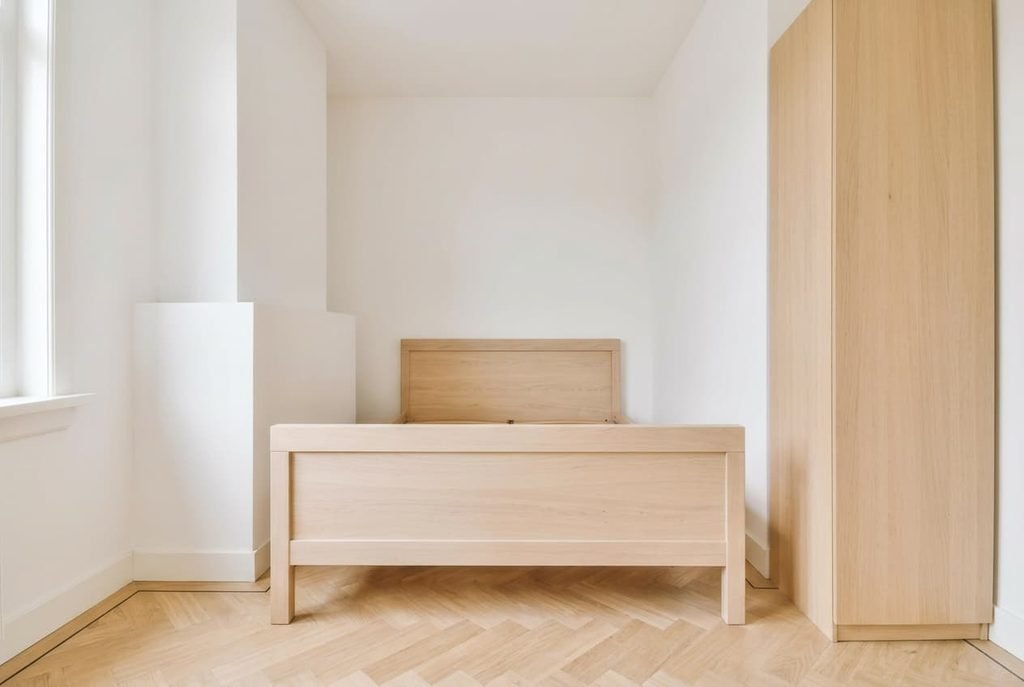
What the Alcove Won’t Let You Change
The bed sits in an alcove 146 cm wide between a chimney breast and a wardrobe, which leaves 3 cm at each side of its 140 cm width. In a space like this, a bed that squeaks every time you turn over has bolts you can’t reach. At the head end the hex key needs about 8 cm of swing, and the walls allow 3. Even a short key won’t fit between the rail end and the plaster. Without that gap you’d tighten blind, and blind work usually means skipped bolts.
Slide the bed 20 cm into the room along its length before you start. The room is 340 cm deep and the bed takes 200, so there’s space to pull it out. Lift the frame instead of dragging it, since the parquet floor belongs to the building and the neighbours below hear every scrape.
The alcove decides what you can reach.
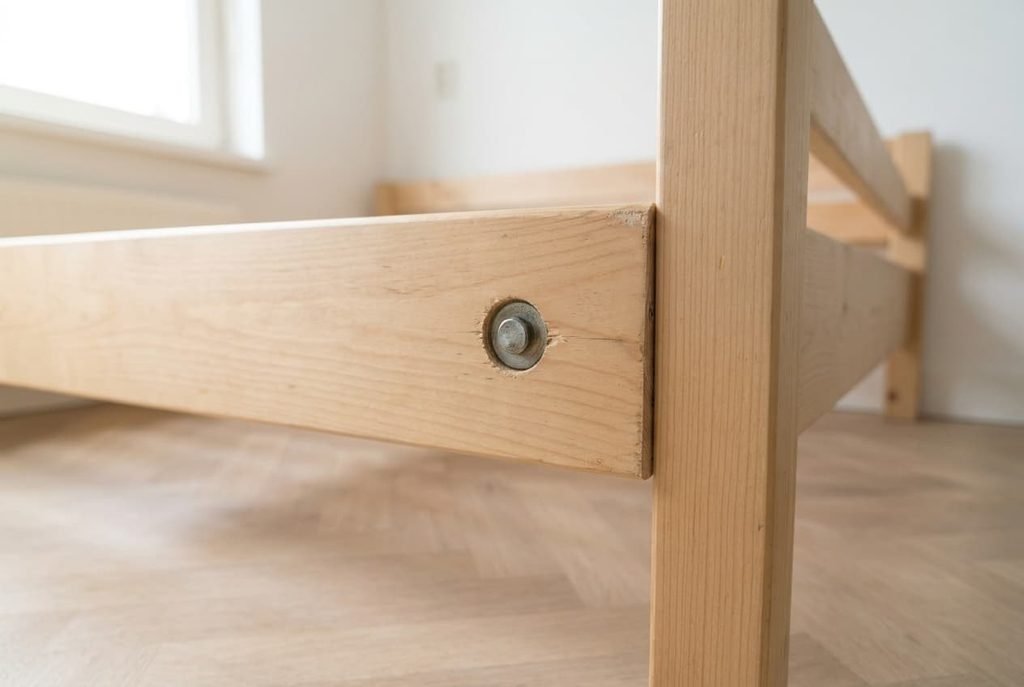
The Fix That Makes the Squeak Worse
Tightening every bolt as hard as you can sounds like the obvious reply to a loose joint, and it backfires. A head that bears on 69 mm² puts 4.3 MPa into the wood at a clamp of 300 N, and softwood starts to crush across the grain at around 4 MPa in our sample. Double the force to 600 N and the pressure reaches 8.7 MPa. The head sinks about 0.3 mm into the rail, and a sunken head means a clamp that has already gone. Long levers can also split a headboard or strip a thread in one evening, and a bed that squeaks every time you turn over then has a damaged hole on top of the noise. Softwood rails take this damage quietly, and the first sign is the squeak itself. Spare bolts from the same flat-pack set won’t help, because the damage sits in the rail.
Aim for firm rather than fierce and add the washers from the second remedy. Then leave the frame alone for a week and try it again, rolling across it as you would on a normal night. If the noise has gone, leave the bolts untouched until autumn. If one corner still moves, treat that corner first. Repeat the sideways push afterwards to confirm.
Questions Readers Keep Asking
Can a squeaking bed be fixed at all?
Almost always. Each source of noise has a remedy you can try at home. The exception is a worn chipboard rail that can’t hold a bolt, where replacing the rail costs less than repairing it. Rock the bare frame first and tighten before anything else.
What does it cost to fix?
Tightening is free. Washers and felt tape cost very little, and a carpenter’s visit is the one real expense. Try the free step first, and quit once the bed stays quiet through a full night of turning over, which means the clamp is back above the 63 N each bolt needs.
What is the most common specific cause?
Bolts that have lost their clamp. Wood under each head compresses and relaxes through the year, so the clamp falls below the roughly 63 N each bolt needs. Check the corners with a hand test, then tighten in turn with a hex key. Test the slats only if the corners stay silent.