Most advice says a dedicated recorder beats a phone. That holds for some meetings and fails for others. Around one table with evenly spoken turns a phone app does the job, and what separates the two tools is whether the recording level stays fixed or chases the speaker. Pick a phone app or a pocket recorder by the loudest moment your session will hold. Our scenario is a one-hour meeting in which speech reaches the microphone at 60 dB and laughter at 78 dB, over a room hum of 42 dB. These numbers are invented samples chosen to keep the sums short, and no brand is named.
The Property That Separates a Phone App or a Pocket Recorder
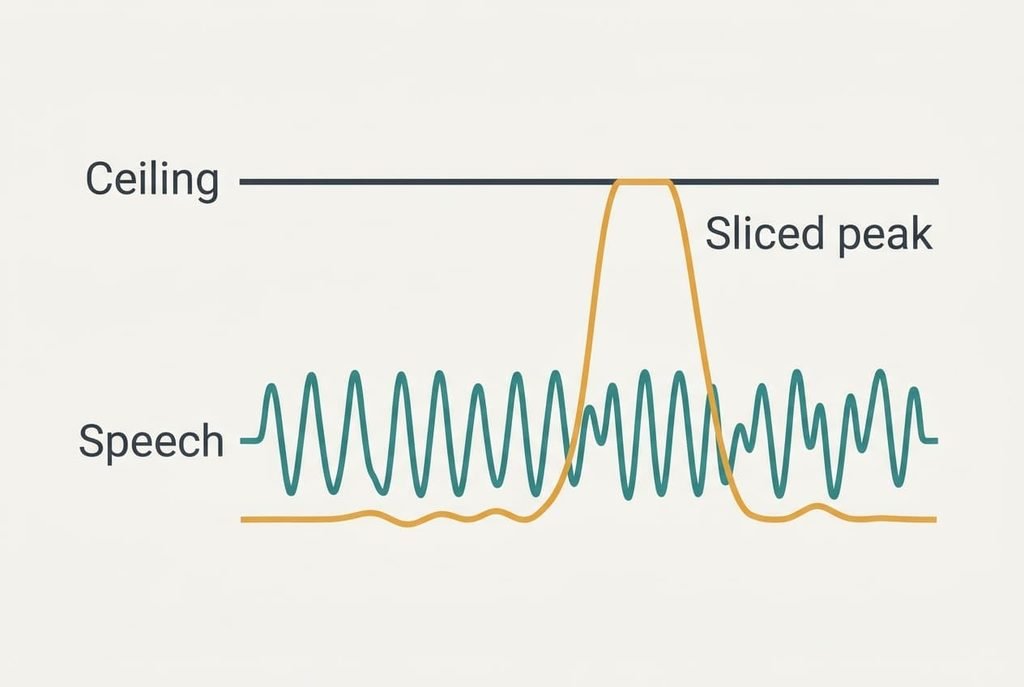
Every recording has a ceiling. Anything louder than the level the device is set to gets sliced flat, and a sliced waveform can’t be repaired afterwards. Anything quieter stays intact and can simply be turned up later. That lopsidedness drives the choice, because errors on the loud side last for good while errors on the quiet side fade.
Give our test a ceiling of 81 dB. Speech at 60 dB sits 21 dB below it. Laughter at 78 dB sits 3 dB below, and the 42 dB hum sits 39 dB below. A fixed setting keeps all three safe.
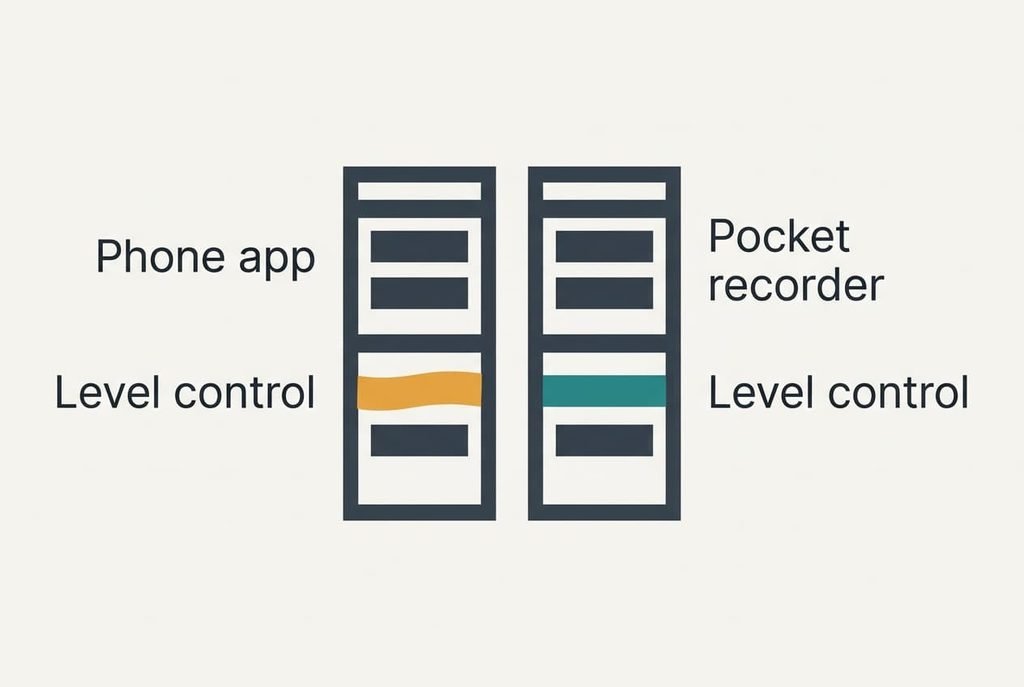
Many phone apps adjust gain on their own instead, creeping up by roughly 1.2 dB a second during silence. After a ten-second pause the gain stands 12 dB higher. Laughter then arrives at the equivalent of 90 dB, and 9 dB of it overshoots the ceiling. The same rising gain lifts the hum by 12 dB, and the hiss swells between sentences. The choice between a phone app or a pocket recorder turns on who fixes the ceiling: you set it before the loudest moment arrives, or an algorithm guesses it afterwards.
Ask who controls the ceiling before you ask which device is better.
Six Points of Difference, Side by Side
The rows below cover where the two tools genuinely differ in daily use. Cost and speed are absent because they would blur the picture, and the table keeps each cell to a few words so the contrasts stay easy to scan.
| Question | Phone app | Pocket recorder |
|---|---|---|
| Microphone aim | fixed by the phone’s body | often angled or clip-on |
| Level control | usually automatic | manual level with a limiter |
| Interruptions | calls and alerts may pause it | nothing competes with it |
| Battery over three hours | about 18% of the phone | its own cells |
| File format | compressed, small | compressed or uncompressed |
| From audio to text | text tools often built in | file moves to another device first |
Many people expect storage or sound quality to mark the gap, yet neither shows up as a deciding row. The battery row looks worrying and resolves quickly: 6% an hour adds up to 18% across three hours, a drain most phones absorb. Interruptions are what hurt. One unnoticed call lasting ten minutes erases 10 of 180 minutes, which is 5.6% of the day. No software brings those words back. Recorders have no calls to answer and no apps competing for their microphone.
Where the Phone App Wins at a Small Table
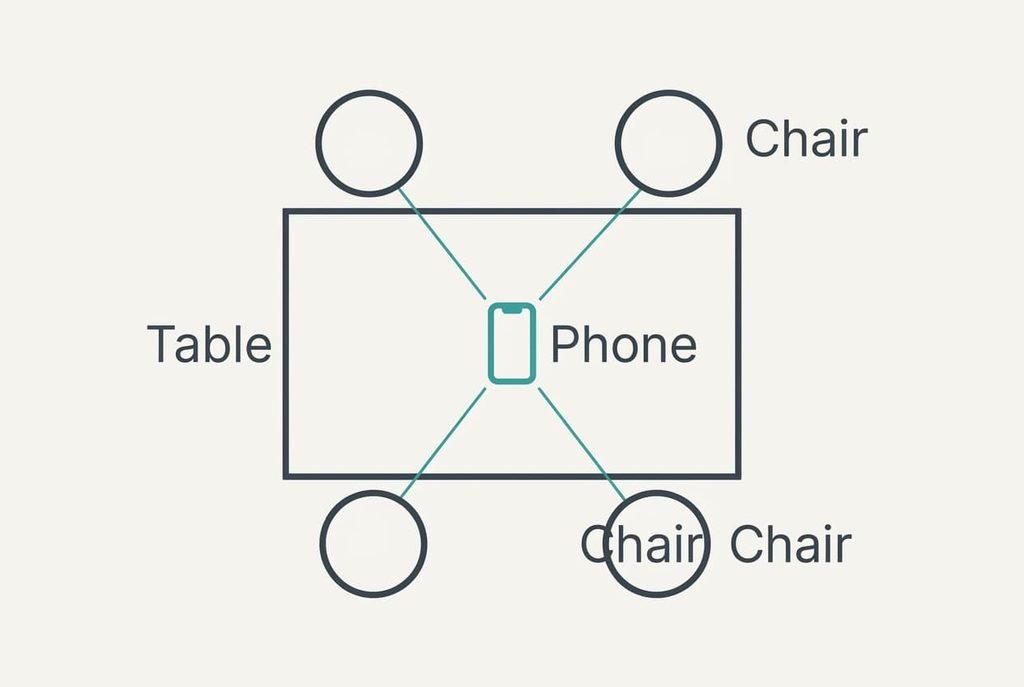
Calm meetings suit automatic gain. Chairs at 40 to 72 cm from a phone laid on a 120 × 80 cm table differ by only about 5 dB. Every voice lands within a narrow band of 58 to 63 dB. Nobody lifts a voice past 66 dB, the gain moves by less than 3 dB, and the clipping that troubles lectures never arrives.
The phone is already in your pocket, which removes one more device to forget or charge. The file can be shared within a minute of finishing, and text tools often sit one tap away. A compressed hour at 128 kbit/s takes 57.6 MB, a size any phone absorbs without a thought.
The weak point is interruption. A call or an alert may pause the recording, and the gap lasts until you notice it. Switch on flight mode before you start, then glance at the timer after one minute. Laying the phone on a folded cloth also keeps cups and elbows from thumping through the table.
Where a Pocket Recorder Beats the Phone App
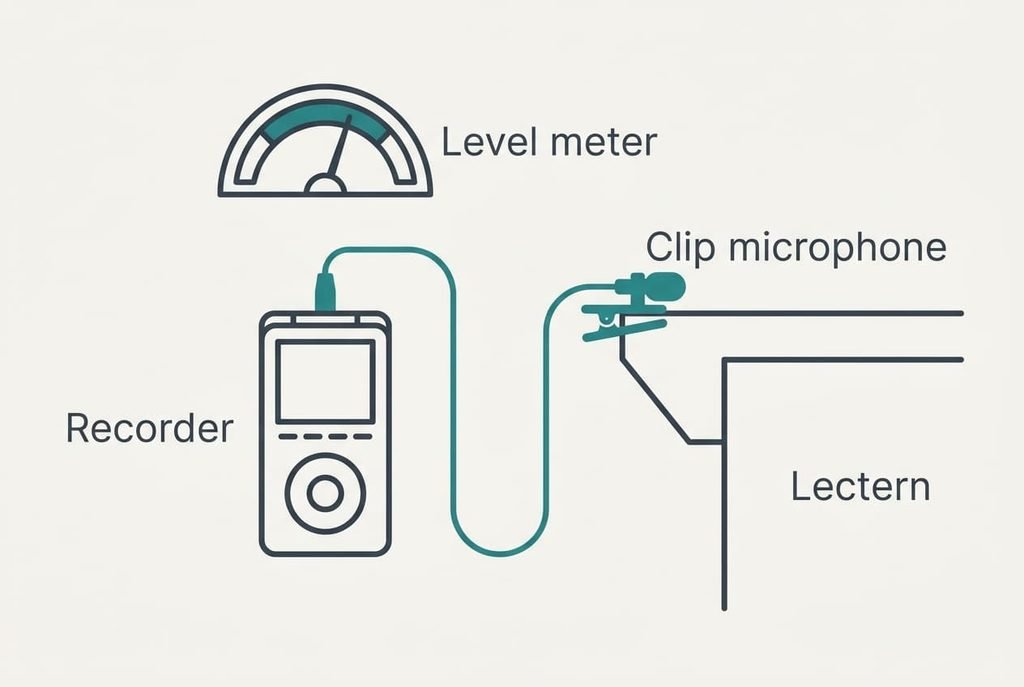
The recorder comes into its own when the room is unpredictable. A lecture brings audience questions and applause, and the speaker may pace. The loud side of the range is crowded. Set by hand at 81 dB, the ceiling holds through every interruption. A limiter adds a second layer, squeezing a surprise peak at 85 dB where an unprotected phone would slice it.
It carries its own cells, which means three hours of recording takes nothing from the phone you’ll need afterwards. Three hours of compressed audio fills 172.8 MB, a size any card absorbs. A socket for a clip microphone is the other advantage, since a microphone worn by the speaker keeps the voice steady however far they wander. Some phone apps offer a manual level too, so check yours before the day.
A pair of angled microphones inside the recorder also captures a wider picture of a roundtable, and the habit sticks because the device lives charged in a drawer. It’s ready whenever a session appears.
When Neither Device Suits the Room
Level settings can’t rescue a voice that never reaches the microphone. Gain lifts the voice and the hum together. The gap between them stays put. Take a back-row seat where the speaker arrives at 45 dB against the same 42 dB hum. The margin is 3 dB, and no level setting will lift the words out of the hum. Whether you chose a phone app or a pocket recorder makes no difference there.
Sit closer if you can. Failing that, ask the organiser for the slides afterwards, since those carry the facts when the audio can’t. A clip microphone worn by the speaker solves the problem outright, though you must ask permission first. Rules on recording differ from one workplace to the next. Handwritten notes beat a poor recording every time.
A page of key points takes minutes to scan, while a poor hour of audio takes an hour to hear and still leaves gaps.
Which One to Pick
Choose the phone app when the voices around you stay within about 6 dB of each other, as they do at a table of colleagues. Automatic gain handles that gently, and there’s nothing extra to buy. Enable flight mode and lay the phone on a folded cloth with its microphone edge towards the group.
Choose the pocket recorder when the volume will swing, as it does with audience questions and a pacing speaker, or when you record every week. For a recurring lecture the difference between a phone app or a pocket recorder is mainly this: the recorder lets you fix the ceiling by hand.
However you choose, run one test in the real room. Record 60 seconds that include a single loud clap at the speaker’s seat, then play it back through headphones. Crackle in the clap means the ceiling sits too low, while a hiss that swells in the gaps means the gain is chasing the room. Adjust once and test again before the real session starts. You’ll want the settings settled by then.
Questions Readers Keep Asking
Is a separate recorder worth the extra effort?
Only when your sessions are lively or weekly. A recorder adds one more device to charge and one more file to move. Anyone attending the odd quiet meeting gets by with the phone. Lectures with questions repay the effort quickly, especially once a clip microphone joins the kit.
What if my phone stops recording halfway?
A call or an alert is the usual cause, along with a full storage space. Switch on flight mode before you start, keep 1 GB of space spare and glance at the timer after one minute. On a long session check it again at the halfway point, because a pause costs you everything said during it.
Which suits a one-to-one interview best?
A phone placed on the table between you, roughly 50 cm from each voice. Two people taking turns stay within a few decibels of each other. Automatic gain copes comfortably. Run a one-minute test and ask the other person’s permission first. A recorder only becomes worthwhile when the interview happens somewhere loud.