A window that rattles in its frame almost always has a leaf that no longer presses against its seal. Wind shoves the leaf to and fro across a small gap, and each return makes a knock. The knock’s origin picks the cure, and a quick palm test reveals it. Take a wooden casement 55 cm wide and 135 cm high on the street side of a Utrecht rental, where gusts reach 12 m/s. Every force and gap here is assumed; measure your own. Four remedies run from free to a joiner’s visit, followed by one shortcut that fails within weeks.
Why a Window That Rattles in Its Frame Is Really a Loose Fit
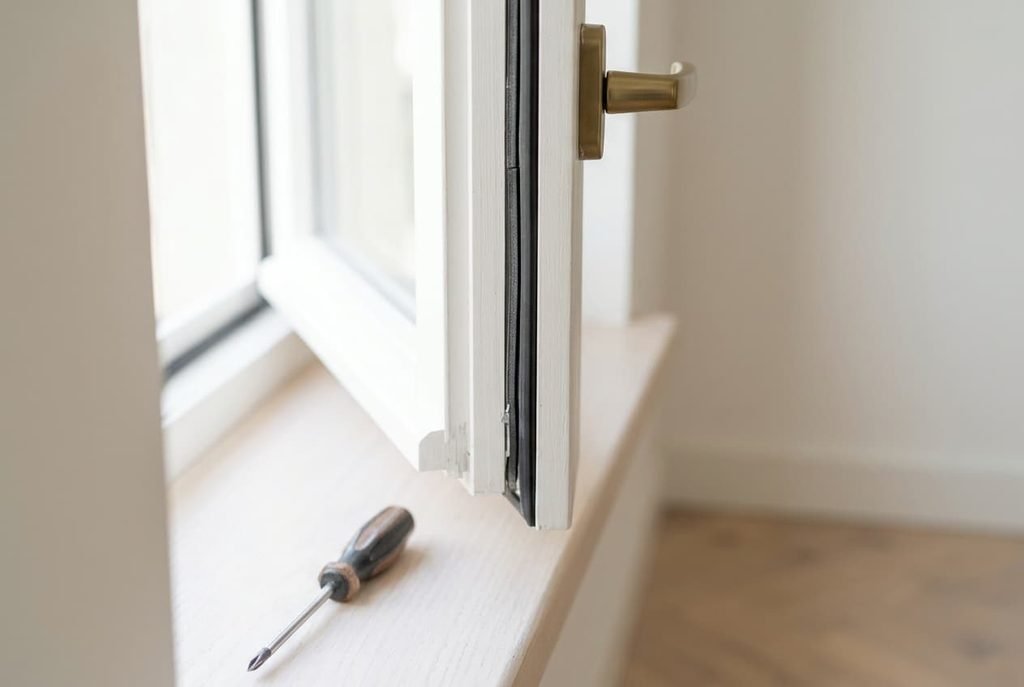
A rattle is an impact. The leaf rests in its rebate against a rubber or foam seal, and the wind tries to lift it clear. While the seal presses harder than the wind pulls, nothing moves. Once the wind wins, the leaf lifts away from the seal and strikes the frame. Then it drops back, and the next puff repeats the cycle. That is why a window that rattles in its frame can often be silenced with a screwdriver and no new parts.
Put numbers on it. Wind at 12 m/s presses on a surface with 0.5 × 1.2 × 12², which is 86 Pa. The leaf has an area of 0.55 × 1.35, about 0.74 m². Together that gives a load of roughly 64 N. The seal runs round a perimeter of 3.8 m. Assume it pushes back with 20 N per metre for every millimetre it is squeezed. At a squeeze of 1.0 mm the seal holds 76 N, which beats the gust. Years of sun and wear leave it squeezed by 0.3 mm, and then it holds just 23 N against a 64 N gust. The leaf lifts at every puff.
The window has lost its preload; nothing has snapped.
A Window That Rattles: Which Version Is in Your Frame
Three separate sources make the same complaint. The leaf striking its frame is the commonest. Glass shifting in its rebate comes second, with a dry click near the corners. Hardware is the third candidate, such as a loose handle or a stay, or a blind cord that taps the pane.
Work through them in turn. Shut the window and push the middle of the leaf with your palm in both directions. Travel beyond 1 mm confirms play in the leaf. Then press each corner of the glass with a thumb and listen for a click, which marks loose glazing. Flick the handle up and let it fall back, and pin the blind cord against the wall. If all three stay silent, wait for a gusty hour and hold the leaf shut with your hand. A noise that vanishes under your hand came from the leaf.
Put a scrap of masking tape beside each suspect spot as you go. Most windows show some play plus a seal that has gone flat.
Four Fixes for a Rattling Window, From Free to a Joiner’s Visit
Try the keep first, and stop once a window that rattles in its frame goes quiet in a gust. The four fixes act on different parts of the problem. Success with the first spares you the others.
Move the keep closer to the sash. The keep is the metal plate on the frame that the handle’s bolt hooks into. Loosen its two screws, slide it about 0.7 mm towards the room and tighten them again. The squeeze rises from 0.3 to 1.0 mm and the hold from 23 to 76 N. You’ll need one screwdriver and about fifteen minutes. Push the leaf again afterwards, and the 1 mm of travel should shrink to almost nothing. The screw slots give roughly 2 mm of travel, and a hole that has been used twice may lose its grip on the thread.
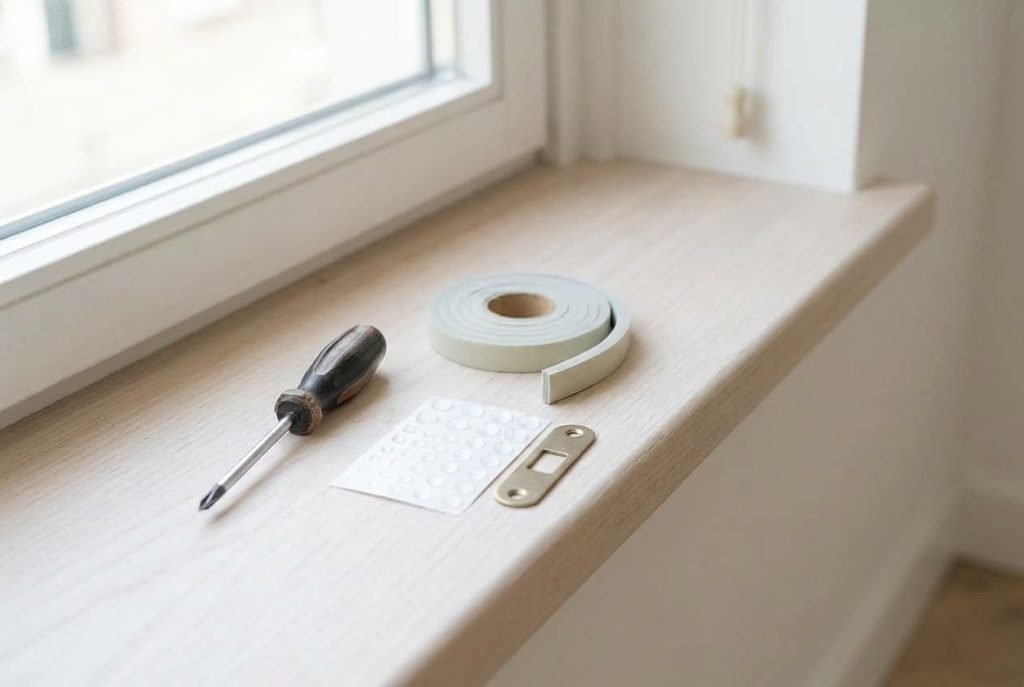
Stick rubber buffers at the contact points. Wood meeting wood in a hard knock lasts about 1 ms. A pad 3 mm thick stretches the same contact to around 6 ms, and the peak force drops to a sixth. A sheet of self-adhesive dots is cheap, and one dot at each corner of the leaf’s edge is enough. Buffers soften the sound but don’t stop the leaf moving, and they flatten after a year or two.
Fit a compressible seal strip in the rebate. This restores the preload along the whole perimeter. If the leaf, shut against the old seal, leaves a gap of 2 mm, choose a strip 3 mm thick so that it squeezes by 1 mm. Run it in one unbroken length round the leaf, stopping short of the hinges so it doesn’t foul them, and 3.8 m covers the lot. Wipe the rebate clean and dry first, since adhesive can’t grip dust. Foam ages in sunlight and needs renewing every few years.
Have a joiner reseat loose glass. When the click comes from the pane, a joiner lifts out the glazing bead, sets the glass on fresh blocks and refits the bead with sealant. The visit lasts about an hour. The landlord should book it, because the work belongs to the building. Old putty and brittle beads sometimes crack during removal, and a split bead turns a quick job into sash repair.
What the Frame and the Landlord Fix in Place
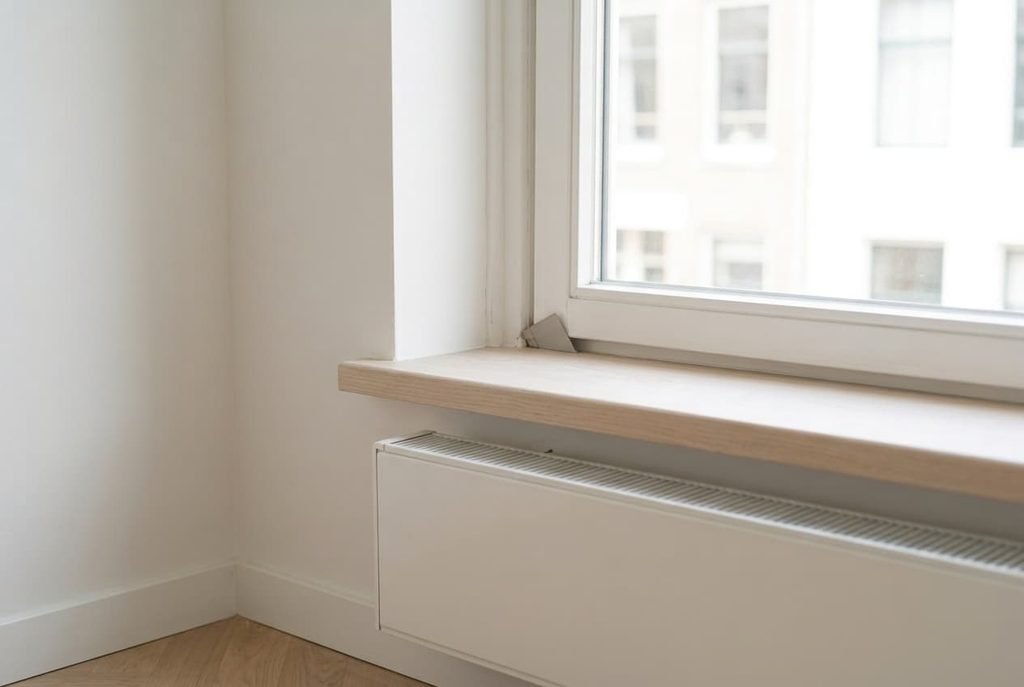
This casement opens inward and is hinged on the left, with its handle 70 cm above the sill. A radiator below leaves a sill only 14 cm deep, which gives your hand room at the keep but little room for a long screwdriver at the lower hinge. Use a short bit holder there. The curtain rail 25 cm above the glass leaves room to reach the top hinge from a step stool, but only with the curtain pushed aside.
The frame and glass belong to the building. Moving a keep or sticking a strip can be undone. Both are safe to try. Taking out a glazing bead or lifting a hinge isn’t a tenant’s decision. Ask the landlord before a joiner is called, and photograph the window before and after any work.
The depth of the sill sets how far your hand can go.
A Quick Fix That Backfires Within Weeks
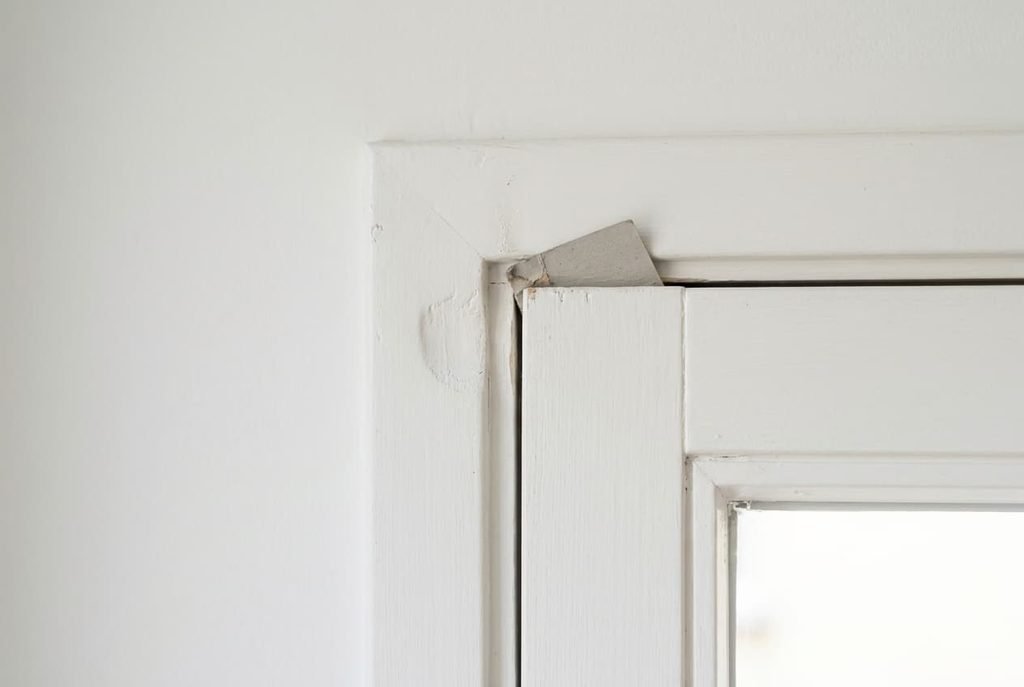
Wedging folded card into the gap feels like the sensible answer to a loose leaf. A strip folded to 4 mm fills the space, and the rattle stops that very evening. Card creeps under steady pressure and loses roughly one third of its thickness within a month, which is 1.3 mm of the play it was meant to take up. Coins and scraps of cork behave the same way, pressing at a single point and fading within weeks. A window that rattles in its frame needs a squeeze along the whole edge. The wedge also pushes the leaf away from the seal on the opposite edge and leaves a draught line there. Paint at the contact point dents, and you have a mark to explain when the flat is inspected before you move out.
Skip the card and begin with the keep. Wait for the next windy hour and press the leaf shut with your palm. If the noise has stopped, leave everything else alone. Date the masking tape, because next spring’s check needs a starting point. If it has shifted to another place, treat that place first, then push the leaf again. A window that stays silent for a whole season needs nothing further.
Questions Readers Keep Asking
Can a rattling window be fixed at all?
Yes, in most flats. Each source has a repair within reach of a screwdriver or a roll of strip. A leaf so worn that its hinges no longer hold it square is the rare case, and a joiner then has to rehang it. Press the leaf with your palm first, because the result shows which route you need.
What does it cost to fix?
Moving a keep is free. Buffers and a seal strip cost little, and a joiner’s call-out is the only large cost. Stop when the window stays quiet through a gust, which means the squeeze has climbed above the 0.85 mm needed to hold a 64 N load.
What is the most common specific cause?
A seal that has gone flat. Foam and rubber lose thickness in sun and cold, and the squeeze falls until a gust outweighs the hold. Test the leaf with your palm, then move the keep. Check the glass corners only when the leaf stays silent.