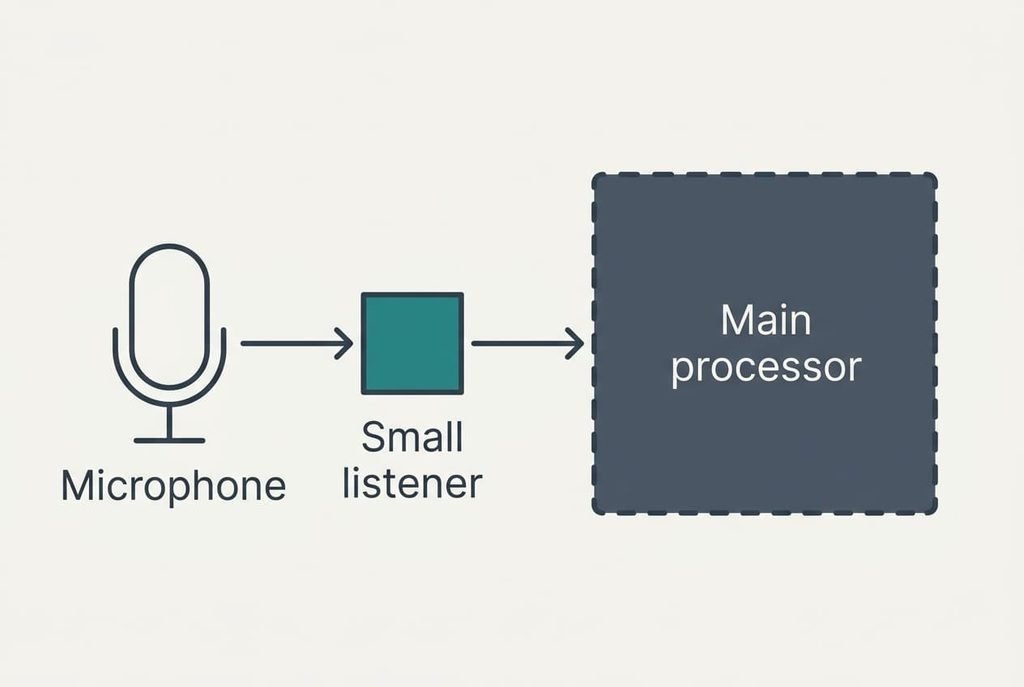
What is a wake word? It’s a short phrase that a tiny listener inside the speaker checks for a hundred times every second, and until the phrase scores high enough, the main processor stays idle and nothing is sent anywhere. The wait saves power and keeps ordinary talk inside the room. Because the check is so cheap, it can run all day on a sliver of silicon. This guide follows one request through the chain using an invented phrase, then marks the limits. Each figure below is invented for a lounge in a UK home, and real devices differ.
What Is a Wake Word? The Short Answer, and What It Leaves Out
If someone asks what is a wake word, one sentence covers it: a wake word is a short phrase that a small low-power listener scans for continuously while the big processor and the network stay idle until the phrase is heard. The assumed listener draws 2 mW while the main processor draws 800 mW, a gap of 400 times. A speaker that ran the big processor all day would drain a battery in hours and run warm on the shelf.
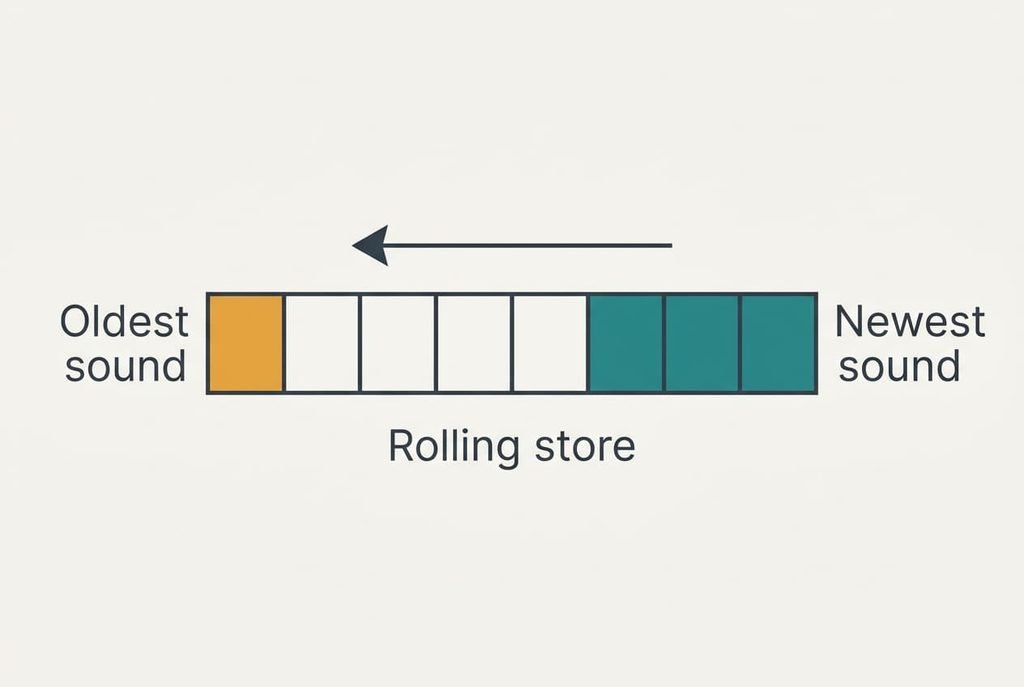
That tidy account hides a pair of details. The listener hears no words at all. It simply scores how closely recent sound resembles the pattern of the phrase, with a number between 0 and 1 as the result. It also needs a short memory, and that’s the part people overlook. To catch the start of a phrase it must have heard the sound just before the score rose. It therefore keeps the last 2 seconds of audio in a rolling store and overwrites the oldest sound as new sound arrives.
A second, larger check then confirms the match before anything leaves the device.
One Request Followed From Sound to Action, Step by Step
Take an invented phrase, “hello Pebble”, followed by the request “turn off the lounge lamp” spoken from the sofa. The microphone samples the air 16,000 times a second at 2 bytes a sample. The rolling store holds 2 seconds, which is 32,000 samples or 64,000 bytes, and one old sample is overwritten at every tick.
Next, the listener cuts the sound into frames of 25 ms, which is 400 samples each, with a new frame starting every 10 ms. That makes 100 frames a second. Each frame becomes a short list of numbers describing which pitches are strong. The phrase lasts 0.9 s and fills about 90 frames. After every new frame the listener takes the latest 90 and gives them a rating between 0 and 1.
While you chat about the weather, the rating hovers near 0.2. When the final syllable of the phrase lands, it climbs to 0.93. The trigger line sits at 0.80, and crossing it makes the listener wake the main processor.
That processor re-examines 1.5 s of the stored audio with a larger model and rates it 0.96. The check passes. The light comes on, and the speaker begins to send. Sending starts 0.5 s before the phrase, because the store still holds that sound, and continues until a pause of 0.6 s tells the speaker you’ve finished talking. The phrase takes 0.9 s and the request 2.0 s. Roughly 3.4 s of speech plus the 0.6 s pause leaves the room, which makes 4.0 s in all.
Over a day with 20 requests, that totals 80 s out of 86,400 s, or 0.09%. Everything else was heard and rated, then overwritten within 2 seconds of arriving.
Now a television drama says “hello Peggy”. The first rating is 0.84, above the trigger line. That wakes the main processor. The larger check rates the same audio at 0.41 and rejects it. Nothing is sent, and the light stays dark.
A Doorman in a Crowded Hall, and Where the Picture Breaks
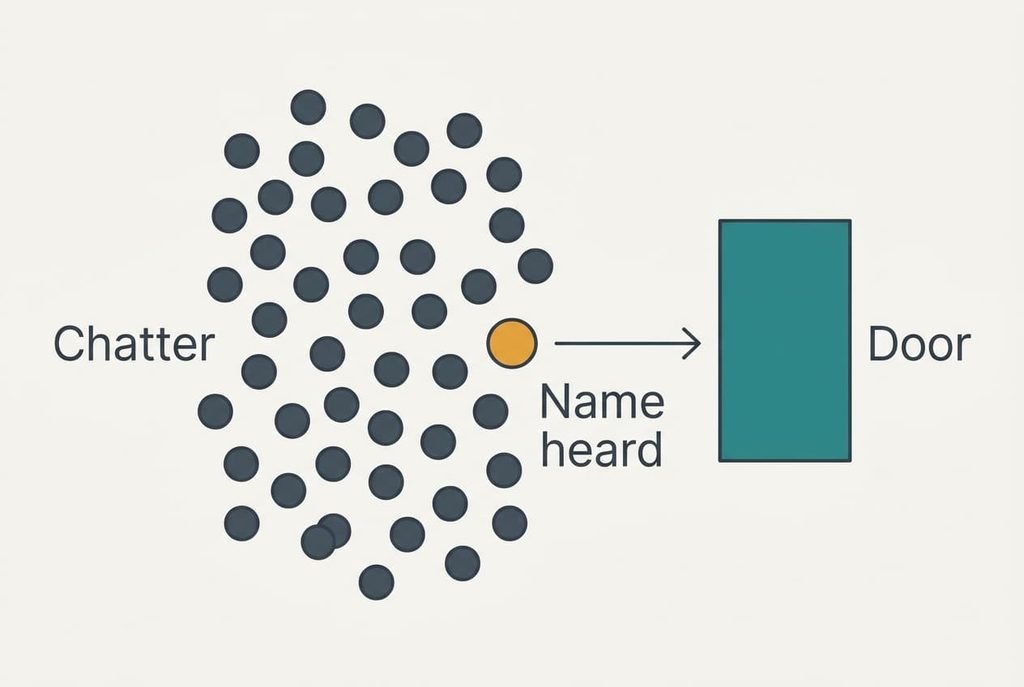
A doorman in a noisy hall shows the pattern. Hundreds of people talk, and he follows none of it. He waits for the sound of his own name, and when he hears it he turns and listens properly. Everything before that moment is ignored by habit, and he never needs to remember it.
The comparison fails at two points. The doorman understands every word of the chatter and chooses to ignore it, whereas the listener understands none of it. And his memory of the chatter fades slowly and unevenly. The rolling store forgets to a strict timetable, and a sound is gone 2 seconds after it arrives.
The store can’t be talked into remembering.
What a Wake Word Cannot Tell Apart
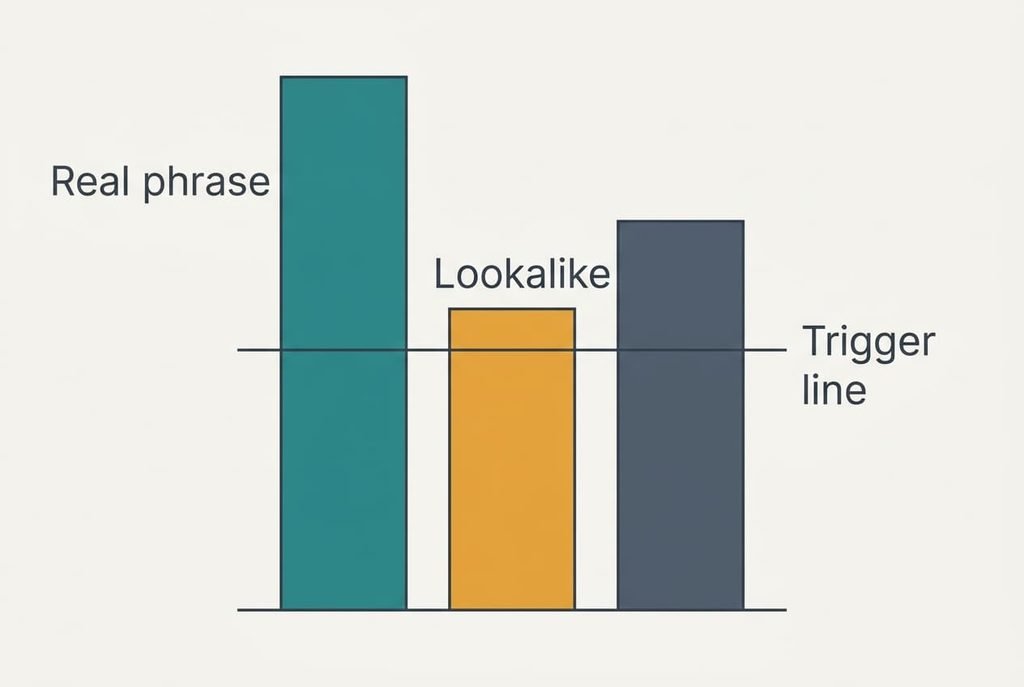
Ask what is a wake word really matching, and the honest answer is a sound. The limit most people misjudge is that the listener matches a sound pattern and never a speaker or a meaning. A recording of the phrase rates as high as your live voice, and a lookalike phrase can rate close behind it. The listener has no idea who is talking.
Conditions move the rating as well, and the listener doesn’t adjust for them. On a noisy evening with the television on, your own phrase might fall from 0.93 to 0.86. The lookalike scored 0.84. Raising the trigger line to 0.88 would block the lookalike and your real request together. One dial moves both errors.
Phrase length matters too. A phrase with few distinct sounds has more everyday words close to matching it, whereas a longer phrase leaves fewer accidental near-misses. Accents and unusual pronunciations also shift the pattern, which can cost a speaker a few hundredths on every attempt. That’s normal and it isn’t a fault.
What People Get Wrong About Always-On Listening
One belief says that the speaker records everything said at home. It grows from the way the speaker reacts the instant you finish the phrase, which feels like constant understanding. The store holds only 2 seconds, and in the sample about 0.09% of the day is ever sent.
Another belief says the speaker knows your voice. People who ask what is a wake word often hold it because a quiet home rarely produces false wakes. The device then seems to be choosing. The detector matches the phrase pattern, and a guest saying it gets the same result.
A third belief says an unexpected wake means a fault. It spreads because the timing looks random. A lookalike that clears the first line comes from setting a threshold low enough to catch you from a seat by the window, and the second check absorbs most of that cost. When both checks are fooled, a few seconds leave the room.
A Rule for Deciding Whether to Change the Sensitivity
Keep a tally for a week, and change the sensitivity only if more than one request in ten is missed or the speaker wakes unprompted over once a week. Misses call for a shorter distance and less background noise before any change to the setting. Unprompted wakes call for lower sensitivity, or for a longer phrase if the device offers one. With neither problem in the tally, leave the setting alone, because the default is a compromise built for typical rooms, and a lone adjustment can swap one problem for another. One odd evening proves little about a threshold, and the tally turns an impression into evidence.
After any change, alter one thing only. Then run the tally for another full week. This small, cheap filter stands between the lounge and the network. It isn’t clever. Its decisions are no better than the sound it gets, and a quieter room helps more than any setting. A wake word that’s rated fairly by a calm room rarely needs touching, and the owner who keeps the tally rarely has to guess. A clean tally means the device works as designed, and nothing needs fixing.
Questions Readers Keep Asking
Can a television wake a speaker by accident?
Yes, if the broadcast contains the phrase or a close lookalike. The first rating only has to clear the trigger line. The larger check then judges the same audio, and most lookalikes fail it. When both checks are fooled, a few seconds of audio may be sent.
Do you need a wake word at all?
Only for hands-free use. If you’re happy to press a button before speaking, the detector has no work to do and can stay off. Many people keep it on because their hands are busy in the kitchen, and that’s a trade they can weigh themselves.
How is a wake word different from speech recognition?
The detector matches one known sound pattern and runs on a tiny chip. Speech recognition turns any speech into words, which takes far more processing and usually a network connection. A wake word therefore decides whether recognition starts at all.