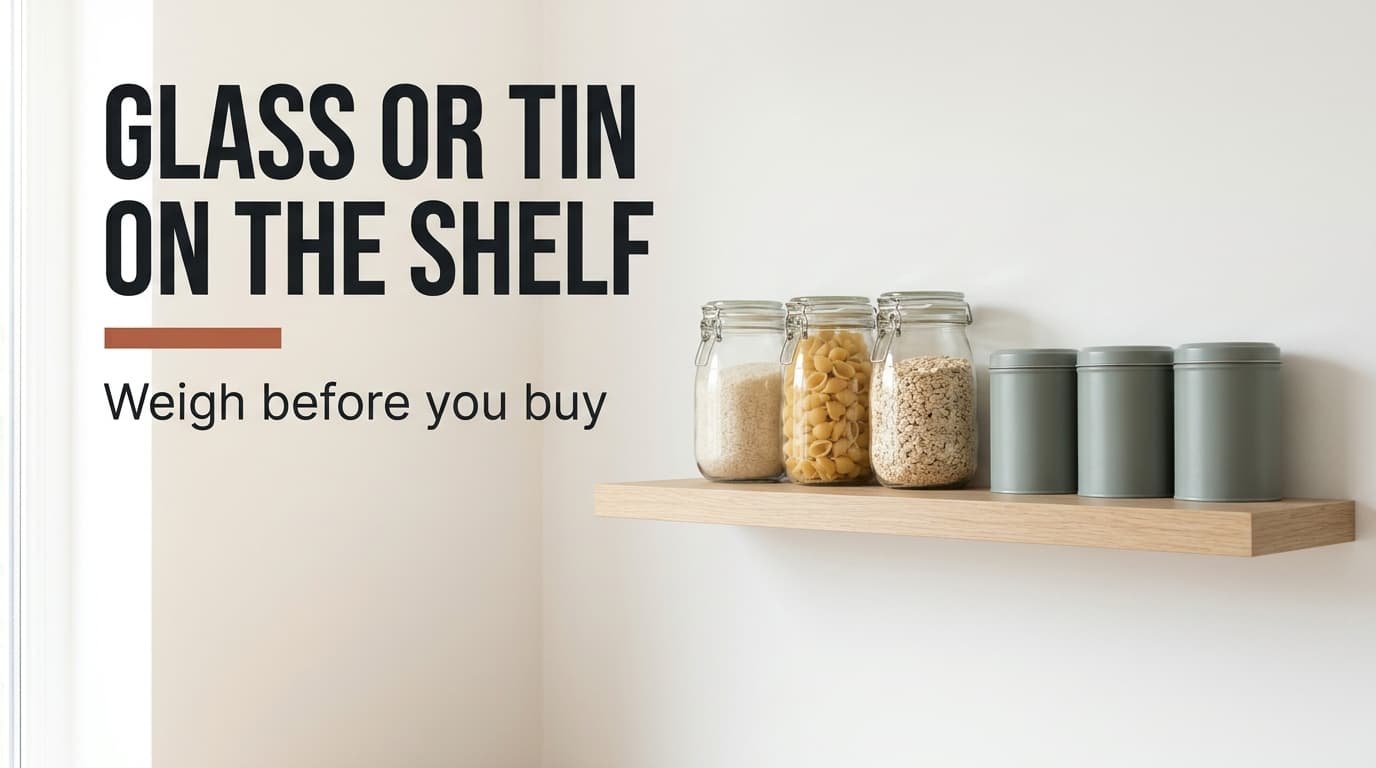
Glass jars or metal tins both keep dry food off the worktop, yet an open shelf treats them very differently. Glass shows the level at a glance and weighs three times as much when empty. Tin hides the level and takes a knock without complaint. We’ll use a kitchen in Rotterdam with a single plank for the staples. The plank spans 80 cm and is 25 cm deep, and it carries twelve containers of one litre each. These numbers are sample assumptions, and no brand appears. You’ll finish knowing which material suits the plank you actually own, and what to weigh before you buy anything.
What Sets Glass Jars or Metal Tins Apart on a Shelf
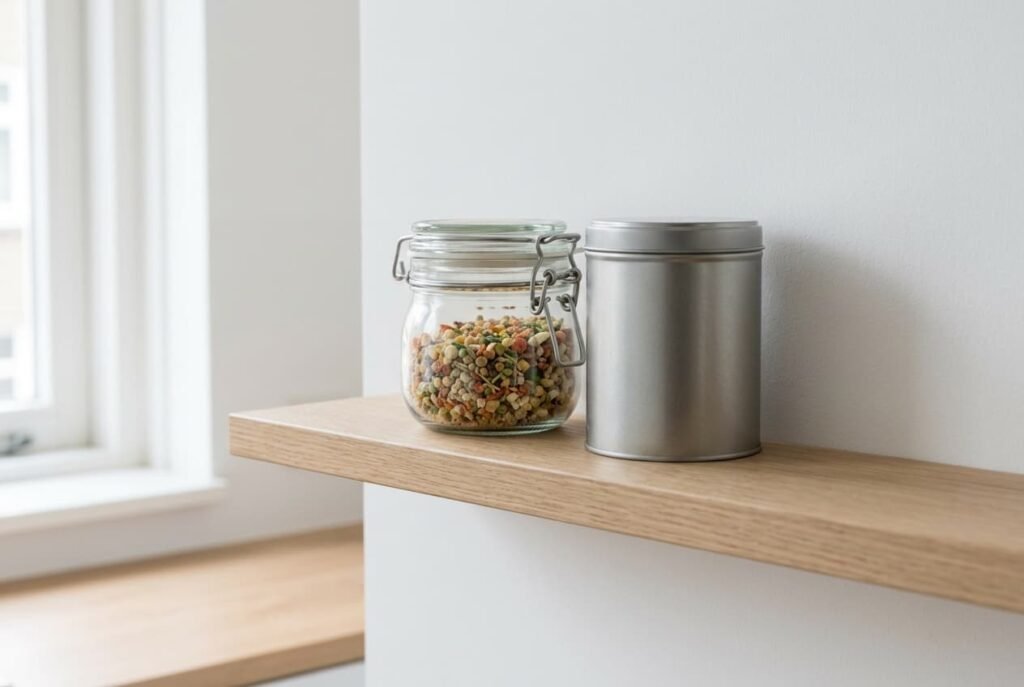
Each material answers two questions: what reaches the food, and what the shelf has to carry. Glass is clear and heavy. Tin is opaque and light. Light passes straight through glass and fades ground spices over a few months. Rice and pasta don’t mind. A tin blocks every ray and keeps a spice bright for longer.
The lid decides how much air gets in. A push-fit lid grips the rim by friction, which lets a little air creep past. A clamp lid presses a rubber ring against the rim and lets almost none through. Either material can come with either lid, and a glass jar with a loose lid does worse than a tin with a snug one. Check the lid before judging the body.
Now the load. Our plank is rated for 15 kg in total, an assumed figure for a rented wall. Take the heaviest case, with all twelve containers full of rice at 0.8 kg per litre. A glass jar weighs 0.45 kg empty and 1.25 kg full, while a tin of the same size weighs 0.15 kg empty and 0.95 kg full. Twelve glass jars come to 15.0 kg, which is the entire rating, and twelve tins come to 11.4 kg.

Two Materials Compared Row by Row
Pick up one jar and one tin from your own cupboard, weigh each on kitchen scales and test every row yourself before you trust any figure here.
| Point | Glass jar | Metal tin |
|---|---|---|
| Seeing the level | at a glance, through the wall | not at all until the lid is lifted |
| Light reaching the food | all of it, including sun from the window | none |
| Empty weight, one litre | about 0.45 kg | about 0.15 kg |
| Full weight with rice | 1.25 kg | 0.95 kg |
| Twelve on the plank | 15.0 kg | 11.4 kg |
| Height, one litre | 16 cm, too tall to stack two under a 30 cm gap | 14 cm, so two stacked reach 28 cm |
| If dropped on a tile floor | likely to shatter | takes a dent |
Weight and breakage separate the two most: glass jars or metal tins differ by a quarter in full weight (1.25 kg against 0.95 kg), and a dropped jar leaves a floor to sweep while a dropped tin leaves a dent. Ask which row would annoy you most after a year of daily use in your own kitchen, and let that single row decide which material you buy for the plank.
Where Glass Wins When You Cook Every Day
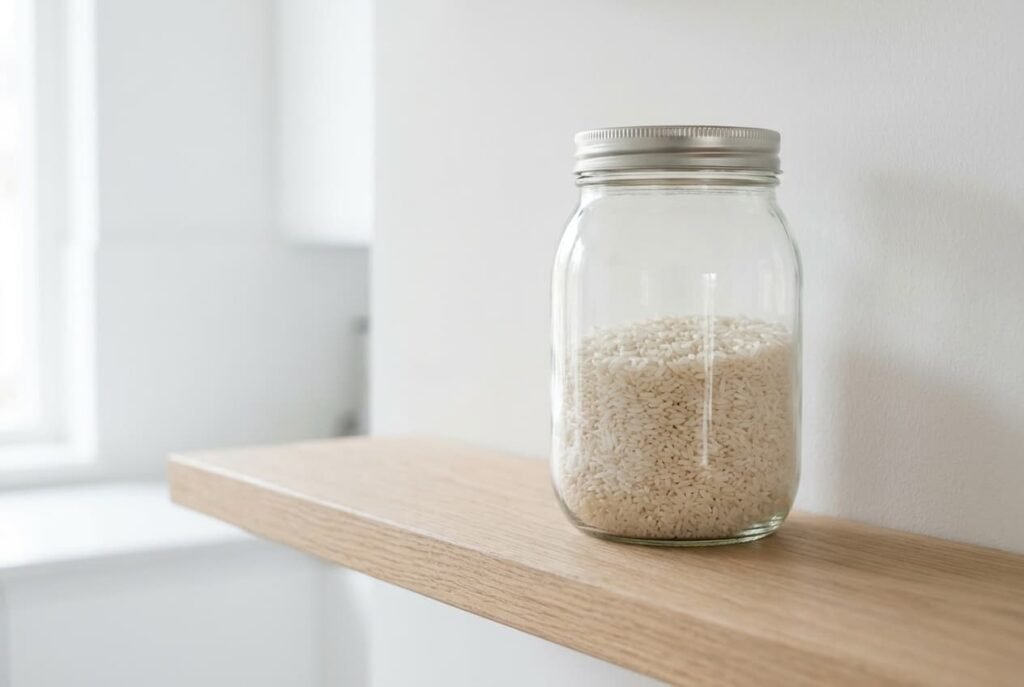
Glass wins on information. Say you use 200 g of rice a week from a jar holding 0.8 kg. The level falls by a quarter each week and the jar is empty after four weeks. You see each step happen. Lift a tin and you learn nothing until the lid is off.
Trouble shows early through a glass wall. You’ll spot a clump or a stray moth before it reaches the next jar. Inside a tin the same problem may already be a week old by the time you look.
Cleaning is simple too. Plain glass takes no smell from the spices it held before, and a hot wash leaves it unmarked. Only the rubber ring keeps a trace. Lift it out and rinse it on its own.
Twelve matching jars also look tidy together. Each container stands on a 10 cm square. The plank holds eight across and two rows deep, which makes 16 spots. Twelve jars fill 12 of them, three quarters of the footprint, and each one can still be lifted out without moving its neighbour.
Where Metal Wins on a Crowded Shelf
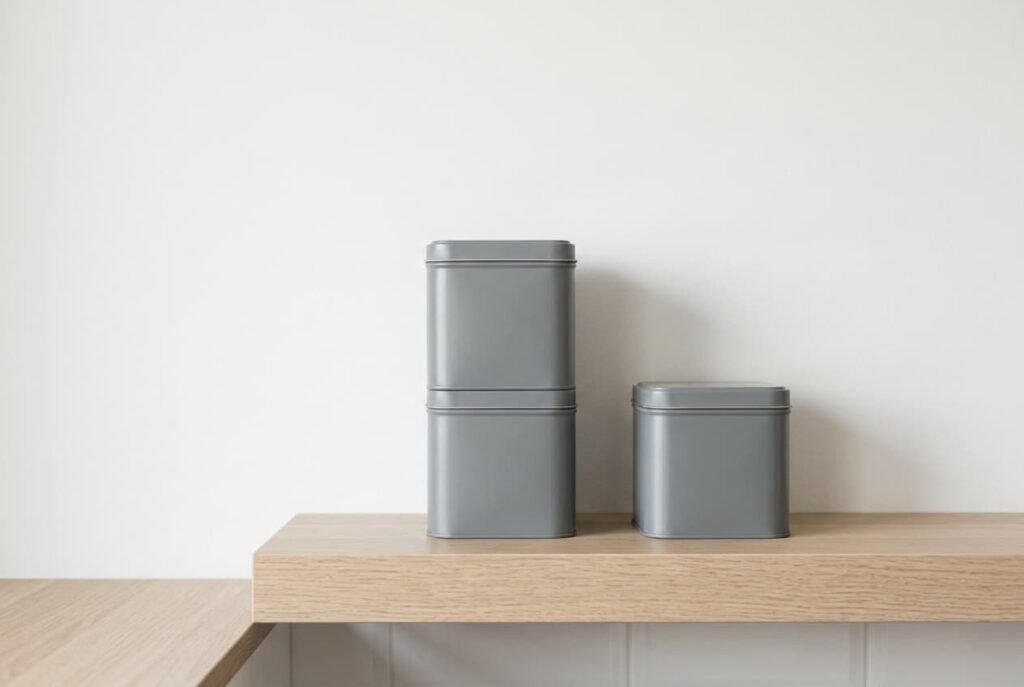
Metal wins on load and on space. Twelve tins reach 11.4 kg and leave 3.6 kg of the 15 kg rating spare. That’s room for three more full tins at 0.95 kg each, though a fourth would tip it over.
Height helps as well. A tin is 14 cm tall. Two stacked reach 28 cm and fit the 30 cm gap above the plank. Twelve tins then take only 6 of the 16 spots, or 37.5% of the footprint. A 16 cm jar would reach 32 cm stacked, and glass shouldn’t carry glass anyway.
Knocks matter on an open shelf. Drop a jar from the 90 cm worktop onto tile and it will most likely shatter. A tin takes a dent, though a badly dented rim can stop the lid from seating.
Tins hide their contents. Each one needs a label. Masking tape on the lid does the job and peels off cleanly. Light never reaches the spices inside, which keeps their colour for longer. When you weigh glass jars or metal tins for a bright kitchen, that single point can outweigh the rest.
The Third Option Is the Packaging You Already Own
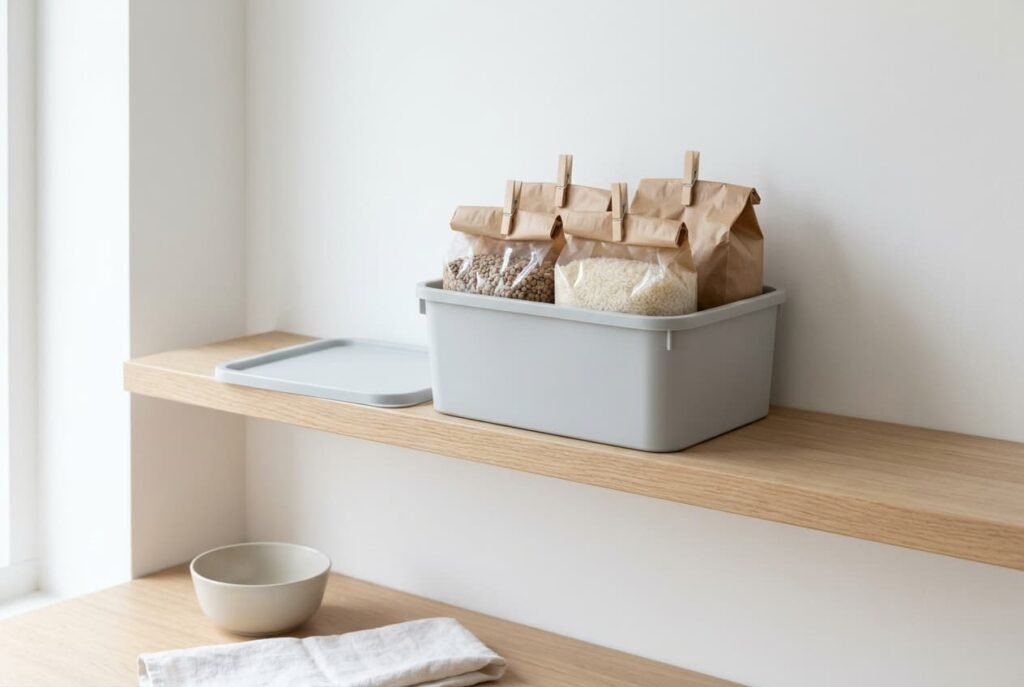
You don’t have to decant at all. Dry food arrives in bags that already keep it clean, and a bag can sit in one lidded box on the plank.
A box of 40 × 25 × 15 cm holds about 15 litres. Twelve one-litre bags need 12 litres, which fills about 80% of it. The bags weigh 9.6 kg together, plus about 1 kg for the box, and that total of 10.6 kg stays under the 15 kg rating. The box takes 40 cm of the 80 cm plank. Half the plank stays free.
Roll each bag down and fold the top over a clip.
If your bags already stay fresh and nothing goes stale before you use it, leave them as they are. New containers only earn their place once a bag has gone limp or a pest has found its way in, and until that happens the plank is better left alone. Weighing glass jars or metal tins against a bag in a box shows how little the container matters for rice that you finish in a month.
Which to Pick: Metal Tins or Glass Jars
Two branches settle most open shelves. Each one carries a cost that you should accept before you buy.
If you use the shelf every day and want to see levels, choose glass. Twelve jars reach 15.0 kg, the whole rating, which means your brackets need checking before the first jar goes up. Keep the plank at chest height so you never lift a full jar overhead. Accept the weight and keep one spare lid in a drawer.
If your plank is rated under 15 kg or sits above a tile floor, choose tins. Twelve reach 11.4 kg, and a dropped one only dents. Accept the labels, and pick tins with a rubber ring when the food is slow to use.
Before you buy twelve of anything, weigh one full container on kitchen scales and multiply by twelve. Hold that total up to the figure printed on your brackets. A shelf you trust matters more than any material, and a week with borrowed containers shows what you really use. Start with four containers and add more later. Write the date you filled each one on its base. The oldest then gets used first.
Questions Readers Keep Asking
Which one lasts longer on an open shelf?
A tin lasts longer against knocks, because a dent leaves it usable while a drop shatters glass. Glass lasts longer in the wash, since its surface stays smooth for years. Rust can start where a tin’s coating is scratched. Keep tins away from the steam of a hob.
How do I keep each one clean?
Wash glass in hot water and let it dry fully before refilling. Rub a tin with a cloth wrung almost dry, then dry the seam at once, because a wet seam is where rust starts. Lift out any rubber ring once a month and rinse it. Never close a lid that is still wet.
Which suits a rented kitchen with a weak shelf?
Tins suit a weak shelf, because twelve of them weigh 3.6 kg less than twelve jars. Glass suits a strong shelf above a worktop where nothing gets knocked. Weigh one full container, multiply it by the number you plan to store and see whether that total stays under your bracket rating.